Physics
 Call Kai
 Learn
Learn Practice Test
 Spaced Repetition
 Match
Match Flashcards
 Knowt Play
 Podcast
1/69

Earn XP
Description and Tags
Nuclear Physics Important Vocabulary
Name | Mastery | Learn | Test | Matching | Spaced | Call with Kai | Chat |
|---|
No analytics yet
Send a link to your students to track their progress
70 Terms
Photon
Chargeless bundles of energy that travel at the speed of light
(3 x 10^8 m/s)
How does radiation behave? High vs Low Frequencies?
High frequencies: behave like particles
Low frequencies: behave like waves.
How does energy and frequency differ with wavlength? Long vs Short
Longer wavelength: lower frequency and less energy (radio and heat)
Shorter wavelength: higher frequency and higher energy (gamma rays and x-rays)
What is matter?
Anything that occupies space and has a mass
What is an atom?
The smallest quantity of an element that retains all its chemical properties.
Proton (Symbol: p or p+)
Positively Charged, Massive, centrally located on atom

What is the numerical charge of a proton?
Charge: +1.6 x 10^-19 Coulombs
What is the mass of a proton ?
1.672^-24 grams
What is atomic number? what letter is it represented by?
The total number of protons found in the nucleaus of an atom. Represented as letter Z
Neutrons (Symbol: n)
Electrically neutral, massive centrally located atom

What is the charge of a neutron and mass ?
No Charge. Mass number 1.675 x 10^-24 grams
Electrons (Symbol: e or e-)
Negatively charged, extranuclear region of atom

What is the numerical charge of an electron?
-1.6 x 10^-19 Coulombs
What is the mass of an electron?
9.1 x 10^-28 grams
What holds and electron in orbit?
Binding energy + motion, and centrifual force keeps them from being attracted into positively charged nucleus
Nucleons
Protons + Neutrons
Which shell has the greatest binding energy?
The innermost shell, the K shell which has a binding energy of n=1
How to find the maximum number of electrons in each shell?
2n² example: K shell n=1 2(1²) = 2
What happens the further an electron is from the nucleus?
Nuclear atraction and binding energy decrease and electron become easier to move
How to find n values for shell?
Shells got K, L, M, N, O, P, Q. K shell is n=1 L shell is n=2 etc. add one to each shell
Molecules
A group of atoms that are chemically bonded together. Can be same or different element. Ex O2 molecule H20 molecule + compound
Compound
Different types of atoms/elements bonded together H20 molecule + compound
What is nuclear stability?
The nucleus ability to remain together without spontaneously changing. As atoms get bigger due to more protons, you have more positive charges repelling each other (proton-proton repulsion). So the nucleus needs extra neutrons to provide strong nuclear force to hold everything together.
Small Nucleus: N=P 1:1 (first 20 elements)
Large Nucleus: N>P 1.6:1 (elements after 20)
Stable Nucleus
Has appropriate balnace and configuration of protons and neutrons and sufficient nuclear binding
Unstable Nucleus
Unfavorable proton to neutron balance or configurationa and may undergo redioactive decay to become more stable
What are the 3 things nuclear stability depend on?
1. Number of protons
How many protons are in the nucleus?
2. Number of neutrons
Is there an appropriate number of neutrons for that number of protons?
3. Configuration/arrangement
How are those protons and neutrons arranged within the nucleus?
How to determne if an element is stable?
1. Is the N:P ratio reasonable?
Small Nucleus: N=P 1:1 (first 20 elements)
Large Nucleus: N>P 1.6:1 (elements above atomic number 20)
↓
2. Are there magic numbers?
If a nucleus has one of these numbers of protons OR neutrons it gets extra stability.
(2, 8, 20, 28, 50, 82, 126)
↓
3. Even-even nuclei tend to have extra stability.
Especially stable: Even protons + even neutrons
Less stable: Odd protons + odd neutrons

Isomeric Transition
The nucleus has the correct number of protons and neutrons, but it has TOO MUCH ENERGY. It gets rid of that extra energy by emitting a gamma ray. Number of Protons and Neutrons DOES NOT change only the energy state of the nucleus changes.
SAME nucleus, LOWER energy state, gamma emitted
Tc-99m → Tc-99 + γ
What is a metastable state?
The nucleus is relatvely stable but still has extra energy that it wants to get rid of. Written as m ex Tc-99m excited/metastable nuclear state

Decay Types
Decay | What changes? | What is emitted? |
|---|---|---|
Isomeric transition | Energy state only | Gamma |
Beta minus | Neutron → proton | β⁻ + antineutrino |
Beta plus | Proton → neutron | β⁺ + neutrino |
Alpha | Protons AND neutrons decrease | α particle |
Mass energy relationship and equation
Mass and energy are two forms of the same thing and can be converted into one another. E=mc²
E = energy
m = rest mass
c = speed of light
Mass and energy are interchangeable
Small amounts of mass can represent large amounts of energy
Mass difference → Energy
And that energy can appear as things like:
Gamma radiation
Kinetic energy of particles
Other forms of radiation/energy
Mass Defect
The difference between the combined mass of the individual nucleons and the actual mass of the nucleus. The difference in mass was converted into binding energy
Example:
If you calculate the mass of the protons and neutrons separately, let's pretend you get:
4.10 amu
But the actual nucleus has a mass of:
4.00 amu
The difference is:
4.10 − 4.00 = 0.10 amu which is the mass defect
1 amu = 1/12 the mass of a carbon 12 atom
Nuclear Binding Energy
Energy needed to separate the nucleus into its individual nucleons.
What does higher energy mean?
Energy → ↑ penetrating ability → ↑ ability to transfer energy
Electron volt jule conversion
1 eV = 1.602 x 10^-19 J
eV = tiny unit of energy, commonly used for electrons, photons, and radiation
Joule = larger unit of energy
Nuclide
A specific type of atom defined by its number of protons and neutrons.
example:
Tc-99 → 43 protons + 56 neutrons
Tc-99m → 43 protons + 56 neutrons, but in a higher energy state
Tc-98 → 43 protons + 55 neutrons
They are different nuclides because their nuclear configurations are different.
Atomic Mass Number (A)
Number of Protons + Number of Neutrons

Atomic Number (Z)
Number of protons

Isotopes
Atoms that have the SAME atomic number but DIFFERENT atomic mass
Ex.
Carbon-12
6 protons
6 neutrons
Mass number = 12
Carbon-14
6 protons
8 neutrons
Mass number = 14
They both have 6 protons, so they're both carbon.
Isobars
Atoms that have DIFFERENT atomic numbers but SAME atomic mass
Example:
Carbon-14
6 protons
8 neutrons
Mass = 14
Nitrogen-14
7 protons
7 neutrons
Mass = 14
They both have a mass number of 14, but different numbers of protons.
Isotones
Atoms that have DIFFERENT atomic number but the SAME number of neutrons
Example:
Carbon-14
6 protons
8 neutrons
Oxygen-16
8 protons
8 neutrons
They both have 8 neutrons, so they are isotones.
Isomers
Atoms that have the SAME atomic number and atomic mass but differ in energy
Tc-99m → Tc-99
What is the Radioactive Decay options when there is Excessive Nuclear Mass?
Alpha Decay
Fission
What is the Radioactive Decay options when theres an Appropriate number of nucleons, but to much energy?
Gamma Emissions
Internal Conversion
What is the radioactive decay options when there is an Unstable Neutron to Proton Ratio?
Too many neutrons
Beta Decay
Too many Protons
Beta Plus/Positron Decay
Electron Capture
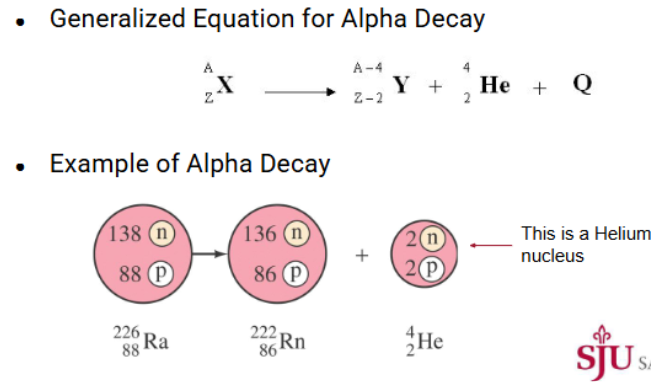
Excessive Nuclear Mass: Alpha Decay
Nucleus ejects alpha particle making the nucleus smaller and lighter
Alpha = helium nucleus = 2 protons + 2 neutrons
Ejects 4 total nucleons above
Example:
U-238 → Th-234 + α
Excessive Nuclear Mass: Fission
Nucleus splits into two smaller nuclei
BIG nucleus → smaller nucleus + smaller nucleus + energy

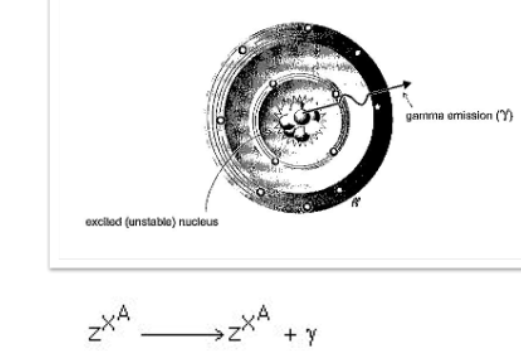
Excessive Energy: Gamma Emission
Nucleus releases extra energy as a gamma photon.
Tc-99m → Tc-99 + γ
Atomic mass and number stay the same
Excessive Energy: Internal Conversion
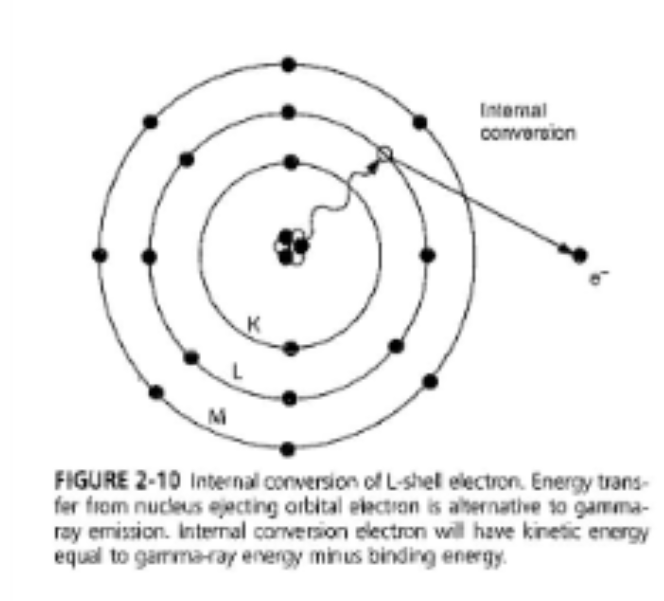
Nucleus transfers its energy to an orbital electron causing it to leave (ejected electron called a conversion electron) This ejection leaves an empty space in the inner electron shell. An outer-shell electron drops down to fill the inner-shell vacancy, releasing energy. The atom releases this transition energy via one of two competing paths:
Characteristic X-ray: The energy is emitted as a photon.
Auger Electron: The energy is transferred to another outer electron, ejecting it from the atom.
Only energy state is changing to become more stable
Atomic mass and number stay the same
Characteristic X ray
Inner-shell electron removed → Causing Inner-shell vacancy → Outer-shell electron falls into vacancy → Energy difference is released as a Characteristic X-ray emitted

Auger Electrons
Inner shell electron removed by incidnet photon or charged particle→ Causing Inner-shell vacancy (photoelectron)→ Outer-shell electron falls into vacancy → Energy is transferred to another orbital electron → Orbital electron is ejected (augar electron) → Two electron vacancies remain (Vacancy 1: electron that left to fill K shell
Vacancy 2: ejected augar electron)→ additional characteristic xray produced or secondary Auger electron may be produced

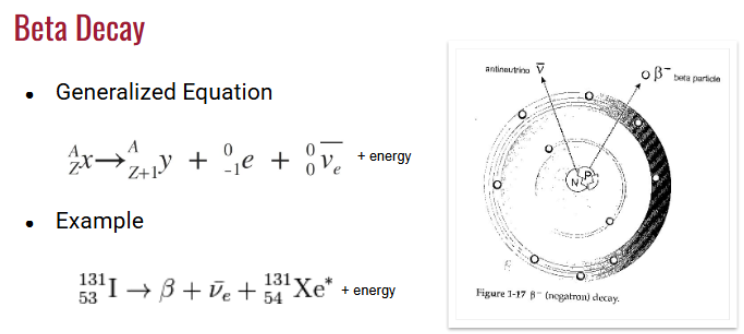
Unstable N-P Ratio: Beta Minus Decay
Too Many Neutrons in the nucleus so it turns a neutron into a proton.
neutron → proton + electron + antineutrino
The electron that is produced is the beta particle.
Element change occurs due to transmutation
Atomic number Increases by 1.
Unstable N-P Ratio: Beta Plus Decay/Positron Decay
Too many protons in the nucleus so it turns a proton into a neutron
proton → neutron + positron + neutrino
Positron is the positive counterpart of an electron
Element change occurs due to Transmutation
Atomic number decreases by 1

Electron Capture
Also turns a proton into a neutron but instead of producing a positron, the nucleus captures an electron, usually from K or L shell.
proton + electron → neutron + neutrino
Element change occurs due to transmutation
Atom is left ionized with a vacancy
Atomic number deceases by 1

Excitation
Electron gets excited and jumps up, but doesn't leave. Electron raises to higher energy state
Normal electron → Absorbs energy → Electron moves to a higher energy level → Electron is still part of the atom → Eventually returns to a lower energy level
Ionization
Electron gets enough energy to leave the atom, creating ion pairs
Radiation interacts with the electron → Electron absorbs energy → energy > electrons binding energy → electron is completely removed → ion is created
What can charged particles interact with? (Alpha particles (α) → +2 charge, Electrons (β⁻) → −1 charge, Positrons (β⁺) → +1 charge)
Electrons of atoms
Charged particle → interacts with electron → excitation or ionization
Nucleus
Because the nucleus has a positive charge, it can attract or repel the incoming particle depending on its charge. causes charged particle to change dirrection or lose energy
What determines how far the particle travels?
Kinetic Energy of the particle
More kinetic energy → particle can travel further (greater trange in motion)
Less kinetic energy → particle stops sooner
Properties of the material
Density
Higher density = more atoms packed into a given space
More atoms to interact with → particle loses energy faster → shorter range.
High density → more interactions → shorter distance
Atomic number (Z) = number of protons
Higher Z = Stronger interactions with charged particles
Mass number (A) = protons + neutrons
Why does an alpha particle have very high specific ionization?
Alpha = BIG charge + HEAVY + SLOW → LOTS of interactions → many ion pairs in short distance + HIGH ionization + HIGH LET.
heavy mostly straight path
slower alpha greater stopping power
Bragg Peak
The point near the end of a charged particle's range where it deposits a very large amount of energy (The Most) in a short distance.
Start of path
→ relatively lower energy deposition
As it slows down
→ energy deposition increases
Near the end of its range
→ 💥 BRAGG PEAK
Then:
→ particle loses essentially all of its energy and stops.
How is Bragg peak useful for partical therapy?
Radiation can be designed to deposit a large amount of energy at a specific depth in the body. spicifically placing the Bragg peak within the tumor, concentrating dose there while reducing the dose beyond the target.
Why does an beta particle have very low specific ionization?
Beta = SMALL mass + LIGHT + FAST → FEWER interactions → LOW ionization + longer range + LOW LET.
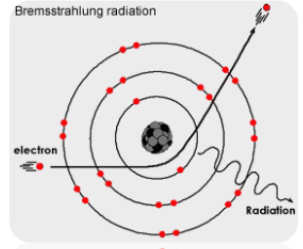
Bremsstrahlung
beta particle slows/deflects near nucleus → loses energy → X-ray photon produced.
Photon Inteactions: Rayleigh (Coherent Scatter)
The photon interacts with the entire atom but does NOT transfer enough energy to ionize it.Causes photon to change direction.
Rayleigh = whole atom interaction → no ionization → photon changes direction → essentially no energy loss.
Photon Inteactions: Photoelectric Effect
Photon gives ALL of its energy to an inner-shell electron, causing that electron to be ejected from the atom. Results in full absorption of photon
Photon → inner electron → photoelectron + vacancy → characteristic X-ray/Auger

Photon Inteactions: Pair Production
When a high-energy photon passes near the nucleus and is converted into an electron + positron pair. Photon must have atleast 1.022 Mev becuase an electron and positron both have a resting mass energy of 0.511 Mev. Results in full absorption of photon.
Pair production = photon ≥ 1.022 MeV → electron + positron.
Positron eventually annihilates with electron → 2 × 0.511 MeV photons.

Photon Inteactions: Compton Scatter
A photon hits an outer shell electron, gives it some of its enery and then continues in a different dirrection with the remaing energy. Cause partial absorption
Photon energy ↑ → Compton interaction probability ↓
Photon energy ↓ → Compton interaction probability ↑

Photo Attenuation
The reduction in the intensity of a photon beam as it travels through matter.
photons enter material → some interact/get absorbed or scattered → fewer photons make it out.
I=I0e^−μx
Where:
I = intensity after traveling through the material
I₀ = original intensity
μ = linear attenuation coefficient
x = thickness/distance traveled through the material
e = mathematical constant (~2.718)

Photon Attenuation Continued:
Half Value Layer
the thickness of material needed to reduce photon intensity to 50% of its original value.
Example:
Start with 100%
1 HVL → 50%
2 HVLs → 25%
3 HVLs → 12.5%
So every additional HVL cuts the remaining intensity in half.
μ ↑ → HVL ↓
μ ↓ → HVL ↑
A material with a high attenuation coefficient doesn't need to be as thick to cut the beam in half.

What are the three processes for the release of energy?
Three distinct processes can occur in the electron structure of the atom to release energy
● Bremsstrahlung Radiation
● Characteristic x-rays
● Auger electrons