Music Terms
 Call Kai
 Learn
Learn Practice Test
 Spaced Repetition
 Match
Match Flashcards
 Knowt Play
1/15

There's no tags or description
Looks like no tags are added yet.
Name | Mastery | Learn | Test | Matching | Spaced | Call with Kai | Chat |
|---|
No analytics yet
Send a link to your students to track their progress
16 Terms
Pitch
- Measured form to describe how HIGH or LOW a sound is
- Can be put in an order/scale
Perceptual aspects of sound
Pitch
Timbre
Length
Loudness
Location
Timbre
- QUALITY of a sound
- It's what distinguishes your voice from your mom's or a trumpet from a piano
- "Brightness" or "darkness" of a sound
- Dr. Lowry's metaphor: we're all wearing clothes but they're all different materials
Scale
- The ORDER of PITCHES
- Set of musical notes ordered by pitch, going up and down like steps on a ladder
- SEVEN PITCHES in typical Western musical scale
Equal-tempered scale
- When the DISTANCE between each pitch is the SAME
- A system that divides each octave into 12 equally-spaced semitones, such that each note is approximately 6% HIGHER in frequency than the note below
Note
Although pitch is how high or low a sound is, a note is a HUMAN NAME or a WRITTEN SYMBOL for a specific pitch
Pure tone
- A sound that has only ONE single FREQUENCY
- Rare in nature
- Used mainly for experiments
Frequency
Frequency is the actual, MEASURABLE speed of a sound wave, while pitch is how your brain hears and perceives that sound
Cent
- UNIT OF MEASUREMENT or RULER for sound
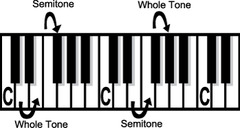
- Just like a dollar is made of 100 pennies, one semitone/half-step (like from C to C-sharp) is made of 100 cents
Semitone
- Smallest musical interval used in Western music
- Aka half-step or half-tone
- Literally ADJACENT notes (interval between two adjacent notes in a 12-tone scale)
Texture + 4 types
- How different LAYERS OF SOUND combine, interact, and relate to one another in a piece
- Four types: monophony, polyphony, homophony, and heterophony
Monophony
SINGLE melodic line with NO accompaniment
Example: singing happy birthday perfectly, altogether
How it would look:
━━━━━━━
Polyphony
MULTIPLE melodic lines INTERWOVEN with eachother
Example: singing row row row your boat but starting at different times
How it would look:
━━━━━━━
━━━━━━━
Homophony
MAIN melody with ACCOMPANIMENT/CHORDS (most common in Western music)
Example: typical pop song, singing happy birthday but with different harmonies
How it would look:
━━━━━━━
I I I I I I I I I
Heterophony
TWO OR MORE voices SIMULTANEOUSLY performing variations of the SAME melody
Example: singing happy birthday altogether but one of more voices are a little off
How it would look:
⎯~⎯~⎯~⎯~⎯~⎯ (but like imagine thats one long curvy line on top of a long straight line)

Form
- Overall STRUCTURE of a piece
- Arrangement of musical units of rhythm, melody, and harmony that show repetition or variation