4 - Synaptic and Neuromuscular Transmission
 Call Kai
 Learn
Learn Practice Test
 Spaced Repetition
 Match
Match Flashcards
 Knowt Play
1/85

There's no tags or description
Looks like no tags are added yet.
Name | Mastery | Learn | Test | Matching | Spaced | Call with Kai | Chat |
|---|
No analytics yet
Send a link to your students to track their progress
86 Terms
1. multipolar
2. bipolar
3. unipolar
What are the 3 neuron structural types?
gap junctions
With an electrical synapse, the current flows between cells via _____
synaptic cleft
Gap between presynaptic and postsynaptic cells
chemical
The following are associated with a(n) [electrical/chemical] synapse:
1. AP in presynaptic cell causes voltage-gated Ca2+ channels to open
2. Ca2+ influx causes release of neurotransmitter from presynaptic terminal
3. Neurotransmitter binds ligand-gated Na+ channel on postsynaptic cell, leading to depolarization (can be excitatory or inhibitory)
![<p>The following are associated with a(n) [electrical/chemical] synapse:</p><p>1. AP in presynaptic cell causes voltage-gated Ca2+ channels to open</p><p>2. Ca2+ influx causes release of neurotransmitter from presynaptic terminal</p><p>3. Neurotransmitter binds ligand-gated Na+ channel on postsynaptic cell, leading to depolarization (can be excitatory or inhibitory)</p>](https://assets.knowt.com/user-attachments/3ee1b0de-bd9b-4fc3-8c49-20eceb0cc2df.png)
circuits
Neurons are arranged in _____ where input cells synapse on output cells
input cells
Output cell may or may not fire an action potential depending on amount of excitation provided by the _____
one-to-one
_____ synapses:
-Neuromuscular junction
-Single AP in motoneuron causes single AP in muscle fiber
one-to-many
_____ synapses:
-Found in some motoneurons of spinalcord
-Single AP in motoneurons causes many APs in postsynaptic cells
many-to-one
_____ synapses:
-Many presynaptic cells converge on a postsynaptic cell
-Common
many-to-one
Postsynaptic potentials commonly use _____ synapse arrangement
excitatory
The following are associated with [excitatory/inhibitory] postsynaptic potentials:
-Pre-synaptic neuron depolarizes post-synaptic neuron, brings neuron's membrane potential to threshold, opens Na and K channels
-Ach, NE, Epi, dopamine, glutamate, serotonin are excitatory neurotransmitters
![<p>The following are associated with [excitatory/inhibitory] postsynaptic potentials:</p><p>-Pre-synaptic neuron depolarizes post-synaptic neuron, brings neuron's membrane potential to threshold, opens Na and K channels</p><p>-Ach, NE, Epi, dopamine, glutamate, serotonin are excitatory neurotransmitters</p>](https://assets.knowt.com/user-attachments/29597fd3-fb15-4ccd-8f0a-bd622973fc90.png)
inhibitory
The following are associated with [excitatory/inhibitory] postsynaptic potentials:
-Pre-synaptic neuron hyperpolarizes post-synaptic neuron and membrane potential moves away from threshold, opens Cl channels
-GABA, glycine are inhibitory neurotransmitters
![<p>The following are associated with [excitatory/inhibitory] postsynaptic potentials:</p><p>-Pre-synaptic neuron hyperpolarizes post-synaptic neuron and membrane potential moves away from threshold, opens Cl channels</p><p>-GABA, glycine are inhibitory neurotransmitters</p>](https://assets.knowt.com/user-attachments/d411edc7-12c6-45c3-8ba9-362def767362.png)
1. spatial summation
2. temporal summation
3. synaptic fatigue
What are the 3 ways synaptic inputs get integrated?
spatial summation
Two or more inputs arrive at postsynaptic cell simultaneously
temporal summation
Two inputs arrive at postsynaptic cell in rapid succession
synaptic fatigue
Repeated stimulation yields a
smaller than expected response
ionotropic receptors
-Ligand-gated ion channels that usually open in response to binding of neurotransmitter
-Usually located along dendrites or cell bodies and receive incoming information from other neurons
Na
A post-synaptic neuron may be excited due to _____ influx causing depolarization
K; chloride
A post synaptic neuron may be inhibited due to either _____ efflux or _____ influx causing hyperpolarization
1. glutamate
2. acetylcholine
3. glycine
4. GABA
What are the 4 neurotransmitters that activate ionotropic receptors?
glutamate
-Neurotransmitter that activates ionotropic receptors
-Primary excitatory neurotransmitters in the CNS
acetylcholine
-Neurotransmitter that activates ionotropic receptors
-Only neurotransmitter used at neuromuscular junction
-Also used by autonomic nervous system (PSNS and SNS)
glycine & GABA
-Neurotransmitters that activate ionotropic receptors
-Both neurotransmitters are used
in the CNS and both are chloride
channels
-Binding of these causes inhibition,
since increase in Cl permeability is
inhibitorys
metabotropic receptors
-Located along dendrites or cell bodies, receive incoming information, slower than ionotropic receptors
-Can use G-protein-coupled receptors (GPCR)
norepinephrine (NE)
-Neurotransmitter that activates G-protein-coupled receptors
-Uses alpha- or beta-adrenergic receptors
glutamate
-Neurotransmitter that activates G-protein-coupled receptors
-Metabotropic receptor
-Acts on post-synaptic sites in CNS
-Modulates cell excitability and
synaptic transmission via second
messenger pathways
-3 groups
GABA
-Neurotransmitter that activates G-protein-coupled receptors
-Found in CNS and autonomicdivision of peripheral nervoussystem
neuropeptides
Synthesized and packaged innerve cell body instead of axon terminal
neuromodulators
-May act on pre-synaptic cell to alter amount of neurotransmitter released
-May be co-secreted with neurotransmitter to alter response of post-synaptic cell
neurohormones
Released from neurons into blood
cell body
The different neuron structure types are based on the # of processes that extend from the _____
multipolar
Neuron structure - 3 or more processes extending from the cell body
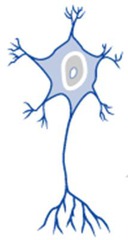
multipolar
What is the major neuron type in the CNS and efferent PNS?
bipolar
Neuron structure - 2 processes extending from cell body in opposite directions - dendrite & axon
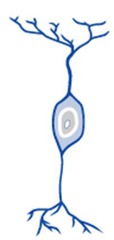
retina & olfactory system
Where will we find bipolar neurons?
unipolar
- Neuron structure - single short process from the cell body, branching into 2 or more
-peripheral process associated with sensory perception
-central process goes toward the CNS
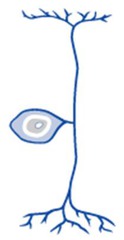
afferent PNS
Where will we find unipolar neurons?
electrical
[Electrical/chemical] synapse:
-Fast & has ability to stimulate cells simultaneously
-Found in cardiac tissue
-Found in some smooth muscle
chemical
AP moves from the presynaptic to postsynaptic cell through a _____ synapse
chemical
[Electrical/chemical] synapse is slower
get neurotransmitter released from the presynaptic cell and get it to the postsynaptic cell
What is the goal with chemical synapse?
calcium
The goal of a chemical synapse is to get neurotransmitter released from the presynaptic cell and get it to the postsynaptic cell. In order to do that, we need an AP to occur. In order for that to happen, we need to voltage gated _____ channels to open.
neurotransmitters
When calcium rushes to the post synaptic cell, it causes the vesicles that have _____ in them to move to the cell membrane and get released, for receptor binding.
ligand-gated
Neurotransmitters bind _____ channel on the postsynaptic cell, leading to depolarization or hyperpolarization
depolarization
Excitatory response = _____polarization
hyperpolarization
Inhibitory response =_____polarization
many-to-one
What is the most common type of synapse?
need convergence of multiple input neurons to cause an AP = sum the inputs
With a many-to-one synapse, you are getting many inputs from many neurons, so info is coming in from multiple neurons all the time. What do we need in order to cause an AP?
excitation
When converging multiple input neurons to cause an AP, if our net is depolarization, that -> _____
inhibition
When converging multiple input neurons to cause an AP, if our net is hyperpolarization, that -> _____
excitatory
Ach, NE, Epi, dopamine, glutamate, and serotonin are _____ neurotransmitters
depolarize
Excitatory postsynaptic potentials -> [depolarize/hyperpolarize]
hyperpolarize
Inhibitory postsynaptic potentials -> [depolarize/hyperpolarize]
inhibitory
GABA and glycine are _____ neurotransmitters
-both inputs could be excitatory -> summation -> depolarization
-one could be excitatory & other inhibitory -> nothing
-both inputs could be inhibitory -> hyperpolarize -> further from threshold
With spatial summation, 2 or more inputs arrive at the postsynaptic cell at the same time. What happens (3)?
depolarization
Both inputs could be excitatory -> summation -> _____
hyperpolarization
Both inputs could be inhibitory -> _____ -> further from threshold
nothing/ cancel out
One input could be excitatory & other inhibitory -> _____
effects are additive
- could have 2 excitatory, one after another
- could have 1 excitatory & 1 inhibitory, one after another
With temporal summation, 2 inputs arrive at the postsynaptic cell in rapid succession (get one and then the other). What happens?
additive
With temporal summation, the effects are _____
smaller
Synaptic fatigue -> [smaller/larger] than expected response
may or may not cause depolarization
(Ca usually associated with 2nd messenger system)
What if there is a Ca influx from an ionotropic receptor interaction?
1. AMPA
2. NMDA
What are the 2 types of glutamate receptors?
AMPA
Allows both Na and K to cross the membrane, but the gradient that drives Na is the strongest one -> net effect is depolarization
Na; depolarization
AMPA allows Na and K to cross the membrane, but the gradient that drives _____ is stronger -> _____
NMDA
Depends on both glutamate binding and voltage, so when you are around resting membrane potential , there is a magnesium ion that blocks the binding site/ movement of other ions -> when glutamate binds and cell depolarizes -> magnesium block is removed
magnesium; magnesium
NMDA depends on both glutamate binding and voltage, so when you are around resting membrane potential , there is a _____ ion that blocks the binding site/ movement of other ions -> when glutamate binds and cell depolarizes -> _____ block is removed
inhibition
Binding of the glycine and GABA neurotransmitters will cause _____, because of increase in Cl permeability
chloride
GABA sub A is associated with _____
G; Gdp
In the system associated with metabotropic receptors, when we get binding, we get a _____ protein that's activated and a G protein alpha subunit that binds to _____
potassium; 2nd messenger synthesis
G protein beta subunit may activate ion channel like _____ while the alpha subunit may activate enzymes that are promoting _____
phospholipase C; adenylyl cyclase
Enzymes used in the 2nd messenger systems are ______ and _____
-activating enzymes, like protein kinases
-phosphorylate something & set off cascade of events in the cell
What is the goal when you set off cascade of the 2nd messenger system?
initiates cAMP second messenger system
Beta adrenergic GPCRs = _____
suppress cAMP system
Alpha 2 adrenergic receptors = _____
activate phospholipase C second messenger system
Alpha 1 adrenergic receptors = _____
increase neuron excitability & activate phospholipase C pathway
Glutamate activates 3 groups of G-protein coupled receptors. Group 1 does what?
suppress neuron excitability & inhibit adenylyl cyclase pathway
Glutamate activates 3 groups of G-protein coupled receptors. Groups 2 and 3 do what?
hyper
GABA _____polarizes the cell when we get an AP
biochemical
We can group neurotransmitters based on their _____ properties
biogenic amines
Acetylcholine belongs to a group of _____, along with NE, Epi, DA, serotonin, and histamine
amino acids
Glutamate, glycine, and GABA are all examples of _____
neurotransmitter
Neuropeptides are neuromodulators, which have the ability to act on the presynaptic cell to change how much of a _____ is released
postsynaptic
Neuropeptides are neuromodulators, which have the ability to be cosecreted along with the neurotransmitter, so the action is on the _____ cell
longer
Neurohormones travel a [shorter/longer] distance
modulators
VIP and Substance P are commonly acting as neuro_____