Nutrition - Anatomy & Physiology
 Call Kai
 Learn
Learn Practice Test
 Spaced Repetition
 Match
Match Flashcards
 Knowt Play
1/39

There's no tags or description
Looks like no tags are added yet.
Name | Mastery | Learn | Test | Matching | Spaced | Call with Kai | Chat |
|---|
No analytics yet
Send a link to your students to track their progress
40 Terms
Nutrition
Applied biochemistry and physiology
Diet formulation
Application of nutrition and economics
Nutrient allocation
What is most effective way to use a source of nutrients
Nutrients - Carbohydrates (energy/ ATP)
CHO = end product of photosynthesis
Base source if energy
Non structural CHO vs Structural CHO
Nonstructural CHO= sugar and starches
Easy to digest
Structural CHO= fiber
cellulose
resistant to digestion
not digestible by mammalian enzymes
Nutrients - Protein (energy/ ATP)
Macromolecule made of AA
contains nitrogen
10 essential AA, must be absorbed by small intestine
10 non essential AA, can be synthesized by mammal
Nutrients - Lipids (energy)
Fat, soluble in organic solvents
2 essential fatty acids
Minerals
Rocks, inorganic
macro minerals %= Ca, P, Na, Cl, K, Mg, S
microminerals ppm/ppb= Mn, Zn, Fe, Cu, Se, Mo, Co, I, Fl
Over and under supplement
Vitamins
Fat soluble= ADEK, KADE
H2O soluble= daily consumption
Water
Clean and abundant
Hot → access
Cold → access is a concern
Enzymes
Proteins, biological catalysts (increase rate of reaction)
Increasing biochemical reaction by interacting with reactants and products to increase likelihood of reaction occurring
Proenzymes and zymogen= inactive form of an enzyme that must be activated
Metabolism
Sum of biochemical reactions in the body
anabolism= biosynthesis, building more complex molecules, requires energy
catabolism= degradation of complex molecules into simple ones, yield energy
Digestive physiology
How the digestive tract of an animal is built
Diet selection or dietary strategy
Animals ability to extract nutrients from a feedstuff
Monogastrics (non ruminants)
Swine, horse, human, cat, dog
Pig vs horse
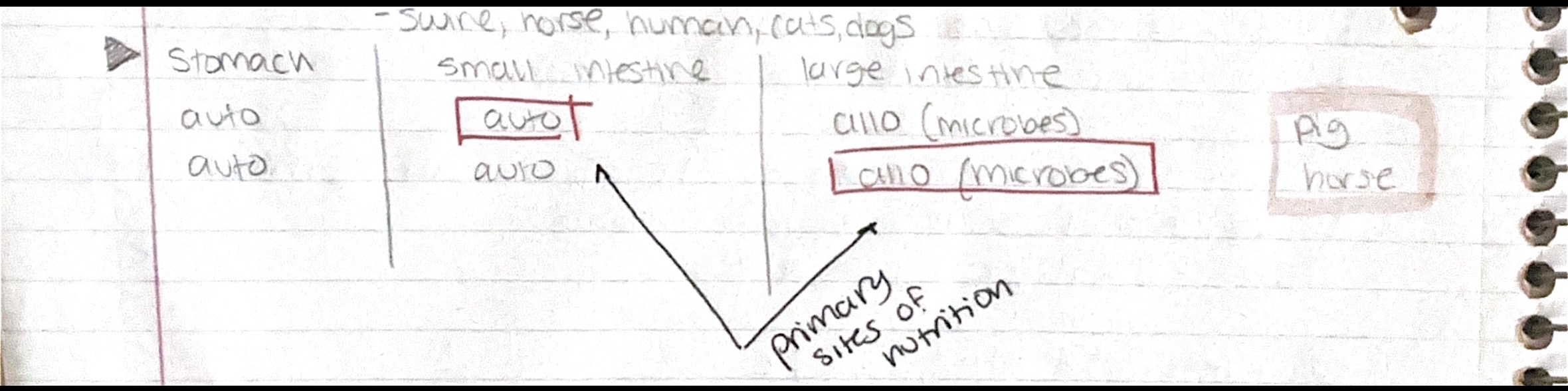
Auto vs alloenzymatic digestion
Autoenzymatic digestion= digestion using enzymes made my mammal
Alloenzymatic digestion= digestion using microbial enzymes
Ruminants
Reticulum, rumen
Reticulorumen= alloenzymatic digestion, microbial fermentation
Cow
Lumen
Space inside of gastrointestinal tract
mouth to anus
outside of body
digestion occurs in lumen
absorption occurs at surface of lumen
Sphincters
Comparable to cork, slows rate of passage of digesta (through longer passageways) for food to get digested/absorbed
Increase retention time
Block flow
Kp
Rate of passage
How fast digesta moves
Slow Kp, higher retention time, higher digestion
Make nutrients smaller for absorption
→ mechanical breakdown= enzymatic breakdown
Kd
Rate of digestion= how fast nutrients are digested
% of nutrient absorbed
extent of digestion = kd/ kd+ kp
higher kd= higher extent of digestion
higher kp= lower extent of digestion
Oral cavity
Mouth
Mechanical breakdown & mastication
lower particle size, higher digestion because higher surface area
surface area= higher enzymatic access
mixing saliva and food
important for lubrication and swallowing of food
saliva has enzymes, starts digestion
saliva has buffers and minerals
saliva is important for oral health
Esophagus
Tuve that transports food from mouth to stomach
Stomach
Has multiple functions
Storage= provides place to store meal
Controls flow of digestion (food + secretions) to small intestine (controls kp)
Mixing= physical processing
Secretes enzymes, acids, buffer & mucus
Digestion= chemical (acid), low ph
enzymatic, activating zymogens
Absorption= H20, alcohol, Cu, Fl, Mo, aspirin
Secretion in stomach
Acid → HCl, decreases pH, denatures proteins and kills microbes
Buffer → HCO3-, raises pH, close to stomach surface, maintain near neutral pH, protect stomach
Mucus → protects surface of stomach from acids & enzymes
Digestion in stomach definition
Preparing ingested for absorption
Mechanical, reduces particle size
enzymatic, hydrolytic reaction (hydrolysis), resulting in H2O
NCHO= monosaccharides
Proteins= AA, dipeptides, tripeptides
Lipids (fats)= monoacylglyceride and 2 fatty acids
Digesta pH 1-3
Absorption in stomach definition
When a molecule moves from the lumen (outside) into the body, typically when it crosses a cell membrane
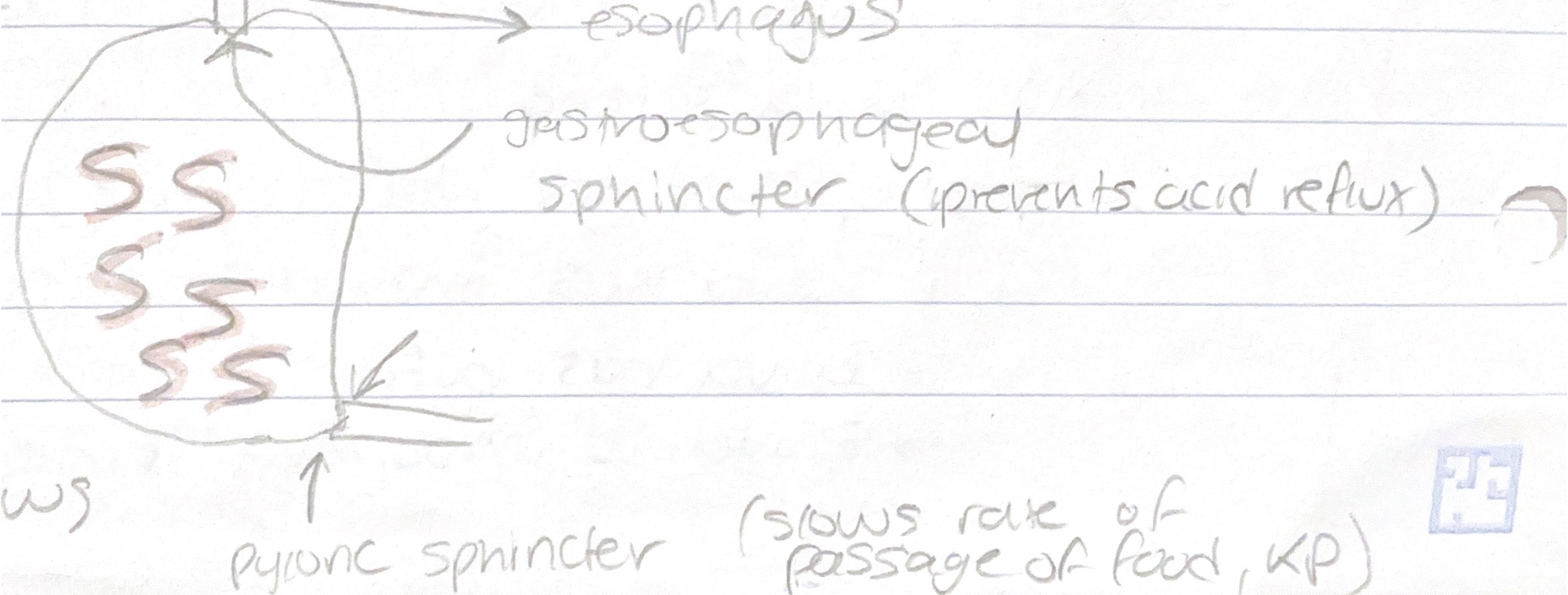
Monogastric stomach - Pyloric Sphincter
Controls flow of digesta into small intestine, determines kP

Monogastric stomach - Gastroesophageal Sphincter
Prevents acid reflux

Monogastric stomach - folds of rugae
Characterized by an S shape
Allows stomach to stretch
Small intestine
Primary site of digestion and absorption
Functions=
Secretion: secretes enzymes and buffer
Digestion: enzymes hydrolyze the molecules into smaller molecules for absorption
Absorption: monosaccharides, AA, dipeptides and tripeptides, monoacylglycerol and 2 fatty acids
Immune
Bile/ Pancreas duct - Bile salts
Helps with lipid digestion
Made in liver
Stored in gall bladder (horses have none)
Bile/ Pancreas duct - exocrine function of the pancreas
Pancreatic enzymes and zymogens
1-2 kg/day of secretions
6-20g of enzymes/ zymogens per day
Makes up 84% of pancreatic mass
Exocrine means…
Secretion goes outside the body
Bile/ Pancreas duct - endocrine functions of the pancreas
4% of pancreatic mass
Cells = glucagon
alpha cells: increase blood glucose
beta cells: produces insulin, decreases blood glucose
Both are islets of langerhans
What produces sodium bicarbonate ? (NaHCO3)? Why?
Pancreas
Brunner’s glands in stomach
Increases pH which protects small intestine from acid
Small intestine - duodenum
Most proximal, next to stomach
pH 5-6
<1m
Sphincter of oddi
Brunners glands
Starts enzymatic digestion of NCHO, proteins, lipids
Small intestine - Jejunum
pH 7-7.5
most of digestion and absorption of NCHO, proteins, lipids, occurs in jejunum
proximal Jejunum has lots of enzyme production and structure to decrease kP and increase surface area
slow rate of passage to help with capacity to digest/ absorb digesta
enzyme production and structures decrease as we move more distally
Ileum
pH >7.5
<1m