Week 2a: Lighting environment
 Call Kai
 Learn
Learn Practice Test
 Spaced Repetition
 Match
Match Flashcards
 Knowt Play
1/62

There's no tags or description
Looks like no tags are added yet.
Name | Mastery | Learn | Test | Matching | Spaced | Call with Kai | Chat |
|---|
No analytics yet
Send a link to your students to track their progress
63 Terms
Light is not visible on it’s own, it’s visible because
It hits a surface
What can happen when light hits a surface
Refraction, reflection and transmission
Why do we see a red door as red
Because red is the only colour not being absorbed but reflected
What is light
Electromagnetic radiation visible to the human eye, ranging from wavelengths (labda) between 380 nm and 780 nm
Why can you not say UV light or infrared light
Because we can’t see it, it is radiation
What does the human light sensitivity curve mean
The brightness perception of green and yellow are stronger than blue and red
When are cones active and what do we call that vision
Daytime and photopic vision
What is radiometry
Deals with quantities associated with radiation including light
Why are all photometric quantities psychophysical
They are related to human perception
What is luminous flux + unit
Amount of light energy per second emitted per second in all directions, weighted against the spectral sensitivity curve of the human eye + lumen
What is luminous intensity I + unit
Describes the luminous flux emitted into a certain solid angle + candela
Solid angle + unit
Relationship between the sphere and the area we are looking at
Formula solid sphere
Area / r²
What is the solid angle of a sphere
4*pi
What is luminous reflectance p
Percentage of visible light reflected by a surface
What is luminance + unit
Light perceived from the surface + cd/m²
What is illuminance + unit
Light on the surface + lux
The definition of luminance is: luminous flux emitted by that surface in the direction towards the perceiver, per solid angle and per unit of apparent area. What does apparent mean?
By taking the apparent area into account, luminance accurately measures perceived surface brightness regardless of the viewing angle.
Glare
Too high luminance or luminance contrast that cause discomfort
What are the two types of glares
Discomfort and disability glare
Formula contrast
C = (L0 - Lb)/Lb or C = Lmax/Lmin
Transmission + refraction + reflection = ?
1
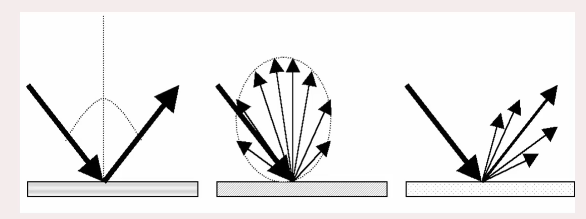
Types of reflection
Specular, diffuse and mixed
Why is illuminance great for measurements and directions
Because it is easy to measure and because we can decide what a surface needs for minimum light source without being influenced by the material
What is the pain threshold for luminance
100,000 cd/m²
CCT abbreviation + unit
Correlated colour temperature + Kelvin
What is CCT
Temperature of a black body radiator that emits light similar to the light source
CRI abbreviation
Colour rendering index
CRI definition
How well a light source renders colours
Luminance distribution and adaptation implication
Not only enough light for comfort and tasks, but also a well lit environment
Rule of thumb for luminance distirbution
1:3:10 (ten times as bright on your task, direct environment and then environment)
How long does it take to adapt from bright to complete darkness
20 to 30 minutes
How long does it take to adapt from complete darkness to bright daylight
5 minutes
What do we find relevant in our view
Ground (people, activity), sky and landscape
Impact of too little or too much light on health of the user
Circadian misalignment, vision loss, safety
Which three colours are cones
Red, blue and green
Image forming pathway in your head
Rods & cones
Visual cortex
Non-image forming route in your head
ipRGC
Supra Chiasmatic Nucleus
Pineal gland
ipRGC abbreviation
Intrinsic Photosensitive Retinal Ganglion Cell
What is the peak sensitivity of the ipRGC
480 nm
Which hormone is suppressed when the ipRGC is triggered
Melatonin
5 quality criteria healthy dwellings
Daylight availability
Glazing
View
Direct sunlight
Solar and brightness control
Daylight factor formula
DF = Ep / Eh (Ep = position, Eh = outdoor)
Daylight factor: worst case is overcast sky, what is the luminance gradient ratio
Horizon: Zenith, 1:3
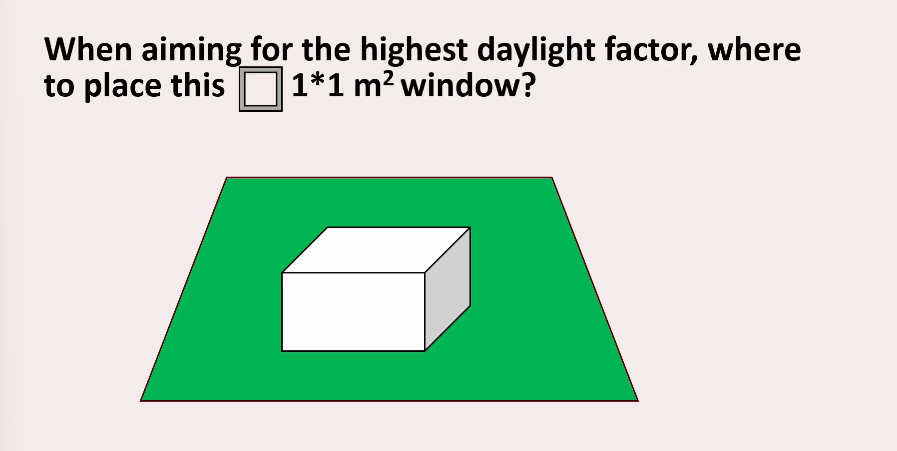
Picture
In the middle on top
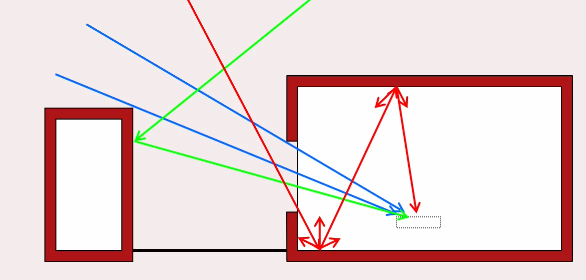
Name all arrows
Blue: DFsc (sky component)
Green: DFext (external reflected component)
Red: DFint (internal reflected component
Increase daylight availability: Urban planning
Reduce obstruction outdoors
Increase daylight availability: architectural planning
Position and size of the window openins
Increase daylight availability: space planning
Bright indoor environments

What does the window look like
Average


What does the window look like
Wide

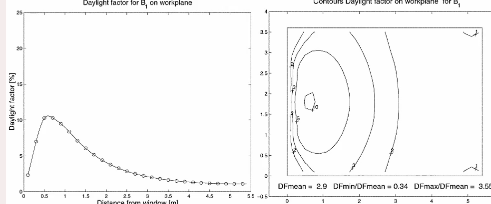
What does the window look like
High

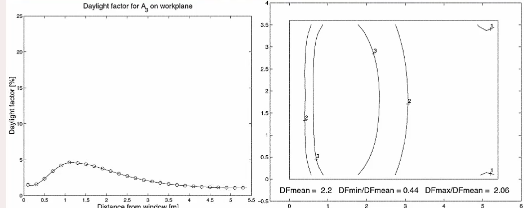
What does the window look like
Wide and high

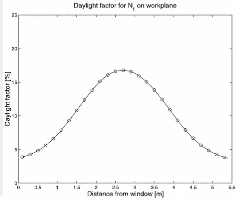
What does the window look like
On top in the middle


Name the skylights
Clerestory, monitor, sawtooth, skylight
Quality criteria for luminous transmittance
tau > 0.5
Criteria: From (…) meter from the facade, one should have (…) degrees of unobstructed view
2, 28

Top: 1,2,3 Bottom: 4,5
Reflection
Absorption
Scattering
Direct
Diffuse
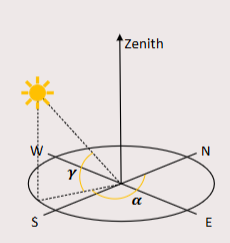
What is y and a
Elevation angle and azimuth angle
Design methods to reduce glare from daylight
Increase indoor illuminance
Decrease the source by shielding
What is the difference between solar control or sun shading devices in the south, north and east/west
South: Dynamic and high daylight levels, easy shading
North: Constant daylight, shading early morning or late evening
EW: Complex
Things to consider when adding solar and brightness control
Flexibility
View
Type of architecture
Outside perception
Three steps for built environment design strategies for daylight
Define what is required from the user’s perspective
Design according to the possibilities and limitations
Find solutions that are sustainable without comprimising user’s needs