Concept 3.2: Four emergent properties of water contribute to Earth’s suitability for life
 Call Kai
 Learn
Learn Practice Test
 Spaced Repetition
 Match
Match Flashcards
 Knowt Play
1/19

Name | Mastery | Learn | Test | Matching | Spaced | Call with Kai | Chat |
|---|
No analytics yet
Send a link to your students to track their progress
20 Terms
Water sustaining properties
Four properties aid an environment for life:
Cohesive behavior
Temperature moderation
Expansion upon freezing
Versatility as a solvent
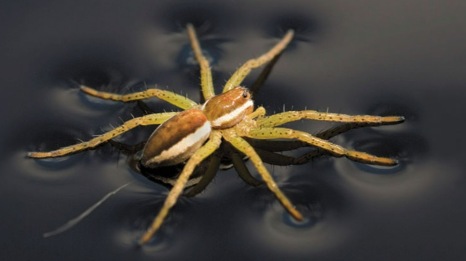
Cohesion
Water molecules holding each other together through hydrogen bonds, creating high surface tension and aiding the transport of water and nutrients against gravity in plants
Surface tension
A measure of how difficult it is to stretch or break the surface of a liquid
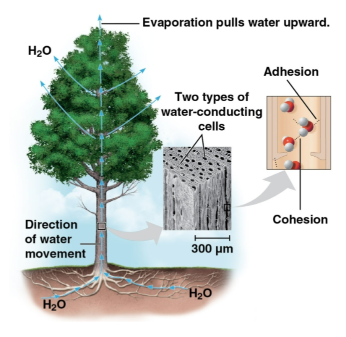
Adhesion
An attraction of molecules between different substances; this occurs in between water and plant cell walls, countering the downward pull of gravity
Water temperature moderation
Water can absorb heat from warmer air and release stored heat to cooler air with only a slight change in its own temperature
Kinetic energy
The energy of motion
Thermal energy
The kinetic energy associated with random motion of atoms or molecules
Temperature
The average kinetic energy of the molecules in a body of matter
Heat
The thermal energy in transfer from one body of matter to another
Specific heat
The amount of heat that must be absorbed or lost for 1 gram of that substance to change its temperature by 1 degree centigrade
Water’s is high, resisting temperature changes while absorbing heat energy
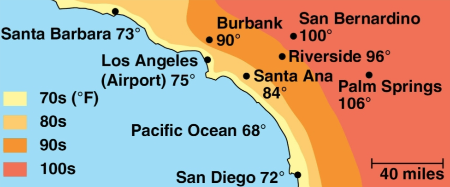
Coastal temperature regulation
Water can:
Absorb and store a huge amount of heat from the sun in daytime and during summer while only warming up a few degrees
Warm the air surrounding it due to gradual cooling at night and during winter
These enable temperature moderation in coastal areas
Evaporation
The transformation of a substance from liquid to gas
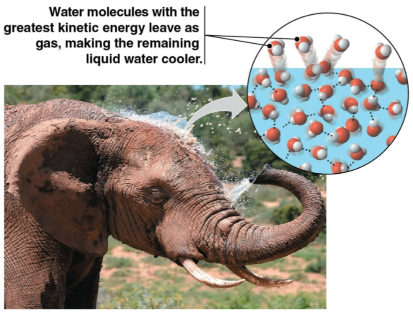
Evaporative cooling
The cooling of a surface as a liquid evaporates from it; this helps stabilize temperatures in organisms and bodies of water
Solution
A liquid that is a completely homogenous mixture of substances
Solvent
The dissolving agent of a solution
Solute
The substance that is dissolved in a solution
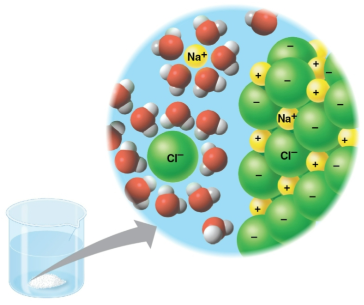
Aqueous solution
A solution where water acts as the solvent; this occurs often due to water’s polarity
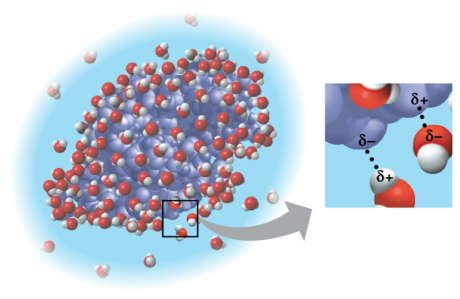
Hydration shell
A sphere of water around each ion in an aqueous solution
Hydrophilic substances
Substances that have an affinity for water, like sugar and salts
Most chemical reactions in organisms involve solutes dissolved in water
Hydrophobic substances
Substances that do not have an affinity for water, like oils
This is because oils have relatively nonpolar bonds