structure of amino acids
 Call Kai
 Learn
Learn Practice Test
 Spaced Repetition
 Match
Match Flashcards
 Knowt Play
1/26

Earn XP
Description and Tags
Name | Mastery | Learn | Test | Matching | Spaced | Call with Kai | Chat |
|---|
No analytics yet
Send a link to your students to track their progress
27 Terms
what is the general structure of an amino acid
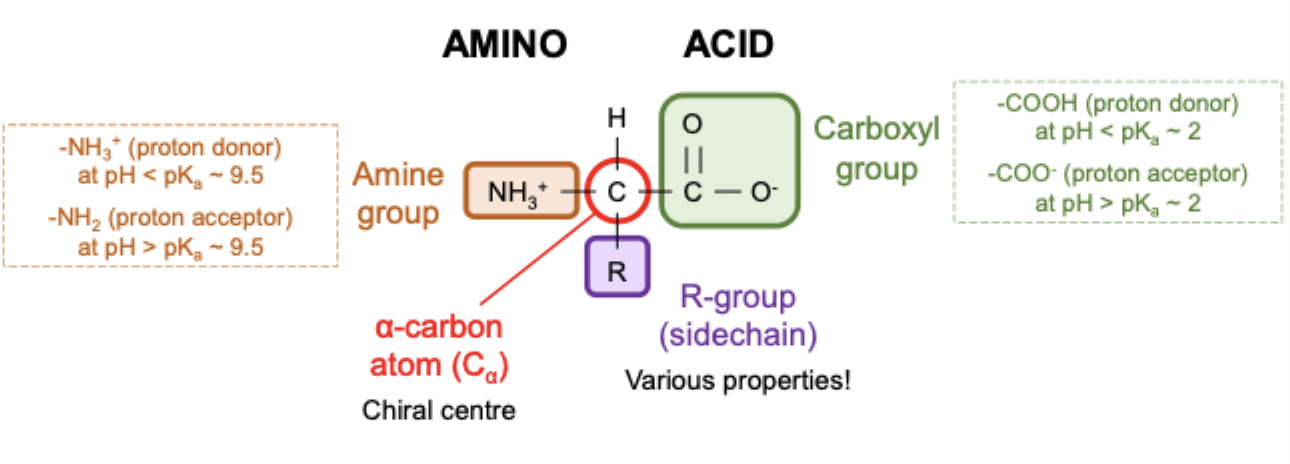
what is a chiral carbon?
a carbon bonded to four different groups (means that stereoisomers can exist)
what is an R group/sidechain?
each amino acid has unique R group
gives amino acid unique chemical and physical properties
can have various properties
how many common amino acids are there?
20
what are the two different states that the amino group/carboxyl group can exist in?
can exist in protonated or deprotonated form
depends on environmental pH
when do the amino group and carboxyl group exist in their protonated form?
when the pH is smaller than their respective pKa
when do the amino group and carboxyl group exist in their deprotonated form?
when the pH is greater than their respective pKa
what is the approximate pKa of the amino group?
9.5
what is the approximate pKa of the carboxyl group?
2
how many possible stereoisomers can amino acids have and what are they called?
2 possible stereoisomers
L stereoisomer and D stereoisomer
what properties do these stereoisomers have?
they are enantiomers (non-superimposable)
they are optically active
how to determine if an amino acid is L/D stereoisomer?
Draw molecule as Fischer projection (carboxyl group on top and side chain on bottom)
If amino group is located on left side of carbon chain, molecule is L
If amino group is located on right side of carbon chain, molecule is D
what types of stereoisomers are usually found in proteins?
L-stereoisomers
where do D stereoisomers exist?
found in plants and animals
they are signalling molecules in organs in mammals
thought to be early biomarkers of disease
where do D amino acid containing peptides come from?
Spontaneous isomerisation - can convert into D-form during aging
Enzyme catalysed post-translational modifications (PTMs)
Non-ribosomal peptide synthesis
what are essential amino acids
amino acids that the body cannot synthesise so must be obtained through diet
what are non-essential amino acids
amino acids that the body can synthesise
what are conditionally essential amino acids?
amino acids that are non-essential but become essential under certain conditions (e.g. phenylketonuria)
what are non-proteogenic amino acids?
amino acids that are not incorporated into proteins but have important biological roles e.g. neurotransmission or sociochemical communication
what are examples of non-proteogenic amino acids
L-DOPA (neurotransmission) and Felinine (sociochemical communication)
what are some properties of amino acids that can arise due to their unique side chains?
hydrophobic
aliphatic
polar
positive/negative charge
small
beta carbon branching
amphipathic (polar and non-polar character)
what are the general characteristics of hydrophobic amino acids?
found in protein cores
stabilise protein structure through hydrophobic interactions
what are the general characteristics of polar/uncharged amino acids (hydrophilic)?
side chains are soluble in water because of hydroxyl and amide functional groups
these functional groups can form hydrogen bonds with water
found on the surface of proteins
what are the general characteristics of polar/charged amino acids
found on surface of protein
involved in salt bridges in protein core (positively and negatively charged residues)
acids (D,E) — proton donors, R groups have net negative charge
bases (KR) — proton acceptors, R groups have net positive charge
histidine can act as proton acceptor/donor
general characteristics of aromatic amino acids
aromatic ring in side chain
relatively non-polar
participate in hydrophobic interactions
aromatic ring absorbs UV light (~280nm)
general characteristics of proline
ring structure
rigid conformation (reduced flexibility)
found in protein turns
found on protein surface
general characteristics of cysteine
can form disulfide bridges (very hydrophobic)
can form covalent links between different parts of protein molecule