OA: Occupational Adaptation Model
 Call Kai
 Learn
Learn Practice Test
 Spaced Repetition
 Match
Match Flashcards
 Knowt Play
1/28

There's no tags or description
Looks like no tags are added yet.
Name | Mastery | Learn | Test | Matching | Spaced | Call with Kai | Chat |
|---|
No analytics yet
Send a link to your students to track their progress
29 Terms
OA was developed by _______ & ______ in ______ at ______
Dr. Schkade, Dr. Schultz 1992 at TWU
Basic assumption of OA
"If we help the patient become more functional, he will be able to adapt..."
3 Primary assumptions of PA
-OA is a state and a process
-Increase adaptive capabilities → increase functional capacity
-OA is a normative process, most pronounced during transitions
How is OA different from other models?
complete reverse
others say: increase functionality = increase adaptiveness
OA says: increase adaptiveness (internal) = increase functionality
The target of OA is:
the patient's internal adaptive process; all therapy directed at improving the patient's adaptiveness
2 interrelated principles to summarize OA:
1. OA is a normative, internal human process
2. OA is an intervention process that can guide an occupational therapist's critical thinking and clinical reasoning within the therapeutic process and relationship
What does OA look like graphically?
OA model
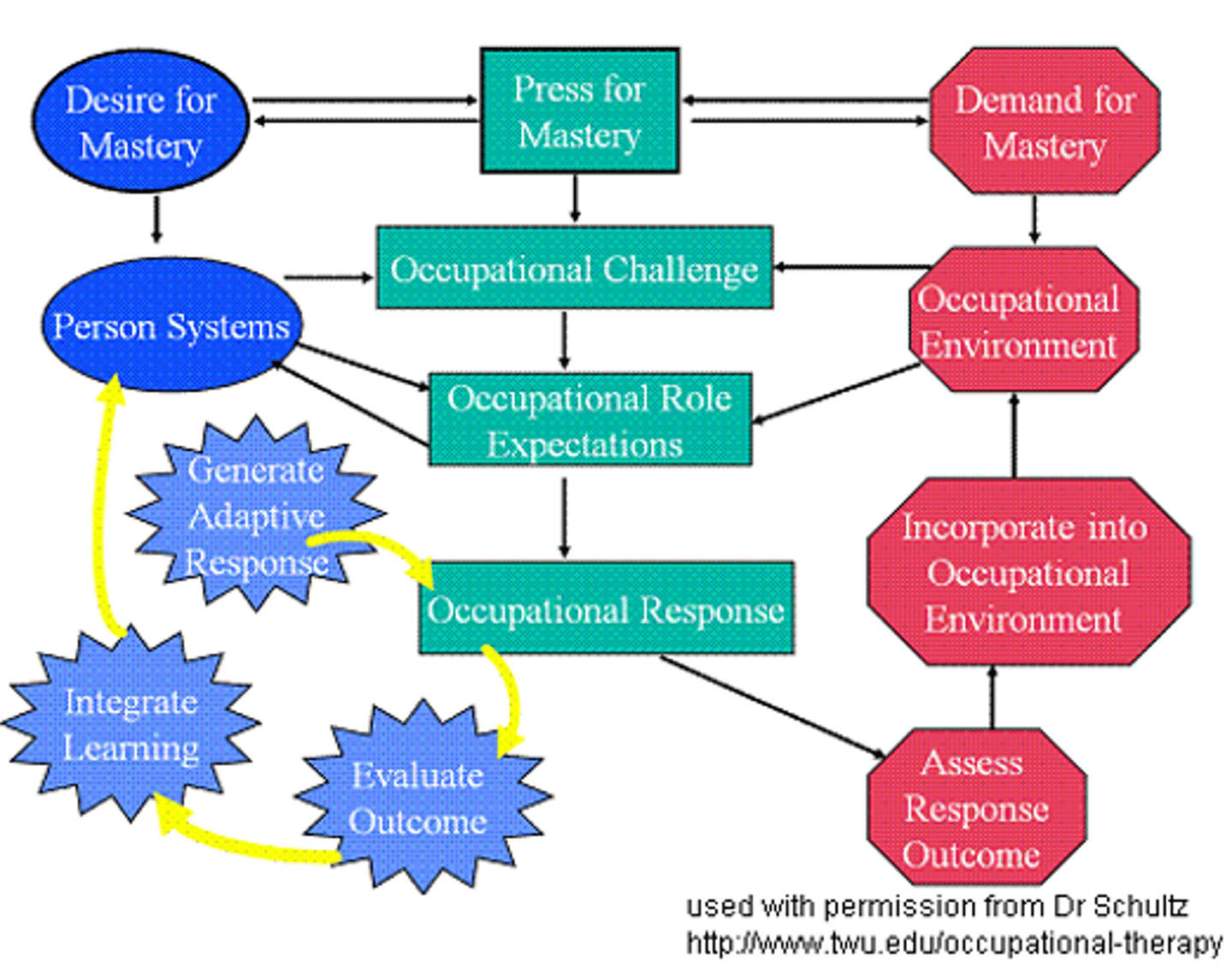
Desire for Mastery and Person Systems
-Everyone has this
-Different experience/circumstances impact ability to be masterful
Demand for Mastery
-comes from occupational environment
-environment : physical , cultural ,social subsystems impact level of demand for mastery
ex) cultural = expectations of grades , expect it to be hard
Press for Mastery
-high, low, medium
-ex) introvert person, demand from enviro for group = ↑press
press impacts level of mastery
When person a demands do not align : pressed feeling (high press for mastery)
Occupational Challenge
something you want need to doainformed by role expectations
↳ internal - external
Occupational Role
-Internal (from self)
ex) responsible = 15 min early
-External (from others)
ex) teacher expect be on time
Occupational Response
How you act in light of challenges and roles
Generating adaptive response: Adaptive Response Mechanisms
Energy
Modes
Behaviors
Energy Response Mechanism
Energy: the desire to do something
Primary: intentional, focused, typically first encounter
Secondary: natural, subconscious, flows, not thinking about it and pops in head
Modes Response Mechanism
Existing mode: familiar, go-to, typical response (most secondary energy)
Modified mode: slight alternative, similar
New mode: whole new response to challenge (most primary energy)
Behaviors Adaptive Response
Primitive (hyperstable): structured, rigid, stuck, often when stressed out/overwhelmed
Transitional (hypermobile): very fluid, highly variable, not modulated, haphazard
Mature (blended mobility/stability): blend stable and mobile
classes of behavior - not hierarchies all three aspects are in repertoire forever *
Generating adaptive response: Adaptive Gestalt
-occurs after the response mechanism
-all person systems present
-assessment of the amount of sensorimotor, cognitive, and psychosocial capacities at varying proportions to respond to occupational demands
Adaptive Response Evaluation
Evaluation of relative mastery
-Efficiency
-Effectiveness
-Satisfaction
Relative Mastery
Relative mastery is NOT the same skill as mastery
Relative mastery IS a phenomenological assessment of the person's experience with respect to a particular occupational event
Response Evaluation: efficiency
Extent of use of available resources (time, energy, resources)
Response evaluation: Effecitveness
achieve their occupational engagement and participation goals
Response evaluation: satisfaction
to self/society = Extent to which people are content with their occupational performance and congruence between occupational participation and performance expectations
Adaptive Response Integration
-comes after generating adaptive response, executing occupational response, and evaluating the event
-occupational adaptation, homeostasis, occupational dysfunction/dysadaptation
Response Integration: Occupational Adaptation
the goal of OA - the good one!
Generalize modified mode into new situation spontaneously with high relative mastery
Response integration: Homeostasis
getting stuck in original thought
Response integration: Occupational Dysfunction/Dysadaptation
-Negative consequences because of response
-a performance rated as dysadaptive can ultimately lead to adaptation and enhancement of occupational adaptation process strength
4 main concepts ("constants")
adaptive capacity
Person's ability to perceive the need to change, modify, or refine responses to occupational challenges in the environment
"Tools in the toolbox"
Goals of OA:
-impact client's internal adaptation process
-client be own agent of change, not technique specific
-look for improvements in relative mastery, generalization to novel situations, self-initiated adaptations