Abnormal liver
 Call Kai
 Learn
Learn Practice Test
 Spaced Repetition
 Match
Match Flashcards
 Knowt Play
1/186

There's no tags or description
Looks like no tags are added yet.
Name | Mastery | Learn | Test | Matching | Spaced | Call with Kai | Chat |
|---|
No analytics yet
Send a link to your students to track their progress
187 Terms
What is Diffuse Hepatocellular disease?
Affects all liver cells(Mainly hepatocytes)
How does liver echo texture look with Hepatocellular disease?
Does not really change the echotexture or shape
What are the types Hepatocellular Disease?
Fatty Liver Infiltration
Hepaitis
Cirrhosis
What is Fatty liver Infiltration?
liver injury
What is Fatty liver Infiltration also know as?
hepatic steatosis
What can Fatty liver Infiltration lead to?
fibrosis and cirrhosis
What is the fatty liver an accumulation of?
Fats/lipid within the liver cells
Is Fatty liver Infiltration usually aquired and reversable?
yes
reversable when abnormal conditions is corrected
what parts of the body is affected by fatty liver Infiltration?
may affect the whole lover or parts of the liver
Cause of fatty liver Infiltration?
-Can be idiopathic(no known cause)
-Excessive alcohol intake(stimulates lipolysis)
-Non alcohol fatty liver disease(Diabetes,Obesity,Dyslipidemia)
-Chemical made drugs(corticosteroid)
-Chemotherapeutic agents(Methotrexate,chemotherapy,amiodarone
-Cystic Fibrosis
-Ulcerative Celitis
-Hyperlipidemia
-Hyperalimentation
-Sever hepatitis
-protein Malnutrition
-High Cholesterol
-pregancy Fatty liver
-Glucogen storage disese
-jejunoileal bypass for obesity
-Chrones disease
-Melnutrition and starvation
What are the laboratory finding of fatty liver Infiltration?
abnormal elevation of( Liver function tests)(Serum Glutamic exalocetic transaminase)(Serum Glutamic pyruvic transaminase)(Bilirubin)
patients may present with RUQ,abdominal pain,nausea,vomiting,jaundice
What is the sonographic appearance of fatty liver Infiltration?
Can be (mild,moderate,severe)
Can increase the beams attenuation(not able to penetrate)
Can see liver enlargement
IT JUST MEANS THE LIVER IS MORE ECHOGENIC DUE To THE FAT
What are the categories of Steatosis?
Mild- normal visualization of diaphragm and blood vessels
Moderate-decreased visualization of diaphragm and blood vessels
Severe-Poor visualization of the posterior segment of rt lobe and diaphram
What can Focal fatty infiltration be confused as?
with malignancy and mimic Focal mass
What is the fatty liver most common at?
At the Anterior aspect of medical part of LLL and adjacent to falciform liver
What does Fatty Foccal sparing most commonly involves?
the periportal region of quadrate lobe,GB fossa
appears as hypoechoic

Describe this image?
Fatty infiltrations
we see increased echogenicity in the Anterior segement
poor beam penetration

Describe this image
Fatty liver infiltration
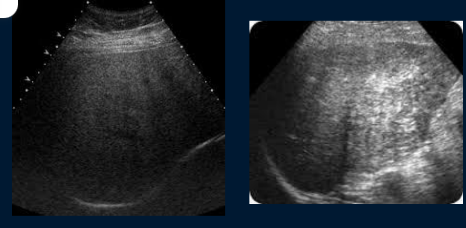
what is this image
Fatty liver Infiltration (We see the increased echogenicity)
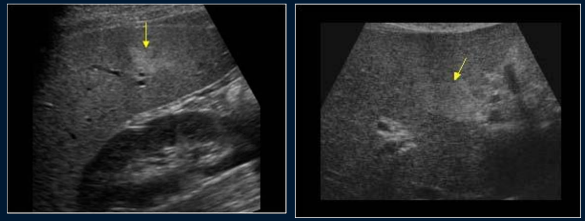
Describe this image
The is fatty infiltration (we see the hyperechoic region)
The echogenicty is near the hepatic vessels

Describe this image?
There is an increased echogenicity and vasculature

What is this image?
This is fatty focal sparing

Describe this image?
There is an increased hyperechoic mass in the liver at the Anterior aspect and the posterior aspect
It looks completely different than the liver

Describe this image?
it involves the periportal region of the quadrate lobe and the GB fossa
We see a hypoechoic area
What is Glycogen storage disease known as?
Gierke disease
Clycogenosis
what organs does Glycogen storage disease affect?
kidneys
liver
What is Glycogen storage disease?
an excessive accumulation of glycogen in the hepatocytes and proximal kidney
what is Glycogen storage disease due to?
Due to the impairment of glucose 6 phosphatase preventing glycogenolysis and release of glucose
Is Glycogen storage disease (type 1 ) an automal disease?
yes it is a genetic disorder
What is Glycogen storage disease associated with?
adenomas
less commonly with Hepatocellular carcinoma
Sonographically explain Glycogen storage disease?
hepatomegally and renomegally seen
Increased echogenicity
Increased attenuation
adenomas seen
mimic fatty infiltration
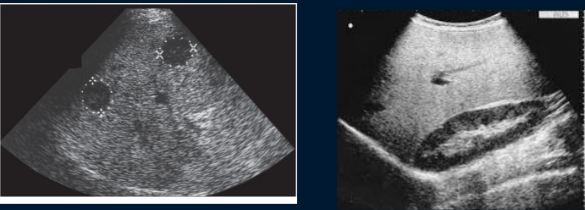
Describe this image?
There is increased echogenicity in the liver(image2)
Enlarged liver and posterior attenuation(image 2)
We see increased attenuation(image 1
May mimic fatty infiltration(image 1
What do we see with Hemocharomatosis?
iron deposit in various organs and organ disfunction
Is Hemochromatosis rare and where does it occur?
It is a rare thing
affects the liver
What can Hemochromatosis lead to?
Cirrhosis
Portal Hypertension
What can Hemochromatosis caused by?
-Blood Transfusion
-Hemolytic anemia
-Myelodysplasia
What are the clinical presentation of Hemochromatosis?
Hyperpigment skin
hepatomegaly
Diabetes
Heart failure
Arthralgia
What are the sonographic feature of Hemochromatosis?
liver shows increased echogenicity
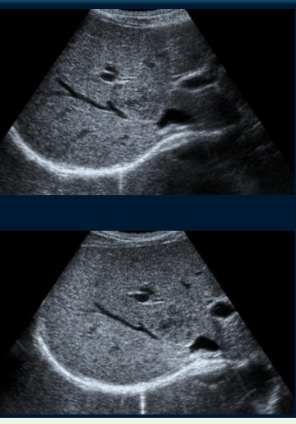
What does this image describe?
there is an increased echogenicty with the echotexture
THis is Hemochromatosis
What is Cirrhosis associated with?
End stage chronic liver disease
What is Cirrhosis?
Fibrosis of the normal liver tissue with abnormal liver nodules
How does Cirrhosis present in the liver?
Late stage of scarring and fibrosis of the liver
With Cirrhosis how does the scarring tissue affect the liver?
Scar tissue block blood flow
Slows process of nutrients,hormones,drugs and other toxis
Is Cirrhosis irreversible?
yes it is often irreversible and progressive
What are the causes of Cirrhosis?
Alcoholism
Viral infection(Hepatitis B,C,D)
Nonalcoholic steatohepatitis
Enviromental toxins
Hemochromatosis
Wilsons disease
Glycogen storage disease
Cystic Fibrosis
Alpha 1 deficiency
Primary Sclerosing Cholangitis
Hepatic Veni occlusion/Budd Chiari syndrome
Chronic hepatitis
What are the Types of Cirrhosis?
Micronodular & Macronodular
What is Micronodular Cirrhosis?
Most common in alcohol consumption
What is Macronodular Cirrhosis?
mostly seen with chronic viral hepatitis
What is the classical presentations of Cirrhosis?
Hepatomegaly
Jaundice
Ascites
What are some asymptomatic clinical symptoms of Cirrhosis?
Fatigue
Jaundice
loss of appetite
vomiting
nausea
itching
spider like blood vessles
weight loss
Abnormal(LFTS,AST,SGOT,ALT,SGPT)
Ascites
hepatic encephalopathy
Coagulopathy
Dilated superficial veins of the abdominal walls
What are the sonographic appearance of Cirrosis?
edema swelling
increased caudate lobe size
increased echogenicity
Shrunken liver
ascites
splenomegaly
GI bleeding
Portal Hypertension
Hepatic vein- shrunken
Hepatic artery enlargement
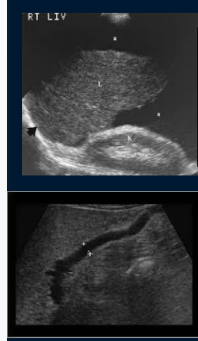
Explain these images
Cirrhosis
(we see enlargement of the liver)
We also see Hepatic artery enlargement
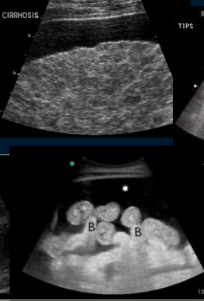
What is this image?
This is Cirrhosis
we see nodular and irregular liver surface capsul
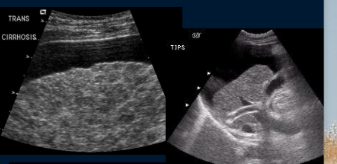
Describe this image?
Cirrhosis
liver more echogenic that Renal capsul

What is this image?
Cirrhosis
recanilization of the umbilical vein
What is A cute Hepatitis referred to as?
inflammation of the liver
What is A cute Hepatitis result in ?
Inflammatory change and swelling of the liver parenchyma
What is acute Hepatitis cause?
Paraascites
Bacteria
Drugs/Toxins
Autoimmune Hepatitis
Steatohepatitis
Matabolic disease
What are Acute Hepatitis presentations?
Fever
Abdominal pain
Jaundice
Dark urine
Pale stool
Loss of appetite
Unexplained weight loss
Elevation of AST & ALT
What is the name of hepatitis if it affected by a virus?
Viral Hepatitis
How is Hepatitis A transmitted?
Mouth to Mouth
How is Hepatitis A commonly transmitted?
By food preparation and unwashed hands
What do patients with hepatitis A present with?
Nausea,Vomiting,Headache
How is Hepatitis B transmitted?
Transmitted through blood (unclean needles and sexual contact)
What hepatitis is the greatest threat to health care workers?
Hepatitis B
What do Hepatitis B presented with?
Malaise
Fatigue
Anorexia
Changes in tase
What is Hepatitis C called ?
non-A/ Non-B Hepatitis
What do most patients with Hepatitis C develop?
chronic liver disease
What do patients with hepatitis C present with?
Vomiting
Headache
Cough and low grade fever
What are the Lab values of Hepatitis?
AST
ALT
Serum Bilirubin
ALP
Leukopenia
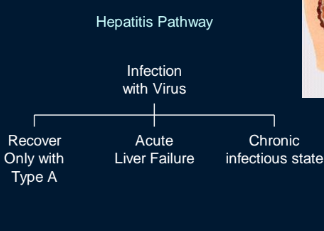
What is Hepatitis pathway?(Image)
What is Acute Hepatitis Sonographic appearance?
liver normal
decrease in echogenicity
Increased in brightness at portal triads
thickend gallbladder wall
Liver present with starry sky pattern

Describe this image?
Decreased echogenicity
We see a thinned gallbladder
What is chronic hepatitis?
Continuation of acute hepatitis
What is Chronic Hepatitis usually a a processes to?
Cirrhosis
liver failure
What is Chronic Hepatitis caused by?
Viral hepatitis
Drugs
Alcohol
Hemochromatosis
Alpha 1 antireypsin
Wilsons disease
Autoimmune hepatitis
what can patients with chronic hepatitis?
Fatigue and mild jaundice
What is Chronic Hepatitis sonographically?
Liver is echogenic due to fibroids
Decreased echogenicty of portal triads
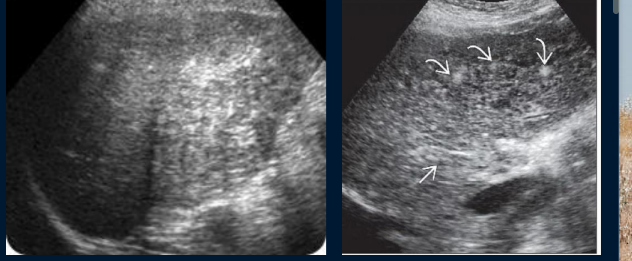
What is this image
Chronic Hepatitis
(echogenic due to the spreads of fibroids)
What is Hepatic Infection Diseases usually a complications of?
• Biliary tract disease (cholangitis, cholecystitis)
• Diverticulitis or appendicitis (through the portal
venous system)
• Osteomyelitis or bacterial endocarditis (through
the hepatic artery)
• Crohn’s disease
• Colitis
• Sickle cell disease
• Surgery
• Trauma
• Neoplasm
• Bacteremia/sepsis in compromised patients
• Diabetes mellitus
What is Pyogenic/Bacterial Abscess?
Absus filled with puss
What is Pyogenetic Abscess caused by?
Escherichia coli=Adults
Straphycoccus=in childer
What are the symptoms of the bacterial abscesses?
• Fever,
• Chills
• RUQ pain
• Nausea
• Vomiting
• Diarrhea
• Anemia, malaise, anorexia
• Pleuritis ( Inflammation of the tissues that
line the lungs and chest cavity)
• Sepsis, shock
• Increase in LFT’s
• Leukocytosis
What are the sonographic finding of Pyogenic?
Can have weel defined or irregular defined walls
Can be anechoic to highly echogenic
We see shadowing and reverberations

Describe this image?
We see less echogenic than the liver

What is this image?
Pyogenic absces
Hypoechoic in comparison to the liver
What is the most common type of fungal hepatic infection?
Candidiasis
Who is candidiasis caused by?
caused by candida albicans
Who is Candidiasis most prevalent in?
ones with diabetes and immunosuppression.
Who can Candidiasis most prevalent in?
transplant recipients, cancer patients on chemotherapy , and HIV
infected patients
also pregnant women
What do patients with Candidiasis present with?
ersistent fever -
chills
hypotension
• Positive blood cultures for pseudohyphae
• Normal white blood cell count in an otherwise neutropenic patient
Oral thrushing
What organs does the Candidiasis affects?
Brain
Heart
Kidneys
What is the sonographic appearance of Candidiasis
Hypoechoic rim corresponding to fibroids
hyperechoic rims corresponding to inflammatory disease
What is the Candidiasis describes as having?
Bulls eye apperence that mimics Metastases
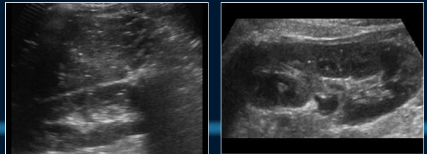
Describe this image?
Candidiasis
The heterogenous liver with micro and punctate calcification of liver and kidney
Ended at slide 65
What is Parasitic Absces Amebiasis?
primary infection of colon and cecum
What is the most common non-enteric Absces?
Parasitic Abscess
What is Parasitic Abscess caused by?
Enteameba Histolytica(collection of puss destroying liver parenchyma)
How is Parasitic Abscess transmitted and occur?
Transmitted through-Fecal oral route
Occurs in warm climate with continamated food and water