Biological Psychology and Behavioral Neuroscience Flashcards
 Call Kai
 Learn
Learn Practice Test
 Spaced Repetition
 Match
Match Flashcards
 Knowt Play
1/254

Earn XP
Description and Tags
Comprehensive vocabulary flashcard set covering foundational terms in biological psychology, neuroanatomy, genetics, brain imaging, action potential dynamics, and synaptic transmission based strictly on course lecture notes.
Name | Mastery | Learn | Test | Matching | Spaced | Call with Kai | Chat |
|---|
No analytics yet
Send a link to your students to track their progress
255 Terms
Biological psychology (biopsychology)
Field that merges relevant information from biology, neuroscience, and psychology to reveal how the brain produces behavior.
Behavioral Neuroscience
The scientific study of behavior in biology.
Pharmacology
Field focused on the manipulation of neural activity and behavior with drugs.
Cognitive neuroscience
Field studying the influence of brain activity in cognitive functions such as memory, using functional brain imaging techniques.
Psychophysiologists
Researchers who study the role of basic physiological functions such as heart rate in various psychological functions using non-invasive procedures.
Neuropsychologists
Researchers who focus on the role of specific brain areas (especially the cerebral cortex) in psychological dysfunction, primarily using case studies and quasi-experiments.
Psychopharmacologists
Researchers who study the effects of drugs on brain behavior.
Comparative psychology
Subfield that compares different species to understand evolution, genetics, and adaptiveness of behavior.
Natural neuroscience
Studying neural mechanisms of ecologically relevant natural behaviors in real-world contexts.

Context
The circumstances surrounding an event and the unique interactions that exist among behavior, the brain, and external environment.
Internal context
Internal physiological or psychological states, such as the digestive system or biological drives, that influence behavior.
External context
Components including social context, cultural context (beliefs, values, customs), and temporal context (timing of event, time of day, season).
Environmental context
Surrounding biological and physical factors that can influence behavior as well as mental functions.
Experiential context
The context provided by past or future experiences.
Adaptations
Biological modifications that enhanced survival in varying environments.
Darwin's finches
Finches studied in different island habitats whose varied beak shapes were adaptations enabling them to retrieve food and survive.
Theory of natural selection
Darwin's theory explaining evolutionary adaptations, such as black iguanas evolving to look like lava rocks to survive against predators.
Ultimate causes
Long-term evolutionary causes of physical and behavioral characteristics, focusing on function and evolution.
Proximal causes
Short-term causes of behavior, such as hormonal secretions or an unexpected loud noise, focusing on mechanisms and development.
Specialists
Animals that eat specific types of food and occupy a specialized ecological niche.
Generalists
Animals that eat any type of food, do not depend on a specific food source, and are adaptable to where they live.
Enriched environment studies
Experiments housing animals in social groups with stimulating objects, showing enhanced recovery and behavioral capability compared to standard isolation.
Rat Park
Study conducted by Bruce Alexander showing that rats in enriched social environments no longer preferred morphine water over regular water.
Bruce Alexander
Researcher who conducted the Rat Park experiment investigating addiction and environmental context.
Frederick Law Olmsted NY
Designer involved in incorporating green spaces such as Manhattan's Central Park, supporting the concept that growing up near green spaces lowers mental health risk.
Context Conundrum
The concept that human domestication and modern urban living outside natural habitats may be altering human behaviors, stress levels, and brain structure.
Anterior cingulate cortex (media multitasking study)
Brain area involved in cognitive and emotional processing found to be smaller in students who media multi-tasked.
Ontological problem
The philosophical question of whether the mind is strictly physical or made up of non-physical properties, addressing the mind-body connection.
Joseph Gall
Pioneer of phrenology who hypothesized that specific cortex structures bulged to reflect higher intellectual faculties.
Marie Jean Flourens
Attacked galls argument with imperial evidence. He removed the “bumps” categorized with emotion from a cat. If Galls theory held true then the cat would show no emotional intrest to male suitors, he argued that the “facilities” proposed by Gall could not be localized in the brain
Paul Broca
Physician who provided empirical evidence for language localization in the cortex through lesion analysis of an epileptic patient.
Neural networks
Modern view of localization representing multiple brain regions linked in critical ways to perform functions.

Gregor Mendel
Scientist who used pea plants to demonstrate that inherited traits follow predictable genetic patterns.
Allele
Different letters or variants assigned to represent specific forms of a gene.
Genes
Varying biological factors responsible for heritable traits.
Phenotype
Observable physical traits or characteristics expressed by an organism, such as shape or color.
Genotype
The underlying genetic composition responsible for the expression of a specific phenotype.
Homozygous
Having two identical copies or alleles of a gene.
Heterozygous
Having two different alleles for a gene (one dominant and one recessive).
Genetics
The study of heritable traits, genes, and phenotypes.
Dominant gene
An allele whose characteristics are expressed even when paired with a recessive allele.
Recessive gene
An allele whose phenotypic characteristic is masked unless paired with another recessive allele.
James Watson and Francis Crick
Scientists who built the physical structural model of DNA double helix with two anti-parallel strands.
Rosalind Franklin
Researcher who studied DNA structure and provided essential evidence for its double helix shape.

Nucleotide bases
The molecular building blocks of DNA: Adenine (A), Thymine (T), Cytosine (C), and Guanine (G).

Transcription
The process in the nucleus where DNA unwinds and mRNA assembles opposite one DNA strand as a mirror image.
Translation
The process outside the nucleus where ribosomes assemble amino acids into proteins guided by mRNA and tRNA.
Messenger RNA (mRNA)
RNA molecule assembled opposite DNA strand that carries genetic code out of the nucleus to the ribosome.
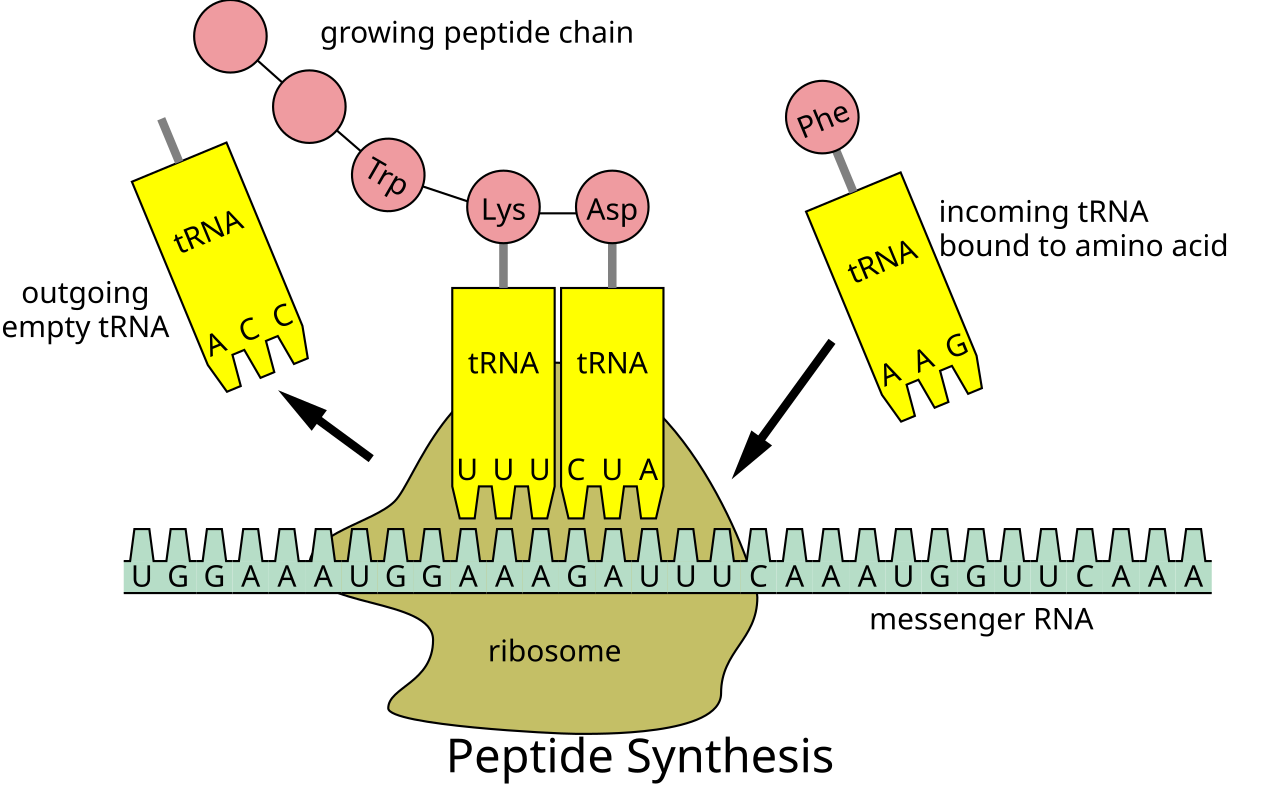
Transfer RNA (tRNA)
RNA molecule that carries amino acids to the ribosome and matches them to mRNA base sequences.
Ribosome
Organelle outside the nucleus that acts as the primary site of protein synthesis.
Darwin's gemmules
Hypothetical particles proposed by Darwin released by body cells, traveling to reproductive organs to pass inherited traits.
Human genome
The complete set of human genes, decoded to contain approximately 3 billion base pairs.
Human Genome Project
Project that decoded the human genome, revealing 20,000–30,000 genes and that protein-coding DNA comprises less than 1.5% of the genome.
Personal Genome Project
Project collecting genetic sequencing and lifestyle data to observe how genes interact with the environment.
Epigenetics
Study of how environmental context and life experiences alter protein expression without altering the underlying DNA sequence.
Tay-Sachs disease
If two recessive Tay-Sachs genes are inherited a vital enzyme in the brain will not be produced (for breaking down fatty lipids)
Genetic counseling
Medical guidance informing prospective parents of genetic risks, such as carrying the recessive Tay-Sachs gene.
Evidence-Based Research
Research relying on direct empirical evidence and rigorous scientific testing rather than unverified hypotheses.
Case studies
In-depth investigations of an individual patient suffering from a specific condition or brain injury affecting behavior.
Electroencephalogram (EEG)
Non-invasive recording technique using scalp electrodes to detect electrical activity of large populations of brain cells.
Single-Cell Recording
Records the activity of an individual neuron. Microelectrodes are positioned in proximity to the neuron so its activity can be recorded
Functional magnetic resonance imaging (fMRI)
Neuroimaging technique measuring brain activity by detecting changes in local blood flow and oxygenation.
Positron emission tomography (PET)
Functional imaging technique using injected radioactive glucose to track regional metabolic activity in the brain.
Diffusion Tensor Imaging (DTI)
Imaging method tracking water molecule movement to visualize white matter fiber tracts in neural networks.
Computed tomography (CT)
Structural technique using X-rays and computer processing to create horizontal cross-sectional images of the brain.
Functional near infrared spectroscopy (fNIRS)
Technique using infrared light to measure oxygenated and deoxygenated hemoglobin(red blood cells) changes in the cerebral cortex.
Independent variable (IV)
The experimental factor manipulated by the researcher.
Dependent variable (DV)
The variable measured to detect changes caused by manipulating the independent variable.
Electrolytic lesions
Targeted brain damage created by passing current through an electrode inserted via stereotaxic surgery.
Stereotaxic apparatus
Surgical instrument used to precisely locate and target specific brain structures like the hippocampus or amygdala.
Social preference test
Behavioral test measuring whether a rodent prefers to socialize with another rodent or remain isolated, used in autism research.
Electrical brain stimulation
Implanting electrodes in specific brain regions to deliver electrical currents that elicit pleasure or reinforce behaviors.
Field research
Observational research conducted on animals in their natural habitats to assess ecologically relevant behavior.
Laboratory research
Controlled experimental research conducted in standardized artificial settings.
David Blaine
Endurance artist who learned to exert voluntary control over autonomic functions, holding his breath for 17 minutes 4 seconds.
Neal Miller
Neuroscientist who challenged the idea that autonomic functions were beyond human control. Conducted series of experiments showing that rats could control their heart rates demonstrated that rats could learn voluntary operational control over autonomic functions like heart rate.
Insular cortex (insula)
brain area located in the cerebral cortex; represents “the state of the body” to other brain areas by integrating input both from within the body and from the external environment
Interoception
The physiological capacity to sense and monitor internal bodily processes.
Camillo Golgi
developed the first technique that enabled scientists to see the structure of neurons. The “histological technique”and advocated the Nerve Net Theory.
Histological technique
used to study the microscopic structure of tissue, to see neurons
Nerve net theory *OLD
Outdated hypothesis proposing that the nervous system consists of a continuous interconnected net of tissue.
Santiago Ramón y Cajal
Neuroanatomists who used Golgi stains establish the Neuron Doctrine: notion that neurons are discrete units, not part of a continuous network
Neuron doctrine theory
Principle stating that the nervous system is composed of individual, contiguous cells rather than a continuous network.

Golgi stain
Histological stain that labels approximately 1% of neurons completely in a dark black silhouette, their sparse
Brainbow technique
Neuroimaging staining technique using genetic fluorescent proteins to label adjacent neurons with distinct colors.
Soma
The cell body of a neuron, ranging from 5–100μm in diameter, containing cellular organelles.

Dendrites
Branching extensions of the neuronal soma that receive synaptic signals from other neurons.

Axon
Single tubular process extending from the soma that conducts action potentials to target cells.

Dendritic spine
Small membranous protrusions along dendrites that increase receptive surface area for synaptic connections.

Nodes of Ranvier
Gaps between the myelin sheath
Uninsulated gaps in the myelin sheath where high densities of voltage-gated sodium channels generate action potentials.

Axon hillock
Cone-shaped region joining the soma to the axon where action potentials are initiated.
Myelin sheath
Insulating fatty layer surrounding axons that speeds electrical signal propagation.

Unipolar neurons
Neurons possessing a single neurite process extending from the cell body.

Bipolar neurons
Neurons having two processes extending from opposite ends of the cell body.

Multipolar neurons
Neurons possessing multiple dendrites and a single axon extending from the soma.
Cell membrane
Lipid bilayer separating intracellular components from the extracellular environment.

Rough endoplasmic reticulum
Organelle studded with ribosomes involved in protein synthesis and processing.
Smooth endoplasmic reticulum
Organelle responsible for synthesizing lipids, steroids, and packaging macromolecules.
Cytoskeleton
aids intracellular biochemical transport.
Lysosome
Contains enzymes that break down molecules such as proteins and lipids