Chapters 8-12 Ratios and Meanings
 Studied by 0 people
 Call Kai
 Learn
Learn Practice Test
 Spaced Repetition
 Match
Match Flashcards
 Knowt Play
1/23

There's no tags or description
Looks like no tags are added yet.
Name | Mastery | Learn | Test | Matching | Spaced |
|---|
No study sessions yet.
24 Terms
Liquidity
Having sufficient cash (or other assets convertible to cash in a relatively short time) to pay currently maturing debts
Lack of liquidity can result in financial difficulties or even bankruptcy
Liquidity Management
Management can influence the ratios that measure liquidity to some extent
Ex:
Delay the shipment and billing of certain inventory parts to receive them in early January rather than late December, reducing inventory and accounts payable at year-end
Make additional purchases in late December, increasing inventory and accounts payable at year-end
Working Capital
The difference between current assets and current liabilities
After paying our current obligations, how much in current assets will we have to work with?
A large positive working capital is an indicator of liquidity (whether a company will be able to pay its current obligations on time)
Not the best measure of liquidity when comparing one company with another, because it doesn’t control for the relative size of each company

Current Ratio
Current assets divided by current liabilities; measures the availability of current assets to pay current liabilities
A ratio greater than 1: indicates there are more current assets then current liabilities
The higher the current ratio, the greater the company's liquidity and less risk

Acid-Test Ratio (Quick Ratio)
Cash, current investment, and accounts receivable divided by current liabilities; measures the availability of liquid current assets to pay current liabilities
Because the numerator contains only a portion of the current assets used in the current ratio, the acid-test ratio will usually be smaller than the current ratio
Provides a better indication of a company's liquidity than the current ratio
A more conservative measure of a company's ability to pay current liabilities
Its more conservative because it eliminates current assets such as inventories and prepaid expenses that are less readily convertible into cash, the acid-test ratio often provides a better indication of a company's liquidity than does the current ratio

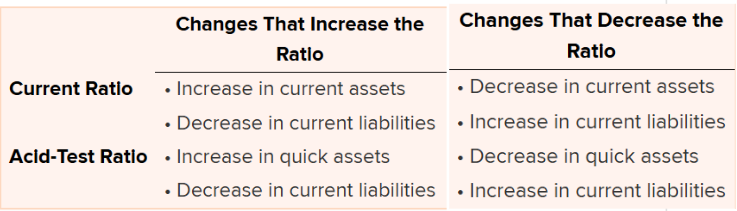
Changes that affect the current and acid-test ratios
Be able to find a second or third monthly interest payment.
first calculate the first month's interest using the original principal, then subtract that interest from your total payment (or the principal for interest-only loans) to get the new principal for the second month, and then recalculate interest on that new, slightly lower principal for the second month
solvency
a company’s ability to pay its current and long-term liabilities
long term
debt-to-equity-ratio
Total liabilities divided by stockholders' equity; measures a company's risk
The higher the ratio the higher the risk of bankruptcy
Best measures financial leverage
Indicates the risk of bankruptcy
Other things being equal, the higher the debt to equity ratio, the higher the risk of bankruptcy
More debt increases the risk of bankruptcy, but it also increases the potential returns investors can enjoy

Return on Assets
Net income/average total assets
Measures the amount of net income generated for each dollar invested in assets

times interest earned ratio
Ratio that compares interest expense with income available to pay those charges
Provides indication to creditors of how many "times" greater earnings are the interest expense
The higher a company's earnings relative to its interest expense, the more likely it will be able to make current and future interest payments
• The times interest earned ratio measures a company’s ability to meet interest payments as they become due.
• A higher ratio indicates a greater ability of a company to meet its interest obligation.
Compares interest payments with a company's income available to pay those charges
Classified as a solvency ratio rather than a liquidity ratio
A company wants a higher net income before interest expense and income tax expense in relation to the amount it needs for interest expense alone

Liquidity Ratios
Liquidity ratios focus on the company's ability to pay current liabilities
short term
Receivables turnover ratio
average collection period
inventory turnover ratio
average days in inventory
current ratio
acid test ratio
Solvency Ratios
solvency ratios include long-term liabilities
Debt to equity ratio
Times interest earned ratio
Receivables Turnover Ratio
Measures how many times receivables are collected during the year
A high turnover ratio is positive
Average Turnover Ratio
Measures the days it takes to convert receivables into cash
The short the period the better
Inventory Turnover Ratio
Measures how many times average inventory is sold during the year
A high ratio indicates that inventory is selling quickly
An extremely high ratio might show lost sales due to inventory shortages
Average Days in Inventory
Measures the average number of days it takes to sell its entire inventory during the year
Companies try to minimize the number of days they hold inventory
Profitability Ratios
Profitability ratios measure the earnings or operating effectiveness of a company over a period of time, such as a year
Investors view profitability as the number one measure of company success
Gross Profit
Return on Assets
Profit Margin
Asset Turnover
Return on Equity
Earnings per share
Price-earnings ratio
Gross Profit Ratio
Indicates the portion of each dollar of sales above its cost of goods sold
Gross profit ratios vary by industry
Return on Assets
Measures the income the company earns on each dollar invested in assets
A higher percentage would indicate a higher amount earned compared to the assets that it owns
Profit Margin
Measures the income earned on each dollar of sales
A higher profit margin indicates a higher amount actually earned (after expenses are accounted for) compared to its total revenues
Asset Turnover
Measures sales volume in relation to the investment in assets
A company wants higher revenues compared to each dollar invested in assets
Return on Equity
Measures the income earned for each dollar in stockholders' equity
A higher amount earned compared to the investment made by the owners of the company is desirable
Price-Earnings Ratio
Compares a company's share price with its earnings per share
A higher PE ratio shows that investors have a higher expectation of earnings growth