ohhhh the nightmare is so close to being over
 Studied by 0 people
 Call Kai
 Learn
Learn Practice Test
 Spaced Repetition
 Match
Match Flashcards
 Knowt Play
1/108

Earn XP
Description and Tags
finals week or my final week?
Name | Mastery | Learn | Test | Matching | Spaced |
|---|
No study sessions yet.
109 Terms
Determinism
Behavior is lawful, it is predictable, and nonrandom.
7 Dimensions of ABA
Generality
Effective
Technological
Applied
Conceptually Systematic
Analytic
Behavioral
(GET A CAB)
Applied
[Dimension of ABA] Interventions focus on behavior changes that are meaningful/socially significant to the individual.
Behavioral
[Dimension of ABA] Fcuses on behavior that is measurable and observable
Analytic
[Dimension of ABA] Data is used to demonstrate that interventions correlate to functional behavior changes.
Technological
[Dimension of ABA] The target behaviors and interventions are described in a way that they can be replicated by others
Conceptually Systematic
[Dimension of ABA] The strategies and interventions are research-based and emphasize the principles of behavior
Generality
[Dimension of ABA] The learned skills are durable over time and are applicable over multiple contexts
Effective
[Dimension of ABA] The interventions result in meaningful improvements to the behavior
3 branches of behavior analysis
Behaviorism - Centered on the philosophies and existing theories, emphasizes how learning occurs
Experimental Analysis of Behavior - Emphasizes evaluation and assessment of basic behavioral principles and the existing processes that explain why behavior occurs
Applied Behavior Analysis - Direct application of principles and techniques of behavior analysis to modify behavior in a socially valid way
Unconditioned Stimulus
Stimuli that elicit an instinctive response
Conditioned Stimulus
Following continued pairing with a US, this stimulus evokes the same instinctive response as the US
Unconditioned Response
Instinctive/Reflexive response
Conditioned Response
The learned response to a previously neutral stimulus
Appetitive
A stimulus that is perceived as desirable and pleasant
Aversive
A stimulus that is perceived as unpleasant
Generalization
The ability to apply a learned skill or behavior across multiple contexts
Extinction
The fading away and eventual elimination of a behavior by removing its reinforcers
Extinction burst
A temporary escalation in the frequency, duration, and intensity of a taret behavior when it is put on extinction
Three term contingency
A psychological model used to describe operant conditioning: antecedent, behavior, and consequence.
Positive Reinforcement
Something is added to the environment, thus the behavior increases
Negative reinforcement
Something is removed from the environment, thus the behavior increases
Positive punishment
Something is added to the environment, thus the behavior decreases
Negative punishment
Something is removed from the environment, thus the behavior decreases
Noncontingent Reinforcement
Reinforcement is provided regardless of responses
Schedules of Reinforcement
Consists of time schedules and response schedules
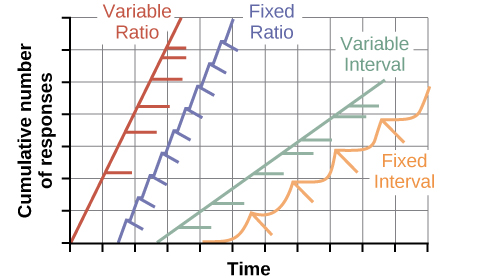
Postreinforcement pause
Pauses in responses that occur following the delivery of a reinforcement. (Often seen in FR schedules as the ratio of responses to reinforcers increases).
Motivating Operation
Motivating operations precede the events of discriminating operants and may have an evocative or abative effect on the ensuing behavior.
Abative effect
A type of MO. Decreases the occurrence of a behavior.
Evocative effect
A type of MO. Increases the occurrence of a behavior.
Stimulus Discrimination Training
Different stimuli are utilized to teach individuals to respond differently between them. Positive reinforcement is provided for each correct response to the respective stimuli
Sd
The discriminative stimulus, it refers to the cue that evokes a specific behavior
S-Delta
Signals that reinforcement is not available for a particular behavior
Stimulus Equivalence
Refers to stimuli that are functionally equivalent to one another.
Indirect measurement procedures
Cannot take measurements of behavior as it occurs, rather, the measurements are taken following the instance of the behavior and data is taken from inferences.
Permanent product recording
Self-monitoring
Structured interviews
Surveys
Rating scales
Direct measurement procedures
Allow observers to take measurements of the behavior itself as it occurs without having to make inferences on how or what occurred from other factors.
Event recording
Duration recording
Interval recording
Time sampling
Topography Recording
Frequency
Continuous method of recording, it takes the count of instances of behavior
Rate
The count of occurrences of behavior divided by a time period
Duration
A continuous measurement; the amount of time an organism engaged in a behavior
Intensity
The magnitude or strength of a response
Latency
The amount of time that elapses before the onset of a behavior
Interobserver Agreement (IOA)
The consistency of at least two or more independent observers in their recording of the same behavior of event
Total Count IOA
Observers tally the number of occurrences of a behavior
IOA = Smaller Count/ Larger Count
Mean Count-per-Interval IOA
The observation period is divided into intervals, percept agreement for each interval is calculated and then averaged.
Trial-by-Trial IOA
Observers record whether the behavior occurred or did not occur during a trial
IOA = Agreement/ Total trials
Independent Variable
The variable being manipulated
Dependent Variable
The variable being measured
Multiple Stimulus With Replacement (MSW)
An array of multiple stimuli is presented to the learner, and they are prompted to select an item following a set interval (e.g., every 20 seconds). The clinician will allow the learner an interval time to emit a response before repeating the prompt, wherein a new trial will be established. If the learner emits a response with an item, the clinician will allow them time to engage with the item for a set time before placing it back in the array.
This type of preference assessment is ideal for learners who cannot tolerate the removal of a reinforcing item, as well as learners who do not struggle with selecting from a large array.
Paired Stimulus
Learners are provided with two options and are able to play with that item for a short period of time. Afterward the selected item is removed and another two options are presented until each item has been paired with every other item.
Ideal for learners who can choose between two items but cannot choose in a large array.
Single Stimulus Preference Assessment
The learner is provided with a single item, and data is recorded on the learner’s behavior to each item. Typically, they can play with the item for as long as they want, and once they stop, a new item is presented. If they do not engage with the item, they will be prompted to engage with it; if they still do not, the item will be replaced.
Multiple Stimuli Without Replacement (MSWR)
Participants are provided a large array of items to select from and are promoted to engage with each item following a prompt. The selected item is removed from the array after the learner has emitted a response to it and the learner is promoted to select an item from the existing array.
This type of assessment may be ideal if the learner is able to tolerate the removal of items and if they can select from a large array. From a clinical perspective, it is also ideal for determining the differential preferences
Free Operant Assessment
The learner is able to interact with many different items or activities for as long as they like. Data is recorded regarding how long they engage in the item or activity
Descriptive Assessment
A component of a FBA that involves the direct observation of behavior in naturally occurring conditions
Narrative ABC Recording
A type of direct observation recording in which the antecedent, the behavior, and the ensuing consequence is recorded and described as a means of understanding the behavior. This is useful in the identification of its function
Scatterplots
A graphical tool most commonly used to visually represent data collected during behavioral assessments; utilized to analyze the relationship between a behavior and other variables
Probability Analysis
The likelihood that a behavior will occur more under certain antecedents and consequences.
Access
The behavior is maintained through access to tangibles
Sensory
The behavior is maintained by automatically reinforcing consequences, typically sensory stimulation.
Attention
The behavior is maintained by attention and is dependent on social responses from others.
Escape
The behavior is maintained by allowing an individual to avoid or remove themselves from an aversive situation
Automatic Reinforcement
Reinforcement occurs independent of other people
Social reinforcement
Reinforcement is dependent on the presence of another individual to mediate it
Functional Analysis (FA)
An experimental process used to identify the function of a person’s behavior by testing how different environmental conditions affect the responding behavior.
Target behavior is briefly reinforced to observe the effects of different conditions on the behavioral output to see what maintains it.
Different from an FBA, while an FBA can include an FA it is not always the case
Task analysis
Breaking down a complex skill into smaller steps
Function based intervention
An intervention that utilizes data collected from the FBA to address the function of the behavior in its intervention.
The general goal is that the individual will obtain the reinforcement that once maintained the target behavior through alternative behaviors from the intervention.
Antecedent interventions
Modification of the environment before the onset of the behavior to decrease the likelihood that undesirable behaviors occur.
Default interventions
Interventions whose effects do not depend on the operant function of problem behavior
Antecedent exercise
Engages participants in a program of effortful activities such as aerobic exercise or strength training to decrease the likelihood of undesirable behavior
Enriched Environment
Providing an individual with a stimulus-enriched environment, such as making preferred items, toys, educational materials, leisure and recreation, social activities, etc., on a continuous response-independent schedule. This is to reduce the likelihood of undesirable behavior
Stimulus Prompt
Modifying a characteristic of a target stimulus to prompt a correct response
Response prompt
Directly follow the response of the learner to prompt a correct answer. May include verbal, gestural, modeled, or physical prompts.
Differential Reinforcement
Selectively reinforcing desired behaviors while placing other behaviors on extinction
Functional Communication Training (FCT)
A differential reinforcement procedure where an individual is taught an alternative response that results in the same class of reinforcement identified as maintaining the undesirable behavior. Emphasizes the teaching of meaningful and functional communication.
Backup Reinforcers
Activities, items, or privileges that can be exchanged for conditioned reinforcers.
Exchange Rate
The amount of conditioned reinforcers (tokens) needed to obtain a backup reinforcer.
High-probability instructional sequence (HPIS)
A series of requests that an individual has a high likelihood of completing. By building motivation with high-p requests, the individual will be more motivated to complete a subsequent low-p request
In Situ Training
Practicing skills in a simulated version of the environment in which those skills would be expected.
(ex: Placing a realistic replica of a firearm in a room and observing how the child responds to finding a “real” firearm following firearm safety training.)
What should a child do when they encounter a firearm
If effective firearm safety skills training interventions are utilized, the child should understand the dangers of playing with firearms and understand the gravity of the situation. Ideally the child should know not to touch it, to remove themselves from the area in which the firearm was found, and to tell an adult.
Deposit contract
An agreement which outlines a monetary amount an individual is expected to pay which may be later returned should they follow the restrictions of the contract.
Ex: For contingency management in the reduction of drug use, individuals would pay an agreed amount of $50 which was then held by clinicians to be paid back to the individual should they reduce drug use behaviors.
Contingency Management
A behavioral treatment based on operant conditioning principles. It establishes a new contingency or available consequence to incentivize individuals to engage in a desirable behavior.
Primary Prevention
Aims to prevent dysfunction and develop competencies within the individual.
Secondary Prevention
The identification of existing problems and the ensuing interventions used to reduce or remove them entirely
Tertiary Prevention
Consists of a more individualized plan of intervention for high-risk behaviors. It aims to reduce the consequences of an ongoing behavior.
Social Validity
Behaviors that are considered socially relevant to the individual, their family, and the overall community, which may include communication skills, leisure skills, developing meaningful relationships, etc.
Expressive Language
Refers to the ability to communicate (ex: A child mands for a toy by saying “toy”).
Receptive Language
Refers to the ability to comprehend language (ex: If a child is asked to pick up a”cup” they understand what the prompt is asking them to do.)
Personalized System of Instruction (PSI)
A student-centered learning model where the material is broken into smaller modules and learners progress at their own pace with an emphasis on mastering the content before moving on. The system utilizes immediate feedback and proctors to deliver course materials and refine learning.
Reciprocal Peer Tutoring (RPT)
A form of collaborative learning with an emphasis on students from similar academic backgrounds interchanging between the roles of the tutor and the learner. It relies on interteaching methodology where peer feedback and active conversation in the switching between learner and tutor promote understanding.
Mand
A verbal operant where the learner will make a request or a demand to express something that they want.
Tact
Labeling and describing items, actions, or events
Intraverbal
Responding to verbal prompts with appropriate and relevant language skills, this type of verbal operant is typically used to develop programs that promote back-and-forth conversational skills and social interactions.
Echoic
The learner repeats or imitates an auditory stimulus, this type of verbal operant is usually used to develop language acquisition programs.
Six components needed for effective coaching
Behavioral measurement - Dependent variable is observable and measurable
Differentiation between acquisition and maintenance of athletic performance - Coaches should approach acquisition and maintenance training differently
Within-athlete comparison - Skills at the initiation of coaching should serve as the baseline comparison for eventual interventions implemented by the coach
Use coaching procedures derived from rigorous experimentation - Data should inform coaching
Recognize the role of the coach in athlete behavior change - The behavior change agent should change their behavior to affect change in the target client
Behavioral coaching must be socially valid - The procedures used by the coach should be acceptable by all relevant sports stakeholders
Industrial Organizational Psychology
Has a foundation in a variety of different conceptual theories and frameworks and emphasizes the selection and placement of employees
Organizational Behavioral Management (OBM)
Has a purely behavioral analytic foundation. Additionally, it emphasizes existing employees and assessing their skills as well as how to maintain if not improve their performance.
Transformation of Stimulus Functions
Function of one stimulus changes or transfers to another.
If A > B and B is reinforcing, A will have a greater reinforcing function than B, even though the only direct history with A
Relational Frame Theory (RFT)
A functional and behavioral perspective on language and cognition involving mutual entailment and combinatorial entailment
Mutual entailment
Relation between two stimuli • A = B; derive B = A
Combinatorial entailment
Relation among three or more stimuli • If A > B and B > C; derive A > C and C < A
Disadvantages of a functional analysis
Training is needed to conduct it correctly
Requires a lot of time and effort
Expertise is needed to manipulate the antecedents and consequences