Science Teaching: Astronomy
 Call Kai
 Learn
Learn Practice Test
 Spaced Repetition
 Match
Match Flashcards
 Knowt Play
1/144

There's no tags or description
Looks like no tags are added yet.
Name | Mastery | Learn | Test | Matching | Spaced | Call with Kai | Chat |
|---|
No analytics yet
Send a link to your students to track their progress
145 Terms
satellites
objects or bodies that orbit other objects, can be natural or artificial
navigation satellite
work with ground based devices to calculate the precise location of an object
Global positioning System (GPS)
weather satellites/observation satellites
monitor conditions on Earth
severe weather monitoring
wildfire detection and monitoring
cloud formation monitoring
communication satellites
send information to different parts of the world"
telephones, internet, tv
astronomical satellites
orbit outside Earth’s atmosphere to gather data about outer space
telescopes that gather information about distant celestial bodies
spectrometers that allow scientist to determine which elements are present in the stars
International Space Station
spacecraft that orbits Earth
contains a lab for scientific research
incorporates coking stations for other space vehicles
Hobby-Eberly
an optical telescope that uses spectrographs to search for planets outside our solar system, study other galaxies and look for black holes
Keck Telescopes
a pair of optical and infrared telescopes build to resist the effects of gravity, a turbulent atmosphere and temperature changes
South African Large Telescope
an optical telescope studying supernovas, black holes and other space events
Atacama Large Millimeter Array
a radio wave telescope that is used to obtain information abou tyoung planets
Five hundred meter Aperture Spherical Telescope
a radio wave telescope that is searching for pulsars, neutral hydrogen and extraterrestrial intelligence
extraterrestrial telescopes
located outside Earth’s atmosphere to observe space phenomena that can’t be seen from Earth
Hubble Space Telescope
telescope that views deep space objects in visible, ultraviolet and near infrared light
Chandra X-ray Observatory
x-ray telescope designed to detect emissions from hot regions of the universe
Spitzer space telescope
an infrared telescope that focused on nearby and distant space objects
STEREO mission
two telescopes designed to orbit and study the sun in 3D
Planck observatory
telescope designed to observe cosmic microwave background
Lobster Eye Imager for Astronomy
a wide field Xray telescope
AstroSat
a telescope that observes stars simultaneously in Xray, visible and UV
Spektr-RG
a telescope that plots xray sources in the universe
James Webb Space Telescope
an infrared telescope that can see farther in the infrared than Hubble- designed to observe objects too far away to see with Hubble
Euclid Telescope
a telescope that orbits between the Sun and Earth that is designed to collect data on dark matter and dark energy
Earth tilt
23.5 degrees on its axis
Why do different parts of the Earth have different amounts of daylight during the year?
the tilt of the earth changes how sunlight hits different regions throughout the year, changing the length of daylight
seasons occur because…
the angle of the Earth’s axis…
uneven heating: direct vs indirect sunlight
hours of daylight
summer solstice
June 21st- beginning of astronomical summer in the Northern Hemisphere
most sun at tropic of cancer
N. hemisphere receives more heat and daylight than S. Hemisphere
Which of the following locations will receive less than 12 hours of daylight on the June solstice?
a) North Pole
b) equator
c) NYC
d) Sydney, Australia
d) Sydney, Australia
autumnal equinox
september 23- beginning of astronomical fall in the Northern Hemisphere
both hemispheres receive similar amounts of heat and the same 12 hours of daylight
Which of the following describes how the amount of sunlight changes between the September equinox and the month of October at locations north of the equator?
a) The amount of sunlight decreases and then begins to increase.
b) The amount of sunlight remains the same.
c) The amount of sunlight decreases.
d) The amount of sunlight increases.
c) The amount of sunlight decreases.
winter solstice
December 22- beginning of astronomical winter in N. Hemisphere
most sunlight at tropic of Capricorn
southern hemisphere receives more heat and daylight than N Hemisphere
vernal equinox
March 21-beginning of the astronomical spring in the N hemisphere
both hemisphere receive similar amount so f heat and daylight
meteorological winter momnths
December, January, Februrary
meteorological spring months
march, april maym
meteorological summer
june, july, august
meteorological fall
september, october, november
Tides (ocean)
the rising and falling sea levels due to Earth’s rotation and the gravitational pulls by the sun and moon
how does the moon affect tides?
moon’s gravity causes bulges, pulling water from other areas toward the side of the Earth closest to the moon
moon’s gravity also pulls the earth towards the moon, leaving deeper water on the far side of the Earth-experience high tide
high tide
location on the Earth closest to where the moon is
spring tides
even larger tides than high tides due to both the moon and sun lining up
occurs every 2 weeks during full moons and new moons
neap tide
smaller tides due to sun and moon on opposite sides of earth
ocean waves caused by…
wind blowing across the ocean’s surface- energy transfered from the wind
ocean wave movement
circular
storm surge
extra high waves will push water up onto shore and cause flooding when wind is very strong
tsunamis
massive waves that build in heigh as they move towards shore due to underwater earthquakes and volcanoes
tidal bore
surge of water that pushes up a river channel like a big wave flowing upstream
full moon
sun is on th eopposite side of earth
new moon
when the sun and moon are one same side of Earth
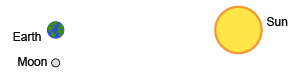
Which of the following phases of the moon might appear if the Earth, Sun, and Moon were arranged as seen?
[third] quarter moon
lunar eclipse
moon on far side of Earth (normally a full moon), but in just the right place, the earth blocks the suns rays from hitting the moon’s surface and causes a reddish full moon (blood moon)
solar eclipse
when the moon is between the sun and earth, normally there is a new moon but in just the right position, it block the sun’s rays from reaching the Earth’s surface, obscuring the sun in the sky showing a black spot with sun rays behind it
solar system
the Sun and its orbiting bodies, including planets and comets
sun size compared to Earth
1.3x larger
Dwarf planet
objects that meet some but not all criteria of a planet
asteroid
rocky bodies, smaller than a planet but laerge than 1 meter, in the sun’s orbit
meteoroids
rocks, smaller than asteroids, moving through space
meteors
meteoroids that enter Earth’s atmosphere, may burn up in the atmosphere due to friction
shooting stars
meteors that burn up in the atmosphere due to friction
meteorites
meteoroids that hit Earth’s surface
comets
objects made of ice and dusts, commonly followed by a “tail” of gas and dust
planet
a celestial body that:
orbits around a star
has enough gravity to maintain a nearly round shape
keep its orbit clear of the bodies of similar size
planet orbits shape
ellipse
First planet
Mercury
extreme temperature variations
large iron core
rocky
no real atmosphere
slightly larger than Earth’s moon with ½ Earth’s mass
2/5 AU from sun
orbit: 88 days
rotation rate 59 days
2nd planet
Venus
similar chemical composition to Earth
rocky
dense atmosphere-mostly Carbon
slightly smaller than Earth
¾ AU from sun
orbit: 225 days
rotation rate: 243 days
3rd planet
Earth
only known habitable planet
71% water
1 moon
rocky
atmosphere 78% Nitrogen and 21% oxygen
1 AU from sun
orbit: 365.25 days
rotation rate 23.9 hours
4th planet
Mars “Red Planet”
2 moons
rocky, signs of volcanic activity in last million years
thin atmosphere- mostly CO2
½ Earth’s size but only 1/10 Earth’s mass
1.5 AU from sun
orbit: 687 days
rotation rate: 24.2 hours
5th planet
Jupiter
largest planet
great red spot storm
4 large moons, 91 smaller moons
gaseous planet90% hydrogen, 10% helium, mostly frozen
5.2 AU from sun
orbit: 11.9 years
rotation rate: 9.9 hours
6th planet
Saturn
lease dense planet
complex ring system
146 moons
gaseous
metal core
large atmosphere of hydrogen, helium and ammonium
9.5 AU from sun
orbit: 29.5 years
rotation rate: 10.7 hours
7th planet
Uranus
only planet that spins perpendicular to the orbital plane
faint rings
27 moons
gaseous, rock and ice
19 AU from sun
orbit: 84 years
rotation rate: 17.2 hours
8th planet
Neptune
faint rings
16 moons
gaseous, mostly ice
gives off energy
methane atmosphere, absorbs red light- looks blue
30 AU from sun
orbit: 165 years
rotation rate: 16.1 hours
Dwarf planets (list)
Ceres
Pluto
Haumea
Makemake
Eris
Ceres
a dwarf planet in the asteroid belt between Mars and Jupiter
Pluto
dwarf planet past Neptune, in Kuiper belt
has 5 moons
Haumea
dwarf planet past Neptune, in Kuiper belt
Makemake
dwarf planet in the Kuiper Belt
Eris
most massive dwarf planet in the solar system, in Kuiper belt
where is asteroid belt
between mars and jupiter
where is Kuiper belt
after Neptune
orbital period ____ as a planet gets further away from the sun
increases
planet rotational speed _____ as the planet gets further away from the sun
decreases
retrograde motion
planet’s direction of rotation appears opposite that of Earth
what does the sun orbit
the black hole at the center of the Milky Way galaxy
% of mass the sun is in the solar system
99.9%
Sun composition
73% hydrogen, 25% helium (plasma- ionized gas, due to high temperature)
how is the sun heated
fusion in the core (atoms of hydrogen combine to form helium)
solar wind
a continual flow of charged particles from the sun
creates its own magnetic field
Earth’s magnetic fields directs the solar wind toward Earth’s poles- aurora borealis
protects earth from cosmic radiation
solar flares
produce high energy and particles burst that comes out of the sun in solar wind
associated with sunspots (dark patches in photosphere)
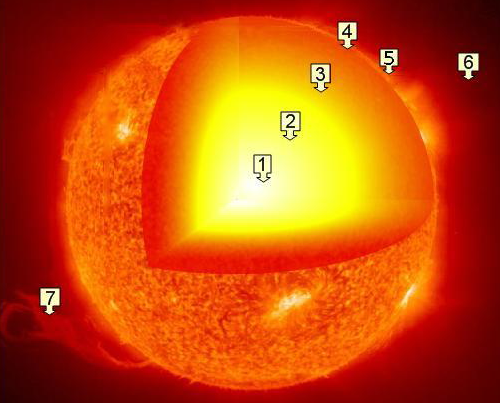
#1?
sun’s core- hottest part
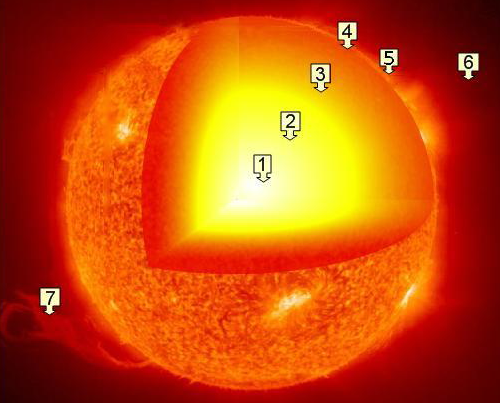
#2?
radiative zone
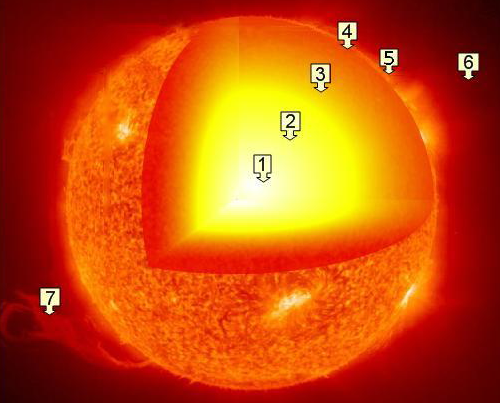
#3?
convective zone
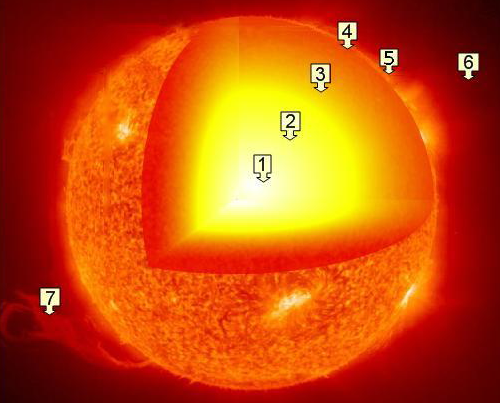
#4?
photosphere- visible layer of th esun
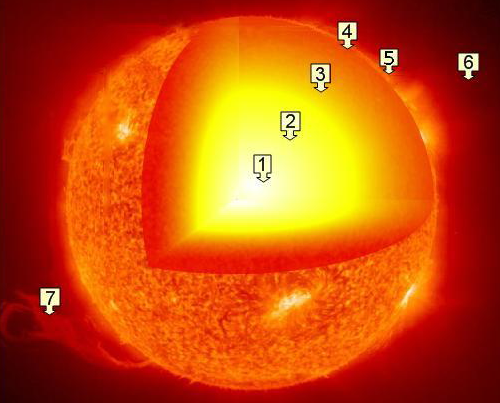
#5
chromosphere- red layer seen during eclipse
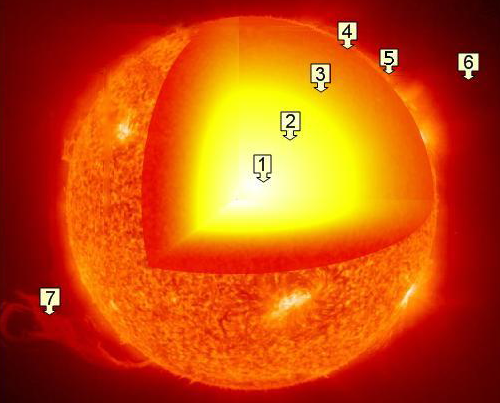
#6
corona- outer atmosphere of th esun
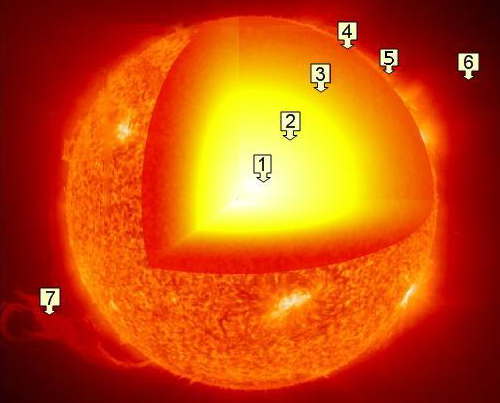
#7
solar flare
Kuiper Belt
donut shaped disc of dwarf planets, short-period comets, asteroids
past Neptune
Oort Cloud
thick, 3D shpere of icy objects, 2000 AU from the sun
Mar’s moons
Phobos
Deimos
Jupiter’s 4 largest moons:
Ganymede
callisto
Io
Europa
Saturn’s largest moons
Titan
EnceladusU
Uranus’ 5 largest moons
Miranda
Ariel
Umbriel
Titania
Oberon
Neptune’s largest moon
Triton