Eve 100 Final
 Call Kai
 Learn
Learn Practice Test
 Spaced Repetition
 Match
Match Flashcards
 Knowt Play
1/80

Earn XP
Name | Mastery | Learn | Test | Matching | Spaced | Call with Kai | Chat |
|---|
No analytics yet
Send a link to your students to track their progress
81 Terms
Gene flow
genetic material transfer in and out of the population
Genetic drift
the change in a population's traits or genes over time due to pure, random chance
Typological species concept
"If it looks like a duck, walks like a duck, and quacks like a duck, it must be a duck."
Pros:
Allows easy classification based on a single specimen
Practical utility in taxonomy and biodiversity surveys
Cons:
Differences are often deceptive
Intraspecific polymorphisms and polyphenisms
Sexual dimorphism
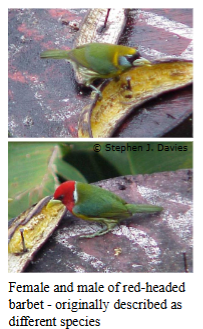
Biological species concept (BSC)
Species are groups of actually or potentially interbreeding natural populations that are reproductively isolated from other such groups
Pros:
Specifies a concrete way in which candidate species must be "distinct"
Can be applied directly to understand the origin of species
Cons:
Requires experimentation to classify organisms
Does not apply to clonally reproducing / asexual organisms
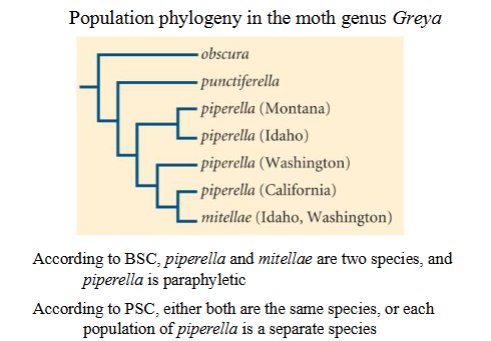
Phylogenetic species concept (PSC)
A species is the smallest monophyletic group of common ancestry
Pros:
Applies equally to all organisms
Allows easy classification
Emphasizes evolutionary history
Cons:
Does not provide an objective criterion of "distinctness”
Is not useful for understanding the origin of species
Depends on the source of phylogenetic information
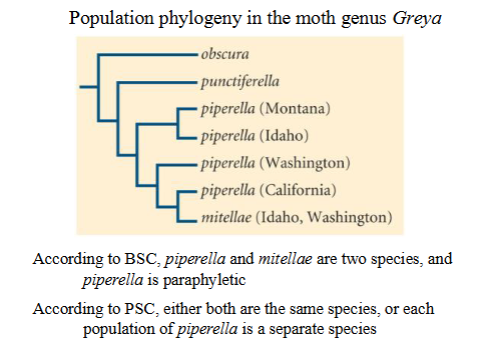
Reciprocal monophyly of species
Occurs when two distinct groups of organisms are each monophyletic with respect to the other.
Pre-mating isolation
(Organisms occur in the same area but don't mate)
Potential mates don't meet:
Different habitats
Different mating seasons
Potential mates meet but don't mate:
Different mating behavior in animals
Different pollinators in plants
Post-mating, prezygotic
Potential mates try to mate but can't form a zygote
Incompatible genitalia (especially in insects)
Incompatible gametes (especially in sessile marine invertebrates)
Postzygotic isolation
Hybrids are formed but have low fitness
"Intrinsic" mechanisms (self regulation)
Hybrid lethality
Hybrid sterility (physiological or behavioral)
"Extrinsic" mechanisms (external regulation)
Ecological: hybrids don't fit into either ecological niche
Mate recognition: mating behavior not appropriate for either species
Intrinsic vs extrinsic post-zygotic isolation
"Intrinsic" mechanisms
Hybrid lethality
Hybrid sterility (physiological or behavioral)
"Extrinsic" mechanisms
Ecological: hybrids don't fit into either ecological niche
Mate recognition: mating behavior not appropriate for either species
Geography of speciation: allopatric, sympatric, and parapatric
Allopatric: physical separation
Parapatric: in between
Sympatric: no physical barrier but two species evolve from one.
Isolation by distance
Desmognathus ochrophaeus in the Appalachians: Reproductive isolation correlates with geographic distance and genetic differentiation
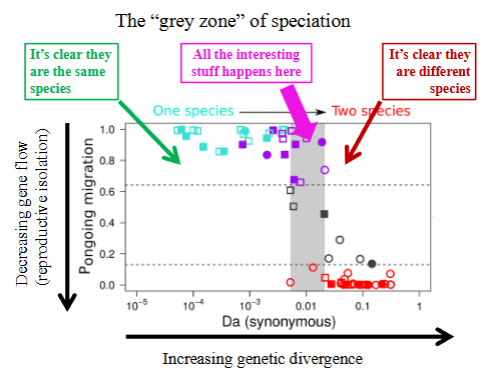
Why, by the time we can confidently diagnose two populations as different species, is it usually too late to study the process of speciation?
Grey zone of speciation
Why does the study of speciation emphasize the origin of reproductive isolation?
Speciation consists of evolution of biological barriers to gene flow
What can we say about the roles of natural selection, genetic drift, and gene flow in speciation?
Any of these mechanisms can produce reproductive isolation => reduce gene flow between populations => promote speciation and increasingly independent evolution of diverging species
What are the different geographic scenarios of speciation, and how to they affect the relative importance of selection and drift?
Speciation is caused by genetic differentiation between populations. Due to coalescence, allopatric speciation can in principle occur through genetic drift alone, without selection. Sympatric speciation is impossible without selection
How allopatric speciation occurs
Speciation begins when a single species becomes geographically separated into two populations => no gene flow
When two populations cannot exchange genes, they gradually accumulate genetic and phenotypic differences that may result in RI
This does not require selection – in principle, genetic drift alone can cause genetic divergence, potentially leading to RI
Eventually the two populations diverge enough that they do not interbreed even if do come into contact - they are now separate species
How sympatric speciation occurs
Gene flow causes populations to converge in allele frequencies
This makes sympatric speciation difficult – very strong selection is required to overcome gene flow
How do the different geographic scenarios of speciation affect the relative probability of evolving pre-mating vs post-zygotic reproductive isolation?
Pre-mating: in the same area but don’t mate → sympatric
Post-zygotic: different areas make them unable to recognize each other → allopatric
Post-zygotic: same area & mate → sympatric
Why is sympatric speciation more difficult, and therefore less common, than allopatric speciation?
Gene flow is possible much longer
How can reproductive isolation evolve as a result of natural selection, even if there is no selection FOR reproductive isolation?
Could be due to genetic drift, bottlenecks, coloring in the environment (sticklebacks), etc. and this can arise accidentally due to a byproduct.
Why and how can reproductive isolation arise as an accidental side effect of other evolutionary changes?
Reproductive isolation often evolves as an accidental by-product of natural selection through ecological speciation and genetic incompatibilities. As populations adapt to different local environments or independently accumulate mutations, changes in traits like body size or courtship rituals indirectly prevent successful interbreeding
What are Dobzhansky-Muller incompatibilities? How, why, and under what circumstances can DM incompatibilities evolve?
Reproductive isolation and speciation are caused by accumulation of genetic differences between independently evolving populations
At any given time, selection tests the fitness of a complete genotype – not any single locus => the fitness effect of each allele depends on how well it works with all the other genes in that genotype
Why does post-zygotic reproductive isolation involve interactions between multiple loci? How does that affect the rate at which DM incompatibilities evolve?
Alleles at different loci that occur in the same population are "co-adapted", since each genotype is tested by selection
Hybrid genotypes have never been tested by selection, and may be unfit (e. g. cause hybrid lethality or sterility)
DM incompatibilities between incipient species accumulate as a function of time… … at a fast and accelerating rate (“snowball effect”)
Incompatibilities are caused by (at least) pairwise gene interactions => they arise at least as fast as the square of genetic divergence (time)
What are ring species?
A chain of interbreeding populations that wraps around a geographic barrier until the end populations meet on the other side and have diverged so significantly they cannot interbreed anymore
What makes ring species so informative for the study of speciation and the interface between micro- and macroevolution?
Allow us to reconstruct the history of speciation by converting time into space
All the intermediate steps, normally missing, can be directly observed
Demonstrate that the origin of new species is caused by gradual accumulation of genetic and phenotypic differences within species
Show that differences between species and differences within species are qualitatively similar - only different in degree
What happens to phenotypic correlation if an evolutionary trait gene and a marker gene are completely linked?
The trait will correlate perfectly with the genotype at that marker gene because they are always inherited together without being separated.
How do we use linkage mapping to identify an unknown gene responsible for an evolutionary trait?
By tracking its genetic linkage to a known marker gene. Because we already know where the marker genes are located on the genome, seeing which marker the trait sticks with allows us to infer the location of the causative gene.
Does linkage between a trait gene and a marker gene need to be complete to map it? Why or why not?
No. Linkage can be partial. Meiosis makes both recombinants (shuffled) and nonrecombinants (unshuffled). Partial linkage to multiple markers still gives enough statistical data to calculate exactly where the causative gene sits relative to them.
What two specific factors increase the precision of our linkage mapping?
More markers (provides a denser grid of known reference points).
More recombinant progeny (provides more crossover events to narrow down the physical boundaries of the gene).
What are Quantitative Trait Loci (QTLs), and how are they related to “genes” as we normally think about them?
a specific region of DNA that correlates with a measurable, continuously varying physical or biological trait (like height, weight, or blood pressure). Instead of a single gene controlling a trait, multiple QTLs work collectively, often alongside environmental factors, to shape the final phenotype.
What is a Genome-Wide Association Study?
A Genome-Wide Association Study (GWAS) is an observational approach that scans the complete genomes of large, diverse populations to identify statistical associations between millions of genetic variants (usually single nucleotide polymorphisms, or SNPs) and specific observable traits or diseases
Differences between GWAS and QTLs
Differences:
Population Type: Traditional QTL mapping relies on experimental, bi-parental crosses. GWAS relies on unrelated individuals from natural or diverse populations.
Historical Recombination: QTL mapping measures genetic linkage in recent, controlled pedigrees. GWAS leverages Linkage Disequilibrium (LD)—the non-random association of alleles that have accumulated across generations of historical recombination in a population.
Resolution: QTL mapping maps traits to large chromosomal intervals (often megabases), whereas GWAS can map traits down to highly specific loci or even individual genes.
How do fossils form
Fossilization requires a series of unlikely external events:
Rapid and complete burial after death, anoxic environment
And then the sediment must remain stable (much more likely in marine than in terrestrial habitats)
Why do we have so (relatively) few fossils?
Primarily hard body parts fossilize (bones, teeth, shells, woody tissues)
Small and/or soft-bodied organisms are unlikely to fossilize
2/3 of animal phyla lack any mineralized body parts
Sediment beds can be buried or destroyed by geological processes
=> Old rocks are much rarer that young rocks
Why is the fossil record not only incomplete, but very strongly biased? And what are the major ecological, geographic, taxonomic, and temporal biases that we see in the fossil record?
Geographic and ecological biases:
Organisms that live in shallow estuaries are much more likely to yield fossils than terrestrial or deep-sea organisms
(Faster deposition, higher stability, less erosion)
Species with larger population sizes are more likely to leave a fossil record (since it’s a rare, chance event)
Taxonomic biases:
Differences in the fossilization potential
Temporal biases:
Older fossils are rarer than younger ones
Sediments form at different rates - depend on the climate of that era
There are many discontinuities in sediments!
What methods can we use for the absolute and relative dating of rocks and fossils?
Relative dating from stratigraphic analysis
(e. g., younger sediment layers lie above older sediments)
Absolute dating: radiometric dating (+ molecular clocks)
any elements occur in multiple isotopes that differ by the number of neutrons (e. g., 12C and 14C)
How can we measure the ages of rocks and fossils using radiometric dating?
Many elements occur in multiple isotopes that differ by the number of neutrons (e. g., 12C and 14C).
Radioactive isotopes are unstable and decay into stable daughter isotopes (e. g. 14C ==> 14N) at a very constant rate described by the isotope's half-life (how long it takes for 50% of the isotope to decay)
Why, in estimating the ages of fossils, do we often have to date rocks instead of dating these fossils directly?
Beyond the limits of carbon dating, the fossils themselves and the sediment in which they are buried are difficult to date reliably
1. Younger minerals can diffuse into the fossils and surrounding sediment
2. Fossils can be eroded out of old sediments, and re-buried in younger sediments
What are some of the isotopes that can be used for radiometric dating, and at what time scales are they useful?
0 half lives
1 half life: 50% of parent isotopes remain
2 half lives: 25% of parent isotopes remain
3 half lives: 12.5% of parent isotopes remain
How can we combine radiometric dating with stratigraphic analysis?
It is safer to "bracket" the age of sediment layers by dating igneous layers above and below
How can we combine fossil evidence with molecular phylogenies to reconstruct the evolutionary history of major groups of modern organisms, and especially the order in which their characters evolved?
Molecular phylogenetic analysis allows us to
1. Reconstruct evolutionary relationships among living taxa
2. "Reconstruct" extinct common ancestors of the living taxa
The fossil record is necessary to
1. Date the divergence between taxa (nodes in the tree)
2. "Directly" observe the evolution of modern taxa through a series of intermediate forms
3. Determine the ecological context in which these organisms existed
How do we apply phylogenetic analysis to the fossil record? Specifically – what are crown and stem groups?
The crown group includes all descendants of the latest common ancestor of all extant taxa (some of these descendants can be extinct)
Stem groups are lineages that branch below the crown group (they are, by definition, all extinct)
Why are most fossil organisms NOT the ancestors of any modern taxa?
Each consecutive ancestor is a branching point in the phylogeny
An ancestor gives rise both to a lineage leading to modern descendants, and to a stem group
Most fossils represent stem groups, not ancestors of any modern taxa
Why are these intermediate forms not nearly as useless as they might seem at first glance?
Co-option (exaptation) allows highly complex organisms to evolve through a series of well-adapted intermediates
Examples:
What good is a half-formed feather?
No good for flight, but good enough for insulation or display
What good is a half-formed leg?
No good for walking, but good enough for crawling in shallow water and raising the head out of the water to breathe air
What good is a half-formed rib cage?
No good for breathing out of the water, but good enough for lung breathing while submerged in water
What good is a half-formed lung?
Not enough on its own, but useful to supplement existing gills in low- oxygen water
What is an “exaptation”
A trait that evolves to perform one function, but is later co-opted to perform a different function
How and why does exaptation solve that problem of intermediate forms, and allow complex traits to evolve through a series of well-adapted intermediates?
Co-option (exaptation) allows highly complex and well-adapted organisms to evolve through a series of equally well adapted intermediates
Are dinosaurs stem-group birds, or are birds crown-group dinosaurs?
Dinosaurs are stem-group birds (= birds are crown-group dinosaurs)
Many adaptations that are essential for powered flight pre-date the origin of flight: feathers, hollow bones, expanded breastbone
How can we measure the rate of speciation? And how does this rate vary over time and across evolutionary lineages?
Can be measured from calibrated fossil record or sequence divergence
Fossil record shows occasional rapid bursts of species diversification that are preceded and followed by slower speciation rates.
These diversification rates correspond to typical speciation rates (BSI) observed in many recent clades (1-2 Myr)
Why does the rate of phenotypic change often seem slower on longer time scales?
Organisms can change very rapidly as they respond to rapid changes in their environment (changing selective pressures)
But over longer periods of time, environmental fluctuations are smoothed over => and so is phenotypic change
Do organismal traits evolve at a steady rate, or in rapid spurts separated by periods of relative stasis?
A few different theories, hard to tell due to incomplete fossil record
Phyletic gradualism: evolution occurred at a slow constant and consistent space over long periods
Punctuated equilibrium: evolution is characterized by periods of little to no morphological changes, which are suddenly interrupted by rapid brief bursts of significant evolutionary change.
Punctuated gradualism is a hybrid of both theories.
Is phenotypic evolution linked to the origin of new species, or can you have rapid phenotypic evolution without the origin of new species?
Both are possible.
Artificial selection of dog breeds
Reproductive isolation leading to different species.
Are periods of unusually rapid diversification seen in the fossil record as exceptional as they seem, or is it all business as usual?
Hard to tell due to incomplete record, it is complicated
Why and how does the incompleteness of the fossil record complicate the estimate of evolutionary rates, and (especially) the extent of variation in these rates?
The rate of speciation varies over time and across lineages
Even the most rapid bursts of speciation observed in the fossil record are well within the typical range of BSI and TFS seen in extant clades
The rate of phenotypic evolution varies over time and across lineages
Rapid short-term phenotypic change due to rapid environmental change is smoothed over time
Phenotypic evolution can be either steady or punctuated
Even the most rapid phenotypic changes are still gradual, but such rapid changes do not leave a sufficiently dense fossil record to follow them
Rapid phenotypic change does not necessarily require speciation
Measuring the rates of evolution is complicated by incomplete fossil record, migration, changes in population size, etc.
Nondegenerate
every possible mutation at this position results in a change to the amino acid. Therefore, all substitutions are nonsynonymous
Two fold degenerate
Two of the four possible nucleotides at this position specify the same amino acid. Mutations result in a synonymous change 1/3 of the time.
Four fold degenerate
All four nucleotides at this position specify the same amino acid. Any mutation at this site is always synonymous
Pseudogenes
Pseudogenes lack regulatory sequences => not transcribed => cannot perform any function in the organism
Non coding regions?
Transposable elements (transposons)
“Jumping genes” that complicate the genome
Lineage-specific genes
Genes that are common/unique to a group of organisms such as plants
Horizontal (=lateral) gene transfer (HGT / LGT)
the movement of genetic material between organisms in a manner other than traditional reproduction, such as from parent to offspring
What factors explain variation in the rates of evolution between different genes?
Pseudogenes
Regulation of gene expression
What factors explain variation in the rates of evolution between different nucleotide positions within a single gene?
Genetic code redundancy
Different types of mutations
How can we test whether a gene is evolving neutrally, or under selection?
Positive selection on a beneficial mutation leads to depletion of neutral variation in flanking genomic regions (selective sweep)
How can we distinguish among different modes of selection (directional, balancing, purifying, etc.) that could be acting on a gene?
# of synonymous / replacement changes showing accelerated FoxP2 evolution in human lineage
How do different modes of selection affect the rate of coalescence and the amount of neutral nucleotide variation in gene sequences?
Positive selection accelerates coalescence and reduces variation compared to the neutral expectation ("selective sweep")
Balancing selection reduces the rate of coalescence, and increases the amount of variation compared to the neutral expectation
What is a “selective sweep”, why do selective sweeps occur, and how can we detect them?
an evolutionary process in genetics where a new, highly beneficial mutation quickly spreads through a population and becomes fixed due to strong natural selection
can be detected in surveys of population-genetic variation within species
How can we use the distinction between synonymous and non-synonymous substitutions to test for selection on protein sequences?
If a sequence is evolving neutrally, the rate of evolution should be constant with time (it just depends on the mutation rate)
Then, the ratio of non-synonymous and synonymous substitutions (dN/dS) ratio should be the same within and between species
What is dN/dS ratio?
The dN/dS ratio measures the pressure of natural selection on protein-coding genes by comparing the rate of amino acid-altering mutations to silent mutations.
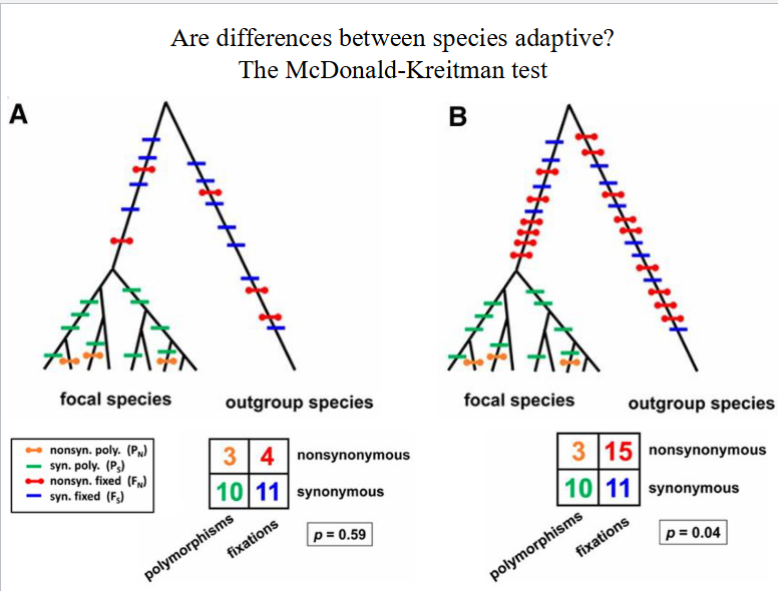
How does the Macdonald-Kreitman test work?
The McDonald-Kreitman (MK) test is a statistical tool used to detect historical natural selection by comparing the ratio of these mutations within a species to those between species
In this example, scenario A has natural selection because the ratios are even (4/11 vs 3/10) while scenario B has the fixations ratio larger than the polymorphism ratio (3/10 vs 15/11)
How is regulatory evolution correlated with coding sequence evolution?
All species have the same genes: bab, AbdB, and dsxF But the regulatory relationships among these genes are different in different species. In the ancestral condition, bab expression is independent of AbdB and dsx
Positively correlated?
Similar functional constraints on protein sequence and gene regulation
How can we use phylogenetic analysis to allocate genetic changes (regulatory or coding) to different evolutionary changes?
Reconstruct species phylogeny, including outgroup
Map character states on phylogeny to reconstruct AA sequence or gene expression level in the MRCA of the two species
Estimate divergence between MRCA and each extant species
Why are the genomes of some organisms so much more compact (have higher gene density) than others?
Genome compaction (or gene density) is primarily driven by evolutionary pressures to replicate quickly and conserve cellular resources. While the amount of DNA an organism carries often reflects neutral evolutionary drift and the accumulation of non-coding "junk DNA," tight compaction is heavily favored under specific biological constraints.
Why do we see so little correlation between genome size and organismal complexity?
This lack of correlation, famously known as the C-value paradox, exists because genome size is largely determined by "junk DNA" and self-replicating sequences rather than functional, protein-coding genes
How and why does the size and protein-coding density of the genome depend on the organism’s effective population size?
The cost of any individual TE insertion to the host is low
Effectiveness of natural selection depends on host population size
Larger organisms => smaller population sizes => less effective selection
On average, organisms with smaller population sizes have more TEs (And vertebrates have very small population sizes compared to bacteria)
What processes explain the differences in genome content (sets of genes) between species and larger clades?
Different species have different sets of genes ("genome content")
Genome content diverges over time: the longer the divergence, the fewer genes the two species will share
Even closely related species have non-identical genome content
This implies that new genes arise from time to time, while some of the old ones are lost
How can new genes evolve from pre-existing genes? Which mechanisms are most common?
Most originate from pre-existing genes
Gene duplication followed by divergence
Exon shuffling
Insertion/recruitment of transposable elements
Retrotransposition
Gene fission or fusion
Horizontal gene transfer
Some originate from non-coding DNA sequences (“de novo genes”)
How can new (de novo) genes evolve from previously non-coding sequences?
Duplication and divergence, leading to subfunctionalization, neurofunctionalization, and gene loss.
Are newly evolved genes essential for organismal function and survival?
Yes they become essential very quickly.
How can we identify instances of horizontal gene transfer? (And how can we be misled)
On microevolutionary time scales, LGT is extremely unlikely
However, whole-genome sequencing has shown that it is common among prokaryotes on macroevolutionary time scales
LGT also occurs among eukaryotes, and between prokaryotes and eukaryotes
Although LGT does not create new genes, it introduces new genes into the genomes of organisms that would not otherwise have them
Is it HGT/LGT or loss of ancestral genes? LGT is only a hypothesis and we need very good taxon sampling to test it.
How common is HGT? What types of genes are most likely to be affected by HGT?
Most frequently: energy metabolism/substrate utilization, "virulence", antibiotic resistance (!)
Least frequently: DNA replication, transcription, and translation
Horizontal (lateral) gene transfer affects primarily the genes that confer unique environmental adaptations, and for which selection is very strong
(this is a major problem in medicine…)