Immunology- B & T cells
 Call Kai
 Learn
Learn Practice Test
 Spaced Repetition
 Match
Match Flashcards
 Knowt Play
1/30

There's no tags or description
Looks like no tags are added yet.
Name | Mastery | Learn | Test | Matching | Spaced | Call with Kai | Chat |
|---|
No analytics yet
Send a link to your students to track their progress
31 Terms
IgM
Produced first exposure to antigen by SL (short lived)
Circulates in blood/extracellular fluid
During next infection it will be made in lower
Binds to surface of B-cells (immature)
IgG (G1=proteins, G2=polysaccharides, G3=proteins, G4=food allergens)
Produced by memory cells (that will become SL plasma cell)
Produced by LLPC(long term antibody)
For future exposures
In circulation
CAN CROSS THE PLACENTA
Lasts 6months in baby
Low during 1st infection
IgA
Produced by SLPC
Secretory= pharangeal mucosa membranes, Breast milk
1% of antibody in infants (when mom is infected she passes this to baby)
Travels through blood to mucosas
IgE
Binds to basophils/ mast cells to increase specificity for future infections
Can bind to parasites (eosinophils recognition of pathogen)
Involved in allergies
IgD
Is not secreted, is on B cell surface
For recognition and activation of cell
Allows Bcell to do antigen presentation (antigen binds on it and then is digested to present on MCH II)
Higher on mature naive Bcells
Types of antigen
Proteins, lipids, sugars, nucleic acid
Proteins antigens defense
B cells— antigen presentation through antigen presenting cells (MCHII) to Thelper cells
Produce IgM and IgG or others antibodies
Memory by Bcells
Non-protein antigens (lipids & sugars) defense
No antigen presentation
The antigen binds to B cell receptor (IgD, maybe IgM) —- cross linking of receptors
Directly activates Bcell and starts differentiation into SLPC
Plasma cells will produce only IgM
NO memory cell formed, when infected again same pathway will happen
First Infection= antigen presentation
Antigen presentation to Th cells
Th cells find & activate B cells
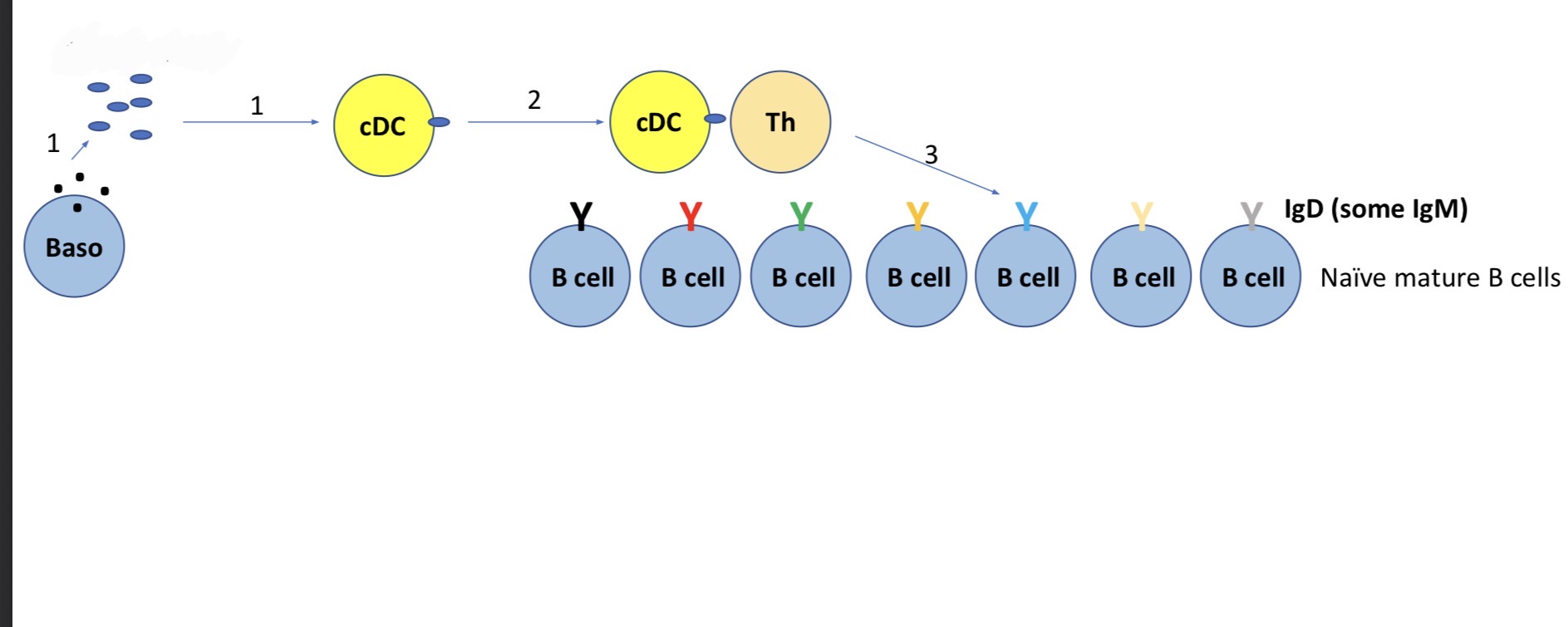
B cell found and activated—-
Divide into memory B cells
SLPC & LLPC
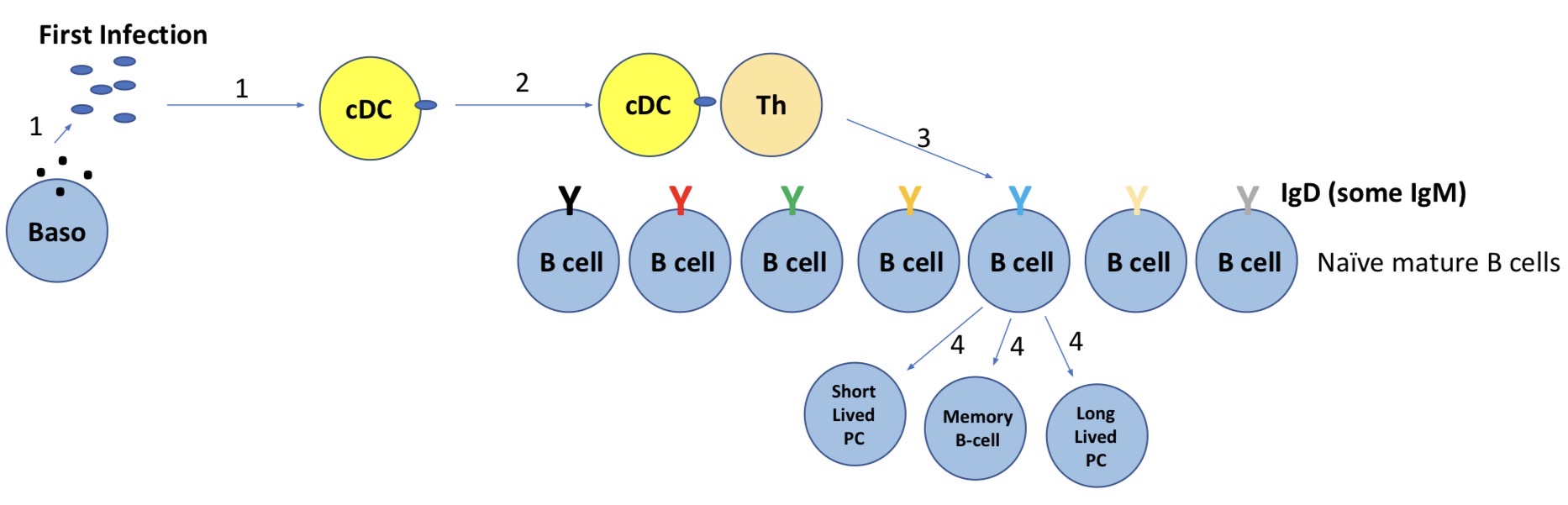
SLPC= produce …
LLPC= produce …
SLPC= produce IgM, IgA (if mucosal), one cell for every Ig
LLPC= produce IgG
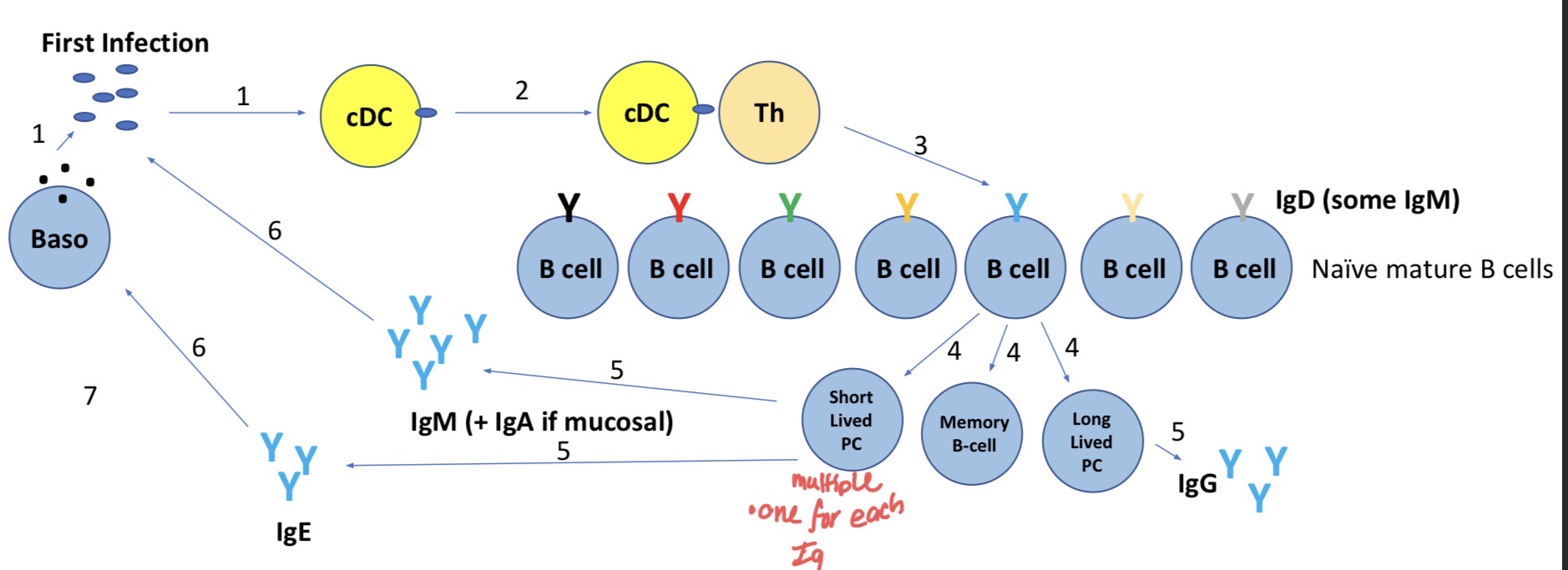
After pathogen is killed, LLPC…
LLPC make IgG
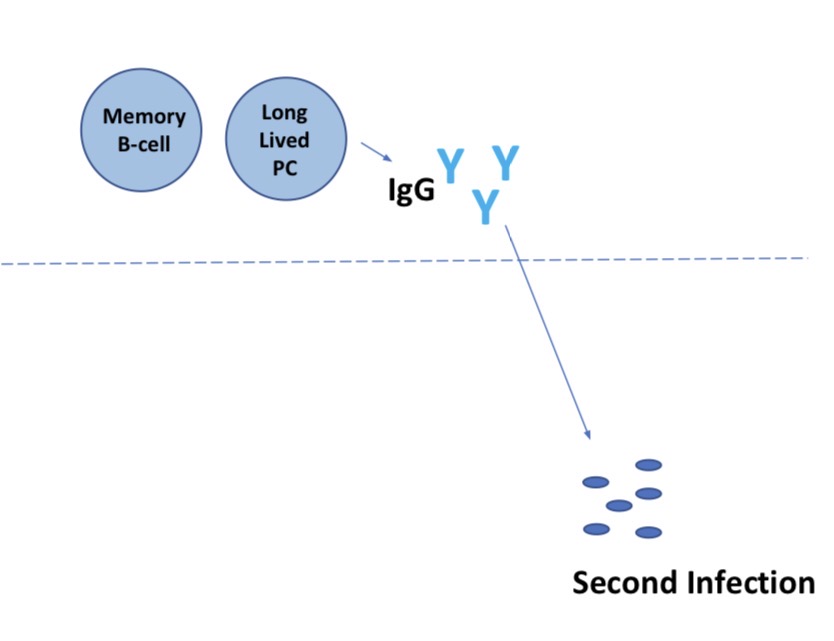
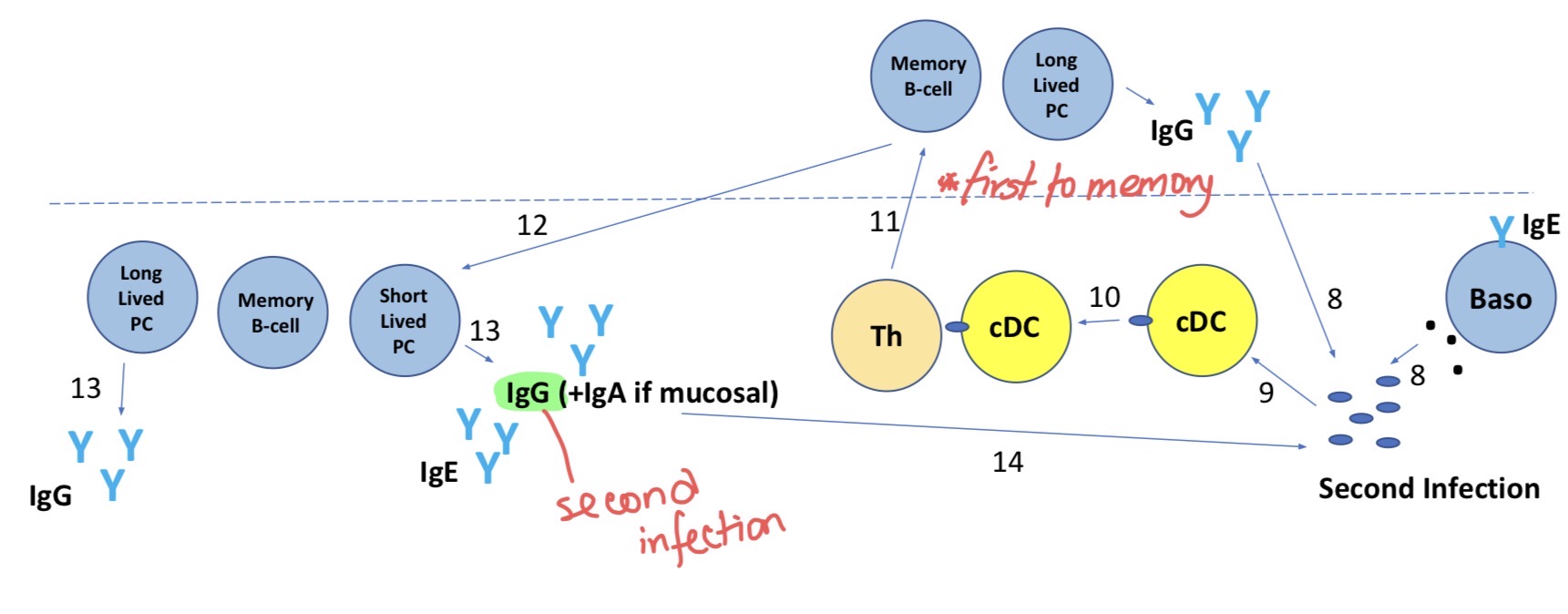
Second infection:
IgG (from LLPC) in blood attack pathogen, basophils enchanted with IgE attack pathogen
Bcell will be activated IgG (by SLPC)
Food sensitivity
Food sensitivity/intolerance= IgG/IgA response
Delayed response
Ex. Gluten
Food allergies
IgE
Immediate response
Ex: peanuts, shellfish, eggs
Basophils with IgE in surface
Antibody class switching
After B-cell activation (during division)
Induced by cytokines by Th cell
Monoclonal antibodies
Can be injected into a person
Ex. Gamma globulin therapy
Gamma globulin therapy
Treatment that involves the injection of antibodies to a specific antigen (typically IgG) 3 to 6 months
Ex. Rh factor (blood), Respiratory syncytial virus, measles
Rh factor problem in pregnancy
When mom (-) and dad (+) there’s a chance that baby has a different Rh factor than mom and during birth any blood contact between mom & baby will activate mom immune response, making antibodies for it (Bcells) could present problems in a future pregnancy
When Rh factor is administered to moms
Last trimester and after birth, when contact happens the antibodies will act on the protein before moms complement cascade is activated and antigen presentation happens
Rh factor
A protein on red blood cells, activates antigen presentation
Blood types
A, B, AB, O
Involves antigens in RBC but are carbs and don’t create memory that’s why you can receive blood from others
The body will produce antibodies for the opposite antigen
Blood types- antibodies
A- ANTIBODIES for B
B- antibodies for A
AB- no antibodies
O- antibodies for A & B
Tc (CD3, CD8)
Divide into Effector cell= specific recognition of antigens on the surface of infected cells (has T-cell receptor), kills infected/ foreign/ cancerous cells, releasing perforin & granzymes
Memory T cell= requires re-stimulation to divide
5years (half life)
Th0 (CD3, CD4)
T helper resting cells (naive)
Control/activate immune response
Receive antigen by presentation from CDC, macrophages, basophils or B-cells
Involves MHC II, and CD8 (APC) and TCR & CD28 (Th)
Once activated differentiates
Th1
Intracellular infections (virus)
Activates Tcytotoxic, NK
Th2
Extracellular parasites (fungi, protozoa, worms)
Activates eosinophils, B cells
Th17
Mucosal infections
Th22
Skin infections
Th22
Skin infections
T-cell cancer therapy (CAR-T cell chimeric antigen receptor)
-obtain blood from cancer patient identify antigen
-Tc cells engineered to have a T-cell receptor that can identify cancer antigen
-T cells are reintroduced in patient where the modified Tcells can attack the cancer