Sport Performance training and conditioning
 Call Kai
 Learn
Learn Practice Test
 Spaced Repetition
 Match
Match Flashcards
 Knowt Play
1/22

There's no tags or description
Looks like no tags are added yet.
Name | Mastery | Learn | Test | Matching | Spaced | Call with Kai | Chat |
|---|
No analytics yet
Send a link to your students to track their progress
23 Terms
Sport classifications and examples of each
Sprint (alactic): 100 M dash
Intermittent Sprint (glycolytic): ice hockey
Transition (glycolytic + aerobic): football
Continuous (aerobic): distance running
What classification is your profile sport?
Ice hockey: intermittent sprint, high frequency collision
What physical attribute is tested via a 300 yd shuttle run?
anaerobic endurance
Which of the following field tests used to test physical qualities of sport performance is a valid method of testing speed?
A) Pro agility
B) illinois agility
C) 3 cone agility
D) 40-yard dash
D) 40- yard dash
What is test validity?
how does it relate to this method of testing speed?
How could it be altered to make it more relevant to ice hockey training program plan?
-test validity: how well the test actually measures what it’s supposed to
-It does well at measuring straight line speed for sports that need it, but not change of direction sports
-perform on ice, shorter distance, add change of direction
Levels of performance pyramid and what they mean
-Competency (bottom): fundamental movements/being able to move
-capacity (middle) strength/power
Specialization(top): sport specific skills
Basketball would be classified as what kind of sport?
What elements lead to it being classified as this?
-intermittent sprint sport
-short sprints/accelerations
-change of direction
-high effort followed by low effort
Sports classification, contact/impact demands, energy systems mix
*ice hockey
basketball
volleyball
soccer
100 m freestyle swim
fastpitch softball
football
baseball
distance running
wrestling
Ice hockey: intermittent sprint, high contact, glycolytic
basketball: intermittent sprint: moderate contact, glycolytic/aerobic
volleyball: intermittent sprint, high impact (floor), alactic
soccer: intermitte
Definition of athleticism
the ability to move at optimal speed with precision, style, and grace
Wolff’s Law & Specificity of Training Principle (SAID)
Overload Principle
5 features of elite athleticism
-ability to absorb force
-hinge
-strong overhead
-strong on one leg
-balance strength
-mobility & stability
Gambettas description of functional training
it is integrated, proprioceptively enriched, multi-directional movement
Functional training continuum
progression of exercises from simple → complex, sport specific
isolation: one muscle or joint
integrated: combines multiple muscles/joints
functional: real-life sport movements
sport specific: closely matches athletes actual sport skills
concept of training movements, not training muscles principle
a part of the FMS
-train how the body moves, not isolated muscles
What’s a needs analysis? what’s included in it & how it applies to program design
process of determining what athlete needs to improve to better performance in sport
-includes: sport demand, athlete position, injury history/risk, current fitness level, goals
-needs analysis helps determine exercises, intensity, volume, energy system work
Bayli’s model for LTAD & stages (age,stage,focus/objective)
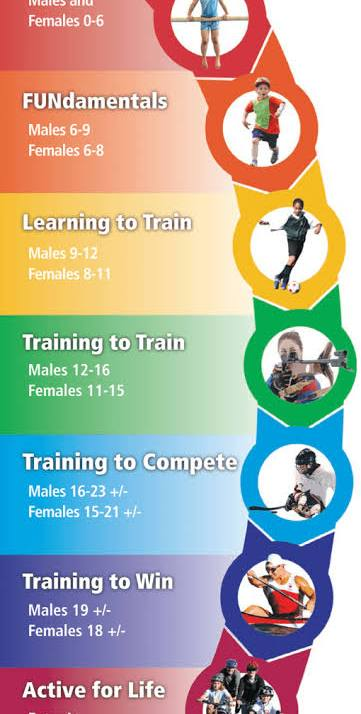
Crossover sports
-Basketball → Volleyball — jumping, agility, quick reactions
Soccer → Lacrosse — endurance, agility, running
Football → Rugby — speed, power, tackling/contact skills
Wrestling → Judo — balance, body control, grappling
Why knowledge of LTAD is essential, and how it impacts needs analysis and program design across many levels?
By knowing what age athlete is, you know what to focus on for their specific age
-ex: you won’t make a competitive workout plan for an 8 year old male
Performance pyramid variations (optimal, overpowered, underpowered, under-skilled)
What it means for training and focus for each
Optimal: Balanced → train everything
🔴 Overpowered: Strong/fast but doesn't move well → Movement
🔵 Underpowered: Moves well but lacks physical ability → Capacity
🟡 Under-skilled: Physically capable but lacks sport skill → Skill
Reasons for tests & types of tests (lab vs field, criteria vs comparison)
-identify strengths/weakness
-set baseline
-track progress
lab test ex: vo2 max
field test ex: 40 yd dash
Factors & consideration in test selection & administration
sport demand
what information you need
Know these capacity tests & tested physical demand
40 yd dash: speed
10 yd dash: quick acceleration
flying 30 dash:quick acceleration
5-0-5 dash: agility/coordination
5-10-5 dash:agility/coordination
L drill: agility/coordination
Vertical jump: lower body power
Beep test: aerobic capacity
shuttle runs: anaerobic capacity
1 min push-up test: upper body muscle endurance
1 min sit-up test: core muscle endurance
sit and reach: mobility/stability
illinois agility: agility/coordination
arrowhead agility: agility/coordination
reactive agility: agility/coordination
Medicine ball throw: upper body power
Broad jump:lower body power