chapter 12 connect with antimicrobial agents
 Call Kai
 Learn
Learn Practice Test
 Spaced Repetition
 Match
Match Flashcards
 Knowt Play
1/86

There's no tags or description
Looks like no tags are added yet.
Name | Mastery | Learn | Test | Matching | Spaced | Call with Kai | Chat |
|---|
No analytics yet
Send a link to your students to track their progress
87 Terms
when were antibiotics introduced
early to mid 1900s
what are the three factors that should be known before selecting an antimicrobial drug?
The overall health of the patient
The nature of the infecting agent
The sensitivity of the infecting agent
Clinicians often use the strategy of Blank______ to treat infections, where a combination of the patient's symptoms, local epidemiology, and preliminary observations provide a good clue to the basis of the infection, even if the identity of the infectious agent is not known
informed best guess
Determining which antimicrobial agent is most effective against an infective microbe is essential when the infection is caused by bacteria that show resistance. Which of the following organisms commonly show antibiotic resistance?
Streptococcus pneumoniae
Enterococcus faecalis
Neisseria gonorrhoeae
Staphylococcus species
aerobic gram-negative enteric bacilli
Which two of the following diseases are no longer significant causes of mortality thanks to the availability of antibiotics?
Scarlet fever
Diphtheria
The ____ technique is an agar diffusion test to determine antibiotic susceptibility of a particular bacterial strain.
Kirby-Bauer
The term antimicrobials describes __
any drug that works against microbes, no matter which microbes are targets
A profile of antimicrobial sensitivity based on the results of a Kirby-Bauer test is called a(n)
antibiogram
what is the correct steps in order of testing a microbe for susceptibility to antibiotics with the Kirby method
dilute the antibiotic in a series of tubes
inoculate a series of tubes with a uniform sample of the culture
incubate the tubes, then examine for growth
Which two of the following sources of information may contribute to an "informed best guess" for beginning antimicrobial therapy?
Analysis of patient symptoms
Direct examination of body fluids, sputum, or stool
T/F: The minimum inhibitory concentration is the lowest dilution of a drug where it visibly inhibits growth of a particular microorganism.1
false 1
it is the highest dilution (smallest concentration) of the drug
The ratio of the toxic dose to the effective dose of a drug, used to assess its safety and reliability, is called the
therapeutic index
The concentration range of a drug in the blood, at which it is producing the desired effect without toxicity, is called the
therapeutic window
Why is it important to have a pure culture of the infecting organism for susceptibility testing?
A mixed culture will show variable results as different microbes will have different susceptibilities.
Select the statements that reflect the overall goal of antimicrobial therapy:
inhibition of the pathogen's replication.
disruption of cellular processes used by the pathogen.
disruption of structures exhibited by the pathogen
Which of the following are the categories of major drug side effects?
Toxic damage to tissues
Normal flora disruption
Allergic reactions
T/F: Some drugs interact with sunlight resulting in a skin inflammation called photodermatitis. 2
true 2
Which of the following are primary sites for action of antimicrobial drugs in bacteria?
cell membrane
nucleic acids
ribosomes
cell wall
The formation of benzylpenicilloyl from penicillin may cause
allergic reactions
T/F: A superinfection is an infection occurring during antimicrobial therapy that is caused by an overgrowth of drug-resistant microorganisms.
true
because antibiotics often severely alter the levels of normal biota
T/F: Antimicrobial drug damage is always permanent.
false
because damage may be short term and reversible
Drug-induced side effects that involve the skin can have a directly toxic effect or produce symptoms of a drug …
allergy
The enzyme that cleaves the beta-lactam ring of penicillin and cephalosporin and thus provides antibiotic resistance to bacteria is known as Blank______ or Blank______
penicillinase
beta-lactamase
A major problem for treatment with penicillin is that some patients experience
allergic reactions
An infection occurring during antimicrobial therapy that is caused by an overgrowth of drug-resistant microorganisms is called a(n)
superinfection
Cephalosporins closely resemble which group of antibiotics in terms of structure and function?
penicillins
t/F: Cephalosporins closely resemble which group of antibiotics in terms of structure and function?
true
because differences in structure result in fewer sensitivity problems
A cephalosporin called ceftriaxone is a ____ -generation semisynthetic broad-spectrum drug for treating a variety of infections, while the ____-generation drug ceftobiprole demonstrates activity against methicillin-resistant S. aureus and agaist penicillin-resistant gram-positive and gram-negative bacteria
third
fifth
Which of the following is a bacterial cell wall inhibitor found in over-the-counter antibacterial ointments?
bacitracin
Which cell wall inhibitor is typically used to treat staphylococcal infections that are resistant to penicillin and methicillin?
vancomycin
The group of antibiotics originally isolated in the late 1940s from the mold Acremonium are the
cephalosporins
Antibiotics composed of one or more amino sugars and a 6-carbon ring are called
aminoglycpsides
Cephalosporins are Blank______-spectrum drugs that are Blank______ to most penicillinases
broad and resistant
There are Blank______ generations of cephalosporins, from the earliest form that was isolated and utilized, continuing through subsequent chemical changes that were then licensed for use
5
what are oxazolidinones
A class of antibiotic, synthesized in the lab, that acts on the 50S subunit of the ribosome to inhibit protein synthesis.
where are sulfonamides derived from
they are synthetic drugs
what bacteria is Fluoroquinolones effective against
since they are broad-spectrum they affect both gram-negative and positive bacteria
what is aminoglycpsides composed of
one or more amino acids and a 6-carbon ring
what is the source of polymyxin, an antibiotic that targets cell membranes
Bacillus polymyxa
All of the following types of antibiotics inhibit protein synthesis except:
aminoglycosides
tetracyclines
rifampcin
macroslides
oxazolidnones
rifampcin because it targets DNA/RNA
what part of protein synthesis does oxazolidnones inhibit
initiation
they prohibit the 50s ribosome from binding to 30s, prohibiting the starting amino acid
why are antifungal agents often toxic
because both the fungal and host cells are eukaryotic
which synthetic drug group inhibit folic acid synthesis 5
sulfonamides and trimethoprim 5
what drug was once used for malaria
quinine
what drug is used to treat influenza
amantadine, zanamir (relenza), oseltamivir (tamiflu)
which drug groups affect cell walls of batceria
Cephalosporins
Carbapenems
Penicillins
which 3 ways can help make fungi more resistant to antibiotics
interfering RNA.
spontaneous mutation.
horizontal transfer
what are the 5 ways microbes become resistant to drugs
synthesize new enzymes that inactivate the drug
decrease the permeability or uptake of the drug into the cell
immediately eliminating the drug using a transmembrane pump
decrease the binding sites or affinity for drugs
shut down an affected metabolic pathway or use an alternative one
how can fungi be temporarily resistant to a drug
a small regulatory RNA binds to a gene and silences it, preventing the synthesis of the target of an antifungal drug
how can many bacteria pump drugs out the cell
use of multidrug-resistant (MDR) pumps
what is beta-lactamase responsible for
inactivating penicillins and cephalosporins,
Resistance to which of the following drugs develops when microbes deviate from the usual pathway that leads to the production of folic acid?
trimethoprim and sulfonamides
how does bacteria decrease the drug permeability
its because of mutations that alter the amino acid sequence of an external protein to which the antibiotic binds
All of the following are factors contributing to the development of antibiotic-resistant microbes in hospitals EXCEPT::
a workforce that may not strictly apply universal precautions.
physicians prescribing narrow-spectrum drugs for bacterial infections.
exposure of pathogens to a variety of drugs.
a population of patients with weakened defenses against microbes.
physicians prescribing narrow-spectrum drugs for bacterial infections.
Which two of the following statements regarding multidrug-resistant (MDR) pumps are correct?
MDR pumps are encoded by genes on plasmids or chromosomes.
MDR pumps work by active transport.
what are probiotics
preparations of live microorganisms fed to animals and humans to improve their intestinal biota
An alteration of the 50S ribosomal binding site can lead to ______ resistance in bacteria
erythromycin and clindamycin
Which two factors contribute to the spread of antibiotic resistance genes in the hospital environment?
Not all hospital workers follow infection control guidelines.
Many hospital patients have weakened defenses.
which drugs target the cell wall
penicillin (penicillin G, ampicillin, amoxcillin)
cephalosporins (cefotaxime, ceftobiprole)
carbaoenems (aztreonam)
bacitracin, isoniazid, and vacomycin
which drugs target protein synthesis
aminoglycosides (streptomycin)
tetracyclines
macrolides (erythromycin, azithromycin)
synercid, linezolid
which drugs target folic acid synthesis 2
sulfamethoxazole
trimethoprim 2
which drugs target DNA or RNA synthesis
rifampin
fluoroquinolones
which drugs target cell membranes
polymyxins and daptomycin
T/F: Azidothymidine, or AZT, is a drug used in the treatment of HIV infection that exhibits a high degree of selective toxicity. 6
true 6
what does a low or high therapy index mean and which is better
a high therapy index means that there is a wider margin of safety vs low means there is a small margin of safety
a high therapy index is always best
T/F: Polymyxin drugs are very broad-spectrum antibiotics that exhibit high selective toxicity. 7
false 7
narrow spectrum, mainly against common Gram-negative bacteria. They are active against most members of the Enterobacteriaceae family, including Escherichia coli, Enterobacter spp., Klebsiella spp., Citrobacter spp., Salmonella spp., and Shigella spp
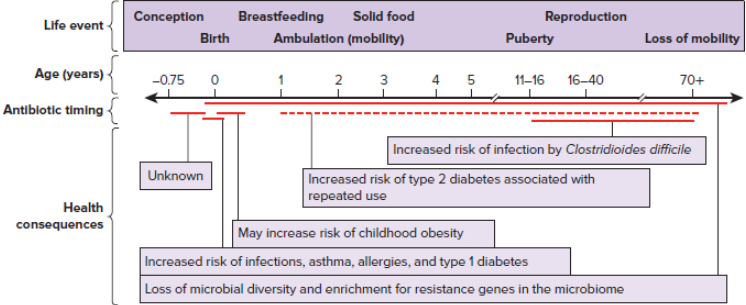
Which of the following statements are true based on the figure below?
Antibiotics taken at any time in life can lead to decreased microbiome diversity and an increase in antibiotic-resistant strains in the microbiome.
Multiple doses of antibiotics throughout life can increase the risk of type 2 diabetes.
A single dose of antibiotics prior to age 1 can increase one's risk of asthma, infections, allergies, and obesity
T/F: Drugs that block quorum-sensing pathways among bacterial cells have unfortunately been ineffective thus far in treating biofilm infections.
false
because Research into these drugs has actually shown great promise in the use of such pathway blocking drugs to prohibit and/or break down biofilm growth
A compound synthesized by bacteria or fungi that destroys or inhibits the growth of other microbes is a/an
antibiotic
what drugs are included in the penicillin group of beta-lactamsthat target the cell wall
penicillians G & V
ampicillin, carbenicillin, amoxicillin
methicillin, nafcillin, cloxacillin
clavulanic acid
what drugs are included in the cephalosporin group of beta-lactams that target the cell wall
cephalothin, cefazolin
cefaclor, cefonicid
cephalexin, cefotaxime
ceftriaxone
cefpriome, cefepime
ceftobiprole
what drugs are included in the carbapenem group of beta-lactams that target the cell wall
doripenem, imipenem
aztreonam
what are other main drugs that target the cell wall
bacitracin
isoniazid
vancomycin (a glycopeptide)
what are drugs in the aminoglycoside group that target protein synthesis (ribosomes)
streptomycin
what are drugs in the tetraglycines and glycylcyclines group that target protein synthesis (ribosomes)
tetracyclines, oxytetracycline (terramycin)
what are drugs in the macroslides group that target protein synthesis (ribosomes)
erythromycin, clarithromycin, azithromycin
what are drugs in the streptogramins group that target protein synthesis (ribosomes)
quinupristin and dalfopristin (synercid)
what are drugs in the oxazolidinones group that target protein synthesis (ribosomes)
linezolid
what are drugs in the pleuromutilins group that target protein synthesis (ribosomes)
altabax
what are drugs in the sulfa group that target folic acid synthesis 3
sulfamethoxazole, trimethoprim
silver sulfadiazine 3
what are drugs in the fluoroquinolones group that target DNA/RNA
(rifampin is included)
nalidixic acid
ciprofloxacin, ofloxacin
what are drugs in the polymyxin group that target cell membranes
polymyxin B & E
daptomycin (a lipopepttide)
what are the 4 classes of antifungal agents
macroslide polyenes
azoles
echinocandins
allylamines
list medications and what the antifungal class of macroslide polyenes does
amphotericin B
binds to fungal membranes, causing loss of selective permability; extremely versatile
can be used to treat skin, mucous membrane lesions caused by the Candida species
injectable form of the drug can be used to treat histoplasmosis and Cryptococcus meningitis
list medications and what the antifungal class of azoles does and what can it treat (yeast infections)
ketoconazole, fluconazole, miconazole, and clotrimazole
interfere with sterol synthesis in fungi
used to treat infections in the skin, mouth, and vagina (yeast infections)
also cutaneous mycoses, vaginal/oral candidiasis, systemic mycoses, AIDS-related mycoses
list medications and what the antifungal class of echinocandins does and what can it treat (inhibit fungal cell wall synthesis)
micafungin, caspofungin
inhibits fungal cell wall synthesis
used against Candida strains and aspergillosis
list medications and what the antifungal class of allylamines does and what can it treat (ringworm)
terbinafine, naftifine
inhibits the enzyme critical for ergosterol synthesis
used to treat ringworm and other cutaneous mycoses