Module 3 Need to Know
 Call Kai
 Learn
Learn Practice Test
 Spaced Repetition
 Match
Match Flashcards
 Knowt Play
1/13

There's no tags or description
Looks like no tags are added yet.
Name | Mastery | Learn | Test | Matching | Spaced | Call with Kai | Chat |
|---|
No analytics yet
Send a link to your students to track their progress
14 Terms
organic chemistry
An organic compound normally contains chains or rings of carbon atoms
Carbon is unusual Bonds strongly to itself (exceptions: Oxides of carbon and carbonates)
Forms long chains and rings
When carbon has four bonds to it, it adopts a tetrahedral geometry
Carbon can bond to fewer than 4 elements by forming one or more multiple bonds
Alkanes
Alkanes - are hydrocarbons that contain single bonds to four other atoms. Alkanes are said to be saturated
Hydrocarbons that form chains or ‘strings’ are regarded as normal (straight-chained) or branched
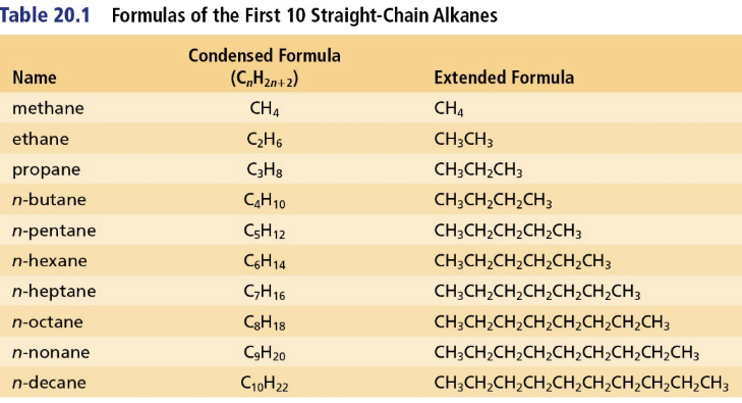
General formula: CnH2n+2 where n = number of C atoms
Normal alkanes can be represented as the following (where m is an integer:) CH3 – (CH2)m—CH3
steps for naming alkanes
Use Greek root as prefix and ‘ane’ as the suffix. The following Greek roots apply to alkanes following n = 4 (butane):
For a branched hydrocarbon, the longest continual chain gives the root name for the hydrocarbon. Replacing a hydrogen atom on a straight-chained alkane with another group gives rise to substituents The substituent is named by using the parent alkane and replacing ‘ane’ with ‘yl’
To specify the positions of the substituent groups, start at the end closest to the branching
When a given type of substituent occursmore than once, we indicate this by using a prefix. The prefix di- indicates two identical substituents, tri- for three, tetra- for four, etc.
names of straight chain alkanes
alkenes and alkynes
Double- and triple-bonded hydrocarbons
Alkenes: hydrocarbons that possess a carbon-carbon double bond
Formula: CnH2n
Suffix ‘-ene’
Alkynes: hydrocarbons that possess a carbon-carbon triple bond
Formula: CnH2n-2
Suffix ‘-yne’
alkenes and alkynes naming rules
The longest continuous chain of carbon atoms that contains the double/triple bond is selected
Root name of the carbon chain ends in ‘–ene’ or ‘-yne’
With more than 3 carbons, double/triple bond is indicated by the lowest-numbered carbon atom in the bond
Substituents on the parent chain are treated the same way as in naming alkanes
Benzene as a substituent
called a phenyl substituent
ortho- (1,2) for 2 ajacent substiuents
meta- (1,3) for 2 substiuents with 1 carbon between them
para- (1,4) for 2 substiuents oppposite each other
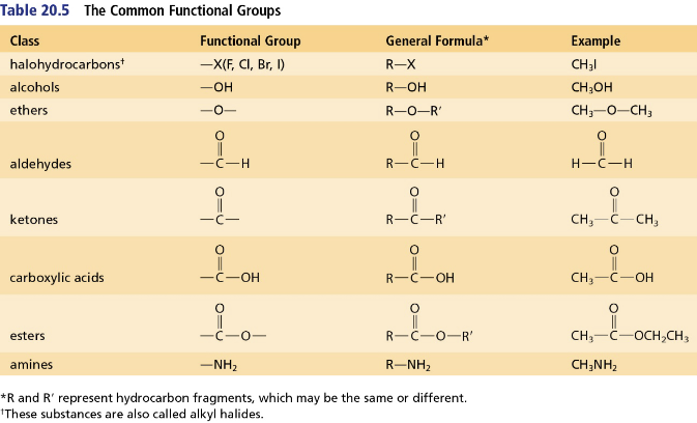
Functional Groups
Alcohols
Alcohols are functional groups with a hydroxyl group (–OH) attached to a carbon atom via a single bond.
Alcohol classification
Primary = 1 R group
Secondary = 2 R groups
Tertiary = 3 R groups
Ketones
contain a C=O (carbonyl) group, 2 carbon-based groups
Aldehydes
contain a C=O (carbonyl) group, 1 hydrogen atom and 1 carbon based group
Carboxylic acids
Compounds that contain a carboxyl functional group (–COOH or –CO2H)
Esters
formed from the reversible condensation (loss of water) of a carboxylic acid and an alcohol molecule.