Scrotal infection and fluid collection
 Call Kai
 Learn
Learn Practice Test
 Spaced Repetition
 Match
Match Flashcards
 Knowt Play
1/30

There's no tags or description
Looks like no tags are added yet.
Name | Mastery | Learn | Test | Matching | Spaced | Call with Kai | Chat |
|---|
No analytics yet
Send a link to your students to track their progress
31 Terms
Most common cause of acute scrotal pain in postpubertal men
Acute epididymitis
Epididymitis most commonly results from…
SexuaLly transmitted disease in males 14-35yrs and lower urinary tract infections in men over 35yrs
USA acute epididymitis
Thickening of the tail first, then entire gland
Head measures >17mm
Decreased echogenicity
Heterogeneous
Hydrocele
Hypervascularity
Epididymis enlarges post-vasectomy and may be similar in 2D appearance to acute epididymitis
HYPERVASCULARITY
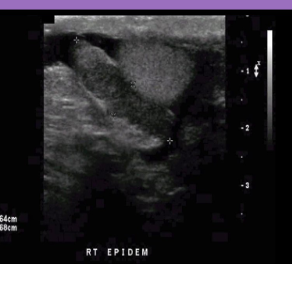
Acute epididymitis
Bacterial Acute orchitis is most commonly caused by
Sexually transmitted disease
Viral Acute orchitis is most commonly caused by
Mumps
Acute orchitis
Same symptoms of acute epididymitis
Prehn sign:
Used to differentiate from Epididymo-orchitis from torsion
Lifting the painful scrotum above the level of the symphysis pubis will relieve pain when infection is the cause for symptoms
No reduction in pain with torsion
Acute orchitis USA
Can be focal or diffuse
Decreased echogenicity
Hypervascularity in the area of infection
Decreased vascularity resistance (= hypervascularity) compared to unaffected side
RI <0.5 in affected testicle
Diastolic flow reversal in some cases of epididymo-orchitis = venous infarction
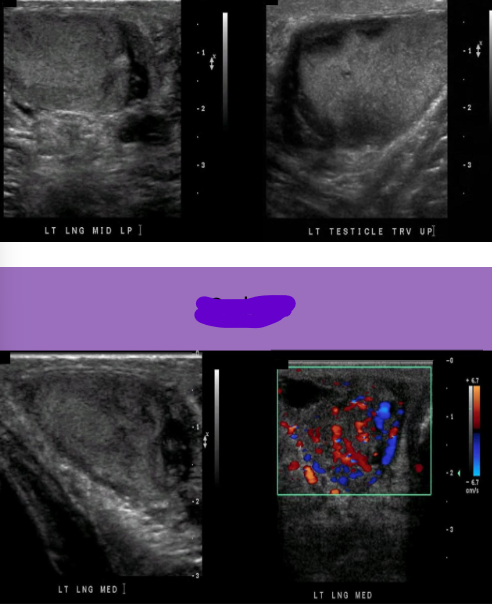
Orchitis
Abscess
Usually a complication of orchitis/epididymitis
Other causes include mumps, smallpox, typhoid and appendicitis
Abscess USA
Mixed echogenicity mass with fluid components
Void of color flow centrally with increased vascularity in peripheral tissues
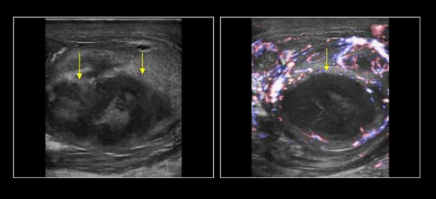
Abscess
Tuberculosis
Heterogeneous epididymis
Nodule formation within the epididymis
Very little vascularity in or around the nodules
Fournier gangrene
Usually seen in diabetic patients
Infections causing acute necrotizing fasciitis of the perineum, scrotum and anterior abdominal wall
Pneumoscrotum - air in the scrotum caused by bacterial infection
CRITICAL
Hydrocele
Accumulation of serous fluid between two layers of the tunica vaginalis
Primary or congenital - usually identified in pediatric patients, caused by persistent communication between scrotal sac and peritoneum; most common
Secondary or acquired - Usually present after 40yrs; caused by trauma, torsion, tumors or inflammation
Most common cause of painless swelling
Hydrocele
USA hydrocele
Anechoic fluid collections
Good through transmission and posterior enhancement
Echogenic fibrin or cholesterol crystals may be seen floating freely
Larger fluid collections may require dual screen, panoramic imaging
A curved linear array may also be used to display a larger section of anatomy
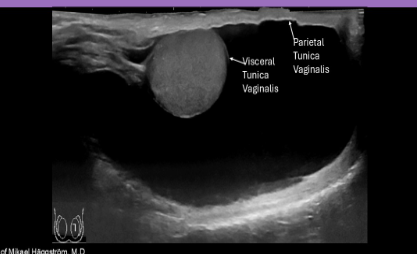
Hydrocele
Hematocele
Blood collection in scrotal sac
Caused by trauma, torsion, surgery, diabetes or neoplasms
Hematocele USA
Contains low level echoes and visible fluid levels
May contain septations
No increase in vascularity surrounding mass helps to differentiate from pyocele
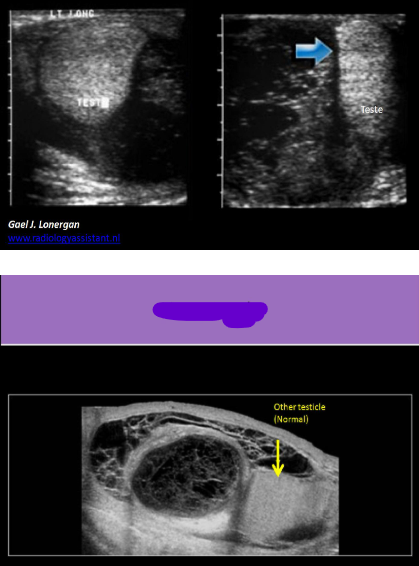
Hematocele
Pyocele
Collection of pus in scrotal sac
Caused by rupture of abscess
USA Pyocele
Similar to hematocele
Collection of fluid, debris, septations
May see thickened scrotal sac
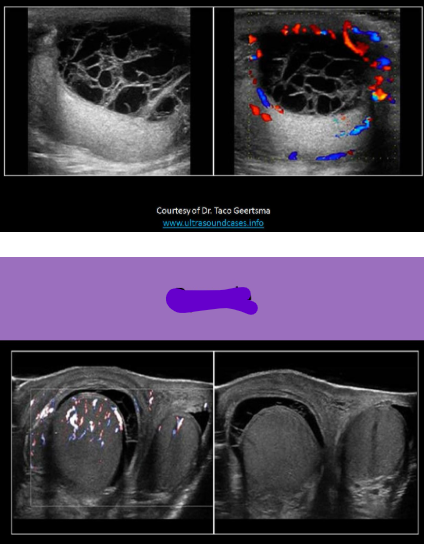
Pyocele
Which of the following sonographic characteristics are shared by pts with acute epididymitis and those have had a vasectomy?
Gland enlargement
Hypervasculairty
Hypovascularity
Cystic degeneration
Gland enlargement
The prehn sign is used to differentiate:
Orchitis from torsion
Viral orchitis is typically caused by:
Mumps infection
Which of the following resistive index
0.4
If diastolic flow reversal is present on the Doppler tracing from an tratesticular artery, this indicates:
Venous infarction or partial torsion
A hydrocele refers to a collection of serous fluid:
Between the two layers of the tunica vaginalis
A hematocele is a collection of ____________ in the scrotum, while a pyocele is a collection of ________ in the scrotum
Blood; pus