Private Pilot Part1
 Call Kai
 Learn
Learn Practice Test
 Spaced Repetition
 Match
Match Flashcards
 Knowt Play
1/40

There's no tags or description
Looks like no tags are added yet.
Name | Mastery | Learn | Test | Matching | Spaced | Call with Kai | Chat |
|---|
No analytics yet
Send a link to your students to track their progress
41 Terms
Whats VFR?
Visual Flight Rules
What's the minimum ceiling height?
1,000ft above the ground
What's a ceiling?
Lowest cloud layer that covers most of the sky
Every flight begins with what?
A go/no go decision based on VFR/Weather
Winter air is _________ than warm air.
Denser, which generally improves aircraft performance
Best to take off and land ________ _________ wind
Into the wind. Crosswinds makes landing and takeoff more difficult.
During the summer months, what situation might cause you to delay a lesson?
presence of local thunderstorms
What are the four forces of flight?
Lift, Weight, Thrust, and Drag

What's Lift?
Force that acts upward against weight.
Produced by the wings.
What's Weight?
Force caused by gravity acting downward.
What's Thrust?
Propels the airplane forward.
Produced by the engine and propeller.
What's Drag?
Force acting opposite to thrust.
Caused by air resistance.
What's Bernoulli's Principle?
Increasing the speed of a fluid decreases its pressure.
How does a wing create lift?
The curved top surface of the wing increases air velocity and is the major source of lift.
How is the wing shaped?
Upper surface is curved (camber); lower surface is relatively flat.
Airflow over the top speeds up, decreasing pressure and creating lift.
What's total lift?
Combination of decreased pressure on top and increased pressure below the wing.
What are the key wing parts? (5 of them)
Leading Edge: Front of the wing.
Trailing Edge: Back of the wing.
Chord Line: Imaginary line from leading to trailing edge.
Upper Camber: Top curve of the wing.
Lower Camber: Bottom curve of the wing.
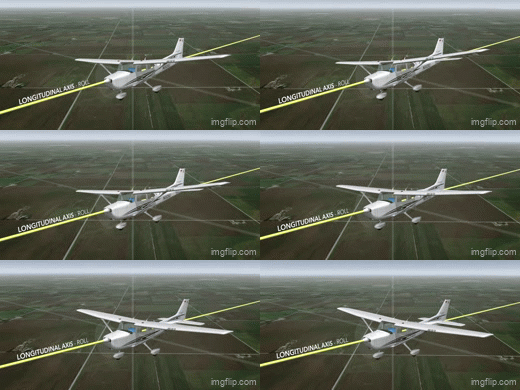
Explain Longitudinal Axis (Roll)
Runs lengthwise through the fuselage.
Movement around this axis is called roll or bank.
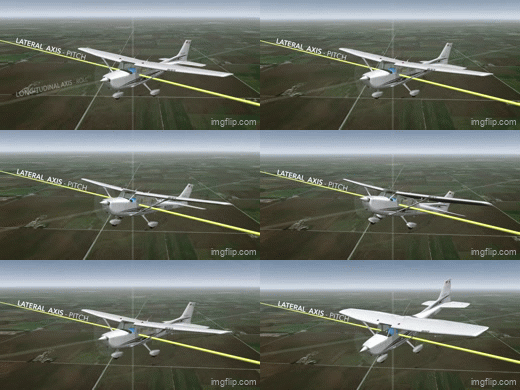
What's Lateral Axis (Pitch)?
Passes through the wings, side to side.
Movement around this axis is called pitch.
Vertical Axis (Yaw)
Runs vertically through the center of gravity.
Movement around this axis is called yaw.

What are the 3 primary flight controls?
Elevator, Ailerons, Rudder
What does the elevator part of the plane control and how does the pilot control it
Controls pitch/lateral axis.
Operated by pushing or pulling the yoke
Pulling back moves the elevator up
Pushing forward moves the elevator down

What does the ailerons part of the plane control and how does the pilot control it
Controls Roll/Longitudinal Axis
Operated by turning the yoke left or right
Turning yoke right raises right aileron, lowers left aileron;
Turning yoke left raises left aileron, lowers right aileron

What does the rudder part of the plane control and how does the pilot control it
Controls yaw (movement around the vertical axis).
Operated by pressing the rudder pedals.
Pushing right pedal moves rudder right, yawing nose right.
Pushing left pedal moves rudder left, yawing nose left.

What is the purpose of the airplane’s rudder?
Its only function is to counteract the adverse yaw when rolling into or out of a turn.
On landing, what is the advantage to using flaps?
Extending the flaps permit a steeper and slower approach.
How does a wing create lift?
The curved top surface of the wing increases air velocity and is the major source of lift.
To climb or descend in an airplane the pilot….
Moves the yoke back and forward which moves the elevator up and down.
Nautical Mile is how long
6,076.1 ft
Or 1.15 SM (Statue Mile)
Statue Mile is how long
5,280 ft
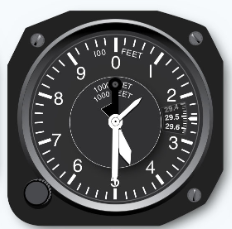
The altimeter indicates
14,500
Which of the following are considered aircraft flight instruments?
Turn coordinator, heading indicator and vertical speed indicator.
What is the purpose of the airplane engine’s mixture control?
To regulate the ratio of fuel to air entering the fuel distribution system.
Which color identifies the normal airspeed operating range?
The green arc
What are the primary flight instruments?
Airspeed indicator
Attitude Indicator
Altimeter
VSI (Vertical Speed Indicator)
Turn Coordinator
Heading Indicator (Directional Gyro)
Magnetic Compass
Airspeed Indicator
Measures speed in knots (Nautical miles per hour)
Red line - Never exceed
Yellow - Caution range (Smooth air only)
Green arc - Normal operating range
White arc - Flap operating range
Attitude Indicator
Displays pitch and bank relative to the natural horizon
Uses a gyroscope to stabilize the horizon bar.
Altimeter
Measures altitude above sea level
Works like a clock
Short hand: Thousands of feet.
Long hand: Hundreds of feet.
Diamond-shaped indicator: Tens of thousands of feet.
Must be set prior to flight
Vertical Speed Indicator (VSI)
Measures rate of climb or descent in feet per minute
Turn Coordinator
Provides information about direction and rate of turn.
Inclinometer (ball) shows quality of the turn (coordination).
Heading Indicator (Directional Gyro)
Main directional instrument used in flight.
Gyroscopically stabilized; not affected by banks, turns, or speed changes.
Must be set to the compass before takeoff and adjusted during flight.