Chapter 6 and 7 AOS4
 Call Kai
 Learn
Learn Practice Test
 Spaced Repetition
 Match
Match Flashcards
 Knowt Play
1/140

Earn XP
Name | Mastery | Learn | Test | Matching | Spaced | Call with Kai | Chat |
|---|
No analytics yet
Send a link to your students to track their progress
141 Terms
Sleep disturbance
Any sleep-related problem that disrupts an individual's normal sleep-wake cycle. Disruption may be temporary, occasional or persistent
Sleep disorder
Any sleep disturbance that is persistent and regularly disrupts sleep, causing distress or impairment in important areas of everyday life during normal waking hours.
Primary sleep disorder
A persistent sleep disturbance that cannot be attributed to another condition, such as another sleep disorder, physical or mental health issues, or drugs. I.e. this sleep disorder is the main cause of the disturbances.
Secondary sleep disorder
A sleep disturbance that is a by-product of or results from another condition, or use of a substance.
Sleep deprivation
Inadequate quantity or quality of sleep
Partial sleep deprivation
Inadequate quantity or quality of sleep than what is normally required for an individual's needs.
Sleep quantity vs sleep quality
Quantity - amount slept (objective)
Quality - how well we feel after sleep (subjective, but interruptions are also considered)
Total sleep deprivation
Not having any sleep at all over a short-term or long-term period.
Sleep debt
The accumulated amount of sleep loss from insufficient sleep
The ABCs of sleep deprivation effects
Affective - emotions, feelings
Behavioural - actions
Cognitive - thoughts, mental processes
Affective effects of partial sleep deprivation
- inability to regulate emotions
- amplified + inappropriate emotional responses
- difficulties interpreting others' emotions
- increased irritability and poor situation judgement
- depressed mood
Behavioural effects of partial sleep deprivation 7
- Sleep inertia is more likely to occur if following poor sleep or abrupt awakening
- Slower reaction time
- Excessive sleepiness + fatigue
- Difficulty concentrating
- Reduced efficiency + awareness
- Microsleeps
- Risk-taking behaviour
Microsleeps
A very short period of involuntary sleep, usually lasting 1-15 seconds. Eyes can be closed or open, and person may have no awareness that they slept.
Cognitive effects of partial sleep deprivation
- Reduced alertness and focus
- Difficulty sustaining and dividing attention (especially for boring tasks)
- Irrational thinking
- controlled tasks less affected than automatic tasks
- Delayed response time
- Difficulties being creative and thinking abstractly
- Difficulties problem solving
- Memory and learning impaired
Dawson and Reid (1997)
identified a significant relationship between fatigue due to a moderate level of sleep deprivation, legal levels of alcohol consumption and impaired performance
BAC
Blood-alcohol concentration, a measure of alcohol in the body expressed as grams of alcohol/100 mL of blood
BAC 0.05 =
17 hours sleep deprivation
BAC 0.10 =
24 hours sleep deprivation
Cognitive effects of alcohol intoxication
•Slower thinking
•Decrease in logical thinking and reasoning
•Decreased awareness of perceptual stimuli
•Reduced concentration
How do the affective effects of high BAC and sleep deprivation differ?
High BAC - Positive or negative mood state (i.e. variable)
Sleep deprivation - Negative mood state
Do sleep deprivation and alcohol influence consciousness in the same way?
No, sleep deprivation, alcohol, cognition, concentration and mood are intertwined and may interact in complex ways in influencing conscious experience.
Behavioural effects of different BAC
Circadian rhythm sleep disorders
Sleep disorders involving sleep disturbance that is primarily due to a mismatch between an individual's sleep-wake pattern and the pattern that is desired or required.
Possible causes of circadian rhythm sleep disorders
- A naturally occurring change or a malfunction of biological mechanisms or processes regulating the sleep-wake cycle e.g. DSPS in adolescence
- Mismatch between sleep-wake and environmental day-night cycle e.g. jetlag
- Mismatch between sleep-wake cycle and schedule required by work/school/social schedule
DSPS
Delayed Sleep Phase Syndrome/Disorder. A circadian rhythm sleep disorder in which the major sleep episode is delayed in relation to the desired sleep time or what is considered a conventional time. Occurs more commonly than ASPS and Shift worker disorder. Tends to be relatively treatment resistant.
Symptoms of DSPS
- Sleep-onset insomnia
- Difficulty awakening at the desired or necessary time
- Excessive sleepiness
DSPS in adolescents
7-15% of adolescents are believed to have biologically-driven DSPS.
ASPS
Advanced Sleep Phase Syndrome/Disorder. A circadian rhythm sleep disorder in which the major sleep episode is advanced in relation to the desired or conventional sleep time. Quite rare, and occurs more among older people. Generally more resistant to treatment than DSPS.
Why is ASPS more prevalent in the elderly?
Possibly due to decreased light exposure during the day, a degradation of the SCN, or a biological shift of melatonin release 2-4 hours earlier.
Symptoms of ASPS
•Falling asleep too early
•Struggling to stay awake in the evening
•Excessive sleepiness in the afternoon / evening
Shift work disorder
A circadian rhythm sleep disorder that occurs as a result of work shifts being regularly scheduled during the usual sleep period, requiring adjustment of sleep and wake times to the work times. Tend to lose 1-4 hours of sleep on average.
Fixed vs rotating shift schedule
Fixed - Employees work the same shift on an ongoing, regular basis
Rotating - Employees change shifts evert so often
Symptoms of Shift work disorder
- Insomnia when trying to go to sleep
- Excessive sleepiness when alertness is required
What shift work situations are more likely to cause shift work disorder?
- Permanent night shift (may cause sleep to occur in two parts and to not feel as restful)
- Rotating rosters (especially rotated more frequently than every 3 weeks)
- Roster rotated against the clock
Why is a shift schedule that rotates with the clock better than one that rotates against?
Because the sleep-wake cycle is slightly longer than 24 hours, workers can adapt better as their cycle is less disrupted.
Bright light therapy
A technique for treating circadian rhythm sleep disorders that uses timed exposure of the eyes to light (e.g. using a light box) with the aim of shifting an individual's sleep-wake cycle to a desired, more appropriate or conventional schedule.
3 important variables of bright light therapy
Using the light at the right time of day, at the right intensity for the right amount of time.
Bright light therapy for DSPS, ASPS and shift work disorder
DSPS - early morning hours, e.g. between 6-8am.
ASPS - evening/night
Shift work disorder - (for night shift) evening, and avoiding light in the day; (to adjust to day shift) morning. Can be difficult to correct.
Sleep hygiene
Practices that tend to improve and maintain good sleep and full daytime alertness. Includes behaviours and environmenetal factors.
Sleep hygiene education
Often used in conjunction with therapies to assist people to change sleep-related activities that may add to sleep issues.
Good sleep hygiene practices
> Establishing a regular relaxing schedule and bedtime routine
> Associate your bed/bedroom with sleep
> Avoid stimulating activities before bed (e.g. vigorous exercise, screens, important discussions, stimulants)
> Getting up when you can't sleep
> Exercise to promote good sleep
> Don't eat within 2 hours of bedtime (hunger is circadian too)
> Ensure adequate exposure to daylight
> Good temperature in room (17-19 degrees) (body temp is circadian too)
Mnemonic for sleep hygiene practices
Regular bed stimulates getting up to exercise, eat, look at the light and feel the temperature.
Entrainment
The process of adjusting or resetting a biological rhythm to align with external cues or an environmental cycle (e.g. sleep-wake cycle adjusting to day-night cycle through influence of a zeitgeber)
How does sleeping in daylight affect NREM sleep?
It can cause an increase in the duration of NREM stage 1 sleep, less deep sleep and therefore more shallow sleep and more fragmented sleep.
How does blue light affect NREM and REM sleep
It can cause reduced amount of NREM deep sleep and REM sleep, and increase awakening frequency, and cause morning sleepiness.
Circadian rhythm of thermoregulation
Body temp gradually falls 2 hours before sleep onset, and continues to lower during the night time sleep phase, then rises during the waking phase. Sleep is more likely to occur at cooler temperatures.
Effects of having a warm bath/shower before bed
Promote relaxation that shorten sleep onset, increase initial sleep cycle length and promote more NREM 3 sleep.
Why do stimulants like caffeine make it hard to sleep?
Because they stimulate the CNS, increasing heart rate and suppressing melatonin. It also takes 4-6 hours for the body to break down caffeine.
How does alcohol affect sleep?
While inducing drowsiness and sleep onset, it can lower sleep quantity and quality (especially in 2nd half of night - more awakenings, night sweats, nightmares, headaches)
How can a sleep disturbance become a sleep disorder?
If it becomes persistent and regular, and causes distress to the individual or impairs their ability to function in everyday life.
How can eating patterns affect sleep?
It is important to consistently change eating patterns in order to suit the desired or required sleep-wake cycle.
Consciousness
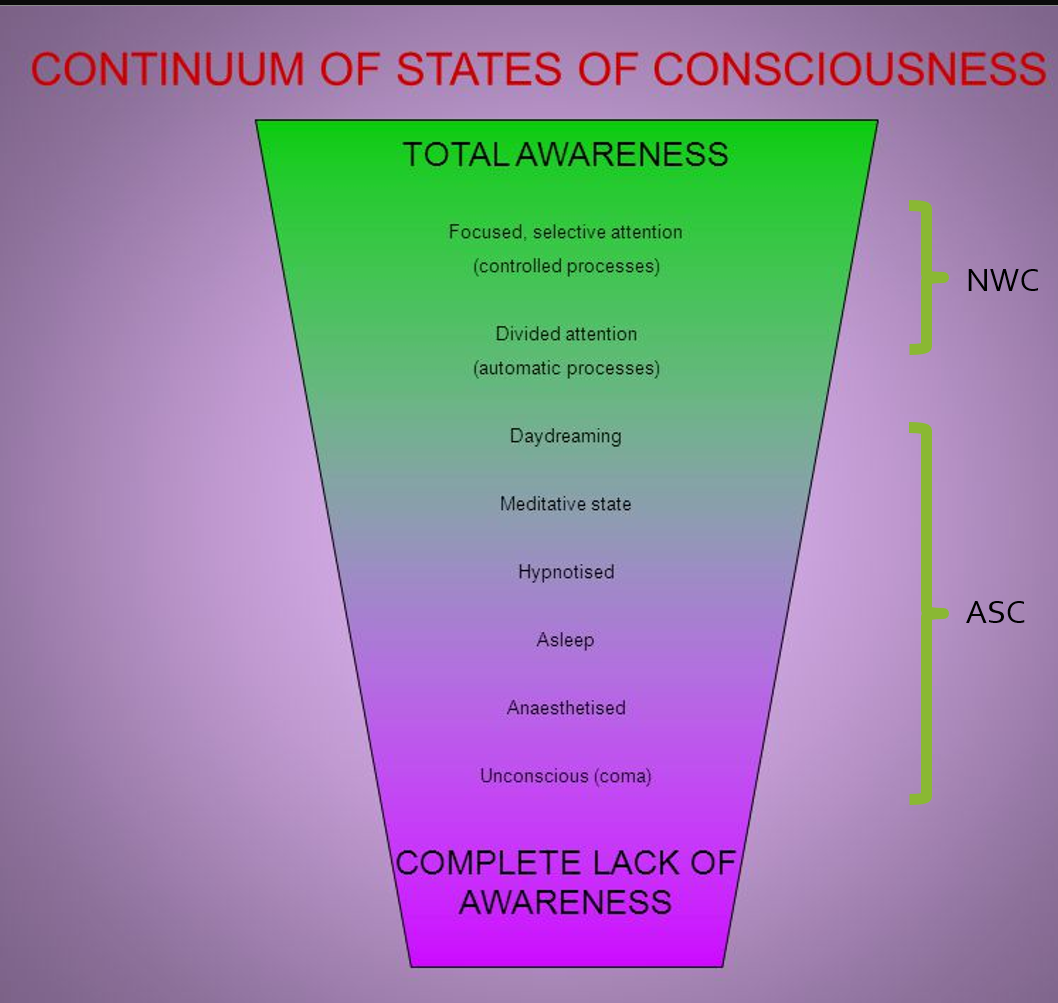
Awareness and responsiveness to the internal and external environment. It is personal, selective, continuous and changing.
State of consciousness
A state of awareness with variations in level and associated with distinguishable psychological and physiological characteristics
Sleep
A reversible, regular and (typically) naturally occurring ASC that involves a loss of awareness and disengagement with internal and external stimuli, i.e. a partial or total suspension of awareness.
NWC
Normal Waking Consciousness; when a person is awake, in control of their movements, aware of their thoughts and feelings, perceives the passage of time accurately, and can accurately perceive internal and external stimuli.
ASC
Altered States of Consciousness; any state of consciousness that is significantly different from NWC in terms of level of awareness and experience
Naturally occurring ASC
Altered states of consciousness such as sleep, dreaming during sleep and daydreaming when awake, that are naturally occurring in the course of everyday activities without the need for any aid
Induced ASC
A temporary change in one's normal mental state without being considered unconscious, that is achieved through some form of assistance/aid e.g. medication, meditation, hypnosis, brain damage, disease or disorder
Continuum of States of Consciousness
Psychological Construct
(Hypothetical construct). An agreed upon description and understanding of psychological phenomena that is believed to occur, but that cannot be overtly measured or observed.
Why is consciousness (and similarly sleep) a psychological construct?
• Abstract concept, not a physical thing
• Cannot be directly demonstrated to exist or measured (and instead relies on self-reports + observations to make inferences)
• Useful for organising our understanding of mental experiences and awareness
What 3 measurements are used by researchers to
- information provided by individuals
- behaviour that is demonstrated
- physiological changes that can be measured
EEG
An Electroencephalograph instrument detects, amplifies and records the electrical activity of the brain through electrodes to indicate levels of activity in different regions, averaging electrical activity to create a visual pattern of brain waves.
Brain waves
Spontaneous, rhythmic electrical impulses that come from different brain areas.
How do ASCs typically present on an EEG and an EMG?
EEG - Higher amplitude waves, with a lower frequency (relaxed)
EMG - Decreased muscle tone and less activity
Electroencephalograms
The recorded graphical display of information gathered through an Electroencephalograph.
Frequency
The number of brain waves per second (more = faster)
Amplitude/intensity
Measured in microvolts and can be visually judged by the size of the peaks and troughs of the waves from a baseline of zero activity.
4 commonly described brain waves, ordered from fastest to slowest (and therefore lowest to highest amplitude)
Beta, alpha, theta, delta
Beta wave pattern
Alertness and intensive mental activity during normal waking consciousness, as well as dreaming in REM sleep.
Alpha wave pattern
Awake and alert but mentally and physically relaxed and internally focused
Theta wave pattern
Drowsy, when falling asleep or just before waking. May also be produced during creative activities while awake
Delta wave pattern
Deep, dreamless sleep or unconsciousness
EMG
An Electromyograph device detects, amplifies and records electrical activity in the skeletal muscles, to indicate level of muscle tone/activity in different areas (also can see leg jerking around sleep onset).
What are the 3 studies of sleep-related physiological changes?
Electroencephalography - a method of studying brain wave patterns by recording the electrical activity of the brain
Electromyography - a method of studying the electrical activity of muscles during sleep
Electro-oculargraphy - a method of measuring eye movements or eye positions during sleep
EOG
An Electro-oculargraph detects, amplifies and records electrical activity in the muscles that control eye movements indicate eye activity.
Sleep diaries
A self-report record of sleep and wake time activities over a period of time, with information on things like timings, feelings of restfulness and tiredness, and timing of food, exercise, meds, caffeine, alcohol and other things throughout the day.
Video monitoring
Using a video camera at a sleep laboratory to monitor and record externally observable aspects of sleep such as posture in bed, changing position, breathing, behaviours when awakening or awakening from a nightmare, and sleepwalking.
Biological rhythm
A naturally occurring cycle of physiological, psychological or behavioural changes. Often linked to environmental stimuli. Two categories are circadian and ultradian.
Biological clock
An innate timing mechanism that regulates the cycle of a biological rhythm. Its functioning is genetically determined and occurs at the cellular level.
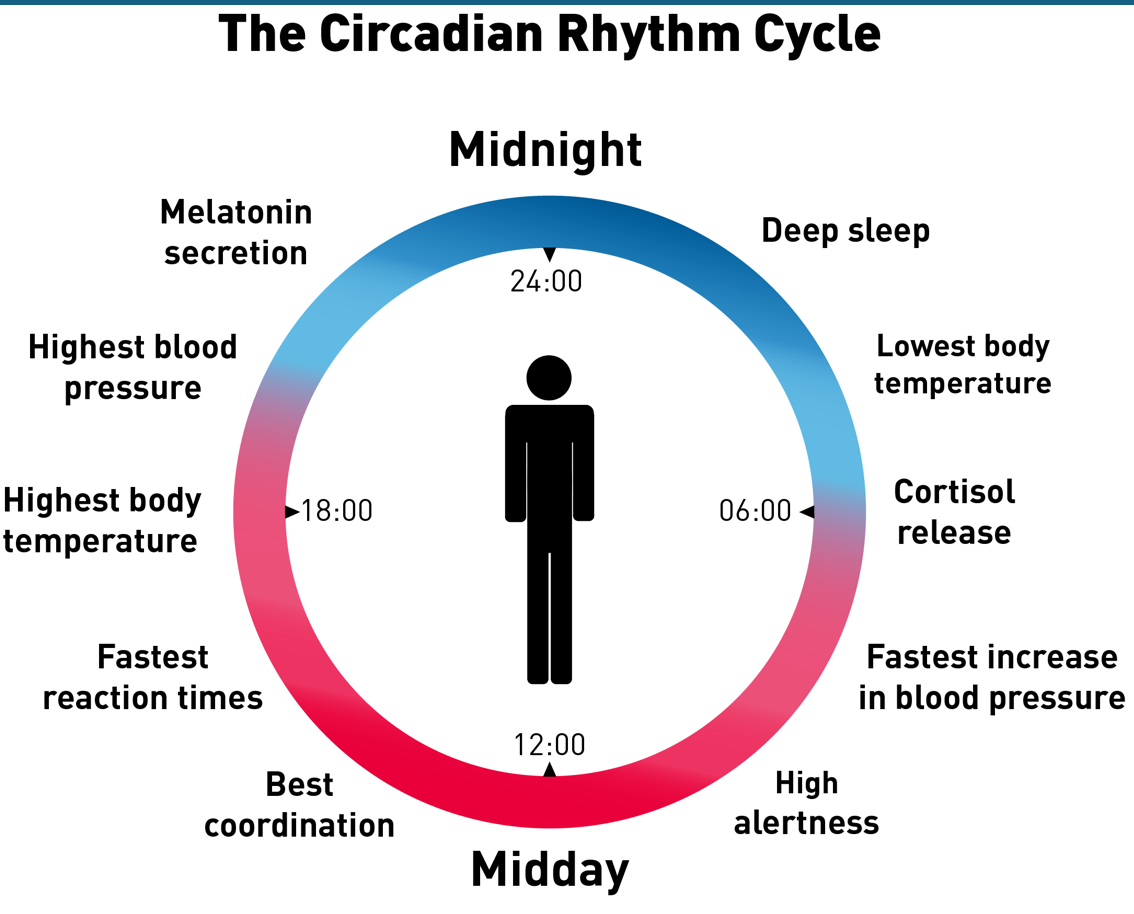
The Circadian Rhythm Cycle Diagram
Circadian Rhythm
A biological rhythm involving physiological, psychological or behavioural changes that occur as part of a cycle with a duration of about 24 hours
Endogenous vs exogenous
Endogenous refers to something that originates within an organism (e.g. sleep-wake cycle) while exogenous refers to something that has its origins outside an organism (e.g. environmental time cues)
What structure regulates ALL CIRCADIAN RHYTHMS
The Suprachiasmatic Nucleus (SCN) in the hypothalamus (as a part of the nervous system).
Suprachiasmatic Nucleus
Pair of nuclei located above the optic chiasm that respond to light to control melatonin production to regulate the timing and activity of the sleep-wake cycle, among other biological clocks involved with circadian rhythms (therefore is also is involved in all other circadian rhythms)
Optic chiasm
The point where the optic nerves that connect the eyes and brain cross.
How does the SCN regulate melatonin levels?
The suprachiasmatic nucleus receives light information from the eyes, along with information about melatonin levels in the brain, then stimulates the pineal gland for secretion in order to moderate the output of melatonin.
What functions does the SCN perform when light is detected?
- Initiates an increase in body temperature
- Stimulates release of hormones like cortisol to promote alertness and support other arousal activities
- Supresses the release of melatonin
(These functions are all supressed when it's dark)
Blue light
Bluer wave lengths of light are even more effective at supressing melatonin release from the pineal gland than other wavelengths are, meaning that looking at blue light keep us awake for longer.
Zeitgeber
Environmental and social variables that are capable of acting as circadian time cues to help sync biological rhythms. Includes light, food intake and physical activity.
Melatonin
Hormone secreted by the pineal gland into the bloodstream that is involved in the initiation of sleep, drowsiness, quality of rest, and regulation of the sleep-wake cycle. Levels stay high from dusk till dawn (i.e. when it's dark or when asleep). Levels determine sleepiness.
Synthetic melatonin
Produced to help those with insomnia or those who are blind; shown to have little negative side effects over short-term use.
Ultradian rhythm
A biological rhythm that involves physiological, psychological or behavioural changes that occur as part of a cycle shorter than 24 hours.
Why is sleep both a circadian and ultradian rhythm?
It's a circadian rhythm because it occurs at a predictable time every day, and it is an ultradian rhythm because it involves different stages of sleep that we cycle in an out of several times per night.
Examples of ultradian rhythms
Heartbeat, breathing, hunger, hormone and neurotransmitter activity
How long is a typical ultradian sleep cycle?
About 90 minutes
What factors can influence an ultradian sleep cycle?
Age, health and environmental cues
Stages of an ultradian sleep cycle?
- REM
- NREM
> Stage 1
> Stage 2
> Stage 3
Key differences between REM and NREM sleep
- REM has rapid eye movements, NREM does not
- NREM has stages, REM does not
- REM is linked to beta brain waves, NREM to alpha, theta and delta
- NREM involves a relatively inactive brain in a body that can move, while REM involves an active brain in a paralysed body
Hypnogram
A sleep graph typically showing sleep types and stages in relation to time