ELECTRICAL SYSTEMS
 Call Kai
 Learn
Learn Practice Test
 Spaced Repetition
 Match
Match Flashcards
 Knowt Play
1/251

There's no tags or description
Looks like no tags are added yet.
Name | Mastery | Learn | Test | Matching | Spaced | Call with Kai | Chat |
|---|
No analytics yet
Send a link to your students to track their progress
252 Terms
Electricity
form of energy generated by friction, introduction, or chemical change, having magnetic chemical and radiant effects.
Electricity
It is the motion of free electrons through a solid conductor.
electric current
An ___________ travels at the speed of light and,
William Gilbert
English Physicist is considered as “Father of Electricity” for his studies on “Electric Attraction” and “The Electric Force”.
Electricity
a property of the primary particles of matter, which like an atom, consists of a negative charge, an electron; the positive charge is a proton; and the neuron, which is not electrically charged.
(electrodynamic)
dynamic electricity
(electrostatic)
static electricity
Primary Batteries
delivers electricity as soon as its parts are assembled or assembled, provided it is connected to a circuit.
Secondary / Storage Batteries
electricity from some external source must be passed through it before it can deliver an electric current “changing the battery”.
Alternating Current Generators or Alternators
The bulk of electrical energy utilized today is a form of alternating current, including energy for power and lighting.
Direct Current Generators
These furnish electric energy for elevators, intercommunicating telephone systems, control of signal systems, and clock system.
MOTORS
A machine that converts electrical energy into mechanical energy.
TRANSFORMERS
For converting one voltage to another from lower to higher (step-up transformer) from higher
to lower (step-down transformer).
ROTARY CONVERTERS
For changing alternating current to direct current and vice versa.
DIRECT CURRENT
A current which flows at a constant time rate and in the same direction.
ALTERNATING CURRENT
A current which is periodically varying in time rate and direction. It rises from zero to maximum falls to aero, reverses its direction, and again returns to zero.
“hertz”
The number of times the current goes through the above cycles per second is called the frequency of the alternating current and is referred to as the _________.
60 cycles, 25 cycles
The frequency commonly used for lighting is ______ per second and for motors_______ per second. (ALTERNATING CURRENT)
Heinrich Hertz.
The hertz is named after
a coulomb of electricity comprises approximately 6.25 x 10¹⁸ electrons.
Coulomb
Ampere
An ampere of current represents a rate of flow of one coulomb or 6.25 x 10¹⁸ electrons/second through a given cross-section.
Ampacity
is the current carrying capacity of a wire or cables expressed in Amperes, without undue heating
Andre M. Ampere.
The ampere is named after
Volt
is the electromotive force or potential difference between two points in an electric field which will move a charge of one coulomb between these points.
Alessandro Volta
Volt is named after
Alessandro Volta
an Italian scientist who discovered that electrons flow when two different metals are connected by a wire and then dipped into a liquid that conducts or carries electrons.
Ohm
The resistance which will allow one ampere of current to flow when one volt is impressed upon it.
James Watt
The Watt is named after
Energy
the capacity for doing work. In electrical units, energy is expressed in Watt- Hours or Kilowatt-Hours.
I (amp) = V (volts) / R (Ohms)
Ohm’s Law
current
The higher the voltage, the larger the _____
resistance
The higher the_________, the lower the current.
Electric Load Control
The effective utilization of available energy by reducing peak loads and lowering demand charge
Demand Charge
the levying of charge for power (kW) in addition to the normal energy (kWh) charge.
AUTOMATIC INSTANTANEOUS DEMAND CONTROL
Also called “rate control”, it is an automated version of the demand metering alarm system, where it automatically disconnects or reconnects loads as required.
IDEAL CURVE CONTROL
This controller operates by comparing the actual rate of energy usage to the ideal rate, the controls KW demand by controlling the total energy used within a metering material.
FORECASTING SYSTEM
These are computerized systems that continuously forecast the amount of energy remaining in the demand interval, then examine the status and priority of each of the connected loads and decide on the proper course of action.
KWH METERS
To measure energy, the time factor is introduced, such that, energy = power x time.
SCHEMATIC ARRANGEMENT of Wattmeter connections.
current coil is in series with the circuit load, whereas the voltage loads are in parallel.

TYPICAL INDUCTION
–TYPE KWh Meter with Kw demand-dial. Decade dials register total Disc revolutions are proportional to the energy. Disc speed is proportional to power.
electrical circuit
defined as a complete conducting path carrying a current form of a source of electricity to and through some electrical device or load and back to the source.
two-wire circuit,
the most elementary of all wiring systems, consists of a live wire carrying the current to various power-consuming devices in the circuit and a neutral or grounded wire which is the return wire carrying the circuit back to the source of supply.
Open Circuit (Broken or Incomplete)
conducting elements are disconnected to prevent the flow of electricity.
Short Circuit
a condition resulting from bridging any part of a circuit with a conductor of very low resistance.
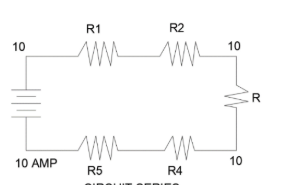
Series Circuit
One of the components is connected in tandem. All separate loads of the circuit carry the same equal current and the total resistance, R, Is the sum of the resistances around the circuit.
Parallel Circuit (or Multiple Circuit)
Is one in which the components or loads are so arranged that the current devices between them.

Parallel Circuit (or Multiple Circuit)
Each current has a live wire connected to the current carrying wire of the circuit and also a neutral wire or grounded wire connected to the return wire of the circuit.
General Purpose Branch Circuit
Supplies outlets for lighting and appliance, including convenience receptacles
Appliance Branch Circuit
Supplies outlets intended for feeding appliances. Fixed lighting is not supplied.
Individual Branch Circuit
Is designed to supply a single specific item, such as a motor load or a unit air- conditioner.
30 watts
General: branch circuits shall be sufficient to supply a load of ________ per square meter in buildings excluding porches, garages, and basements.
SINGLE AND THREE-PHASE ELECTRICAL SYSTEM
A single-phase electrical system can either be 2-wire or 3-wire and composed of two hot legs and a neutral wire.
Two-wire Single Phase DC or AC

Three-wire Single Phase DC (Edison System)
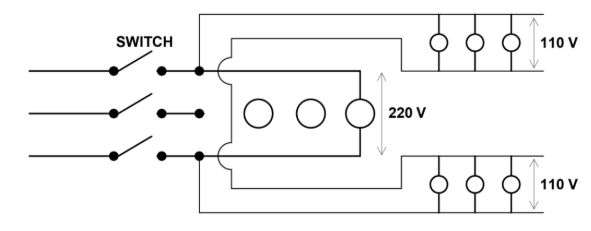
Three-Wire Three-Phase AC
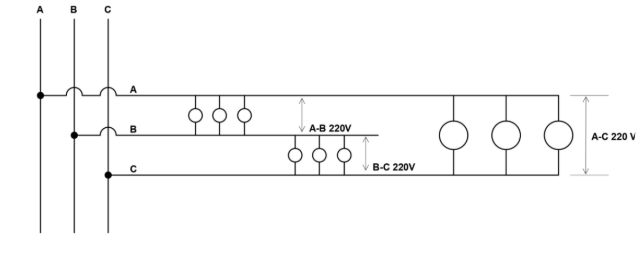
Four-Wire Three-Phase AC

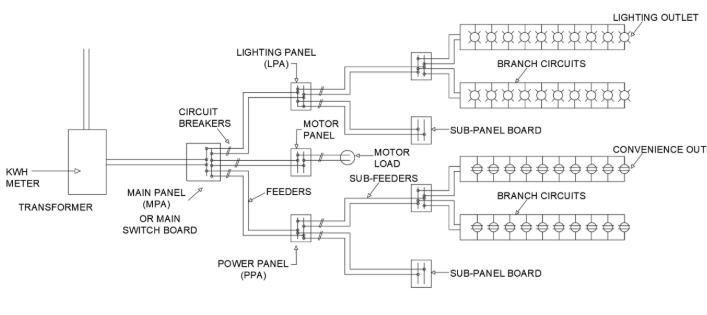
Parts of the Wiring System
Equipment
general term including materials, fitting, devices, appliances, fixtures, apparatuses used as part of, or in connection with an electrical installation.
Appliance
currents consuming equipment / fixed or portable ex: heating, cooking & small motor operated equipment.
Fittings
an accessory ex: locknut, bushing, or other part of a wiring system w/c is intended to perform a mechanical rather electrical function.
SERVICE ENTRANCE
The point of delivery of electricity to a building by a Public Utility Company.
Service Conductors
conductors with extended from the street distribution main or distribution transformer to the service equipment of the building.

Service Entrance Switch
this affords the means of connecting or disconnecting the entire electrical service and of automatic protection against serve overloads and short circuits.
Kilowatt Hour Meter
The device used by the utility company to determine power consumption.
Service Entrance
the conductor and equipment for delivering energy from the electricity supply system to the wiring system of the premises served.
Overhead Service
A service drop is connected from the nearest utility pole to the building service entrance and enters the building through the weather head or entrance cap down to the electric power meter.
Underground Services
consists of a buried concrete enveloped raceway extending from the building to the property line where it is tapped to the main by a service lateral
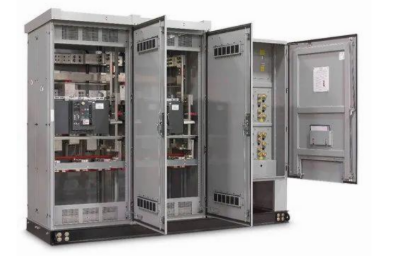
MAIN SWITCHBOARD
The service entrance conductors in the form of bus bars terminate in the main switchboard and connect to the distribution panel boards using feeder circuits protected by circuit breakers.
MAIN SWITCHBOARD
serves for the control, protection, and metering of the main feeders.
Service Drop
The overhead portion of service conductors extending from the nearest utility pole to a building.
Service Lateral
The underground portion of service conductors extending from a main power line or transformer to a building.
Switchboard or Switchgear
are free-standing assemblies of switches, fuses, and circuit breakers that provide switching and feeder protection to several circuits connected to the main source.
FEEDER CIRCUITS
a set of conductors which extend from the main switchboard to a
distributing center (panel board) with no other circuits connected to it between, the source and the distributing center.
SUB-FEEDER CIRCUITS
Are line extensions of a feeder, fed through a panel board or cut-out, from one distributing center to another and having no other circuit connected to it between the two distributing centers.
sub-feeder
serves to power from the main feeders to smaller local panel boards, called sub-panel boards.
BRANCH CIRCUITS
These are small-capacity conductors which deliver capacity to lamps, motors, and other loads within the circuit.
PANEL BOARDS6/SUB-PANEL BOARDS (CUT-OUTS)
These serve to control and protect the sub-feeders and brand circuits
UTILIZATION EQUIPMENT
These are lighting, power, motor loads, and wiring devices which are directly handled and utilized by users.
Panel Board
A single panel or group panel limits designed for assembly in the form of a single panel. (NEC)
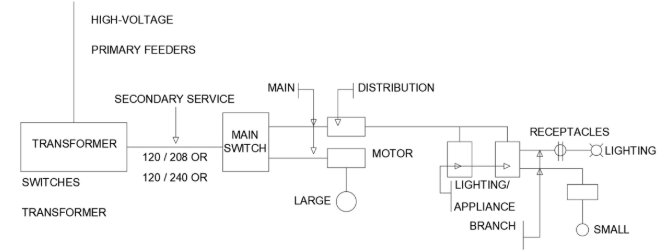
BLOCK DIAGRAM
A horizontal single-line diagram of the building’s electrical system from the incoming service to the utilization items at the end of the system where the major electrical components are shown as blocks or rectangles.
SINGLE LINE DIAGRAM
When electrical symbols are used instead of the blocks, it is called a “one line” or _______
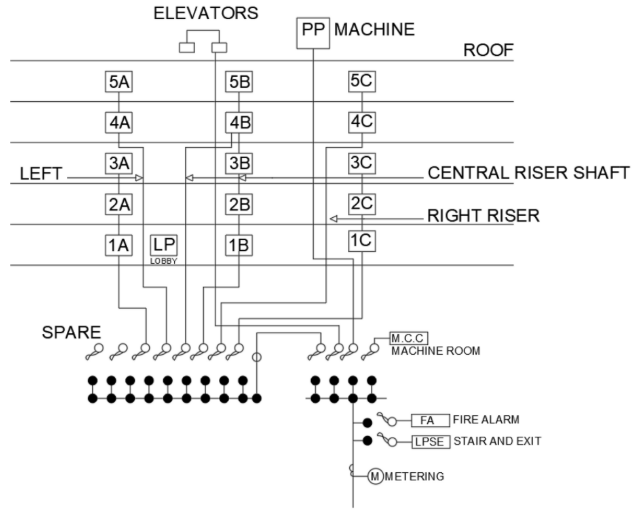
RISER DIAGRAM
A vertical line diagram of the major electrical components of the building's electrical system is presented showing the spatial relations between components.
Wiring
which includes conductors and raceways of all types
Power Handling Equipment
transformers, panel boards, large switches, and circuit breakers.
Utilization Equipment
such as lighting, motors, controls, and wiring devices.
Emergency Systems
provide electric power and illumination essentially for life safety and protection of property during an emergency, such as electricity for exit lighting, elevators, fire alarm system, fire pumps, and the like.
Standby System
provides power to selected loads not directly involved with life safety, such as water and sewage treatment plants and industrial machines for manufacturing processes.
Battery Equipment
central storage batteries are mounted in individual racks and always provide with automatic charging equipment.
Engine Generator Sets
are machines intended to produce electricity and are composed of three components: the machine and its housing, the fuel storage tank, and the exhaust facilities.
Engine Generator Sets
The disadvantages in its use are noise, vibration, nuisance of exhaust, need for constant maintenance, and difficulties in the handling and storage of its fuel. Additionally, it has a longer start-up time compared to batteries. However, it has unlimited KVA capacity and can last a lifetime if properly maintained.
Conductors
These are materials that allow to free flow of electrons through them.
silver, gold, and platinum.
The best conductors are precious metals, such as_________
Copper and aluminum
most commonly used materials for conductors.
small wires
aluminum is restricted to ______ while copper is preferred in all conductor types.
Wires
are single insulated conductors No. 8 AWG (American Wire Gauge or smaller; for the English System, it is the B & S Gauge or Browne and sharp gauge.
No.14
The smallest size of wire permitted is
Cable
are single insulated conductors No.6 AWG or larger; others may be several conductors of any size assembled into a single unit.
stranded wire
consists of a group of wires twisted to form a metallic string.
cord
an insulated stranded wire, such as the cord of a flat iron.
Bus Bars
large conductors which are not circular in cross- section and are usually found only to supply the main switchboards.