Topic 6: Atmosphere and Climate change (6.1 Intro Atmosphere; 6.2 (yes.) Climate Change — causes & impacts; 6.3 (yes.) Climate Change — mitigation vs. adaptation; 6.4 Stratospheric Ozone)
 Call Kai
 Learn
Learn Practice Test
 Spaced Repetition
 Match
Match Flashcards
 Knowt Play
1/21

There's no tags or description
Looks like no tags are added yet.
Name | Mastery | Learn | Test | Matching | Spaced | Call with Kai | Chat |
|---|
No analytics yet
Send a link to your students to track their progress
22 Terms
(6.1) How ATMOSPHERE systems work Earth?
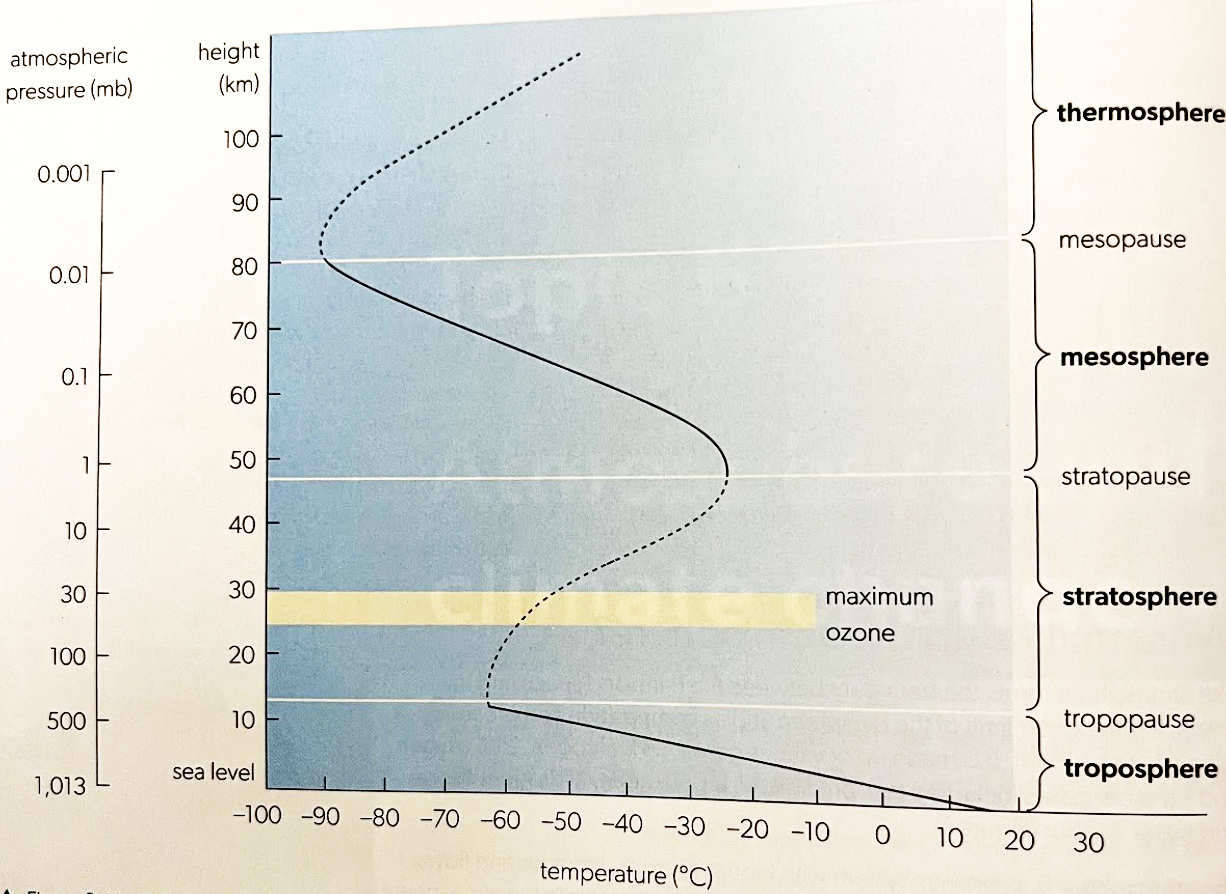
STRUcture of Atmosphere:
(highest —> lowest)
thermosphere
mesosphere
stratosphere
troposphere (most life reactions, ozone formation + clouds)
Albedo
albedo = Earth’s reflectivity; 30% sun reflected back, 70% absorbed by Earth
Explain “The GREENHOUSE EFFECT”
“The GREENHOUSE Effect” = Earth’s atmosphere + gases (GHGs) trap heat (reflected off surface), some reflect back
**humans adding extra GHGs, increasing Greenhouse effect
—> side note: Main GHGs = water vapor + carbon dioxide + methane
Role of water vapor
Water vapor (is most significant GHG) **usually excluded from climate models bc changes frequently tho
Role of chlorofluorocarbons (CFCs)
Chlorofluorocarbons (CFCs) = MEGA destructive; one CFC can have rippling effect, 5,000-10,000 times more potent than CO2
aerosols
aerosols = small solid particles suspended in atmosphere (e.g. soot, etc.)
come from naturals; volcanic eruptions, forest fires
GOOD bc COOLING—reflect radiation back to space!!
BAd bc cause respiratory issues, can release hydrocarbons/global warming stuff, smog formation
↳“radioactive forcing (RF)” = incoming - outgoing energy (Net)
(6.2) To what extent humans CAUSE Climate change?
A. How humans CAUSE Climate Change?
A. *NOTE, long-term climate change ALWAYS happening BUT…tipping points passed means dynamic equilibrium unable to return to stable, reaching NEW equilibriumspecifically—RATE of global warming concerning + matches 50% increase post-industrial CO2
accelerating carbon cycle w/ GHG emissions — HOW HUMANS INFLUENCE CARBON CYCLE??? + global warming……..
fossil fuels (industry, cars, etc.)
deforestation (removing forest sinks), destroying plants
industrial agriculture; using fertilizers, livestock farming, etc. + FOOD WASTE!?
urbanization
B. IMPACTS of Climate Change
Oceans, sea level
sea level rise ⇒ flooding in Bangladesh, Maldives, etc. coastal communities
fish migrating away
ocean acidification (+25%) bc absorbing CO2 !! coral bleaching. shells dying, fish eggs sensitive, phytoplankton skeletons
Polar ice caps
Melting. (leads to sea level rise) + desalination
positive feedback loop → trapped methane in ice released
Glaciers
loss of freshwater (scarcity!), drought in Himalayas, Ganges, etc.
hurts water supplies + changes human migration/refugees, bad for indigenous peoples (ex. Mbororo of Sahel suffering from drought in pastoral lands) + societal inequities (poverty, etc.) + even economic hurts
Weather
⬆ violent + unpredictable weather, severe drought, Bigg storms, monsoon
Animal ecosystems & biodiversity
killing plants—can’t really migrate to cooler regions
extinction!! of polar bears, alpine plants, burning koalas and trees and plankton
Food production
kill plankton, kill livestock w/ heat + drought
change soil quality, dry land
How can we Model Climate CHange?
==> 5 MAIN easy climate can change…(in models)...
direct relationship (aka incr solar radiation, increase methane, incr pos. feedback loop)
buffering action = forcing increases but climate change NOT linear; ex. negative feedback loops
acceleration of climate to new equilibrium
reach tipping point! — when reaches threshold, climate SUDDEN changes
stuck NEW equilibrium.
(6.3) How humans FIX Climate change (—mitigation vs. adaptation)?
International Policies for Climate Change
Climate Change:
UN Conventions (or treaties) that legally bind
ex. three sister “Rio Conventions” — UNFCCCC, Convention on Biodiversity, UN Convention to combat Desertification
GOAL—STABILIZE GHG emissions
“Paris Agreement” (2015) = keep global average temp. rise < 1.5 ℃ from pre-industrial levels
CONS: NO legal “enforcement” for compliance
Kyoto Protocol = 5% total GHG emissions reduction
*Doha Amendment to Kyoto Protocol; reduce GHGs by 18%.
Intergovernmental Panel on Climate Change (IPCC)
consolidates/assesses existing climate research —> helps policy
CONS: doesn’t even do its own research, requires consenesus which is dificult, takes (too) long-term studies
Ozone:
The Montreal Protocol (1987): regulates use + trade of CFCs, ODs (Ozone Depleting Substances)
PROS: part UNEP, Massive SUCCESS 197 countries, 99% phase out CFCs international coordination!!!!
CONS: illegal CFC trade, expensive alternatives for refridgeration/AC, HCFCs later used as alternatives
How can HUMANS FIX Climate Change — MITIGATION vs. ADAPTATION??
A. “The precautionary principle” = act NOW, in case
B. DECARBONIZATION
switch electric, energy efficiency
REDUCE food production; meat/dairy consumption, vegetarian diets + STOP FOOD WASTE>
technology—carbon recapturing, farming (vertical farming, hydroponics, etc.)
C. Mitigation STRATEGIES:
REDUCE GHG emissions;
change diets/agriculture (livestock)
fossil fuel alternatives (renewable energy)
carbon tax
STOP deforestation
REMOVE CO2 from atmosphere;
afforestation
rewilding, land management
carbon capture technology
geoengineering —> manual cooling……..so like injecting sulfur dioxide into the air, reflecting sun back
D. Adaptation STRATEGIES:
“adaptive capacity” = ability or potential of system respond successfully to climate changes (w/ tech, etc.)
flood-resistant infrastructure (sea walls)
drought-resistant crops
..green infrastructure —> permeable pavement, green roofs, etc.
manage weather—cloud seeding, re-planting trees
vaccination, other legislation + policies
NAPAS
*NAPAS = requests submitted to UNFCCC by vulnerable countries, asking help for URGENT adaptation (e.g. flooding help, building, etc.)
(6.4) Describe ozone equilibrium works + HUMAN affect OZONE?
Role of ozone
Ozone (O3) = gas
Tropospheric ozone = BAD; pungent, causes ground-level ozone pollution, photochemical smog, coughing/respiratory issues
Stratospheric ozone = good!; deflects sun’s harmful UV rays (preventing skin cancer, photochemical smog, etc.)
Describe the ozone EQUILIBRIUM. (Chapman cycle)
The Chapman Cycle is where ozone is created/destroyed at EQUAL rates (steady-state equilib)
HOW? UV radiation breaks DOWN ozone (O3) to O2 and O, which REFORM into O3
What are Pros/Cons of UV radiation?
PROS
most harmful (UV-C, most UV-B) absorbed by stratosphere
vitamin D + light
kills some bad bacteria, purify water/air
CONS
skin cancer
UV damages phytoplankton, ecosystems (esp. near poles)
Photochemical SMOG
How do humans affect OZONE? (“The Ozone Hole)
—> “THE OZONE HOLE”: = depletion STRATOSPHERIC ozone
CFCs + HCFCs; “ODs” = ozone depleters
(CHANGEs Chapman cycle — more formation than depletion)
OTHERS!
coolants, aerosols, etc.; react w/ UV radiation, releasing chlorine, etc.
[==> hundred years to degrade…]