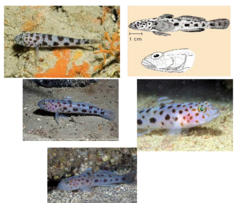
Fish and invertebrates
 Call Kai
 Learn
Learn Practice Test
 Spaced Repetition
 Match
Match Flashcards
 Knowt Play
1/149

There's no tags or description
Looks like no tags are added yet.
Name | Mastery | Learn | Test | Matching | Spaced | Call with Kai | Chat |
|---|
No analytics yet
Send a link to your students to track their progress
150 Terms
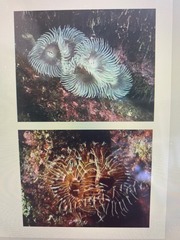
Bispira volutacornis
Twin fanworm
- Approximately 10 cm with 3 cm fan diameter
- Two retractile spiral branchial crowns
- The tube of the fan worm is made up of a silt- mucoid outer layer and usually has either a green, purple or brown colouration
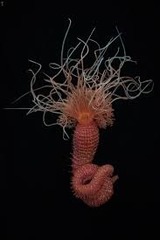
Eupolymnia nebulosa
Spaghetti worm
- Up to 25 cm long
- Body yellowish or orange with white markings and the tentacles are milky white
- Long and tubular, with many long tentacles at one end
- Usually only tentacles show
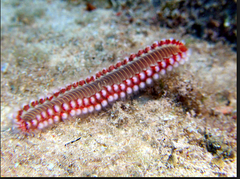
Hermodice carunculata
bearded fireworm
- Reaches a length of 35cm and the thickness of a
finger
- Varies in colour from green to red with tufts of bristles which causes severe irritation not unlike a bad burn when touched.
- Feeds on many invertebrates such as anemones and also any dead animal on the bottom of the sea. Also known as fireworm
- It has hollow bristles along each side which are filled with venom and if disturbed, the bristles become flared so that they become more exposed.
- The setae can easily break off and penetrate flesh if touched, with the venom causing an intense burning irritation
Myxicola infundibulum
slime tube worm
- Up to 20 cm long.
- Usually pale purple or greyish-white in colour.
- Tube rarely protrudes above ground level.
- Has about 60 tentacles
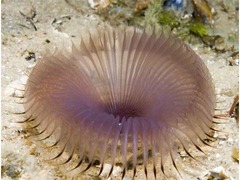
Protula tubularia
Red-spotted horshoe worm
- Fan is normally around 50mm in diameter.
- The most common tube worm.
- Has a white or pale cream tube. The fan ranges in colour from orange to red.
- Body has 120 posterior segments
- The head is reduced and has two gill lobes, each with 20- 45 white or pinkish spiralled tentacles in two rows
- It has paired red blotches and numerous eyespots
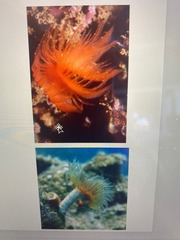
Sabella pavonina
Peacock worm
- Up to 30 cm long and up to 4mm wide
- Tube projects 10cm above surface
- Crown is composed of two semi- circular red, purple or white with dark striped lobes joined at the base with a membrane
- The body is orange to dull purple
- The tube is constructed from mud and sand particles held together with mucus
- Body divided into 100-600 segments
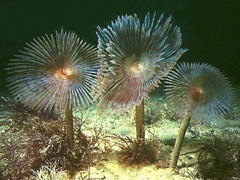
Sabella spallanzanii
- The biggest tube worm in the Mediterranean,
up to 40cm.
- Has an easily identifiable double tiger-like spiral
crown.
- The tube of the worm is semi-hardened mucus, which is secreted by the worm as it grows.
- It is often covered by many small organisms and becomes wrinkled towards the base
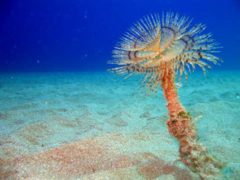
Bonellia viridis
Green spoonworm
- Females 1.5m, males 3mm
- Female body is walnut sized and covered with papillae
- Proboscis only extended at night when the two lobes at the end collect organic particles from the bottom.
- Can reach 100 cm
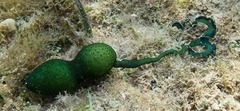
Calcinus tubularis
Tube hermit crab
- Up to 9mm in length
- Body colour red but the end of the legs white with red points.
- Can be found inhabiting empty shells, tubes of annelids and in holes made in rocks by the perforant spongi.
- Beneath the eyes are 2 pairs of antennae, the first pair being blue in colour and the pair beneath that being long and striped red and white
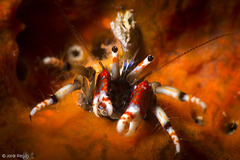
Clibanarius erythropus
Hermit crab
Carapace length 15mm
Body colour is a greenish-brown and the antennas and legs are red or orange.
Prefers shells of Cerithium and O. turbinatus
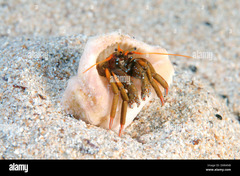
Pagurus anachoretus
Striped hermit crab
- Up to 3 cm
- Tentacles grow up to 12mm
- Overall colour is brown with white stripes, the legs and claws have blue irregular spots, depending on the individuals they highlight the claws.
- The eyes of this species are a distinctive green colour
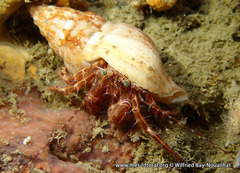
Dardanus arrosor
Mediterranean hermit crab
- Up to 8 cm
- Colour varies from bright red to bright orange
- Short eyestalks, red and white striped
- Blue-green eyes
- Claws are covered in small hair, with the left claw generally more developed
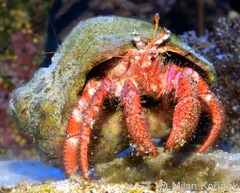
Cinetorhynchus rigens
Mechanical shrimp
- Up to 10 cm
- Elongated body
- Milky colour with red patterns covering its body
- Black eyes with pink pupil nocturnal
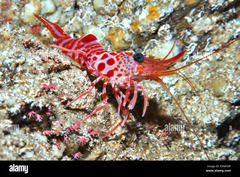
Lysmata seticaudata
Mediterranean cleaner shrimp
- Up to 7 cm
- Elongated red coloured body, with bright red streaks from head to tail
- Has bright blue spots on its back
- Black eyes
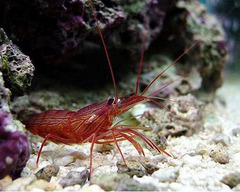
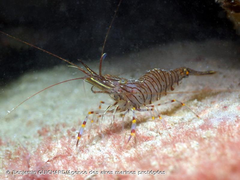
Palaemon elegans
Rockpool shrimp
- Up to 6 cm
- One of the few shrimp active during the day
- Has a variable pattern of golden spots and dark stripes on the transparent body
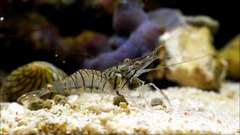
Palaemon serratus
Common prawn
- Up to 11 cm
- P. serratus can be distinguished from P. elegans by the shape of its rostrum and the number of dorsal and ventral rostral teeth
- Long and denticulate face with a transparent body
- Its body is translucent with red/brown lines, which on the carapace are horizontal or oblique and are vertical on the abdomen
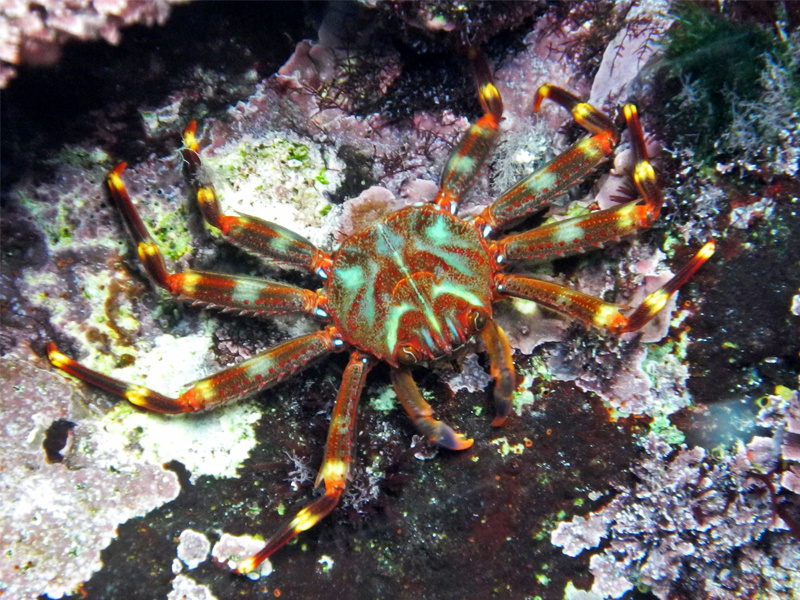
Percnon gibbesi
Nimble spray crab
- Carapace about 4 cm
- Very thin carapace
- Long flattened legs
- Brown with red lines and yellow circles close to articulations
- Invasive species (most invasive decapod crustacean), as native in America, may compete for habitat with Pachygrapsusmarmoratus and Eriphia verrucosa
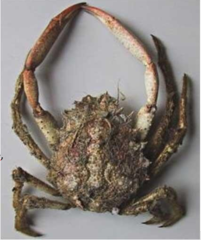
Maja crispata
lesser spider crab
- Carapace ranges from 8-10cm
- Reddish coloration usually covered by algae, large and oval carapace with lateral spines.
- Smaller spines cover the entire dorsal surface.
- Can be characterised by its long slender pereopods (walking legs), the first pair being chelate, and its pear shaped carapace.
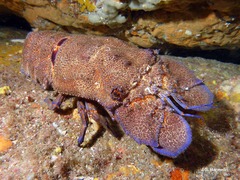
Scyllarides latus
Mediterranean slipper lobster
- Up to 45cm long with a shell width of 12cm
- Brown and reddish body which is typically flat and robust with a large tail which is covered in thick granules and short hairs.
- Antenna have transformed into smooth plates.
Balanus perforatus
Perforated barnacle
- Up to 1 cm, usually form large colonies
- Grey or white colour
- The larvae settles and builds a conical house
around itself
- Shell consists of a ring of overlapping calcareous plates
- Filter feeding at night
- Penis 20x the size of its body

Electra posidoniae
Neptune-grass bryozoan
- Each zooid is about 0.5mm in length
- Epiphyte Encrusting, calcareous elongated colonies formed by flattened zooids running up Posidonia leaves
- The frontal membrane is oval shaped and bordered by spines, the mid proximal spine often being considerably longer than the rest.
- One third of the frontal surface is heavily calcified with very few pores
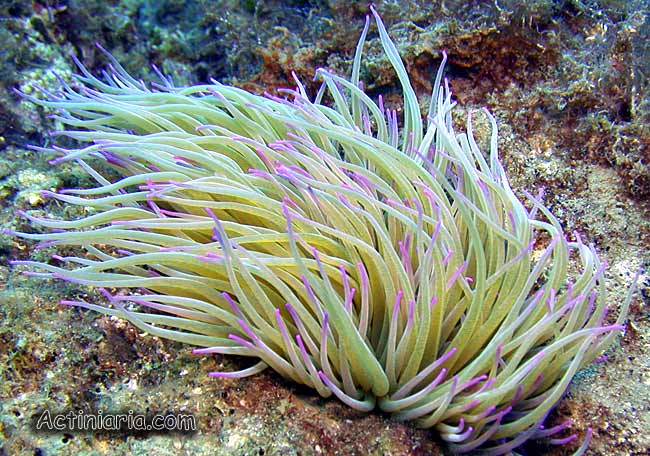
Anemonia viridis
Snakelocks anemone
- Span of tentacles up to 20cm
- Base up to 7cm
- Up to 200 tentacles which range from olive green to white with violet tips, found in large colonies.
- Symbiotic algae called zooxanthellae live in the anemone and contain chlorophyll which gives the anemone its green colour
- Does have a sting but can't penetrate the skin; however, can severely irritate eyes and mouth
Balanophylia europaea
Scarlet coral
- Fairly common up to 1.5cm height,
- Diameter up to 2.5cm
- Common scleractinian coral endemic to the Mediterranean
- Solitary
Aglaophenia sp.
ostrich plume hydroid
- Typically up to 10cm
- Difficult to identify organisms to species level they produce fern or feather-like groups
Eudendrium racemosum
Knob-tipped hydroid
- Up to 12 cm high
- High growth rate, maximum population during summer (as lives in temperate areas) and minimal density during winter
- Form colonies (on average more than 250 polyps per colony)
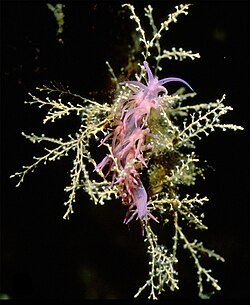
Halocordyle distincha
Christmas tree hydroid
- Up to 5 cm tall
- Green to brown "stem" with bright white beads along the branches
- Has a crude appearance of a tree with a central stem and smaller stems branching off at regular intervals
- Form colonies/ Bright white beads cover branches

Astropecten aranciacus
Red comb star
- Maximum diameter recorded was 55 centimetres however usual size is 30cm
- Reddish orange colour at middle moving to yellowish or white at arm tip
- Medium sized central disk with long pointed arms
long spines along its inferomarginal plates

Astropecten spinulosus
Slender sea star
- Max size is 10 cm in diameter
- Brown, reddish brown and sometimes greenish colour
- Inferomarginal spines are long and pointed
- May have a touch of blue
- Wide central area with 5 wide limbs extending at even intervals

Echinaster sepositus
Mediterranean red sea star
- Usually diameter of 20 cm but can be up to 30 cm
- Red or Red-orange colour
- 5 slender arms around a small central disc
- Soapy texture distinguishes it from Hacelia attenuata
- Surface is dotted with evenly spaced pores
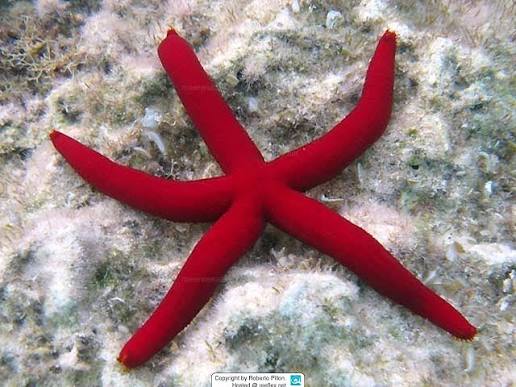
Ophidiaster ophidianus
Purple starfish
- Can grow up to 50 cm
- Brightly coloured ranging from red to orange and dark purple
- 5 long cylindrical, blunt tipped arms
- Rough texture
- Each side of the arms has a double row of short blunt spines and a single row of "club shaped" spines
Abracia lixula
black sea urchin
- Generally around 10-15 cm
- Black colour
- Thick spines often between 3-5cm long and positions regularly
- Has a flattened test
Diadema setosum
Long-spined sea urchin
- Test up to 10cm, spines up to 30cm
- Black test, long and narrow spines (black, white or banded black and white), mildly venomous
- 5 characteristic white dots on its body
- Presence of an orange ring around the sea urchins periprotcal cone
- Invasive species
Paracentrotus lividus
rock sea urchin
- Generally around 10-15 cm
- Purple, green, brown or black colour
- Slightly small spines compared to test size, not arranged as neatly, may cross each other
- May cover themselves in debris due to tube feet with suckers on backside
Sphaerechinus granularis
Purple sea urchin
- Up to 20 cm in diameter
- Test is purple, spines may be tipped with white
- Uniform short length
- They are blunt and arranged neatly in rows
- Often covers itself in algae and shell fragments

Holothuria poli
White spot sea cucumber
- Can grow up to 20cm
- Brown colour with very small white spots at irregular intervals along body
- Cylindrical in shape with a flattened bottom
- May have small spines along surface however much less obvious than Holothuria tubulosa
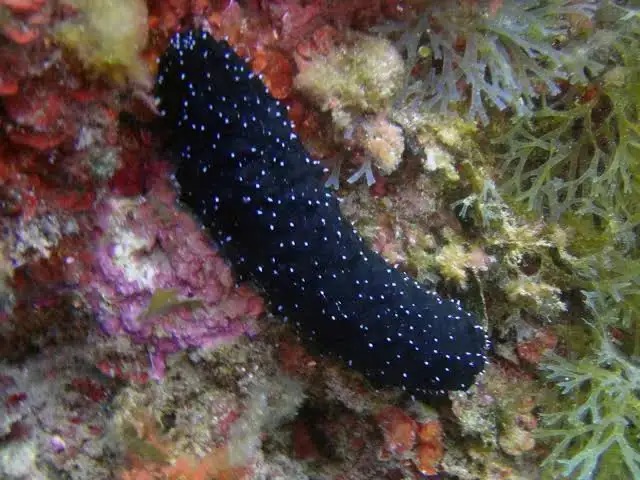
Holothuria sanctori
Variable sea cucumber
- Grow up to 30cm
- Brown-orange/dark brown colour
- Often with large white spots along its body
- Cylindrical with a flattened base
- Sprays copious amounts of sticky threads when provoked

Holothuria tubulosa
tubular sea cucumber
- Usually between 20 cm and 45 with a diameter of 6
- From black to a brownish-grey colour, belly usually lighter
- Roughly cylindrical with a flattened base
- Tough, leathery skin
- Has thorn like projections at irregular intervals down body
Synaptula reciprocans
Worm sea cucumber
- 40-50cm in length
- Dark-brown to black elongated body
- Mouth surrounded by tentacles
- Species distribution highly depends on the water currents
- Invasive species
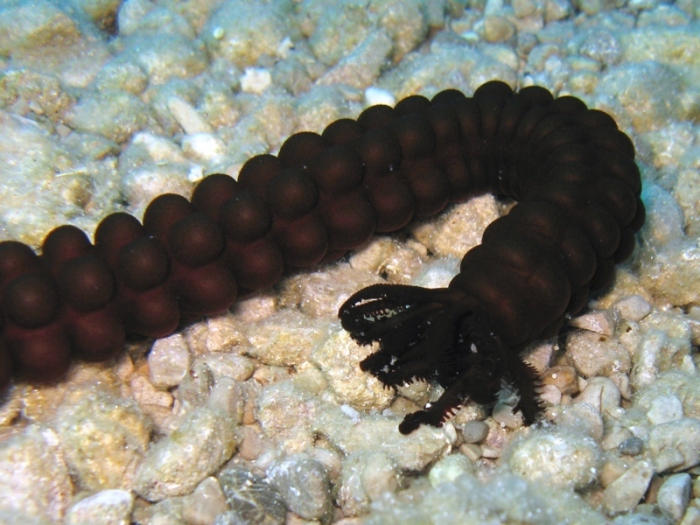
Pinna rudis
Rough pen shell
- Smaller than Pinna nobilis
- Fan-Shaped
- Translucent and Pinkish-Orange
- Low, broad, rounded ribs with scaly projections
interior with nacreous (shiny) layer,

Pinna nobilis
Noble pen shell
- The shell can be up to 1m long
- Triangular equivalve with a rounded dorsal side tapering to a point that is buried vertically in the sand.
- Scaly structure is seen on younger shells, which is worn or eroded in older individuals.
- It is the biggest bivalve in the Mediterranean

Loligo vulgaris
European squid
- 75cm in length, maximum weight of 1.5kg
- Tapering muscular body ending in a triangular lateral fins, has a small head with eight arms and two extendable tentacles.
- Arms have two rows of suckers and tentacles have four rows on the tips.
- Has the ability to mimic colours.

Octopus vulgaris
Common octopus
- Usually measures around 70cm but may reach a maximum of 3m
- Large globular head with two developed eyes is distinct from the rest of the body.
- Eight tentacles with double rows of suckers form the body.
- The skin can emit protuberances of different size and aspect resulting in well-developed mimicry behaviour.
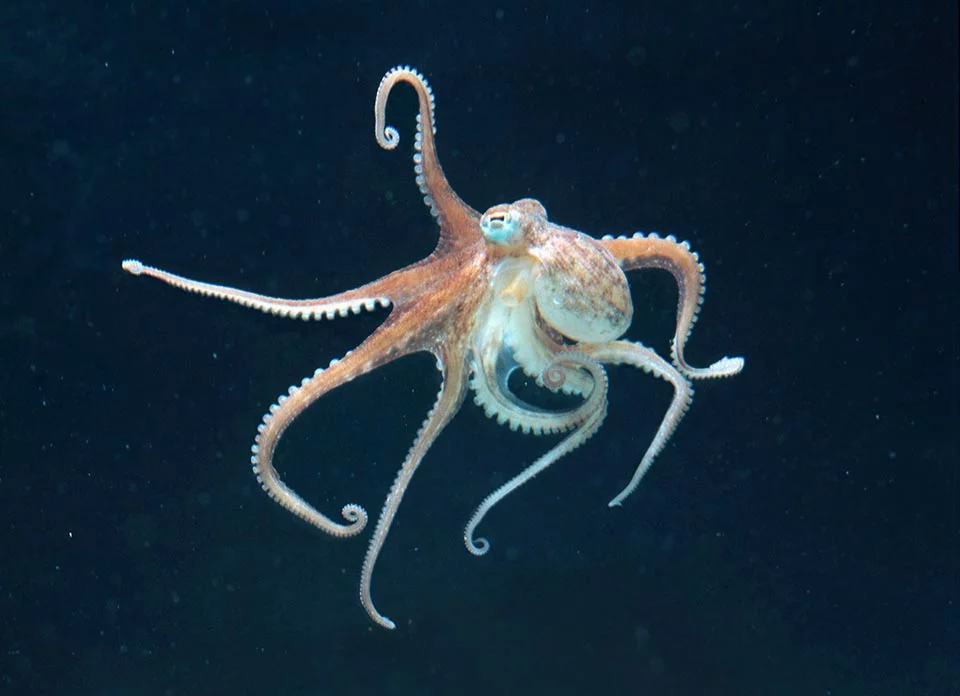
Sepia officinalis
Cuttlefish
40cm in length, tentacles can double this, approximately 2kg in weight
Oval shaped with a well developed head and a prominent dorsal lobe between the eyes.
Attached to the head are 8 arms with 4 rows of suckers.
The flat body is surrounded by an undulating fin used for swimming
Felimare picta
Regal sea goddess nudibranch
- Up to 13cm (one of the largest species of chromodorididae in Europe)
- Usually dark blue, sometimes pale blue, smaller species have the edge of their mantle white and a yellow band in the middle of the back
- Elongated body, quite narrow mantle feeds on sponges (genus Dysidea)
Cerithium sp
Small sea snails
- Maximum length 7cm
- Easy to identify at genus level due to elongated body shape but difficult for individual species

Zebrus zebrus
Zebra Goby
Sphyraena viridensis
Yellowmouth barracuda
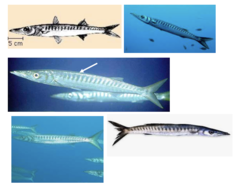
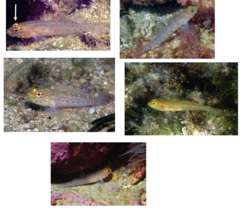
Gobius xanthocephalus
Yellow-mouthed goby
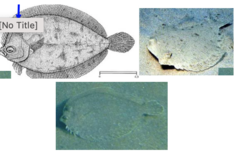
Bothus podas
Wide-eyed flounder
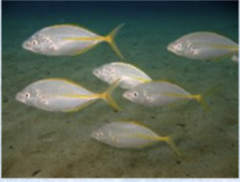
Pseudocaranx dentex
White trevally
Diplodus vulgaris
Two-banded seabream

Diplodus sargus sargus
White seabream

Epinephelus aeneus
White grouper

Parablennius gattorugine
Tompot blenny
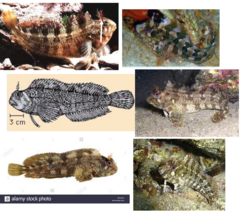
Tripterygion tripteronotum
Threefin blenny

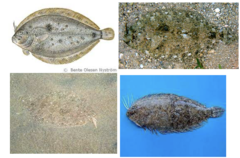
Arnoglossus thori
Thor's scaldfish
Parablennius tentacularis
Tentacled blenny

Anthias anthias
Swallowtail seaperch

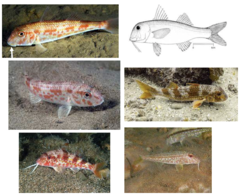
Mullus barbatus barbatus
Striped mullet
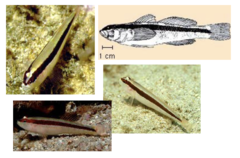
Gobius vittatus
Striped goby
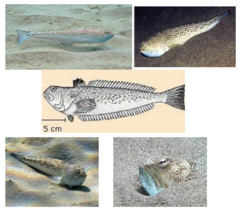
Trachinus radiatus
Streaked weever
Gobius auratus
Steven's goby

Uranoscopus scaber
Stargazer

Trachinus araneus
Spotted weever
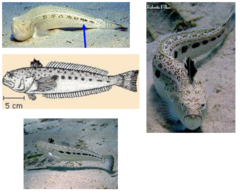
Scorpaena notata
Small red scorpionfish
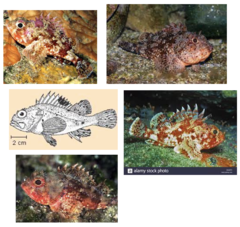
Gobius geniporus
Slender goby
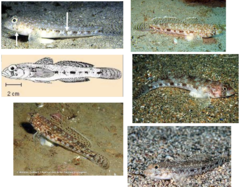
Lepadogaster lepadogaster
Shore clingfish
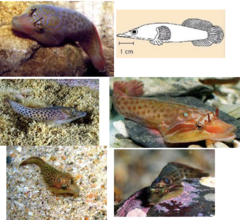
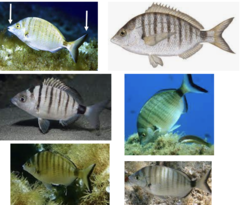
Diplodus puntazzo
Sharpsnout seabream
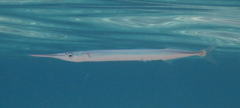
Belone belone
Sea Needle
Arnoglossus laterna
Scaldfish

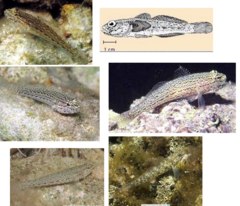
Gobius fallax
Sarato's goby
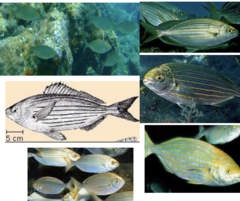
Sarpa salpa
Salema
Oblada melanura
Saddled seabream

Parablennius sanguinolentus
Rusty blenny

Gobius paganellus
Rock goby
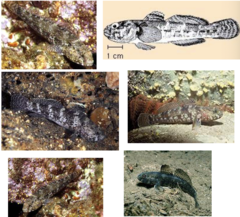
Gobius cruentatus
Red-mouthed goby

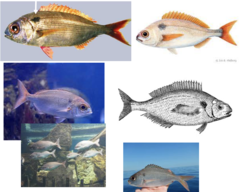
Pagellus bogaraveo
Red seabream
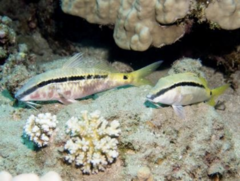
Parupeneus forsskali
Red sea goatfish
Mullus surmuletus
Red mullet

Parablennius zvonimiri
Red blenny
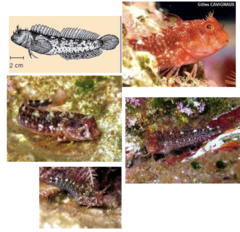
Tripterygion melanurus
Pygmy dark-faced blenny
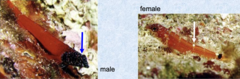
Trachinotus ovatus
Pompano
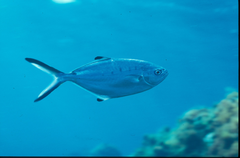
Symphodus rostratus
Pointed-snout wrasse
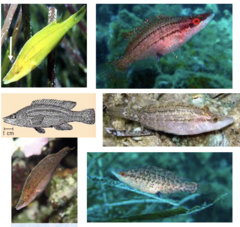
Spicara smaris
Picarel
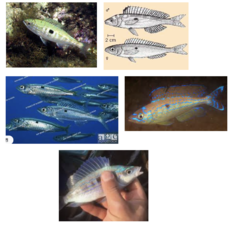
Symphodus tinca
Peacock wrasse
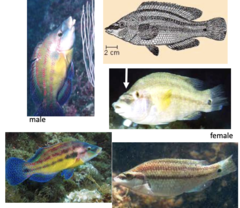
Sparisoma cretense
Parrotfish

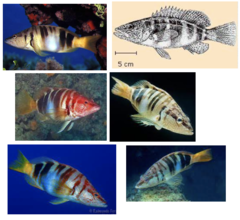
Serranus scriba
Painted comber
Thalassoma pavo
Ornate wrasse

Symphodus ocellatus
Ocellated wrasse

Parablennius incognitus
Mystery blenny
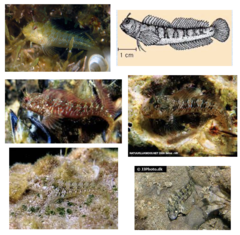
Muraena helena
Mediterranean moray

Coris julis
Mediterannean Rainbow Wrasse

Siganus rivulatus
Marbled spinefoot
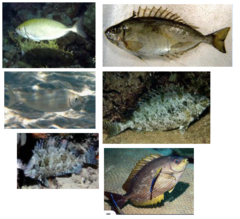
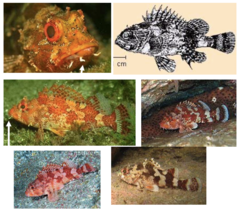
Scorpaena maderensis
Madeira rockfish
Parablennius rouxi
Longstriped blenny

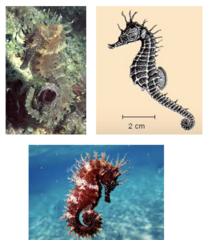
Hippocampus guttulatus
Long-snouted seahorse
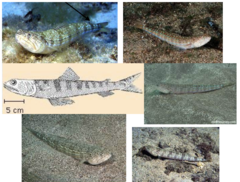
Synodus saurus
Lizardfish
Pterois miles
Lionfish

Echiichthys vipera
Lesser Weever

Thorogobius ephippiatus
Leopard-spotted goby