Lecture 7 - TCA cycle I
 Call Kai
 Learn
Learn Practice Test
 Spaced Repetition
 Match
Match Flashcards
 Knowt Play
1/11

There's no tags or description
Looks like no tags are added yet.
Name | Mastery | Learn | Test | Matching | Spaced | Call with Kai | Chat |
|---|
No analytics yet
Send a link to your students to track their progress
12 Terms
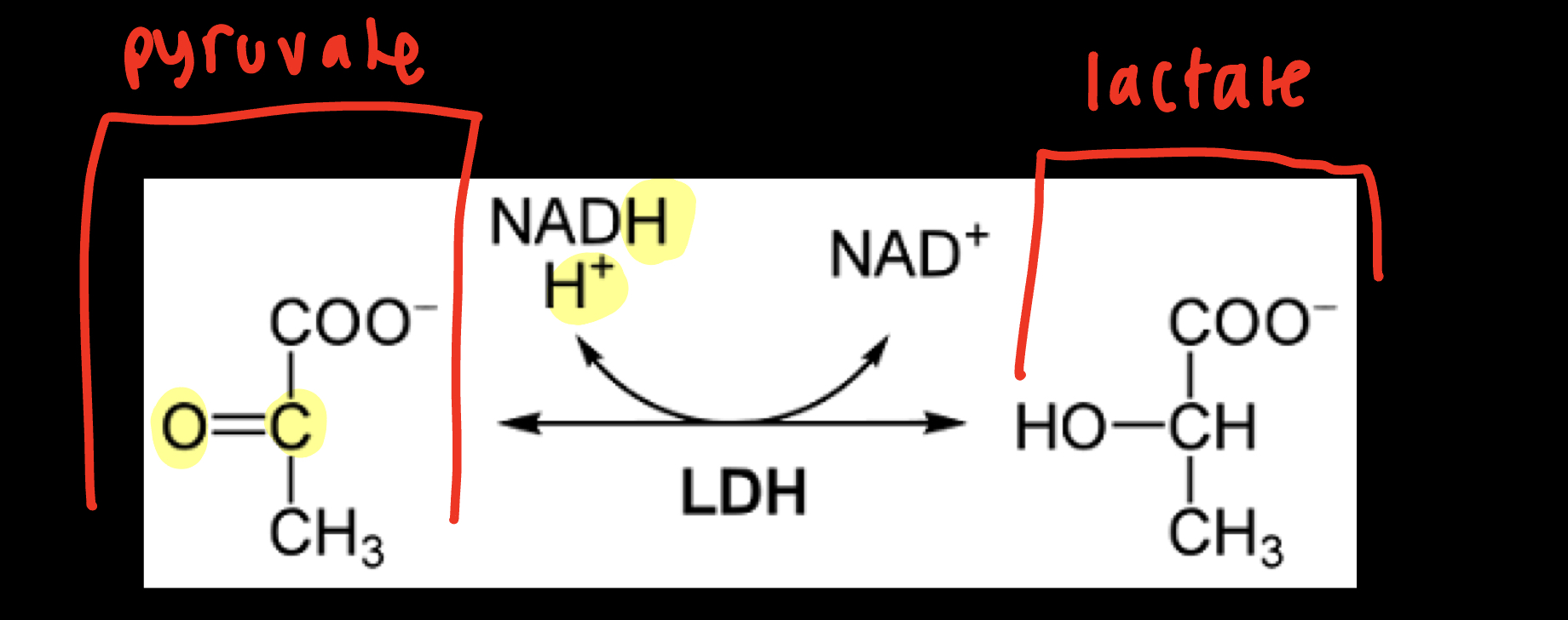
What is the reaction for pyruvate → lactate? What is its purpose? Explain it.
Purpose: Regenerate NAD+ for the GADPH rxn in the cytosol
This process lowers the pH of your muscles, causing aches
lactase dehydrogenase (LDH) catalyzes this rxn
Process explained:
H from NADH attacks the C from the C=O in pyruvate
The H+ is taken by the oxygen from C=O in pyruvate
Lactate is formed
Formula: pyruvate + NADH+ H^+ ⇌ lactate + NAD^(+)
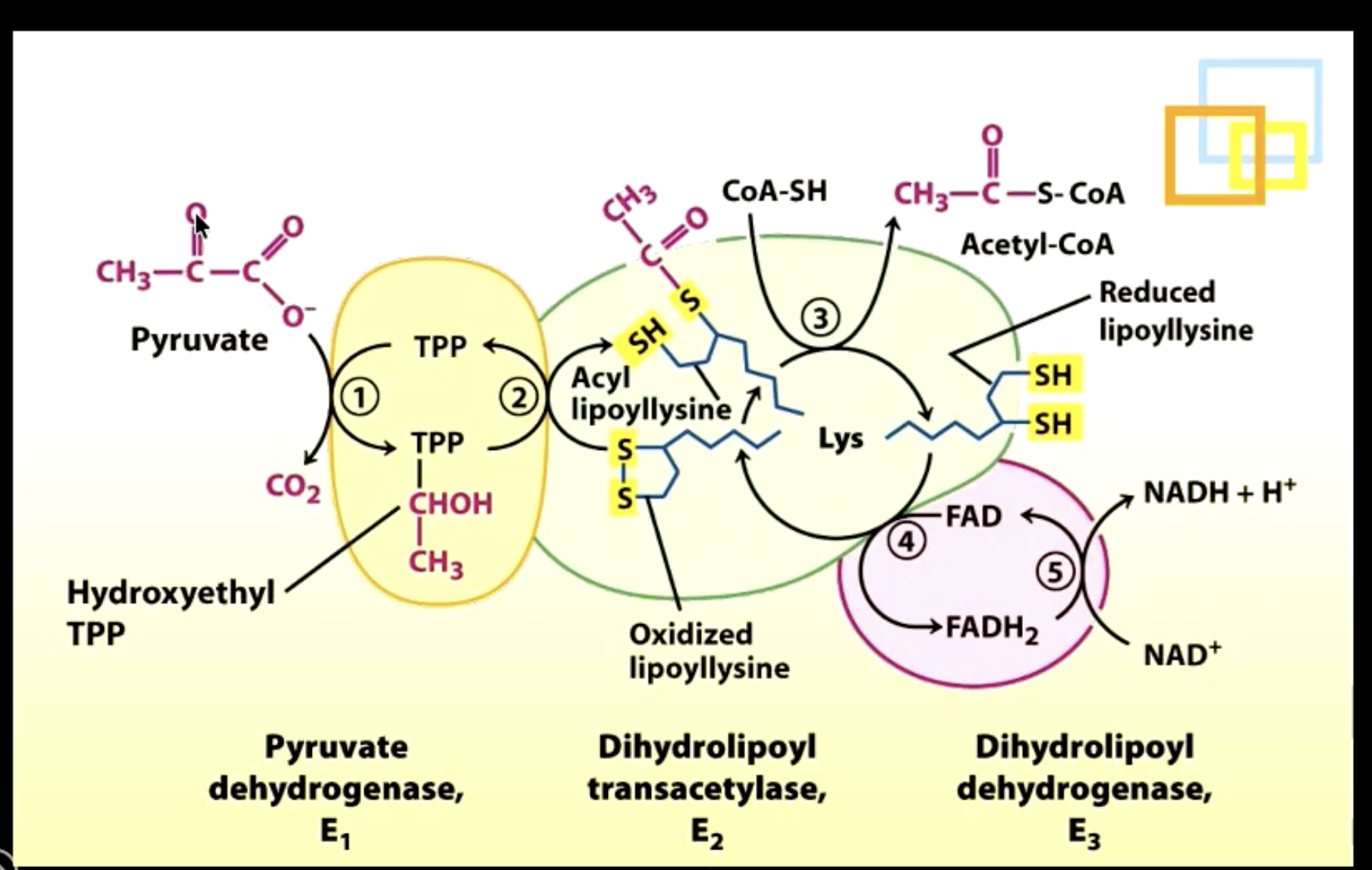
Explain the entire reaction for pyruvate → acetyl-CoA
Pyruvate dehydrogenase consists of 3 subunits that help catalyze the reaction.
E1 (step 1)
Overall: TPP + pyruvate → hydroxyethyl-TPP complex
1) O-C-O of pyruvate leaves as CO2 (TPP helps this process)
2) TPP and pyruvate bond → hydroxyethyl-TPP complex forms
E2 (step 2)
Overall: hydroxyethyl-TPP complex + lipoamide → TPP + acetyllipoamide
1) hydroxyethyl-TPP complex is oxidized by lipoamide (lipoamide takes away electrons from the acetyl group of hydroxyethyl-TPP complex)
E2 (step 2, continued)
Overall: CoA + acetyllipoamide → acetyl-CoA + dihydrolipoamide
1) cetyl group from acetyllipoamide is transferred to CoA
E3 (step 3)
Overall: dihydrolipoamide + FAD → lipoamide + FADH2 → NADH + (H+) + FAD
1) FAD oxidizes dihydrolipoamide → FADH2
2) FADH2 transfers electrons to NAD+ → forms NADH, (H+), FAD
*Lipoyl arms facilitate the transfer of electrons
n/a
n/a
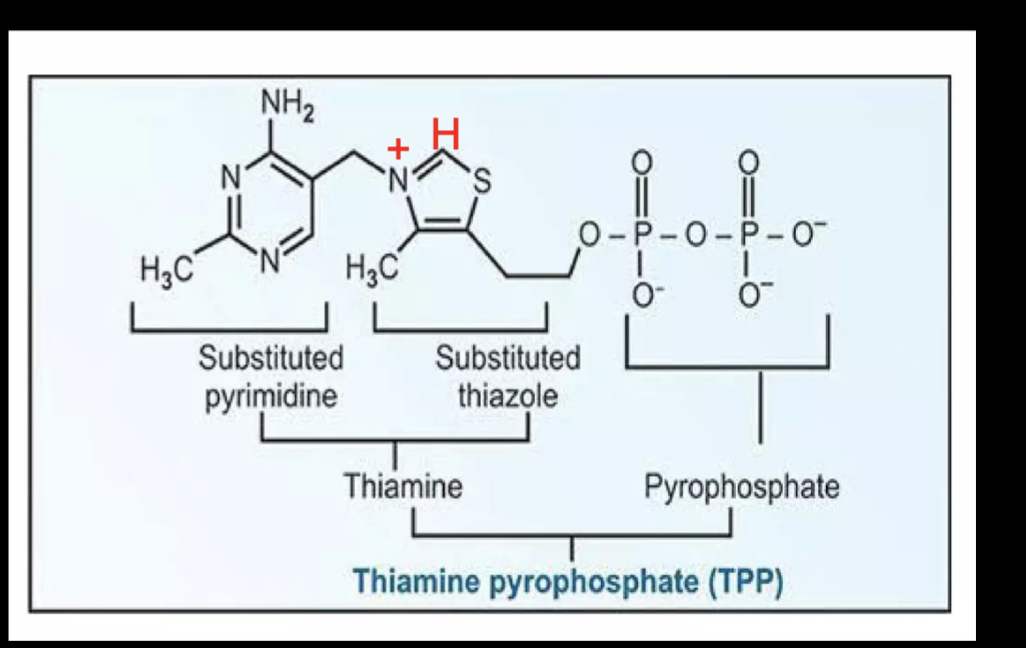
What is TPP?
Coenzyme that helps catalyze steps in the rxn of pyruvate → acetyl-CoA
Carbon between N and S is highly acidic, stabilized by the N
highly nucleophilic carbon
thiazole ring
Pyrimidine
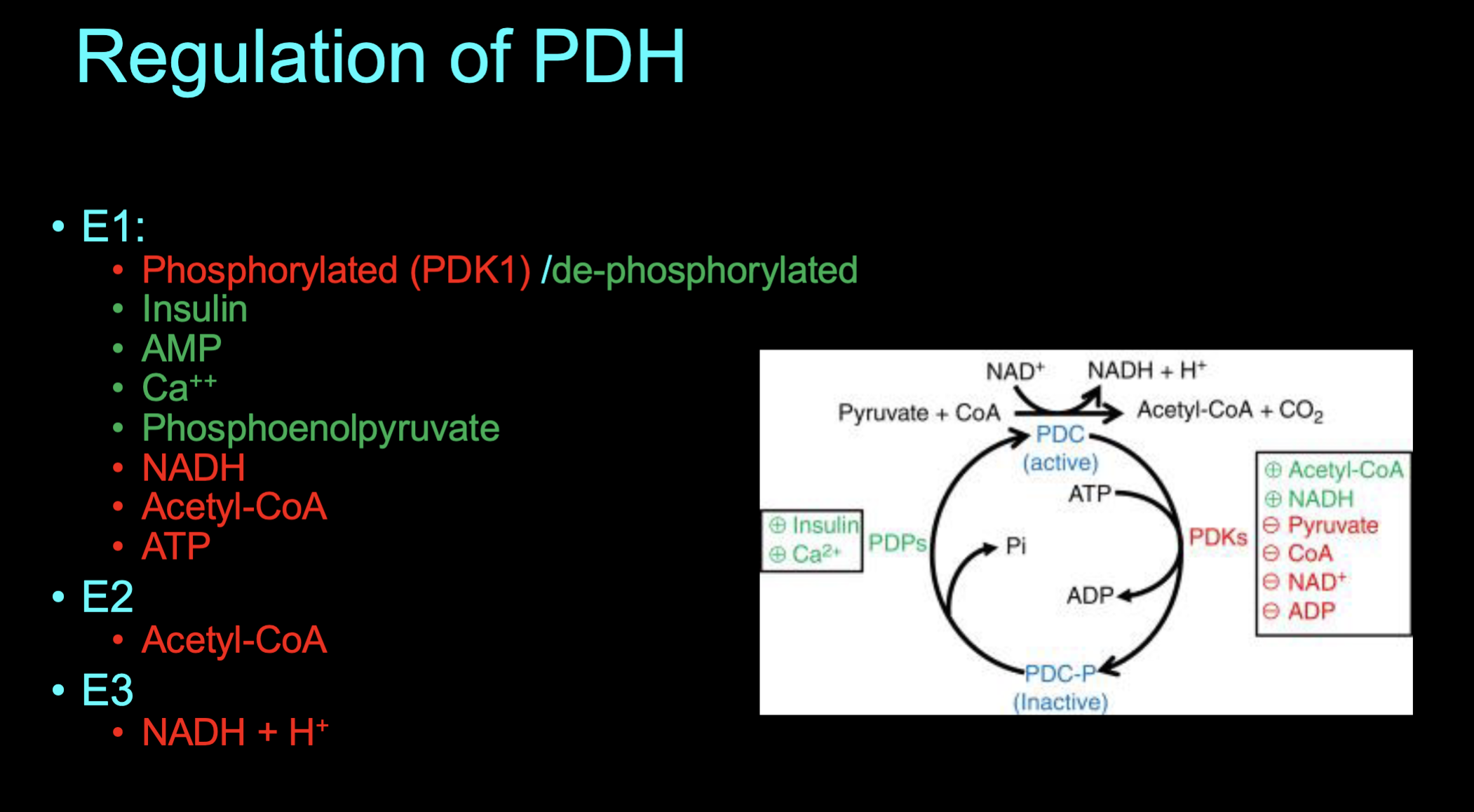
Explain the reasons behind each regulation (red = inhibition, green = activation)
phosphorylation (done when there are conditions where it is not necessary to use energy) → if the cell has enough energy, there is no reason to convert pyruvate to acetyl-CoA (inhibits)
de-phosphorylation → increases acetyl-CoA if energy is needed (activation)
Insulin → high insulin → promotes glucose uptake/glycolysis → pyruvate and acetyl-CoA production increases (activation)
AMP → signals to cells it needs more energy (done if there is not enough ATP) (activator)
Ca++ → During muscle contraction, Ca++ increases → so it signals that cell needs energy for muscle to contract (activator)
NADH → if high concentration, it means the cell has enough electrons available, and there are fewer molecules available to accept electrons (inhibitor)
acetyl-CoA → if there is enough acetyl-CoA, the cell doesn’t need more (inhibitor)
ATP → if there is enough ATP, the cell doesn’t need to use glucose for no reason (inhibitor)
What are four reasons why acetyl-CoA is so big when it only carries a small 2-carbon acetyl?
Enzymes with big active sites recognize the large CoA part
CoA is big, so it helps enzymes regulate what gets in and out
The polar regions of acetyl-CoA make it soluble in aqueous environments
The adenine-ribose tail in acetyl-CoA can interact with other co-enzymes that also have the tail
Warburg Effect
Cancer cells have a tendency to make lactate even with sufficient oxygen available → results in increased glucose consumption
Explain the reaction of pyruvate → transamination to alanine + the reason we do this
Reasons we do this:
alanine can be passed through the blood to the liver (shuttles carbon whcih can be converted back to pyruvate for gluconeogenesis)
Alanine takes up free amino groups that can be toxic
Process:
Pyruvate’s C=O receives an amino group (NH2) from glutamate → alanine forms
Reaction:
pyruvate + glutamate ⇌ alanine + alpha-ketoglutarate
Transamination
Exchanges of an amine + hydrogen for an oxygen
Explain the pyruvate → oxaloacetate reaction. What is its purpose?
Purpose: to start gluconeogenesis
Overall rxn: Pyruvate + HCO₃⁻ + ATP → Oxaloacetate + ADP + Pi
Process:
CO2 is added to pyruvate so that one more carbon is added → oxaloacetate forms
this is an anaplerotic process and driven by pyruvate carboxylase
anaplerotic reactions
Reactions that replenish citric acid cycle intermediates
Explain the reaction of pyruvate → acetaldehyde → ethanol. What is its purpose?
Purpose: to regenerate NAD+ under anaerobic conditions
CO2 is removed from pyruvate, acetaldehyde and CO2 formed (via pyruvate decarboxylase)
NADH becomes NAD+, acetaldehyde reduced to ethanol (via alcohol dehydrogenase)
Overall rxn: Pyruvate + NADH + (H+) → ethanol + CO2 + NAD+