graded potential
 Studied by 3 people
 Call Kai
 Learn
Learn Practice Test
 Spaced Repetition
 Match
Match Flashcards
 Knowt Play
1/28

There's no tags or description
Looks like no tags are added yet.
Name | Mastery | Learn | Test | Matching | Spaced |
|---|
No study sessions yet.
29 Terms
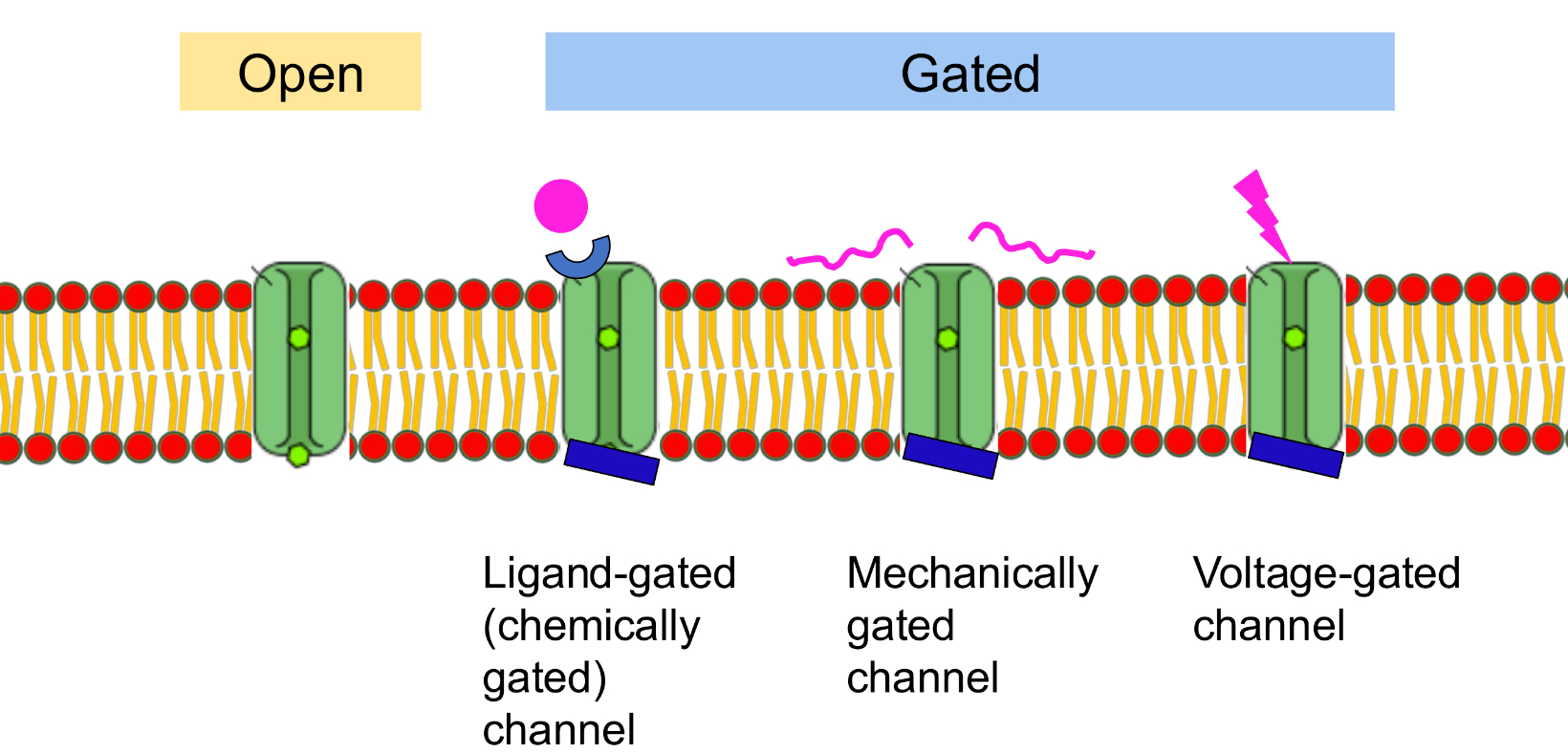
main way to change the membrane potential in an average cell
Increase permeability to ion
- by opening existing channels. These
channels are gated (can be voltage-gated).
Could decrease too
Channel mediated facilitated diffusion
All passive
Na+ channels open
Vm decreases, more positive, and depolarizes
Na increase
K+ channel closes
K+ decreases
Vm decreases, more positive and depolarizes
K+ channels open
K+ increase
Vm increases, more negative, and hyperpolarizes
Cl- channel opens
Vm increases, more negative, hypolarizes
Ca2+ opens
Vm decreases, more positive, depolarization
significance of changing the membrane potential?
It is how electrical signals are sent
Two types of electrical signals
Graded potential
Action potential
To continue the electrical signal:
Depolarizing Graded Potential initiates Action Potential
To stop the electrical signal:
Hyperpolarizing Graded Potential
Graded potential
• IN A NEURON, usually occurs in dendrites or
cell body
• Variable in amplitude
• Hyperpolarizing or depolarizing
• Dissipates over time/distance
• Can summate
Directly uses ligand- or mechanically-gated channels
Graded potential begins with
Depolarizing or Hyperpolarizing with a change in permeability to an ion!
Subthreshold
A graded potential starts above threshold (T) at its initiation point, but decreases in strength as it travels through the cell body. At the trigger zone it is below threshold and therefore does not initiate an action potential.
Suprathreshold
A stronger stimulus at the same point on the cell body creates a graded potential that is still above threshold by the time it reaches the trigger zone, so an action potential results.
Made by summation
Spatial summation
Summation of several subthreshold signals results in action potential
Temporal summation
When two graded potentials from one presynaptic neuron occur close together in time
No summation: Two subthreshold graded potentials will not initiate an action potential if they are far apart in time.
Summation causing action potential: If two subthreshold potentials arrive at the trigger zone within a short period of time, they may sum and initiate an action potential.
Threshold
the minimum Vm required to open voltage-gated Na+ channels
A suprathreshold graded potential at the axon hillock causes an action potential
Action potential
• IN A NEURON, usually begins at axon hillock
• Occurs only in axon
• “All-or-none”
• Has threshold
• Regenerative: occurs over and over again, down the axon
• Does not vary in amplitude: so it does not get lost in axon
• Does not summate
Mostly uses voltage gated channels
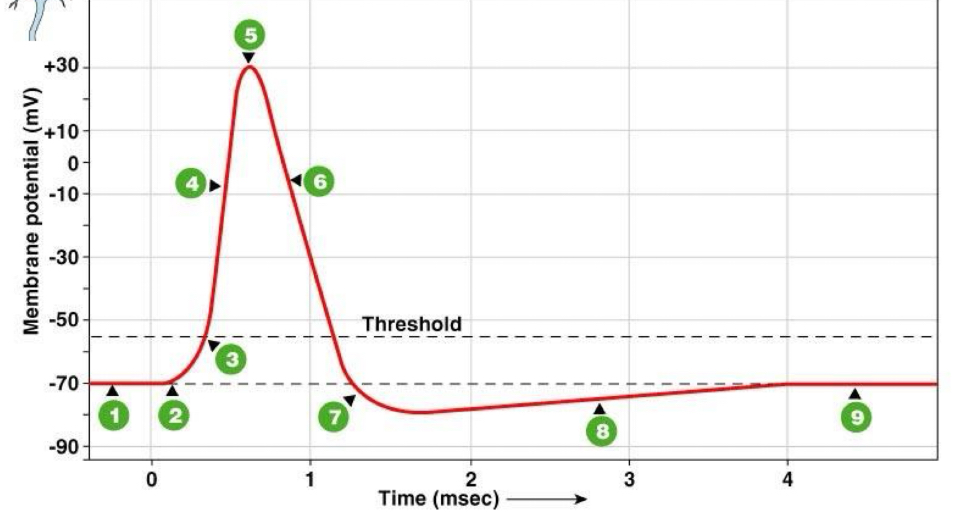
Resting membrane potential
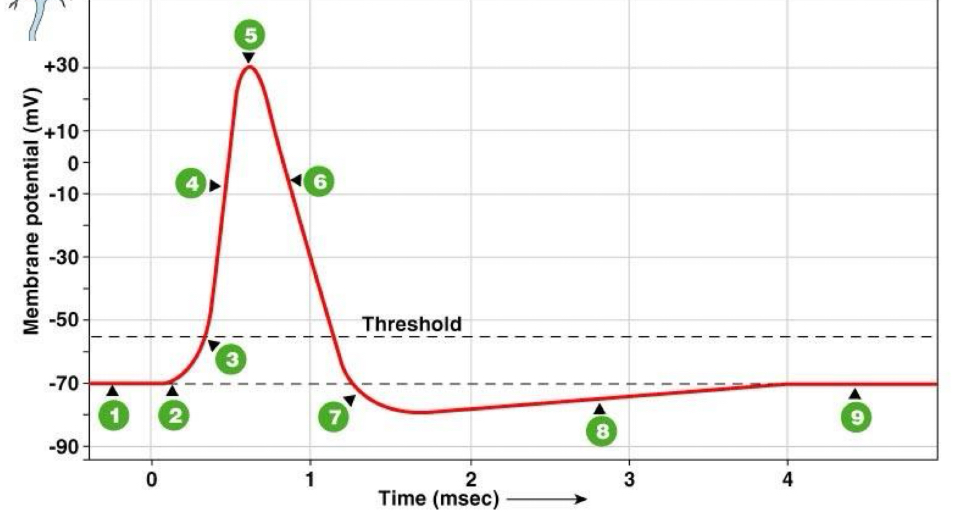
Depolarizing stimulus
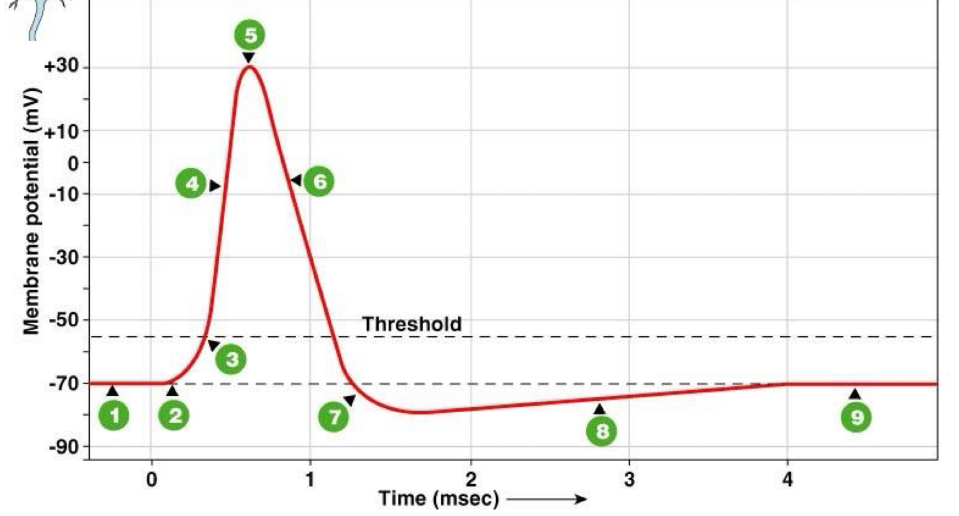
Membrane depolarizes to threshold.
Voltage-gated Na* channels open and Na* enters cell. Voltage-gated K+ channels begin to open slowly.
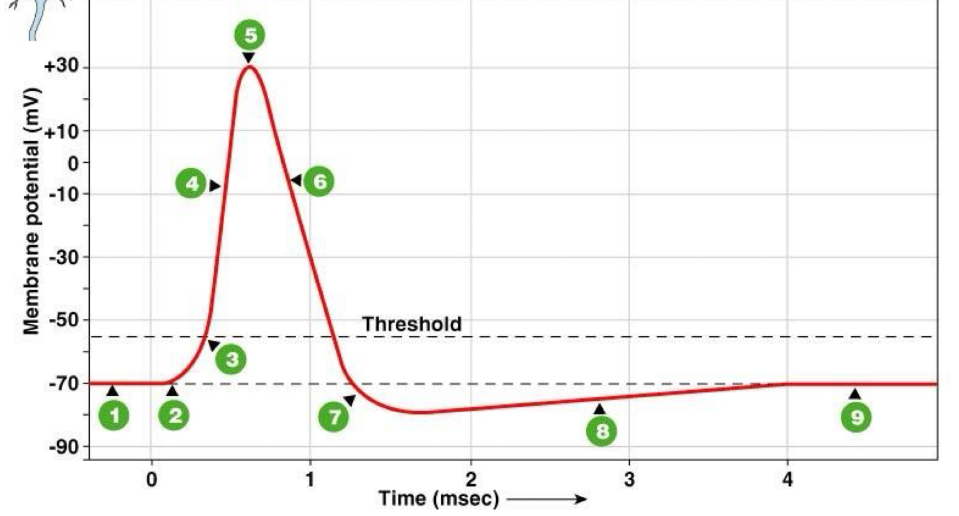
Rapid Na* entry depolarizes cell.
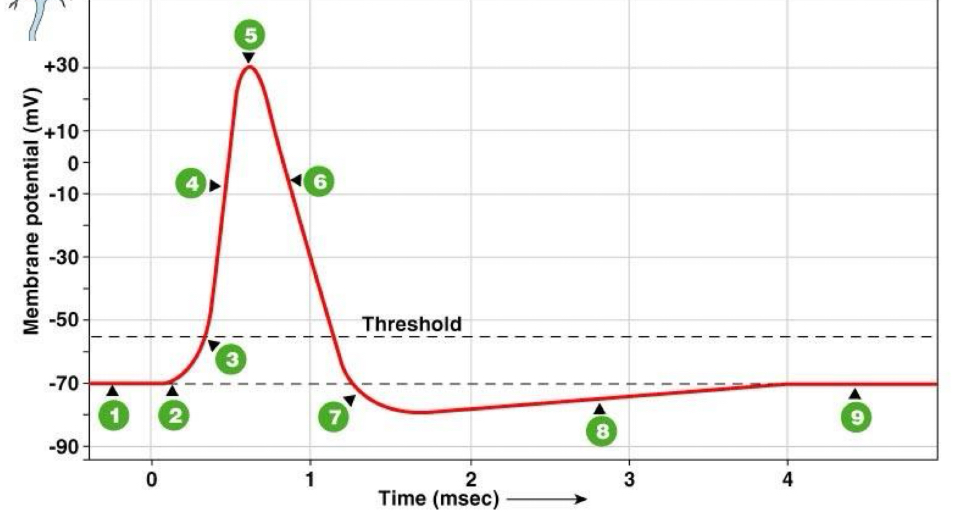
Na+ channels close and slower k+ channels open
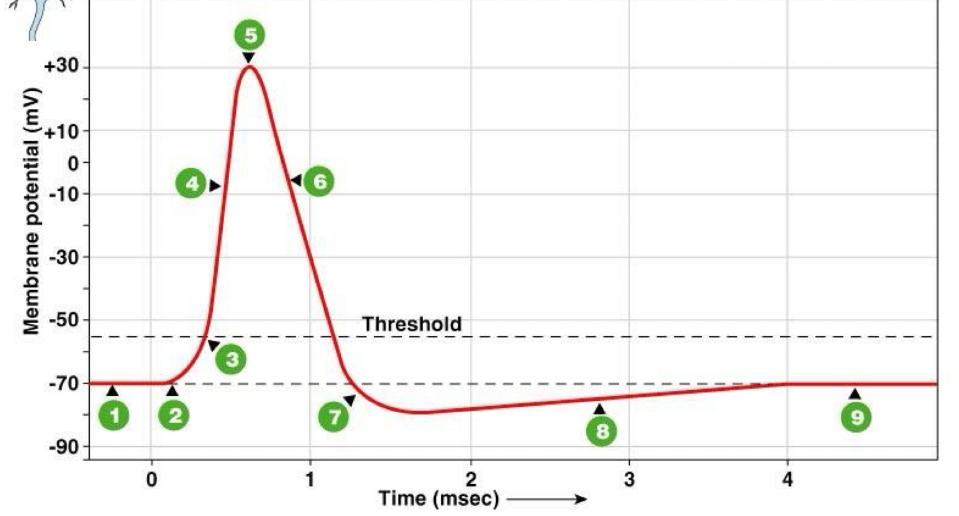
K+ channels remain open and additional K* leaves cell, hyperpolarizing it.
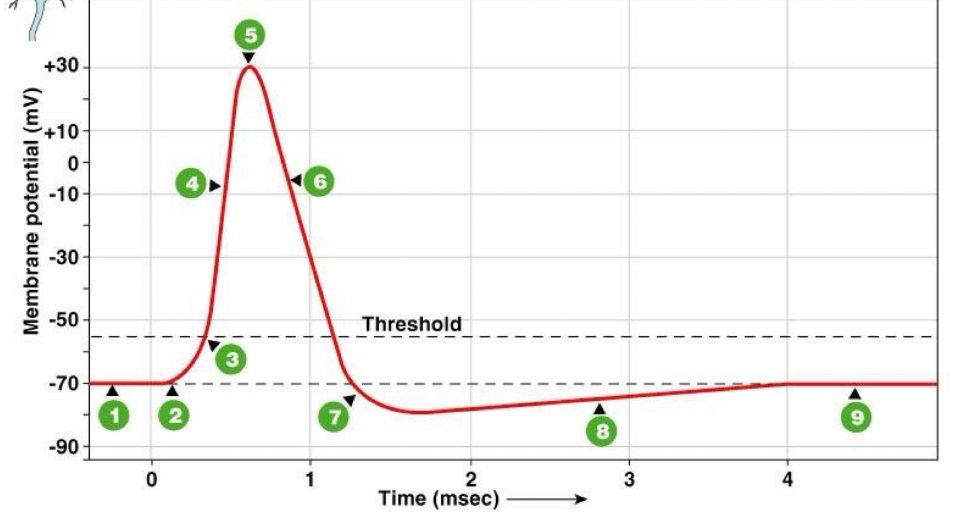
Voltage-gated K* channels close less K* leaks out of the cell
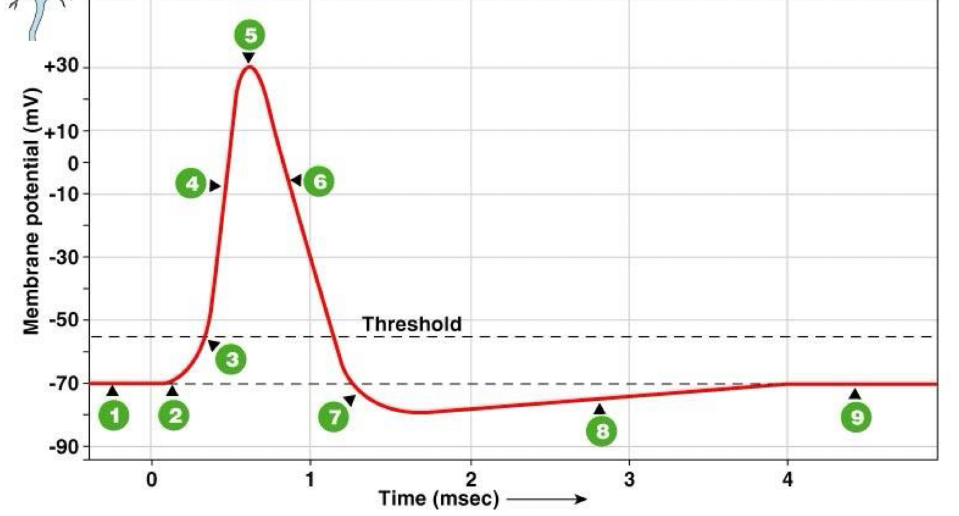
Cell returns to resting ion permeability and resting membrane potential.
Signal is unidirectional because of
refractory period: once region has action potential go into it it will no longer have action potential going thru that region again
Signal spread by
Local current flow: change in membrane potential changes charge. in adjacent region so copy of signal can persist