P4.1 Simple phenomena of magnetism
 Call Kai
 Learn
Learn Practice Test
 Spaced Repetition
 Match
Match Flashcards
 Knowt Play
1/10

There's no tags or description
Looks like no tags are added yet.
Name | Mastery | Learn | Test | Matching | Spaced | Call with Kai | Chat |
|---|
No analytics yet
Send a link to your students to track their progress
11 Terms
Describe the force between magnetic poles
Opposite poles (N and S) attract
Like poles (N and N or S and S) repel
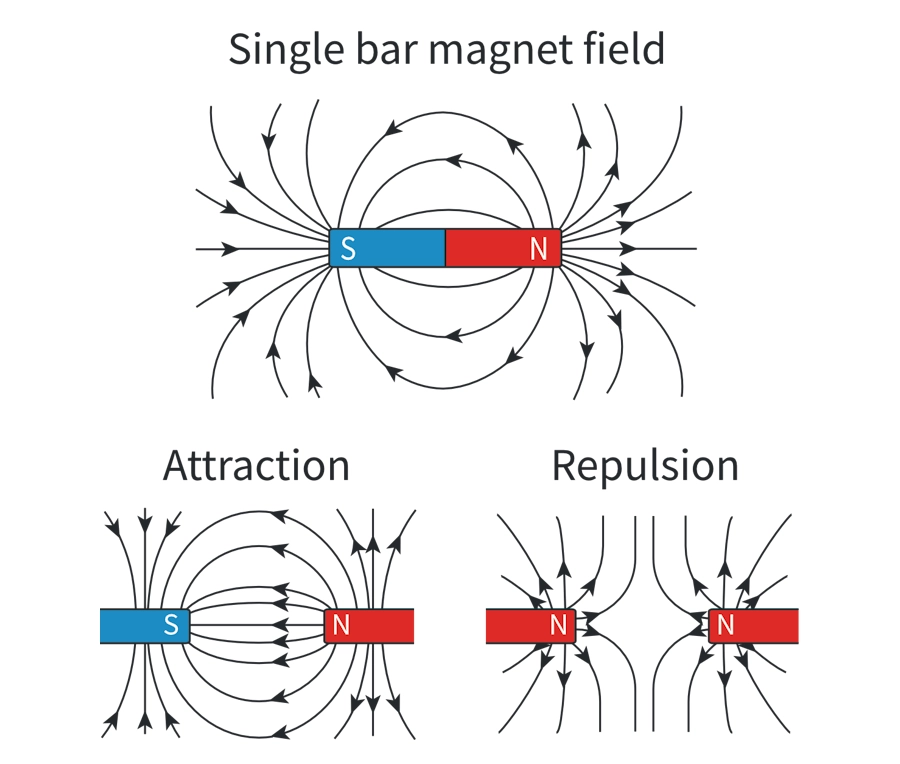
What is a magnetic field?
A region of space where another magnet or magnetic material experiences a force
All magnets are surrounded by magnetic fields
Draw a magnetic field diagram
Describe induced magnetism
Magnetic materials only attract to each other if theres a permanent magnet present
Once a permanent magnet attracts a magnetic material, it induces a magnetic field in the material
This is called induced magnetism
How do you induce magnetism in a material?
Stroking them with a magnet in one direction
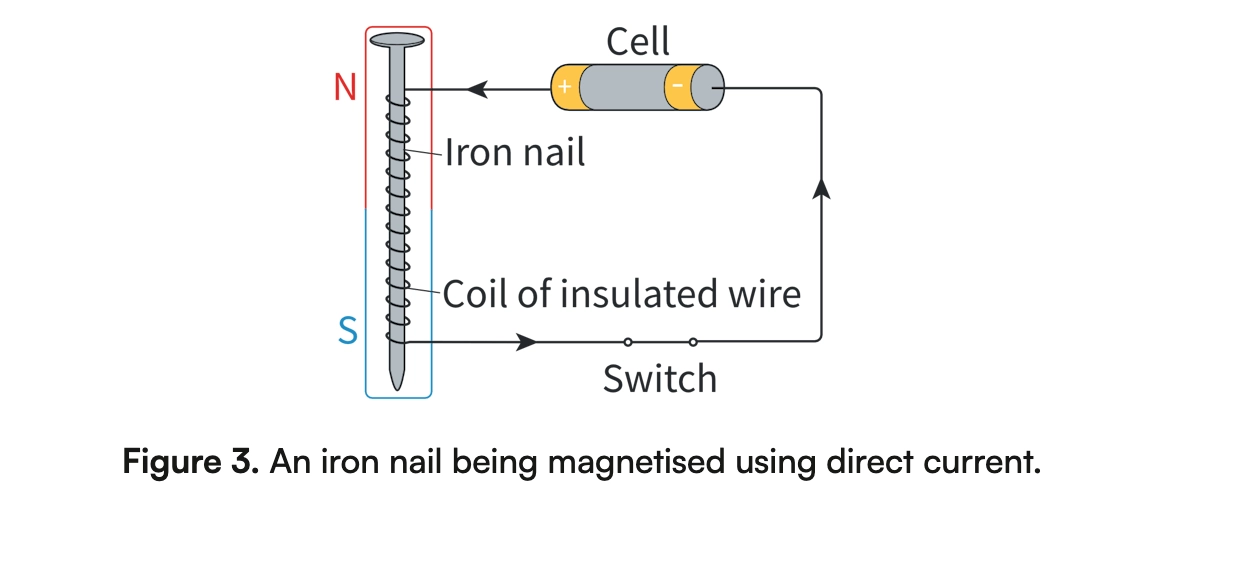
Using a d.c coil
Hammering in a magnetic field (in north → south orientation)
How do you demagnetise a material?
Hammering or heating: causes particles to unalign and lose magnetic properties
Use of an a.c coil: causes domains to point in different directions
What is the difference between a magnetic and non-magnetic material?
Magnetic materials:
Strongly attracted to magnets
Can be magnetized to form permanent magnets
Have magnetic domains which are aligned with an external field
Non-magnetic materials:
No attraction or weak repulsion to magnets
Cannot be magnetized
Do not have magnetic domains at all
What are the properties of a temporary magnet and some examples?
Easy to magnetise and unmagnetise
Soft magnetic materials:
Iron
Cobalt
Nickel
Mumetal
What are the properties of a permanent magnet and some examples?
Difficult to magnetise and unmagnetise
Hard magnetic materials:
Steel
Alcomax
Magnadur
What is an electromagnet?
Magnet whose magnetic field is produced by an electric current flowing through a coil
Only creates magnetic field when current passes through it
State differences between electromagnets and permanent magnets
Permanent magnet | Electromagnet |
Constant magnetic field | Temporary magnetic field which can vary in strength by adjusting the current |
Cannot be switched on or off | Can be switched on and off quickly |
North and south poles cannot be swapped | North and south poles can be changed by switching direction of current flow |