Experiment 6 - 10 and quizzes
 Call Kai
 Learn
Learn Practice Test
 Spaced Repetition
 Match
Match Flashcards
 Knowt Play
1/46

There's no tags or description
Looks like no tags are added yet.
Name | Mastery | Learn | Test | Matching | Spaced | Call with Kai | Chat |
|---|
No analytics yet
Send a link to your students to track their progress
47 Terms
Flagella are used by many microorganisms for _________ .
locomotion
Structure of flagella differs among the ________ .
three domains of life
Eukaryotic flagellum
made of microbtubules
driven by dynein motor proteins
Prokaryotic Flagellum
made up of a filament, hook, and basal body/motor and has a rotating motor
The curved hook in prokaryotic flagellum
connects basal body to the extracellular component of the flagellum, the filament
Bacteria are anchored by a complex of proteins in the cell enveloped called the ________ .
basal body or motor
The filament of prokaryotes is made of _______ .
flagellin proteins
The current model for the movement of bacterial flagella is by a ____________ .
rotary motor (proton gradient provides energy to rotate it
force to spin motor proteins happens when protons flow back into the cell through mot proteins (near motor)
Polar
one or more flagella attached to the ends of cells
has many forms
Amphitrichous
has flagella on each end
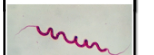
Monotrichous
singe flagellum attached on one end
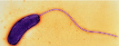
peritrichous
flagella found at multiple locations
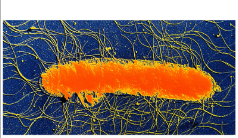
lophotrichous
a tuft of flagella are attached to one of both ends

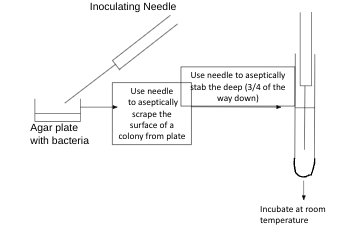
Motility Test medium
Helps determine if bacteria have flagellum and are motile
Low agar concentration (0.4%)
Contains tetrazolium salt (TTC)
should be kept refrigerated till inoculation
Tetrazolium salt (TTC)
makes interpretation of results easier
Colorless and soluble in oxidized form
When reduced: red and insoluble
Non-motile bacteria: red only along stab line
Motile bacteria: red radiating out from stab line
streak plate
determines what in culture
Serial dilution and plating
Determines “how much” is in a culture
Serial dilution is used in conjunction with spread plating
Expressed in terms of cfu/ml
Colony forming units per milliliter of culture
Dilutions
With each consecutive transfer you are decreasing the number of bacteria present in each dilution tube
sometimes referred to as 10-fold serial dilutions
Bacterial counts can be used to determine _______.
the growth rate of a lab culture or the level of contamination in a food, urine, or water sample
spread plating
Uses the entire plate
Pipette a known amount into the center of the plate and spread the inoculum over the entire surface of the plate using a spread rod
more expensive and sensitive
TNTC for spread plates
more than 300 colonies
TFTC for spread plates
less than 30 colonies
Spot plating
four separate dilutions on a single plate
Spot” 25 µl aliquots of each dilution tube onto an appropriately labeled quadrant
Count the number of colonies within each spot
Adjust the numbers to a per ml basis
TNTC for spot plates
more than 25 colonies per spot
TFTC for spot plates
less than 5 colonies per spot
formula for cfu/mI
#colonies x reciprocal of dilution x (1000/amt plated in ul)
cfu/ml numbers can be used in the following
UTI’s (Urinary tract Infections) – Only considered an active infection if plated cfu/ml exceeds 105
Used in food and water safety
Estimate the amount of protein and or DNA based upon viable counts in a population for research purposes
To prepare a "spot" plate; how many spots should you have in each quadrant?
3 spots
How much should you be aliquoting onto spot plates?
25 uL
How much should you be aliquoting onto your spread plate?
100 uL
What tool will you use to spread around the sample for your spread plate?
spread rod
How much are your transferring for each dilution?
500 uL
Which two dilutions will you use for your spread plate?
10-6 and 10-7
You inoculate a Motility Test Deep with an unknown bacterium. After 24 hours of incubation, you see that there is red only by the initial stab life. What does this mean?
bacterium does not have flagellum, non-motile
fomites
contaminated inanimate objects
reservoir
continual source of infection
An infectious virus consists of _________.
nucleic acid and capsid
PEA is partially inhibitory to _________.
gram-negative organisms
Which of the following media is not differential?
PEA
MSA
MAC
PSP
PEA
If a bacterium is capable of growing on MSA, what two characteristics do you know about it?
it is halophilic and mostly likely a Staphylococcal species
Which of the following is not a result for TSI?
motility
acid production
gas production
H2S production
motility
After inoculation and incubation, you notice a simmons-citrate tube is blue. Is this a positive or negative result?
positive
Reagents are added __________ .
after incubation
You inoculate a set of OF glucose tubes with an unknown bacterium. The following are the results:
+ tube: yellow
- tube: green
What type of ability does the organism have to catabolize glucose?
fermentative
The carbohydrate fermentation tube appears orange after inoculation and incubation with a bubble in the durham tube. What is this bacterium positive for?
weak acid producer and gas production
Starch agar plates test for the presence of ___________; whereas, spirit blue test for the presence of ___________.
amylase; lipase
You observe the following results:
No reagents have been added
MR: visible growth; cloudy broth - no color change
VP: minimal growth on the bottom of the tube - no color change
What is the next step?
add Methyl Red to MR tube and VP1 and VP2 to VP tube