People and the Earth's Ecosystems - Finals (reporting)
 Call Kai
 Learn
Learn Practice Test
 Spaced Repetition
 Match
Match Flashcards
 Knowt Play
1/110

There's no tags or description
Looks like no tags are added yet.
Name | Mastery | Learn | Test | Matching | Spaced | Call with Kai | Chat |
|---|
No analytics yet
Send a link to your students to track their progress
111 Terms
Biodiversity
total variety of life on Earth, from genes to entire ecosystems
Bio
means life
Diversity
means variety
Genetic Diversity
variations in DNA within a single species
Species Diversity
sheer number of different species living in a habitat
Ecosystem Diversity
variety of habitats
Provisioning
Regulating
Supporting and Cultural
3 Reasons why Biodiversity is Important
Provisioning
production of food, clean water, timber, and plant-based medicines
Regulating
forests absorbing carbon dioxide, wetlands filtering water, and insects pollinating food crops
Supporting and Cultural
soil formation, nutrient cycling, and eco-tourism
Biodiversity
is the asset
Conservation Biology
is the tool
Biodiversity
the rich, complex, and vulnerable library of life on Earth that is currently facing a global threat
Conservation Biology
active science, framework, and practice dedicated to preserving biodiversity
Crisis Discipline
emerged in the late 1970s and1980s as traditional biology fields proved too slow to stop accelerating global extinction rates.
Late 1970s and 1980s
when did the Crisis Discipline emerge
Crisis Discipline
developed as a rapid-response science, much life emergency room medicine
Crisis Discipline
to take immediate action and make critical ecosystem management decisions even when scientific field data is incomplete.
Ecology and Genetics
managing wildlife populations
Social Sciences and Economics
working with local indigenous communities
Environmental Law and Policy
enforcing protected areas and cracking down on poaching
Overexploitation/Pverharvesting
involves hunting, fishing, or otherwise collecting organisms at a faster rate than they can be replenished
Bush Meat
generic term used for wild anials killed for food
Bush Meat
recent commercialization ofthe practice now has it available in grocery stores, which has increased harvest rates to the level of unsustainability
Overhunting
unsustainable killing of wild animals at a rate faster than they can reproduce
Poaching
illegal killing or capturing of wild animals, usually in violation of local laws, wildlife protection, or property rights
Overfishing
removal of aquatic animals at a rate fasterthan species can naturally reproduce
Bycatch
animals thatfishers sometimes catch anddiscard because they do not want them, cannot sell them, or are not allowedto keep them
Tragedy of the Commons
economic pressure in which fishers have little motivation to exercise restraint in harvesting a fishery when theydo not own the fishery
Wild Ginseng
valuedforits healthbenefits, are decreasing
Waling-waling
are aggressively collectedfrom the wild to supplydomestic andinternationalblack-market exotic plant collectors.
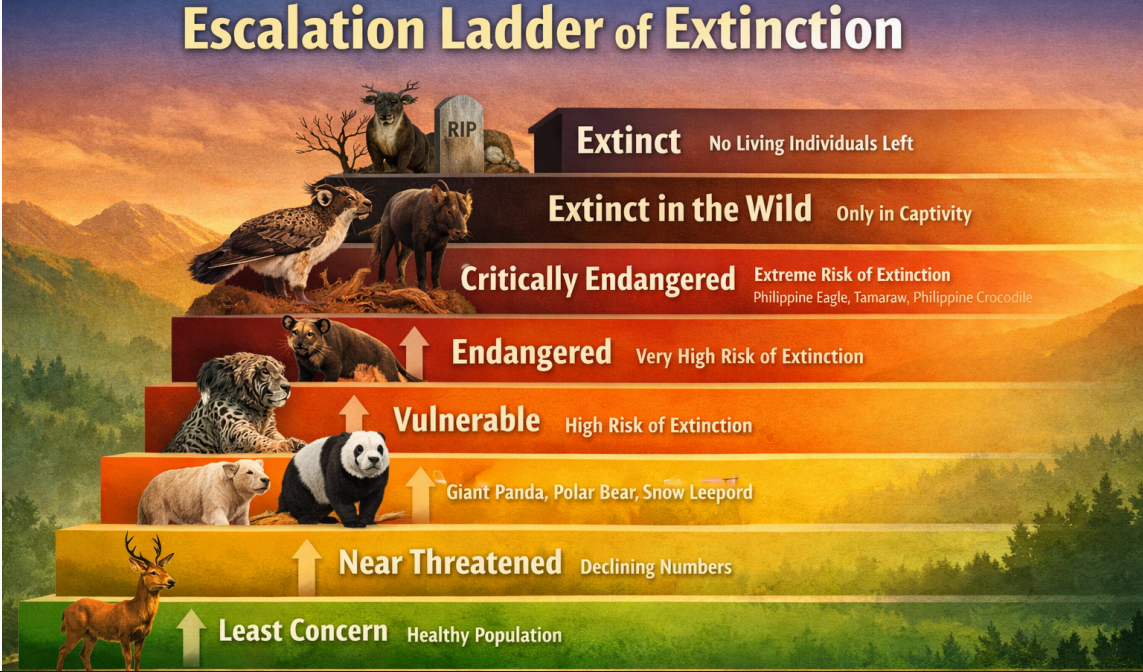
Threatened Species
species likely to become endangered if current threats continue
Endangered Species
species facing a very high risk of extinction in the wild
1,864
how many individuals of the giant panda are left
22,000-31,000
how many individuals of the polar bear are left
4,000-6,000
how many individuals of the snow leopard are left
Escalation Ladder of Extinction
Exotic Species
species that have been intentionallyy or unintentionally introduced by humans into an ecosystem in which they did not evolve
Human Transportation
cause of exotic species
Exotic Species
often undergo dramatic population increases in their new habitat and reset the ecological conditions in the new environment, threatening the species that exist there
Invasive species
can threaten other species through competition for resources, predation, or disease
Lakes and islands
_______ and ____ are particularly vulnerable to extinction threats from introduced species
Flowerhorn Fish in Lake Sampaloc (San Pablo, Laguna)
The researchers said the fish first entered Lake Sampaloc ’ s ecosystem after escaping from breeding facilities during a major typhoon.
Flowerhorn Fish in Lake Sampaloc (San Pablo, Laguna)
his fish is extreme territorial aggression andhigh reproductive potential.
Flowerhorn Fish in Lake Sampaloc (San Pablo, Laguna)
The fish compete for essential resources with native fish in the lake.
This will potentially reducing their abundance and contributing to the decline ofthe lake's overallbiodiversity
Habitat Fragmentation
is the breaking of a large, continuous habitat into smaller, isolated patches due to human activities
Habitat Fragmentation
is one of the leading threats to biodiversity because it reduces the amount of suitable habitat available for wildlife
smaller habitat
patches support dewer species
reduced genetic diversity
increases vulnerability to disease and environmental change
edge effects
habitat edges experience more sunlight, wind, predators, and human disturbance than the forest interior
habitat fragmentation
has isolated populations of the Bornean orangutan, reducing thier access to foods, mates, and shelters
Early Detection and Rapid Response networks
monitor and instantly eradicate newly formed colonies
Eco-bridges
facilitate safe travel and gene exchange
Biodiversity
sustains humanity by providing food, clean water, medicine, climate regulation, and cultural enrichment
Biodiversity
faces urgent threats that demandimmediate action.
Pollution
is unwated waste of human origin released to air, land, water, and the ocean without regard for cost or consequence
Pollution
is an existential threat to human health and planetary health, and jeopardises the sustainability of modern societies.
Pollution
includes contamination of air by fine particulate matter (PM2·5); ozone; oxides of sulphur and nitrogen; freshwater pollution; contamination of the ocean by mercury, nitrogen, phosphorus, plastic, and petroleum waste; and poisoning of the land by lead, mercury, pesticides, industrial chemicals, electronic waste, and radioactive waste.
9 million
pollution was responsible for an estimated how many deaths
16%
globally, pollution was responsible for an estimated how many deaths
US$ 4·6 trillion
how much money was pollution responsible for in the economic output of 2015
Water Pollution
contamination of water bodies—such as lakes, rivers, oceans, and groundwater—usually as a result of human activities
Water Pollution
It degrades water quality, making it toxic for humans and the environment
Harmful Algal Blooms (HABs)
Caused by nutrients when excess agricultural fertilizers (nitrogen and phosphorus) run off into lakes.
Harmful Algal Blooms (HABs)
causes explosive algae growth that depletes oxygen in the water, killing fish.
Untreated raw sewage
overflows introducing bacteria (causing gastroenteritis), or industrial factories discharging "forever chemicals" (PFAS) and heavy metals into rivers
Per- and Polyfluoroalkyl Substances (PFAS)
ontain carbon-fluorine bonds. In organic chemistry, the carbon-fluorine bond is one of the strongest imaginable.
Because this bond is so tight, these chemicals do not break down naturally in the environment.
Air Pollution
The introduction of hazardous gases, particulate matter, or biological molecules into the Earth’s atmosphere
Air Pollution
It is one of the most severe environmental health hazards, impacting respiratory and cardiovascular systems.
ground-level ozone (smog)
Unlike the protective ozone layer high in the atmosphere, _______________ is created when nitrogen oxides (NOx) and volatile organic compounds (VOCs) from cars and factories chemically react in the presence of sunlight
Particulate Matter
Microscopic solid or liquid droplets from vehicle exhaust, coal-fired power plants, and wildfire smoke.
Particulate Matter
Because they are so small, they can enter the lungs and bloodstream.
Noise Pollution
Unwanted or harmful sound that disrupts the quality of life, sleep, and communication
Noise Pollution
The WHO recognizes it as a major public health hazard that causes chronic stress, cardiovascular disease, and cognitive impairment
75-40 dBA
noise range
Light Pollution
excess or inappropriate artificial light outdoors.
Light Pollution
occurs in three ways: glare, light trespass, and skyglow
2.2%
Light pollution is increasing globally, in both developed and developing countries. Satellite data show that from 2012 to 2016, continuously lit areas brightened at a rate of ________ (percentage) per year
Light pollution
is increasing globally, in both developed and developing countries. Satellite data show that from 2012 to 2016, continuously lit areas brightened at a rate of 2.2% per year
9.6%
Scientists’ measurements indicate that the average night sky got brighter by ________(percent) per year from 2011 to 2022, which is equivalent to doubling the sky brightness every 8 years
Glare
is the bright and uncomfortable light shining directly to the observer that interferes with your vision
Light Trespass
is the unintended spill of artificial light into other people’s property or space and often becomes a source of conflict
Skyglow
is the brightening of the night sky from human-caused light scattered in the atmosphere
Electromagnetic Pollution
The invisible presence of artificially generated, non-ionizing electromagnetic fields (EMFs) and radiation in the environment
While the severe health impacts are still heavily debated and studied, the sheer volume of radiofrequency waves is recognized as an environmental alteration.
300 MHz to 300 GHz
frequency range that can be associated with microwaves from electronic devices such as smartphones, tablets, microwave ovens, radio, and television sets emit low intensity electromagnetic radiation
Electrosmog
Sources of low-frequency radiation are electrical wires, overhead lines of railways and electrical appliances in households.
The increase in electricity consumption and intensification of trade on the liberalised electricity markets have resulted in higher electricity transmission rates via the distribution network.
This means that low-frequency magnetic fields will continue to increase along existing transmission lines
300 MHz and 15 GHz
frequencies in which Airport surveillance radars operate in
Land Pollution
presence of toxic chemicals (pollutants or contaminants) in soil in high enough concentrations to pose a risk to human health and the ecosystem
Itai-Itai Diseas
is characterised by osteomalacia, osteoporosis, painful bone fractures and kidney dysfunction (WHO, 2019).
used to be widespread and is still seen in women over 50 years of age.
Cadmium
root cause of the Itai-Itai disease
Agrochemicals
The excessive use of synthetic pesticides, herbicides, and mineral fertilizers that degrade the soil microbiome and seep into the food chain
Acid Rain
is a type of precipitation (rain, snow, sleet, hail, or fog) that has a higher acidity than normal due to the presence of sulfuric acid (H₂SO₄) and nitric acid (HNO₃).
Acid rain
is one of the major forms of air pollution caused by the release of sulfur dioxide (SO₂) and nitrogen oxides (NOₓ) into the atmosphere
sulfur dioxide (SO₂) and nitrogen oxides (NOₓ)
these gases react with water vapor, oxygen, and other chemicals to form acids, which then fall back to the Earth's surface through precipitation or dry deposition.
Pure Rainwater
is naturally slightly acidic because it dissolves carbon dioxide.
5.6
pH of normal rain
below 5.6
pH of acid rain