The nervous system and the endocrine system (Not complete)
 Call Kai
 Learn
Learn Practice Test
 Spaced Repetition
 Match
Match Flashcards
 Knowt Play
1/26

Earn XP
Description and Tags
Name | Mastery | Learn | Test | Matching | Spaced | Call with Kai |
|---|
No analytics yet
Send a link to your students to track their progress
27 Terms
Nervous system
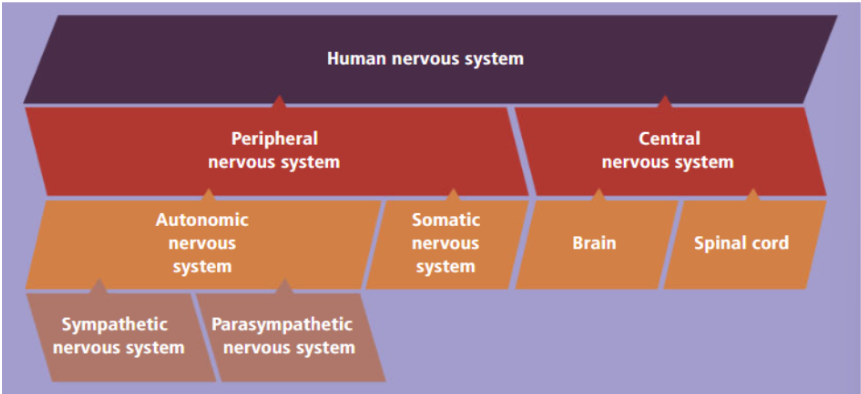
Consists of the central nervous system and the peripheral nervous system.
It communicates using electrical and chemical signals
CNS
Consists of the brain and the spinal cord and is the origin of all complex commands and decisions.
PNS
Sends information to the CNS from the outside world, and transmits messages from the CNS to muscles and glands in the body.
Autonomic nervous system (ANS)
Transmits information to and from internal bodily organs.
Somatic nervous system (SNS)
Both receives and transmits information from the CNS to sensory organs.
e.g. muscles and skin.
Endocrine system
One of the body's major information systems that instructs glands to release hormones directly into the bloodstream.
These hormones are carried towards target organs in the body.
The system communicates through chemicals
Hormones
Chemical substances that circulate in the bloodstream and only affect target organs.
They are produced in large quantities but disappear quickly.
Their effects are very powerful.
Gland
An organ in the body that produces hormones.
Fight or flight response
The way an animal responds when stressed.
The body becomes physiologically aroused in readiness to fight an or, in some cases, flee (or freeze or fawn).
Adrenaline
A hormone (produced by the adrenal glands) which is part of the human body's immediate stress response system.
Adrenaline has a strong effect on the cells of the cardiovascular system - stimulating heart rate, contracting blood vessels and dilating air passages.
What is the nervous system two main functions
To collect, process and respond to information in the environment.
To co-ordinate the working of different organs and cells in the body.
How is the nervous system is divided?
into two subsystems:
CNS
PNS
What is the CNS made up of
brain and the spinal cord.
The brain is the centre of all […] awareness
The brain is the centre of all conscious awareness
The brain's outer layer, the […], is only 3mm thick and covers the brain
The brain's outer layer, the cerebral cortex, is only 3mm thick and covers the brain
What makes our brains special
The brain is highly developed in humans and is what distinguishes our mental functions from those of other animals.
How is the brain divided
The brain is divided into two hemispheres.
What is the spinal cord
The spinal cord is an extension of the brain.
What is the spinal cord roles
It passes messages to and from the brain and connects nerves to the PNS.
It is also responsible for reflex actions,
such as pulling your hand away from a hot plate
How does PNS transmit messages
The PNS transmits messages, via millions of neurons (nerve cells), to and from the central nervous system.
What is the peripheral nervous system is further subdivided into.
Autonomic nervous system (ANS)
Somatic nervous system (SNS)
ANS is ''[…]'‘ as the system operates […].
ANS is 'automatic' as the system operates involuntarily.
What are the two main divisions of ANS
the sympathetic and parasympathetic nervous systems.
Autonomic nervous system (ANS) - governs vital functions in the body such as breathing, […], digestion, […] and […].
Autonomic nervous system (ANS) - governs vital functions in the body such as breathing, heart rate, digestion, sexual arousal and stress responses.
Somatic nervous system (SNS) - governs […] and receives information from […] receptors.
Somatic nervous system (SNS) - governs muscle movement and receives information from sensory receptors.
The nervous system acts more […] than the endocrine system.
The nervous system acts more rapidly than the endocrine system.
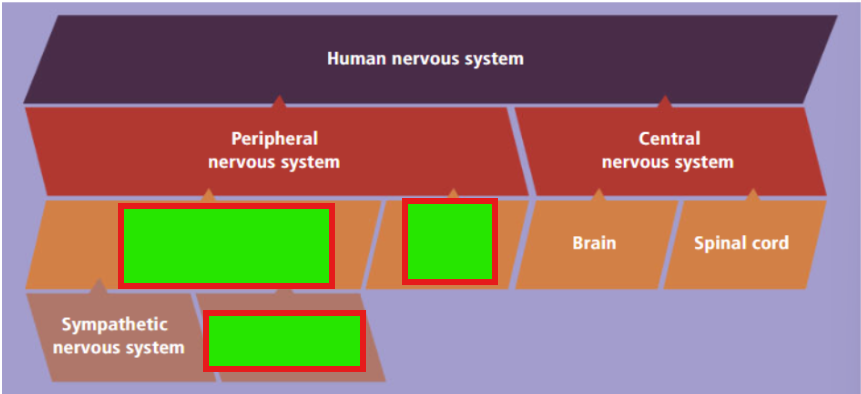
Fill in the blank