KINE 266 - L9
 Call Kai
 Learn
Learn Practice Test
 Spaced Repetition
 Match
Match Flashcards
 Knowt Play
1/82

There's no tags or description
Looks like no tags are added yet.
Name | Mastery | Learn | Test | Matching | Spaced | Call with Kai | Chat |
|---|
No analytics yet
Send a link to your students to track their progress
83 Terms
What is a group?
Two or more people who have a sense of interaction or interdependence for a common purpose
How is a team different from a group?
A team is a group that must interact with each other to accomplish a shared objective.
4 key characteristics of teams
Collective sense of identity
Distinctive Roles (& that role is valued)
Structured modes of communication (can range from when team meetings are to how they speak to each other - more complex)
Norms
What is group dynamics?
The study of how groups form, develop, interact, and relate to individuals and institutions.
long version: A field of inquiry dedicated to advancing knowledge about the nature of groups, the laws of their development and their interrelationships with individuals, other groups and larger institutions.
3 major perspectives of how a group becomes a team
(1) Linear Perspective
(2) Cyclical (Life Cycle) Perspective
(3) Pendular Perspective
What is the Linear Perspective (Tuckman) model?
proposes that teams move through fixed stages in order and do not return to earlier stages.
Stages of Linear Perspective/Tuckman model
Forming → Storming → Norming → Performing → Adjourning
Linear Perspective: Stage 1 - Forming
groups initially get together, a lot unknown, no cohesion, no roles yet
Linear Perspective Stage 2 - Storming
where conflict arises, usually over roles (not having established norms), some people may step up to roles some may feel coach is giving special attention to others
→ infighting !! People don’t know what it is expected of them
Linear Perspective Stage 3 - Norming
things work out, athletes start to but in, acceptance & clarity of roles
Linear Perspective Stage 4 - Performing
everything at its height & in place
→ established norms & understand + accept roles, modes of communication in place
→ this is where they will physically perform their best
Linear Perspective Stage 5 - Adjourning
end of the season, things might change next season, some shift out, some new coming in, process would start over
What is the Cyclical (Life Cycle) perspective?
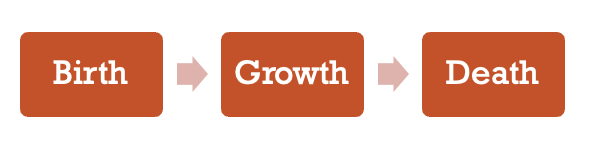
Groups develop in a manner similar to the life cycle of individuals
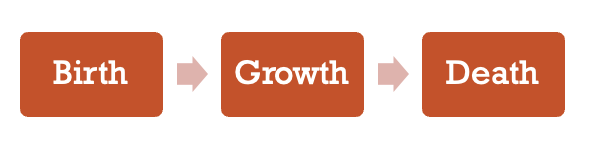
birth → growth → death
often used for short-term teams.
Why is the cyclical model used for some teams?
Because some teams are temporary and naturally decline in cohesion over time.
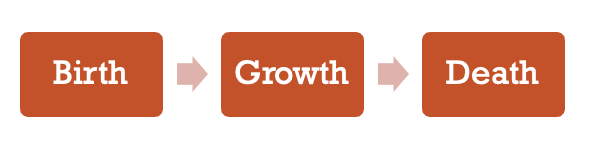
Cyclical Perspective: Birth
getting to know each other
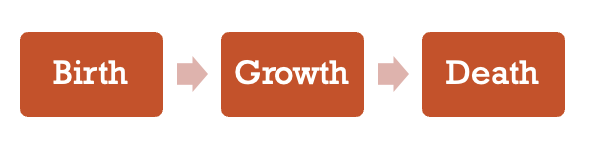
Cyclical Perspective: Growth
at their height of performance, height of connection within team
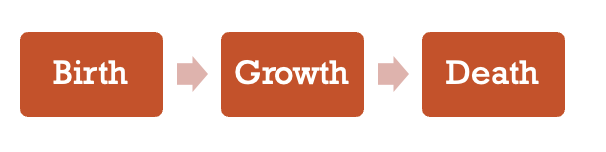
Cyclical Perspective: Death
knowing its temporary, subconsciously or consciously preparing for end, limits them from achieving their best potential
What is the Pendular perspective?
Teams move back and forth between cohesion and conflict throughout the season.
Stages of pendular model
Orientation → Conflict → Cohesion → Conflict again → Termination
Pendular Perspective Stage 1: Orientation
High cohesion and unity
excited, no animosity or competition yet, looking forward to it
Pendular Perspective Stage 2: Differentiation & Conflict
Subdivision into smaller groups
cliques, starters vs. nonstarters, groups that get more/less playing time → bring conflict in
Pendular Perspective Stage 3: Resolution & Cohesion
Sharing of common concerns and feelings
work through it, accept goal, communication with coach
Pendular Perspective Stage 4: Differentiation & Conflict
Some individuals are rewarded, others punished
maybe one athlete takes a spot, others are mad bc they think they deserved it, new player comes in maybe → conflict comes back
Pendular Perspective Stage 5: Termination
Feelings of cohesion based on season outcome
outcome of season is what people are going to base their analysis of their cohesiveness on,
could have been a lot of conflict but if they won the season most athletes will say it was a great season & there was lots of cohesion
if they didn’t win they would say the opposite
Group Roles & Norms are…
..essential for creating an effective team
Role
A set of behaviors required or expected of the person occupying a certain position in a group, or a set of skills
Difference: formal vs informal roles
Formal: assigned (captain)
Informal: naturally developed (leader, comedian, spark plug)
What is role ambiguity?
Uncertainty about one’s responsibilities → lowers cohesion, increases conflict.
Norm
A level of performance, pattern of behavior or belief. How you conduct ourself in environment
Role clarity and role acceptance are key
Having clarity about what your role in the team is regardless of what it is, that it is valued, and accepting your goal even if its not your own personal goal
Informal Roles: Comedian
person that brings humor to most situations
Informal Roles: Spark Plug
Person who brings level of enthusiasm when necessary, brings high level of vigor
Informal Roles: Cancer
person that brings everybody down, bring a lot of negativity, form cliques, not on board with productive norms
Informal Roles: Enforcer
supports team mates so much that they physically back them
Informal Roles: Mentor
person that everybody trusts, high communication skills, sought out to have conversations with
Informal Roles: Nonverbal informal leader
lead by action, not appointed captain, lead through actions
Informal Roles: Verbal informal leader
hasn’t been appointed as captain, but uses words to rally team on & off field
Informal Roles: Team Player
not seeking individual glory, makes the pass before the shot, willing to make sacrifices for good of the team
Informal Roles: Star Player
flashy player, not always impactful to game, certain style of play that causes people to pay attention to them, not ALWAYS the best
Informal Roles: Malingerer
always has an injury, usually fake, seeking attention
Informal Roles: Social Convener
person really interested in things to gather outside of sport (hanging out after practice
Norms can be
Formal or informal
Norms for productivity facilitate success
Can be negative
Norms for productivity
facilitate success
6 factors of creating an effective team climate
Social support, perception, proximity, fairness, similarity, task interdependence
Effective Team Climate: Social Support
athletes want to know coach cares about development, over-all well being & them as a person, also among athletes
Effective Time Climate: Perception is key!
what do athletes think is happening → affects team climate
Effective team climate: Proximity
closer you can keep athletes, can create more effective team climate
Effective Team Climate: Distinctiveness
knowing this is who we are, team uniforms for ex. But there are different ways
Effective Team Climate: Fairness
does not mean sameness, when athlete believes environment. Is fair (seen as people & that coaches are trying to work w/them as individuals)
Effective Team Climate: Similarity
similarity in motivations for being there, what team is trying to accomplish
Effective Team Climate: Task Interdependence
creating situations where people have to work together more often, thinking critically of how to structure team
What is task interdependence?
Players must rely on each other to succeed.
Steiner’s Model of productivity formula
Actual Productivity = Potential Productivity – Losses Due To Faulty Group Processes
Types of process losses: Motivational Losses
any situation that results in members putting less than their full effort in
Types of process losses: Coordination losses
physical components (tiny) understanding of plays, understanding of game formation
Ringelmann effect definition
The phenomenon by which individual performance decreases as the number of people in the group increases
As groups grow in size, people are more likely to put in less effort
Social loafing
What is social loafing?
putting in less than your full effort in groups than alone
Ringlemann’s Rope Pull Study
Observed individuals and groups of 2, 3 and 8
Results:
2 people = 93% of individual potential
3 people = 85% of individual potential
8 people = 49% of individual potential
Social Loafing Research
Replicated rope pulling
Eliminated coordination as a factor (were told other people were on the rope (blinded) but there actually weren’t)
Results:
1 person = 100%
2 people = 90%
3 people = 85%
4 people = 86%
5 people = 84%
6 people = 85%
When Does Social Loafing Occur? (Long Version)
It is more prominent in situations where:
The individual’s output cannot be independently evaluated.
The task is perceived to be low on meaningfulness.
The individual’s personal involvement in the task is low.
A comparison against group standards is not possible.
The individuals contributing to the collective effort are strangers.
The individual’s teammates or coworkers are seen as high in ability.
The individual perceives that his contribution to the outcome is redundant (not valuable, unnecessary).
The individual is competing against what she believes to be a weaker opponent (underestimating opponent).
The group is larger rather than smaller.
When does social loafing occur?
Low accountability
Large groups
Low task importance
Effort not individually measurable
Definition of Cohesion
A group’s tendency to stick together to achieve goals and satisfy emotional needs.
Long version: A dynamic process which is reflected in the tendency for a group to stick together and remain united in the pursuit of its instrumental objectives and/or for the satisfaction of member affective (emotional) needs
Elements of Cohesion: Attractiveness of the group
how much do I like these people, & how much do I want to be around them./be in this environment
Elements of Cohesion: Means control
what am I going to get out of this experience? Vary from individuals & their motivations (Am I going to play the position I want, advance my play, get me recognition for a higher level team?)
Factors of Cohesion
Multidimensional
Dynamic (shifts overtime)
Instrumental (for a purpose, what are we cohesive towards)
Affective (produces feelings of emotion in people)
Types of Cohesion: Task Cohesion:
how well the group works together physically, technically, tactically, to produce sport outcomes
Types of Cohesion: Social Cohesion
how much they like each other and get along
Two types of cohesion
Task cohesion (performance focus)
Social cohesion (liking each other)
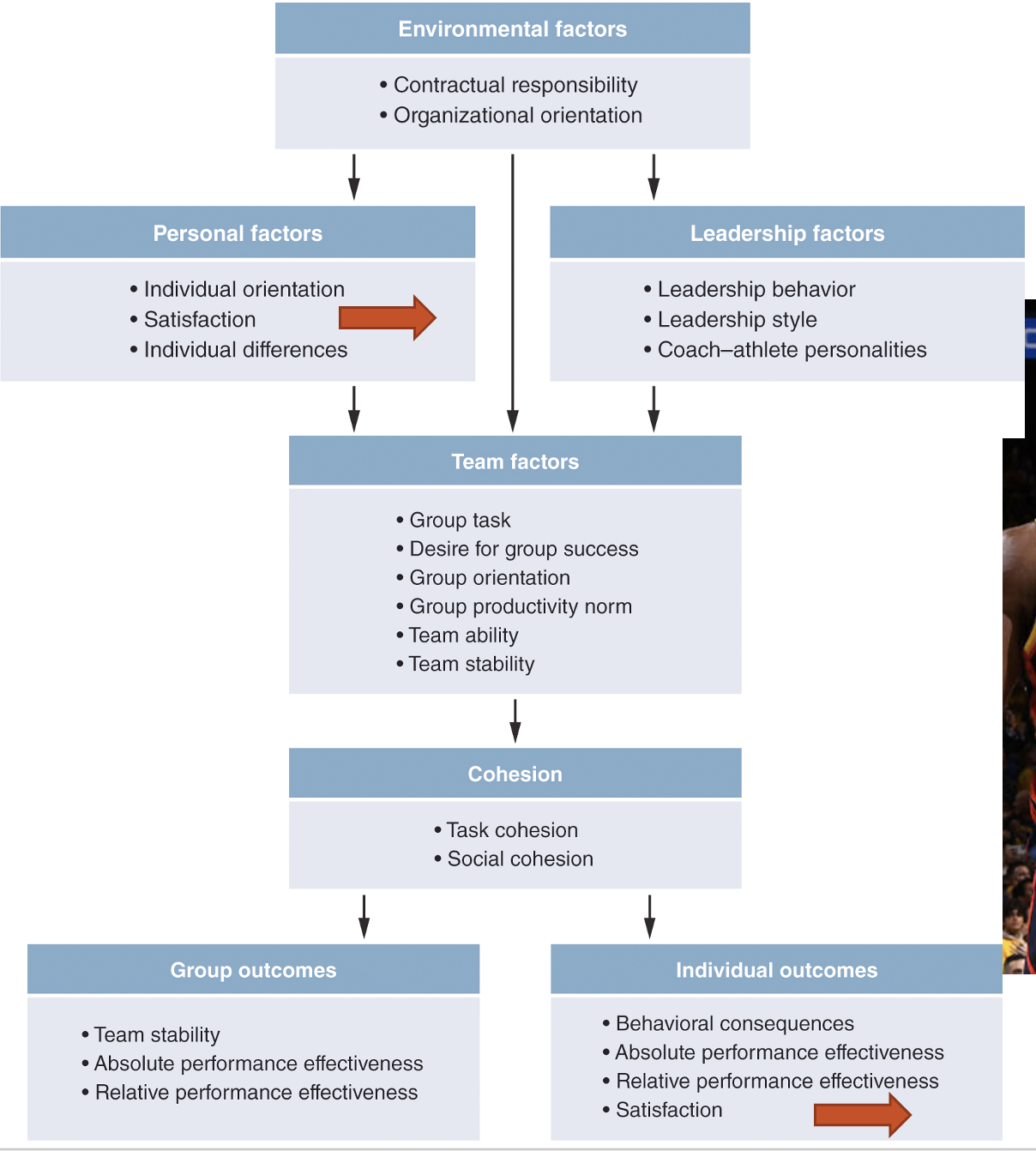
Factors that affect cohesion
Environmental
Personal
Leadership
Team
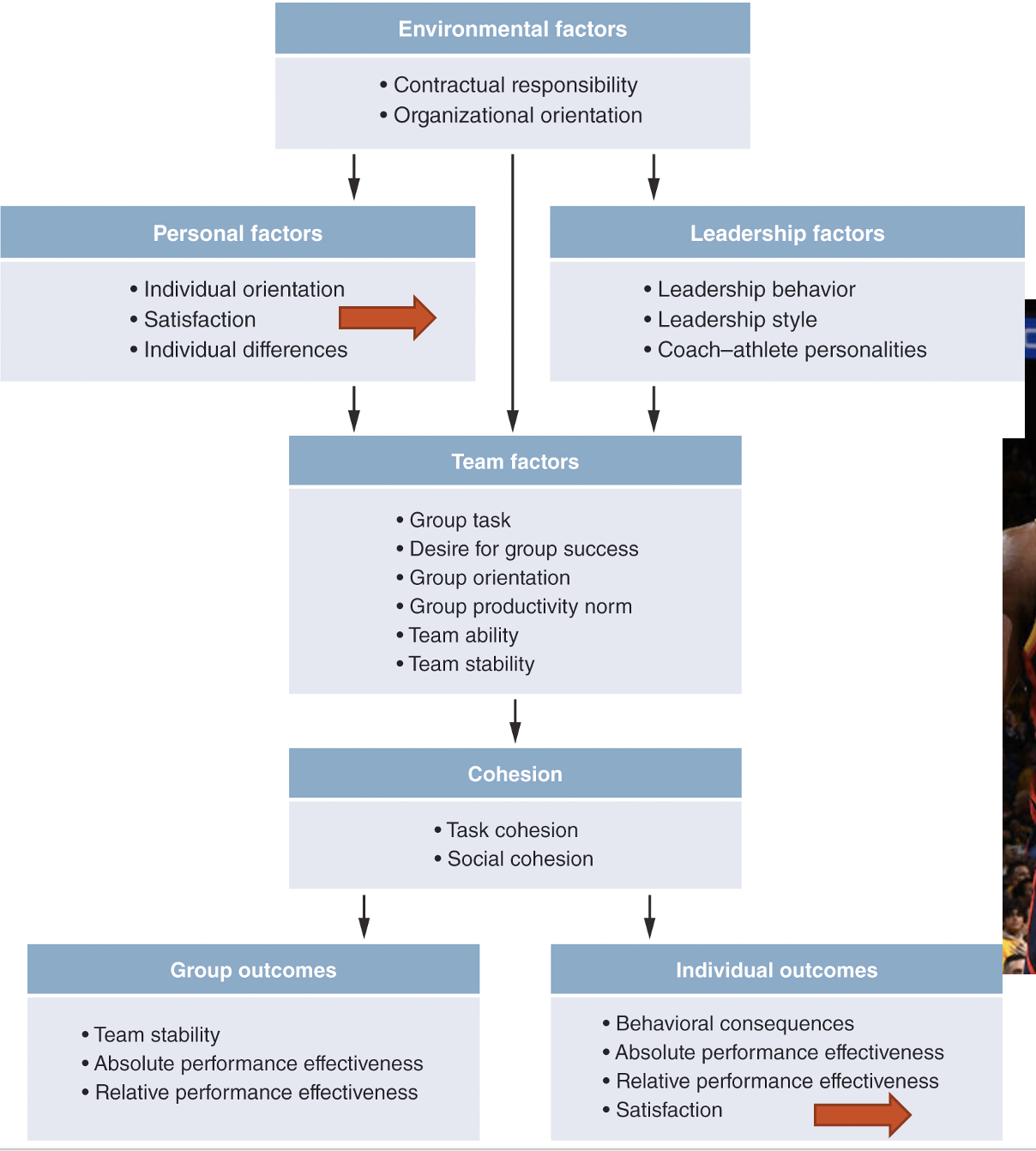
Environmental Factors in model
Contractual responsibility, organization orientation impacts person factors & leader ship factors + team factors
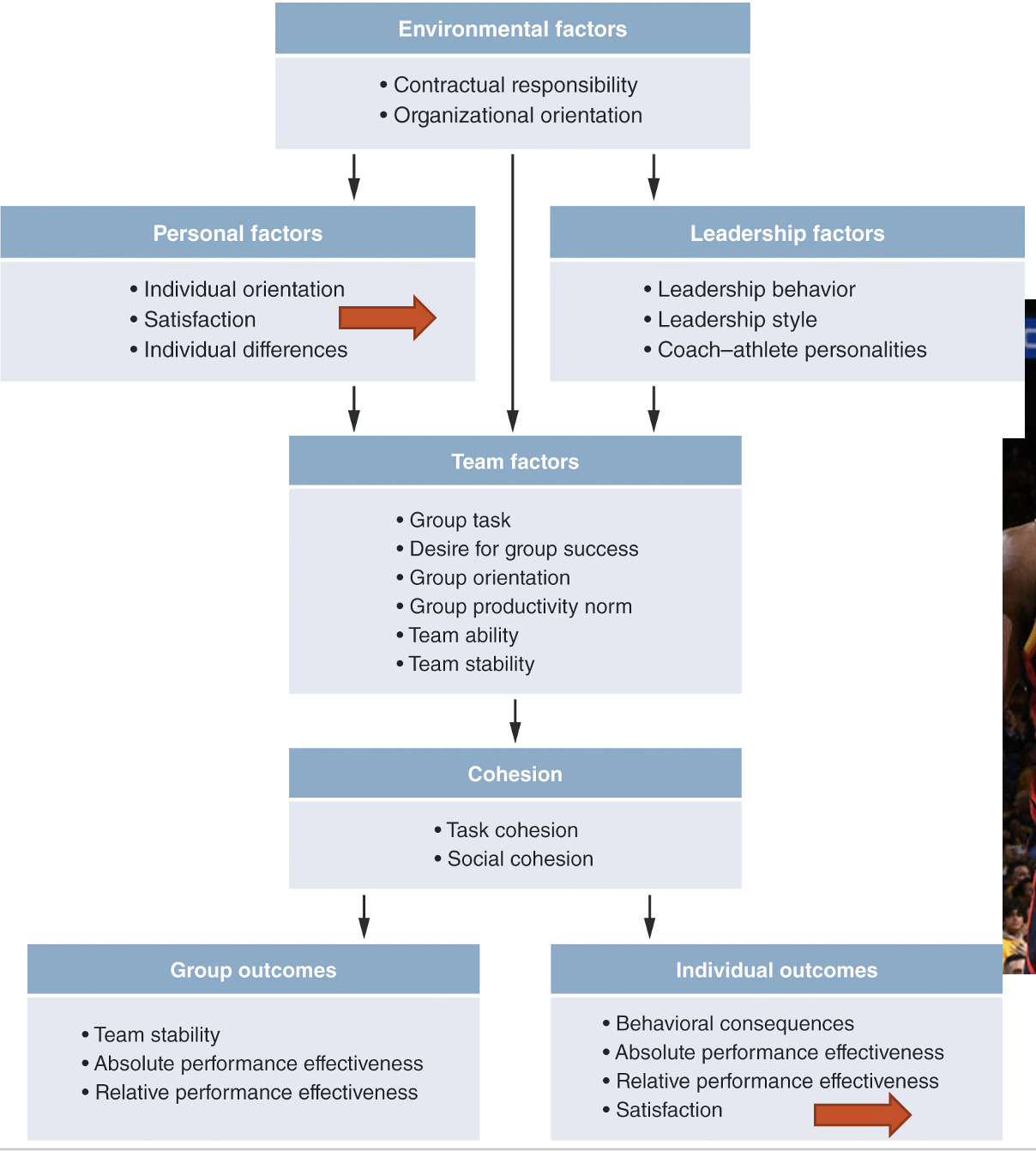
Personal factors in model
individual orientation, satisfaction, individual differences impact team factors + leadership factors
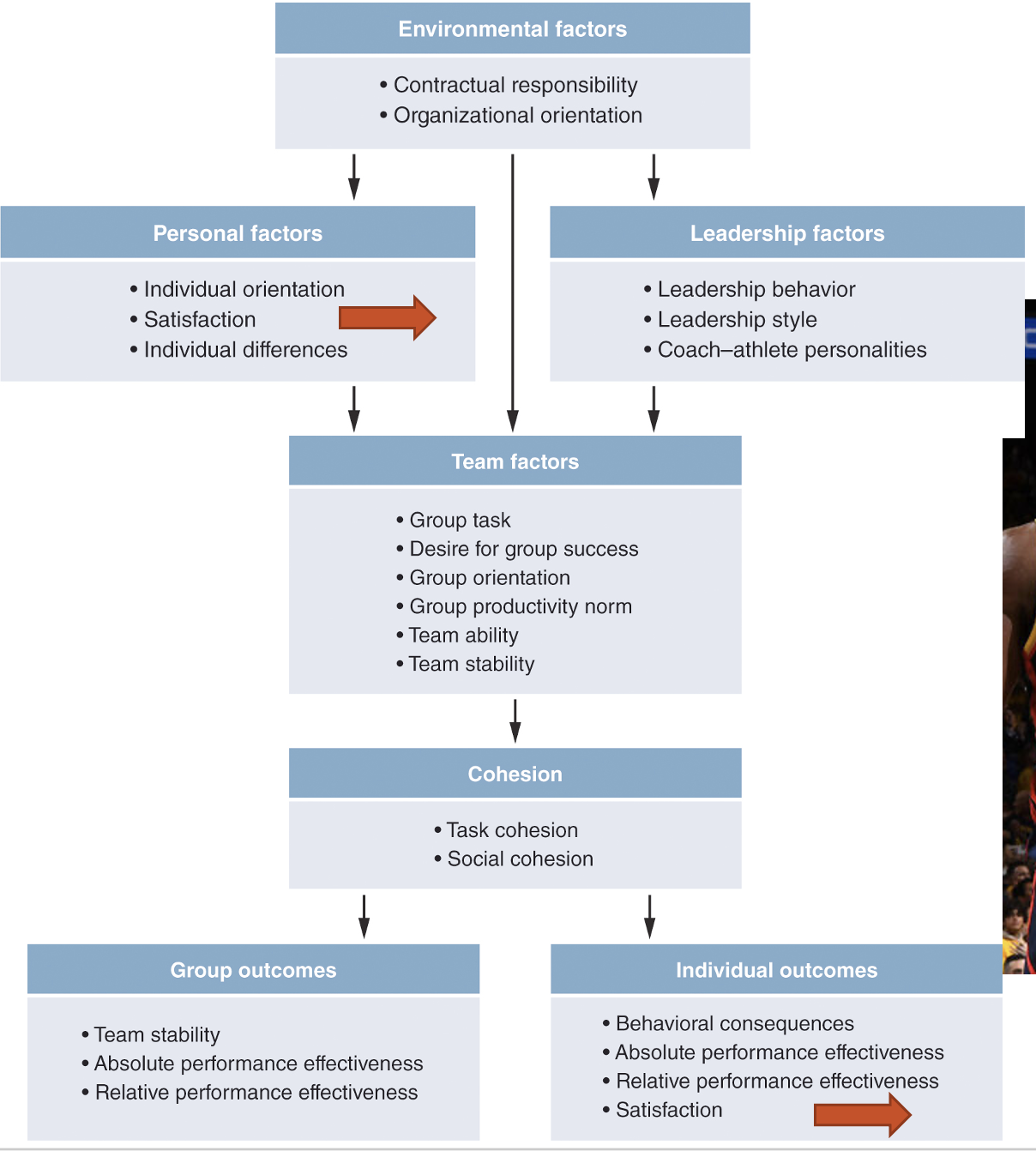
Leadership factors in model
leadership behavior, leader ship style, coach athletes personalities --< impact team factors
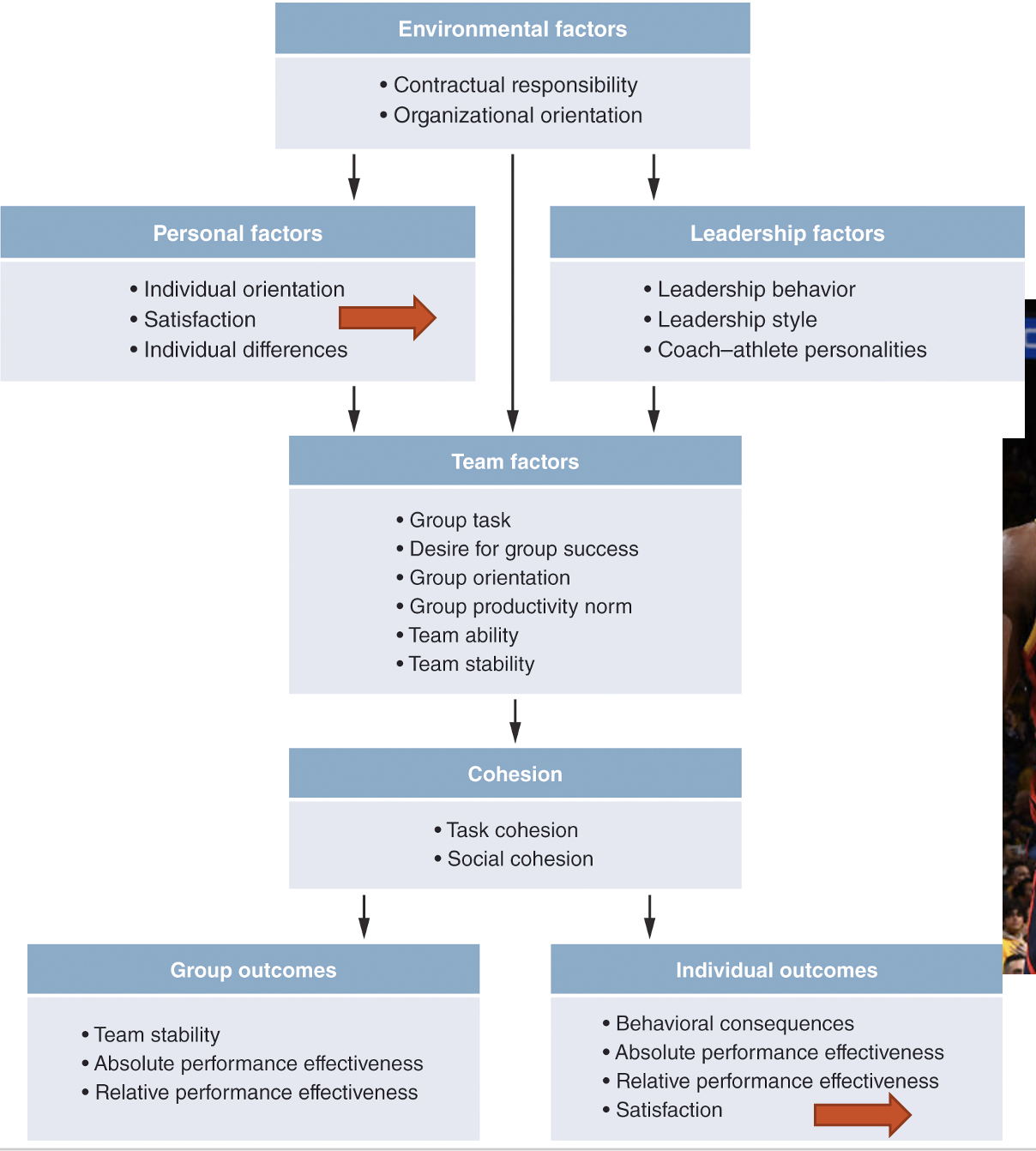
Team factors in model
group task, desire for group success, group orientation, group productivity norm, team ability, team stability --> impact cohesion
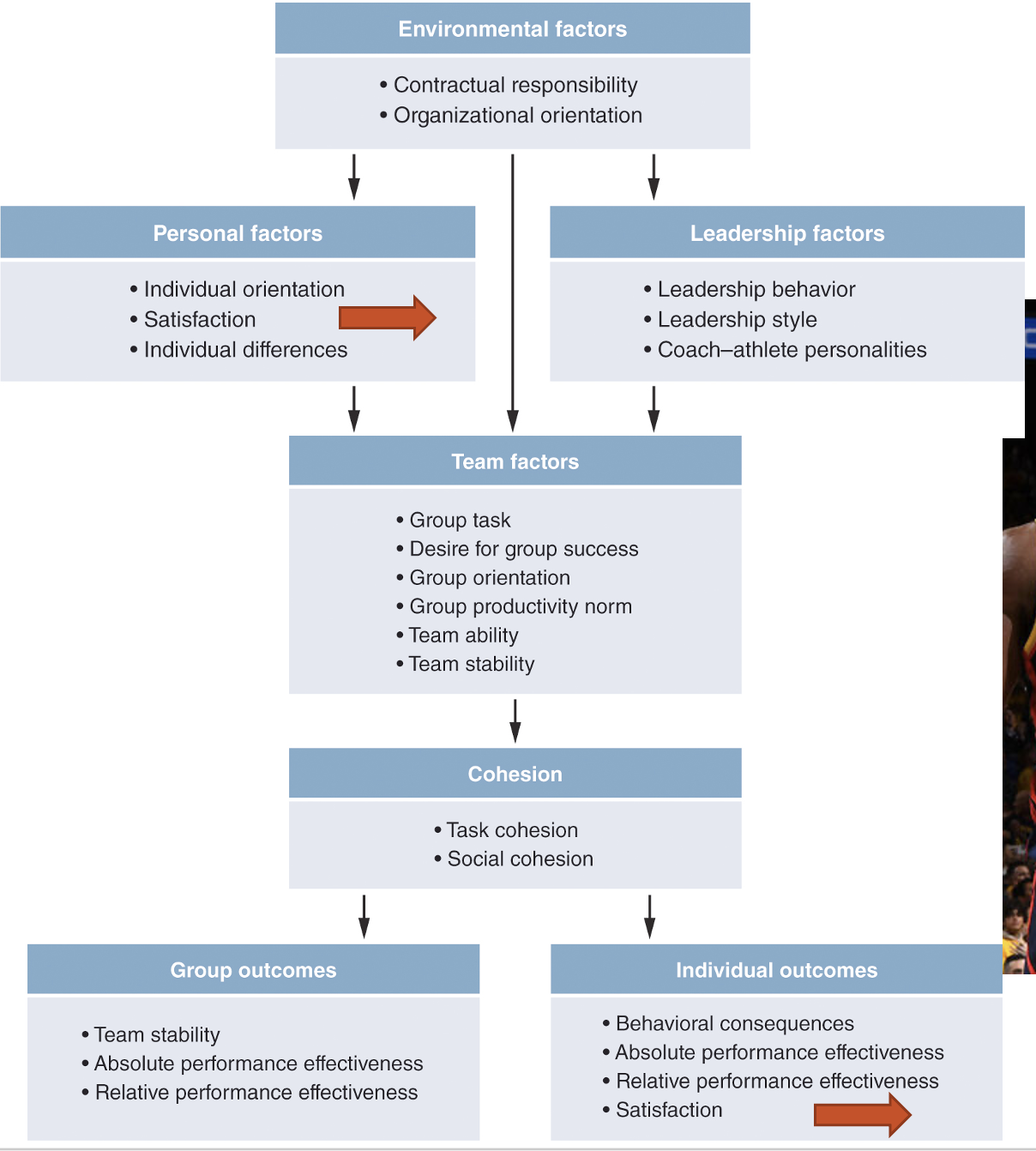
Cohesion in model
task cohesion or social cohesion impact group outcomes & individual outcomes
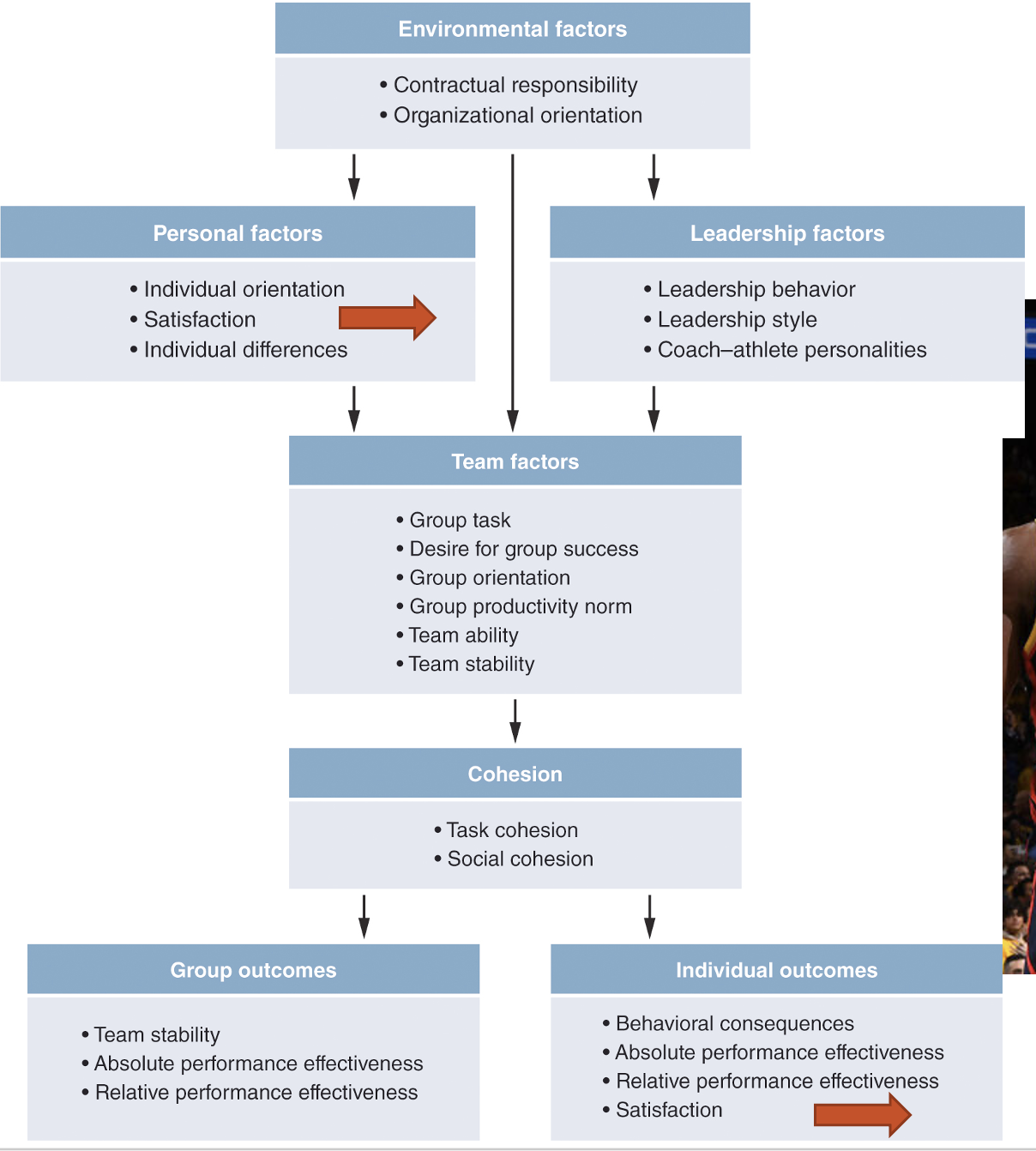
Group outcomes in model
team stability, absolute performance effectiveness, relative performance effectiveness
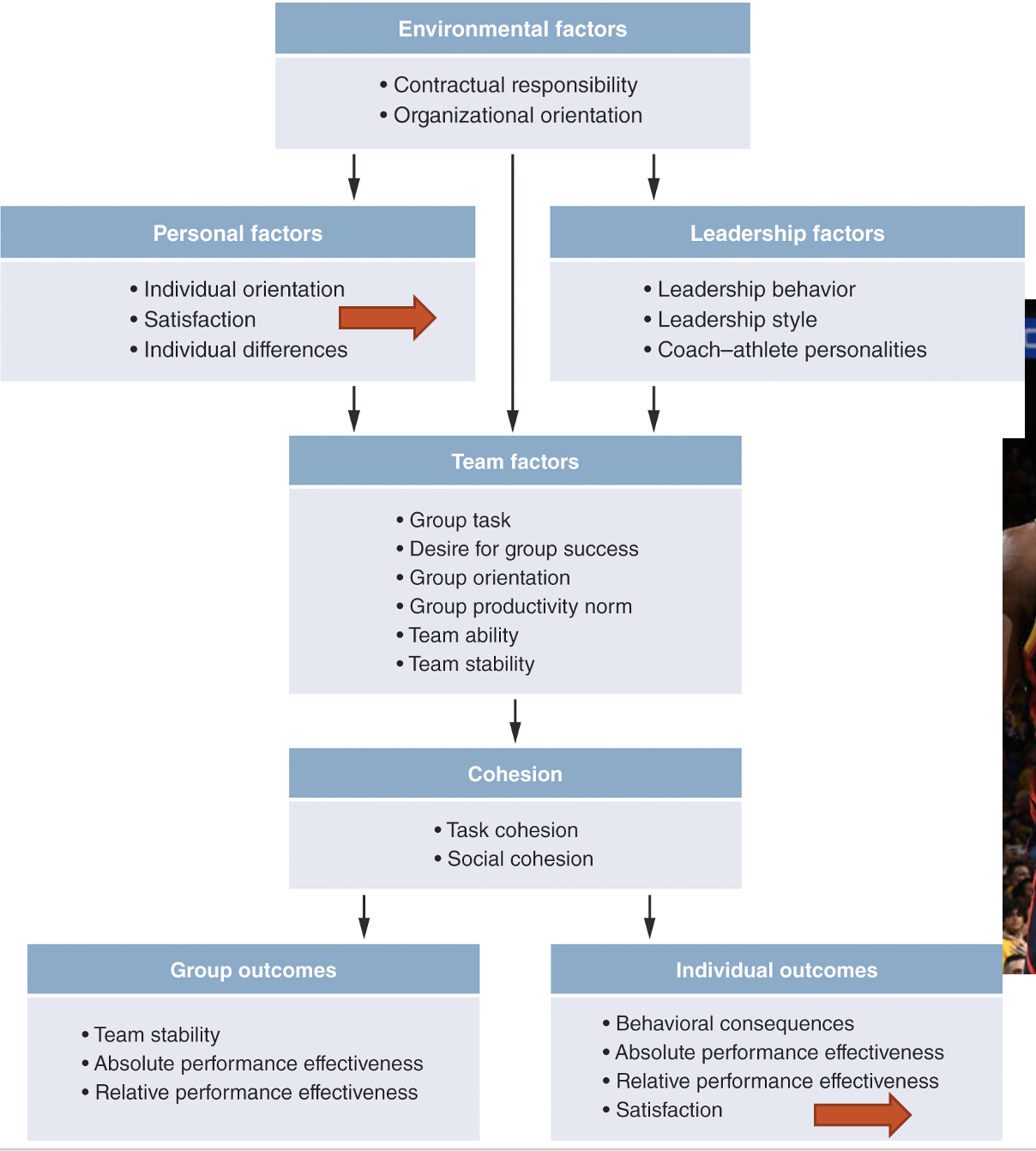
individual outcomes in model
behavioral consequences, absolute performance effectiveness, relative performance effectiveness, satisfaction impact group outcomes
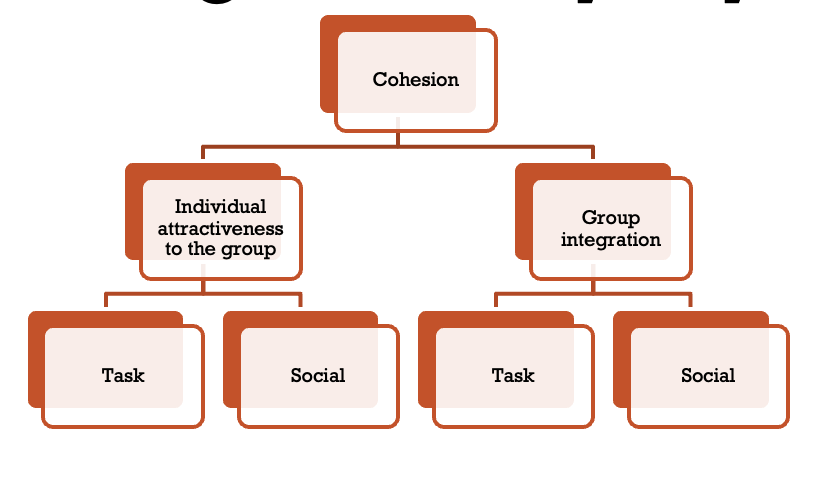
Measuring Cohesion: Group Environment Questionnaire (GEQ) - 4 dimensions
Attraction to group – task: I like this groups style of play
Attraction to group – social: I like this person/people on this team
Group integration – task: We all take responsibility for anu loss or poor performance by team
Group integration – social: We all hangout everyday after practice
Cohesion & Performance Key Research Findings
Cohesion is positively related to success → groups that are more cohesive on both task & social tend to have better outcomes
Direction of causality in cohesion-performance link research
Cyclical Relationship ! → Can start off with one or the other & produce better performances, feed off of each other
Research of Cohesion & Performance - Task Demands: Coactive vs Interactive Sports
Coactive = outcome does not depend directly on you interacting w/each other
Interactive = outcome depends on HAVING to work together with teammates to produce outcome
Cohesion is most important in interactive sports (but important in both)
How Can Cohesion Be Increased?
Communication
Roles
Development of pride
Goals
Distinctiveness
Avoid cliques
Team meetings
Know your team
Social disclosure (leader/coach sharing things so athletes see them as person, then more willing to talk to each other)
What model fits teams with repeated conflict and resolution?
Pendular perspective.
What does team identity (e.g., jerseys, bracelets, team name) increase?
Distinctiveness → increases cohesion.