Microbial Diversity
0.0(0)
Studied by 2 people0%Exam Mastery
Build your Mastery score
 AP Practice
Supplemental Materials Call Kai
Call KaiCard Sorting
1/52

Earn XP
Description and Tags
Last updated 7:12 AM on 10/12/22
Name | Mastery | Learn | Test | Matching | Spaced | Call with Kai |
|---|
No analytics yet
Send a link to your students to track their progress
53 Terms
1
New cards
Cell
it is the basic structural and functional unit of living organisms
2
New cards
cell theory
it is a collection of ideas and conclusions from many different scientists over time that describes cells and how cells operate
3
New cards
Robert Hooke 1665
who discovered cells and when?
4
New cards
anton van leeuwenhoek 1674
who observed living cell and when?
5
New cards
robert brown 1883
who discovered nucleus and when?
6
New cards
felix dujardin 1835
who discovered fluid content of cell and when?
7
New cards
Matthias Schleiden 1838
who proposed all plants are made up of cells and when?
8
New cards
J.E. Purkinje 1839
who named fluid content of cell as protoplasm and when?
9
New cards
Theodor Schwann 1839
who proposed all animals are made up of cells and when?
10
New cards
Carl Heinrich Braun 1845
who proposed cell is the basic unit of life and when?
11
New cards
Rudolf Virchow 1855
who proposed all cells arise from pre-existing cells and when?
12
New cards
prokaryotes
it includes bacteria and archaea
13
New cards
Cocci
usually round but can be oval, elongated or flattened on one side. When it divides to produce, the cells can remain attached to one another.
14
New cards
diplococci
remain in pairs after dividing
15
New cards
streptococci
divide and remain attached in chainlike patterns
16
New cards
tetrads
divide in 2 planes and remain in groups of 4
17
New cards
sarcinae
divide in 3 planes and remain attached in cube-like groups of 8
18
New cards
staphylococci
divide in multiple planes and form grapelike clusters or broad sheets
19
New cards
bacilli
they mostly appear as single rods
20
New cards
diplobacilli
appear in pairs after division
21
New cards
streptobacilli
occur in chains
22
New cards
coccobailli
looks oval
23
New cards
vibrios
bacteria that look like curved rods
24
New cards
spirilla
- have a helical shape, like a corkscrew
- Has whip-like external appendages called flagella for movemen
- Has whip-like external appendages called flagella for movemen
25
New cards
spirochetes
- spirals which are helical and flexible
- Move by means of axial filaments that looks like flagella
- Move by means of axial filaments that looks like flagella
26
New cards
flagella
Has whip-like external appendages in spirilla for movement
27
New cards
axial filaments
move by means ______________ that looks like flagella
28
New cards
Coccus
Single coccus

29
New cards
diplococcus
pair of two cocci

30
New cards
tetrad
grouping of four cells arranged in a square

31
New cards
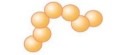
streptococcus
chain of cocci
32
New cards
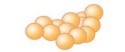
staphylococcus
cluster of cocci
33
New cards
bacillus
single rod

34
New cards
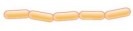
streptobacillus
chain of rods
35
New cards
Glycocalyx
- means sugar coat
- term used for substances that surrounds cell
- term used for substances that surrounds cell
36
New cards
capsule and slime layer
what are the two types of glycocalyx?
37
New cards
capsule
- substance is organized and firmly attached to the cell wall
- it protects pathogenic bacteria from phagocytosis by the cells of the host
- it protects pathogenic bacteria from phagocytosis by the cells of the host
38
New cards
slime layer
- the substance is unorganized and loosely attached to the cell wall
- it enables pathogenic
- it enables pathogenic
39
New cards
flagella
are long filamentous appendages that propel bacteria
40
New cards
1. monotrichous
2. amphitricous
3. lophotrichous
4. peritrichous
2. amphitricous
3. lophotrichous
4. peritrichous
what is the arrangement of flagella?
41
New cards
monotrichous
single polar flagellum
42
New cards
amphitricous
a tuft of flagella at each end of the cell
43
New cards
lophotrichous
2 or more flagella at 1 pole of the cell
44
New cards
peritrichous
flagella distributed over the entire cell
45
New cards
filament
long outermost and constant in diameter
46
New cards
hook
where filament is located and consist of different protein
47
New cards
basal body
it anchors the flagellum to the cell wall and plasma membrane
48
New cards
taxis
it is the movement of bacteria toward or away from a particular stimulus
49
New cards
axial filaments
allows spirochetes to move in a spiral, helical, or inchworm manner
50
New cards
fimbriae and pili
they have hairlike structures, most often observed on gram-negative bacteria
51
New cards
Fimbriae
can occur at the poles of the bacterial cell or they can be evenly distributed over the entire surface of the cell
52
New cards
Pili
usually longer than fimbriae and only one or 2 every cell
53
New cards
Cell Wall