Psychopathology WEEK 2.0
 Call Kai
 Learn
Learn Practice Test
 Spaced Repetition
 Match
Match Flashcards
 Knowt Play
1/109

There's no tags or description
Looks like no tags are added yet.
Name | Mastery | Learn | Test | Matching | Spaced | Call with Kai | Chat |
|---|
No analytics yet
Send a link to your students to track their progress
110 Terms
What is the integrative approach to psychopathology?
An approach that looks at multiple dimensions that can contribute to psychological disorders rather than assuming there is only one cause
What is the main idea behind the integrative approach?
No influence operates completely by itself. Different influences interact with and affect one another
What does "bidirectional" mean in the integrative approach?
Influences can affect each other in both directions.
Instead of:
ONE cause → ONE disorder
Think:
Biology ↔ Psychology ↔ Social factors ↔ Emotions ↔ Development
All of these can interact.
five major dimensions:
Biological
Psychological
Social learning
Emotional
Developmental
What do biological dimensions include?
Causal factors from genetics and neuroscience
What are the two major areas associated with biological influences?
Genetics and neuroscience
Example:
A person's genetic makeup may increase their vulnerability to a psychological disorder.
What do psychological dimensions include?
Behavioral and cognitive processes, including unconscious processes
What does the psychological dimension focus on?
How a person's thoughts, behaviors, and unconscious processes may contribute to psychological problems
Important idea:
"Not the disease a person has, but the person a disease has."
This emphasizes looking at the whole person, rather than seeing someone only as their disorder.
What is social learning?
Learning that occurs through observing and interacting with other people
How can social learning contribute to psychological disorders?
Modeling and reinforcement from other people can shape maladaptive behaviors and beliefs
What is modeling?
Learning by observing another person's behavior
ow can reinforcement from others affect behavior?
Behaviors that receive reinforcement may become more likely to continue.
Example:
A child sees a parent respond to strangers with fear → the child learns that strangers are dangerous → the child may develop social anxiety
How can emotional influences contribute to psychopathology?
Difficulty regulating emotions and having sustained negative emotions can increase vulnerability to psychological disorders.
What does difficulty regulating emotion mean?
Having trouble managing or controlling emotional responses
What does sustained negative affect mean?
Experiencing negative emotions for an extended period
Easy example:
Someone who has difficulty managing fear may continue feeling anxious even when the situation is no longer dangerous
What are developmental influences?
Factors related to how a person develops throughout life.
What factors are included in developmental influences?
Attachment, parenting, ACEs, social relationships, and developmental milestones.
What are ACEs?
Adverse Childhood Experiences.
Why does timing matter when considering developmental influences?
The same risk factor can produce different outcomes depending on when in life it occurs
Same experience ≠
same outcome
The effects of an experience can depend on when it happens during development.
Do biological, psychological, social, emotional, and developmental influences operate independently?
No, they interact and influence each other.
How do the different dimensions contribute to psychopathology?
Each dimension can influence the others, and they work together to create vulnerability to psychological disorders.
Each dimension can influence the others, and they work together to create vulnerability to psychological disorders
Example from the lecture:
A person may have:
Fear of people
Negative past experiences
Parental influence
Insecurities
A tendency to expect the worst from people
Lack of socialization during important developmental periods
These factors can interact rather than having one single cause.
What is the fallacy of a single cause?
Assuming that a psychological disorder or symptom has only one cause
There are two important possibilities:
One Cause → Many Symptoms
Can one event cause multiple symptoms?
Yes.
Example:
A traumatic event → anxiety + avoidance + fear + other symptoms
Can one symptom have multiple possible causes?
Yes.
Example:
Anxiety can result from biological, behavioral, emotional, social, or developmental influences
One cause →
many symptoms
One symptom →
many causes
If certain phobias, such as fear of heights or snakes, may be genetically prewired because they helped humans survive in the past, which influence is this?
Biological
Why?
The explanation involves genetics and evolutionary survival.
Jan's ex-husband's aftershave makes her nauseous even years after their divorce.
Q: Which influence best explains Jan's response?
Behavioral
Why?
The response can be understood as a learned association between the smell and her past experience.
Nathan is 16 and has more difficulty adjusting to his parents' separation than his 7-year-old sister.
Q: Which influence may explain the difference?
Developmental
Why?
The siblings are at different stages of development
Juanita had a traumatic Ferris wheel experience when she was young.
Q: What type of influence is likely involved in the initial development of the phobia?
Behavioral
What type of influence may maintain or increase the fear because of her strong emotional reaction?
Emotional
What is a genotype?
The genetic constitution of an individual organism
What is a phenotype?
The set of characteristics of an individual that are usually observable
What creates phenotypes?
Heredity and environment combine to create phenotypes
Does genetics alone determine every characteristic?
No. Environment also plays an important role.
Key idea:
Genes + Environment → Phenotype
This is important because psychological characteristics cannot always be explained by genetics alone.
Where are chromosomes located?
In the nucleus of cells.
What are chromosomes made of?
DNA and proteins
What does DNA stand for?
Deoxyribonucleic acid
What does DNA carry?
Genetic information in the form of genes
Chromosomes and DNA- Easy chain
Cell → Nucleus → Chromosomes → DNA → Genes
What are alleles?
Different versions or variants of the same gene
How many alleles do you inherit for each gene?
Usually two — one from each parent
What do the two alleles help determine?
A specific trait, such as eye color or blood type.
What is a dominant allele?
An allele that affects the individual's characteristics in dominant-recessive inheritance.
What is a recessive allele?
An allele that does not affect the characteristics when paired with a dominant allele.
Important:
Dominant + Recessive → dominant characteristic
What is incomplete dominance?
A pattern of inheritance in which the resulting phenotype is combined or intermediate between the two alleles.
Easy example:
Instead of:
Red + White → Red
or
Red + White → White
you could get:
Red + White → Pink
The resulting trait is intermediate.
Do all cells use all of their genes?
no
What happens to genes in specialized cells?
Only a small proportion of genes are turned on or expressed
Why does gene expression matter?
It allows cells to become specialized.
Example:
Different genes being expressed can help cells specialize in things such as:
Liver function
Brain functions
Personality-related characteristics
Can environmental factors influence whether genes are expressed?
yes
What does it mean for a gene to be "turned on"?
The gene is being expressed or actively used
Can environmental effects on gene expression potentially last across generations?
The lecture notes that effects can extend up to several generations.
⭐ Key idea:
Environment can influence gene expression.
So genes and environment aren't completely separate
Do genetics contribute to psychological disorders?
Yes. Research has identified genetic contributions to psychological disorders and related behavioral patterns
Approximately how much of enduring personality traits and cognitive abilities does the lecture estimate may be attributed to genetic influence?
About half
What examples of characteristics are given?
Extroversion, intelligence, and problem solving
If one identical twin has schizophrenia, does the other twin definitely develop schizophrenia?
no
What does the lecture say about the likelihood that the other identical twin will develop schizophrenia?
It is less than 50%
Why is this important?
If genetics completely determined schizophrenia, identical twins would be expected to have the disorder at a much higher rate.
The fact that the rate is less than 50% shows that environmental factors also matter
Can environmental experiences overwhelm the influence of genes?
yes
What type of experiences can affect genetic influence?
Adverse or stressful life events, such as a chaotic childhood or the death of a loved one.
Can two people with similar genetic backgrounds have different outcomes?
Yes, because their environments and experiences can differ.
What does it mean that the brain is plastic?
The brain and its functions can continually change in response to the environment
Can learning and environmental experiences influence gene activity?
yes
How can changes in gene activity affect the brain?
They can affect things such as the number of receptors at the end of a neuron and therefore influence biochemical functioning
What neurotransmitters/hormones are mentioned in this context?
Dopamine, serotonin, cortisol, and melatonin
Remember:
Plastic = changeable
The brain isn't completely fixed
What is the diathesis–stress model?
A model suggesting that people can inherit vulnerabilities or tendencies toward certain traits or behaviors that may become activated when they experience certain types of stress
What is a diathesis?
An inherited tendency or condition that makes someone susceptible to developing a disorder.
What is needed for a disorder to develop according to the model?
Both a vulnerability/predisposition and an appropriate environmental trigger or stressor.
Formula:
Diathesis + Stress/Trigger → Disorder
Example:
Someone may inherit a vulnerability toward addiction.
But:
Vulnerability alone ≠ addiction
If the person experiences certain environmental events, trauma, or other adverse experiences, the vulnerability may become more prominent.
Vulnerability alone ≠
addiction
If the person experiences certain environmental events, trauma, or other adverse experiences, the vulnerability may become more prominent
Is there an "alcoholic gene"?
no
What genetic factors may contribute to vulnerability to addiction?
Factors involving impulse control, decision making, alcohol tolerance, ability to metabolize alcohol, and dopamine production
What is the diathesis in the addiction example?
The inherited tendency or vulnerability toward addiction-related behaviors.
What can activate the vulnerability?
Environmental events such as adverse experiences, trauma, or depression.
Main point:
Genes can create vulnerability, but environment can help determine whether that vulnerability becomes expressed.
What system regulates many processes involved in psychopathology?
The nervous system.
What are the two major divisions of the nervous system mentioned?
The central nervous system and peripheral nervous system
What makes up the central nervous system (CNS)?
The brain and spinal cord
What makes up the peripheral nervous system (PNS)?
he somatic nervous system and autonomic nervous system
Central Nervous System
Brain
Spinal cord
Peripheral Nervous System
Somatic nervous system
Autonomic nervous system
What do neurotransmitters do?
They carry messages from one neuron to another
Why are neural pathways important in psychopathology?
Some neural pathways play roles in psychological disorders
What does "neurons that fire together, wire together" mean?
When neurons are repeatedly active together, their connections can become stronger
Easy way:
Repeated activity → stronger connections
What did older studies sometimes claim about neurotransmitters and psychological disorders?
They suggested that disorders were caused by biochemical imbalances, excesses, or deficiencies in certain neurotransmitter systems
What neurotransmitter has often been associated with depression?
Serotonin
What neurotransmitter has been implicated in schizophrenia?
Dopamine
Is it accurate to say that psychological disorders are simply caused by one neurotransmitter being "too high" or "too low"?
No. The lecture identifies this as an oversimplification
Psychological disorders are more complicated than simply having "too much" or "too little" of one neurotransmitter.
What does an agonist do?
Increases neurotransmitter activity.
What does an antagonist do?
Decreases or blocks neurotransmitter activity
AGONIST =
ACTIVATES
ANTAGONIST =
AGAINST
Who is associated with conditioning?
Pavlov
What can conditioning contribute to?
Learned responses associated with experiences such as trauma
What famous experiment is associated with learned fear?
The Baby Albert experiment.
Who is associated with learned helplessness?
Martin Seligman
What is social learning based on?
Modeling and observational learning
SUPER IMPORTANT COMPARISON
table
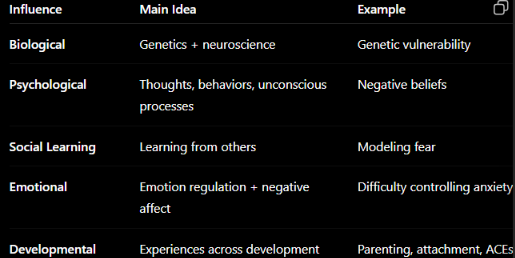
SUPER IMPORTANT MEMORY MAP
Psychological Disorder
Think:
Biological
↓
Psychological
↓
Social Learning
↓
Emotional
↓
Developmental
But DON'T memorize these as a straight line.
The important point is:
They interact with each other.
Heredity and ________ combine to create phenotypes
environment
An individual's genetic constitution is called their ________
genotype