AQA A level Chemistry 3.07 Optical Isomerism
 Call Kai
 Learn
Learn Practice Test
 Spaced Repetition
 Match
Match Flashcards
 Knowt Play
1/6

Earn XP
Description and Tags
Name | Mastery | Learn | Test | Matching | Spaced | Call with Kai | Chat |
|---|
No analytics yet
Send a link to your students to track their progress
7 Terms
Define the term racemic mixture (1)
Racemic mixture contains 2 enantiomers in equal proportions (1)
State and explain how you could distinguish between separate samples of two enantiomers (2)
Shine plane polarised on these two enantiomers (1)
One enantiomer will rotate light in one direction whereas another enantiomer will rotate light in the opposite direction in equal amounts (1)
The carbonyl compound CH3CHO reacts very slowly with HCN
Explain why this reaction produces a racemic mixture (3)
the carbonyl group is planar (1)
equally likely to be attacked by nucleophile above and below the bond (1)
and therefore there will be equal proportions of two enantiomers (1)

Two isomeric ketones are shown below and they then react with HCN
Some students were asked to suggest methods to distinguish between isomers Q and R. One student suggested testing the optical activity of the products formed when Q and R were reacted separately with HCN. By considering the optical activity of these products formed from Q and R, explain why this method would not distinguish between Q and R. (3)
Product from Q is a racemic mixture (1)
A racemic is optically inactive (two enantiomers’ optical rotations cancel each other out) (1)
Product from R has no chiral carbon (1)
State the relationship between two chiral molecules with the same structural formula (1)
They are non-superimposable mirror images of each other (1)
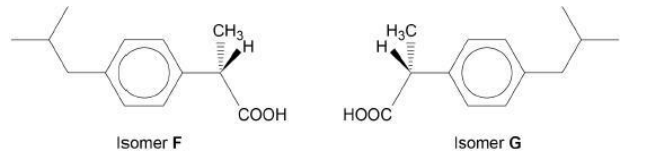
Figure 2 shows optical isomers F and G.
Isomer F is the active compound in the medicine ibuprofen. In the manufacture of ibuprofen both isomers F and G are formed. An enzyme is then used to bind to isomer G and catalyse its hydrolysis. After the products of hydrolysis of G are removed, a pure sample of isomer F is collected. Explain how a structural feature of this enzyme enables it to catalyse the hydrolysis of isomer G but not the hydrolysis of isomer F. (2)
Enzyme has an active site (1)
The enzyme has the correct stereo chemistry/stereospecific
OR
Enzyme has the complementary shape (1)

Acrylonitrile, H2C=CHCN, can be used as a starting material for the synthesis of butane-1,4-diamine, as shown in this reaction scheme.
Reaction 1 produces a mixture of W and two other isomers. Draw the structures of the two other isomers. Explain, by considering the mechanism of this reaction, why all three isomers are formed.
Stage 1 Types of isomers formed
CH3CHBrCN
Exists as two Optical isomers/enantiomers
Stage 3
2-bromo isomer has chiral carbon/ C with 4 different groups
Optical as C+ is planar
So can be attacked from above or below
