FAA and Gleim Questions
 Call Kai
 Learn
Learn Practice Test
 Spaced Repetition
 Match
Match Flashcards
 Knowt Play
1/71

There's no tags or description
Looks like no tags are added yet.
Name | Mastery | Learn | Test | Matching | Spaced | Call with Kai | Chat |
|---|
No analytics yet
Send a link to your students to track their progress
72 Terms
1-1 AMP056
Which statement is true regarding bearings used in high-powered reciprocating aircraft engines?
A—The outer race of a single-row, self-aligning ball bearing will always have a radius equal to the radius of the balls.
B—There is less rolling friction when ball bearings are used than when roller bearings are employed.
C—Crankshaft bearings are generally of the ball-type due to their ability to withstand extreme loads without overheating.
1-1. Answer B. JSPT 1A, FPH
Both ball bearings and roller bearings are used in aircraft engines. However, since the steel balls in a ball bearing offer less surface contact than the rollers of a roller bearing, ball bearings produce less rolling friction. Therefore, ball bearings are generally used in high-powered reciprocating engines to keep friction to a minimum.
1-2 AMP053
What is the principal advantage of using propeller reduction gears?
A—To enable the propeller RPM to be increased without an accompanying increase in engine RPM.
B—To enable the engine RPM to be increased with an accompanying increase in power and allow the propeller to remain at a lower, more efficient RPM.
C—To enable the engine RPM to be increased with an accompanying increase in propeller RPM.
1-2. Answer B. JSPT 1A, JSPT 12D, FPH
The amount of horsepower an engine produces is directly related to the engine’s RPM. Therefore, most aircraft engines must run at a speed in excess of 2,000 RPM to develop sufficient power. However, propeller efficiency at these speeds decreases rapidly. Therefore, in order to maintain an acceptable level of propeller efficiency a reduction gear is used. A reduction gear allows an engine to run at the high rpm needed to produce more horsepower while at the same time, allows the propeller to rotate at a lower, more efficient RPM.
1-3 AMP054
Which of the following is a characteristic of a thrust bearing used in most radial engines?
A—Tapered roller
B—Double-row ball
C—Deep-groove ball
1-3. Answer C. JSPT 1A, FPH
Special deep-groove ball bearings are used as thrust bearings in most radial engines. This type of bearing generates the least amount of friction of all the types of bearings listed while still being able to withstand both the thrust and radial loads. Although tapered roller bearings and double-row ball bearings are capable of withstanding both thrust and radial loads, they produce more friction than a deep-groove ball bearing.
1-4 AMP056
Which bearing is least likely to be a roller or ball bearing?
A—Rocker arm bearing (overhead valve engine)
B—Master rod bearing (radial engine)
C—Crankshaft main bearing (radial engine)
1-4. Answer B. JSPT 1A, FPH
The question asks for the least likely use of a roller or ball bearing. Master rod bearings on radial engines are generally subjected to radial loads only and, therefore, plain bearings are used. Therefore, Master rod bearing (radial engine) is correct.
1-5 AMP054
The operating temperature valve clearance of a radial engine as compared to cold valve clearance is
A— greater.
B— less.
C— the same.
1-5. Answer A. JSPT 1A, FPH
As a radial engine warms up, the aluminum alloy cylinder heads expand causing the rocker arm in the head to move away from the crankcase. At the same time, the pushrod also expands but at a lesser rate than the cylinder head. The difference in expansion amounts between the cylinder head and pushrod effectively increases the space between the valve stem and rocker arm (valve clearance). Therefore, greater is correct.
1-6 AMP056
Which statement is correct regarding engine crankshafts?
A—Moveable counterweights serve to reduce the torsional vibrations in an aircraft reciprocating engine.
B—Moveable counterweights serve to reduce the dynamic vibrations in an aircraft reciprocating engine.
C—Moveable counterweights are designed to resonate at the natural frequency of the crankshaft.
1-6. Answer B. JSPT 1A, FPH
Each time a cylinder on an engine fires, a pulse of energy is transferred to the crankshaft. Since the power stroke occurs out of line with the throw of the crank, dynamic vibrations occur. To dampen these vibrations, moveable counterweights, or dynamic dampers, align to dampen out the vibrations.
1-7 AMP056
Master rod bearings are generally what type?
A—Plain
B—Roller
C—Ball
1-7. Answer A. JSPT 1A, FPH
The master rod in a radial engine is subjected to radial loads only and, therefore, plain bearings are typically used as master rod bearings.
1-8 AMP056
Cam-ground pistons are installed in some aircraft engines to
A—provide a better fit at operating temperatures.
B—act as a compensating feature so that a compensated magneto is not required.
C—equalize the wear on all pistons.
1-8. Answer A. JSPT 1A, FPH
A cam-ground piston is constructed with a slightly oval cross-section. In other words, the piston’s diameter perpendicular to the piston pin is slightly larger than the diameter parallel to the piston pin. This oval shape holds the piston square in the cylinder when an engine is cold and allows the greater mass of the piston pin bosses to expand more freely at operating temperatures. Once expanded, camground pistons provide a better fit within the cylinder.
Piston-pin boss area expands more → cam-ground shape compensates → piston becomes rounder when hot.
1-9 AMP056
Some aircraft engine manufacturers equip their product with choked or taper-ground cylinders in order to
A—provide a straight cylinder bore at operating temperatures.
B—flex the rings slightly during operation and reduce the possibility of the rings sticking in the grooves.
C—increase the compression pressure for starting purposes.
1-9. Answer A. JSPT 1A
Most cylinders have a certain degree of choke, or taper. This means that the cylinder barrel is slightly narrower at the cylinder head than at the cylinder skirt. A choked cylinder allows for cylinder expansion resulting from the higher operating temperatures near the head. Once a choked cylinder reaches operating temperature, the choked area expands to match the bore at the skirt, and the entire bore becomes straight.
1-10 AMP056
An aircraft reciprocating engine using hydraulic valve lifters is observed to have no clearance in its valve-operating mechanism after the minimum inlet oil and cylinder head temperatures for takeoff have been reached. When can this condition be expected?
A—During normal operation
B—When the lifters become deflated
C—As a result of carbon and sludge becoming trapped in the lifter and restricting its motion
1-10. Answer A. JSPT 1A, FPH
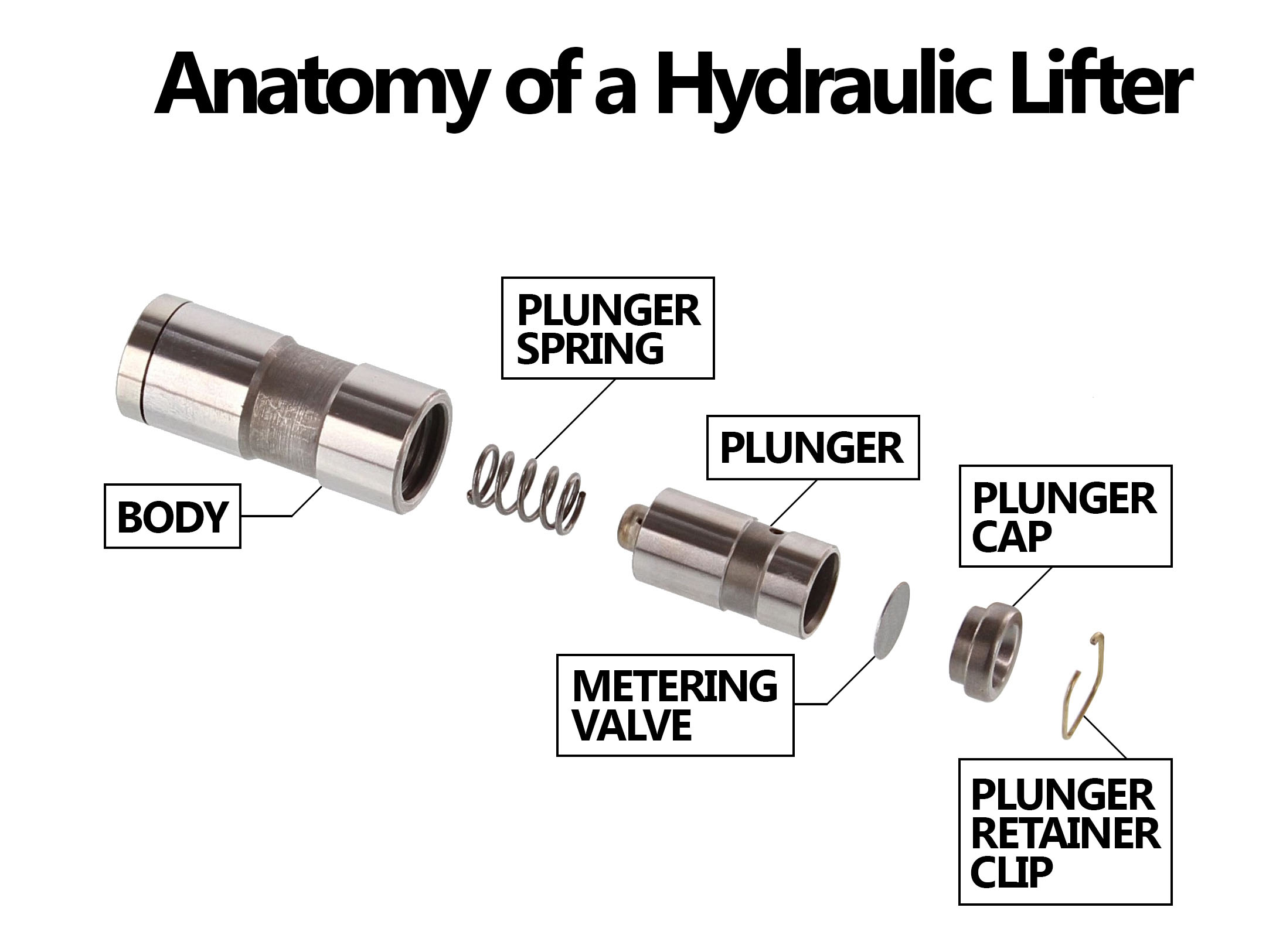
In a zero-lash or zero-clearance hydraulic valve lifter, oil pressure forces the lifter outward until all clearance between the rocker arm and the valve stem is removed. This condition in an engine is normal.
The plunger spring pushes the plunger outward to take up the slack, while engine oil fills the lifter and supports/holds that position under pressure.
Right. The spring helps position the plunger and take up the initial slack, but the spring alone is not strong enough to hold everything solid while the valve is being opened.
The oil pressure inside the lifter supports the plunger and makes the lifter act almost like a solid piece during operation.
1-11 AMP056
Some cylinder barrels are hardened by
A—nitriding.
B—shot peening.
C—tempering.
1-11. Answer A. JSPT 1A, FPH
The cylinder barrel of a reciprocating engine is made of a steel alloy forging with its inner surface hardened to resist wear. One method used to harden cylinders is nitriding. In the nitriding process, the cylinder is heated and exposed to ammonia or cyanide gas. Nitrogen from the gas is absorbed by the steel causing iron nitrides to form on the steel’s surface.
1-12 AMP056
What is the purpose of the safety circlet installed on some valve stems?
A—To hold the valve guide in position
B—To hold the valve spring retaining washer in position
C—To prevent valves from falling into the combustion chamber
1-12. Answer C. JSPT 1A, FPH
The stems of some valves have a narrow groove cut in them just below the lock ring groove that allows for the installation of safety circlets or spring rings. The circlets are designed to prevent the valves from falling into the combustion chamber should the valve tip break during engine operation.
1-13 AMP056
The valve clearance of an engine using hydraulic lifters, when the lifters are completely flat, or empty, should not exceed
A—a specified amount below zero.
B—a specified amount above zero.
C—0.00 inch.
1-13. Answer B. JSPT 1A, FPH
When operating properly, an engine equipped with hydraulic lifters will have a valve clearance of zero. However, when the lifters are flat or empty, the lifter must have a specified clearance greater than zero in order to provide the proper operating range.
EXPLANATION: The confusing part is that it’s talking about the lifter when it is empty/collapsed, not during normal operation.
When the hydraulic lifter is filled with oil and operating, it expands and takes up the slack, giving you essentially zero clearance.
But when the lifter is flat/empty, it is collapsed, so there should be a small specified gap above zero. That gap gives the lifter room to expand when oil fills it.
If there were zero clearance while the lifter was empty, then when it filled and expanded, it could push too far and potentially hold the valve slightly open.
1-14 AMP056
Full-floating piston pins are those which allow motion between the pin and
A—the piston.
B—both the piston and the large end of the connecting rod.
C—both the piston and the small end of the connecting rod.
1-14. Answer C. JSPT 1A, FPH
A full-floating piston pin gets its name from the fact that the pin is free to rotate in both the piston and in the small end of the connecting rod.

1-15 AMP008
If the hot clearance is used to set the valves when the engine is cold, what will occur during operation of the engine?
A—The valves will open early and close early.
B—The valves will open late and close early.
C—The valves will open early and close late.
1-15. Answer B. FPH
When an engine is hot, the clearance between the rocker arm and the valve stem is greater than when the engine is cold. Therefore, if the valves are set to hot clearances when the engine is cold, the overall valve clearance will be excessive and the valves will open late and close early.
Explanation: With the normal smaller gap, the rocker contacts the valve sooner and keeps pushing on it longer.
With the larger gap:
it takes longer before the rocker reaches the valve → opens late
the rocker loses contact sooner on the way back → closes early
So the valve ends up staying open for a shorter amount of time than it should.
1-16 AMP056
The purpose of two or more valve springs in aircraft engines is to
A—equalize side pressure on the valve stems.
B—eliminate valve spring surge.
C—equalize valve face loading.
1-16. Answer B. JSPT 1A, FPH
Each valve on a reciprocating engine is closed by two or three helical-coiled springs. If only a single spring were used to close a valve, the spring would vibrate or surge at certain speeds. However, with multiple springs, each spring vibrates at a different engine speed resulting in rapid dampening of all spring surge vibrations.
Explanation: A single valve may have two or three springs around it, and all of those springs have the same basic job: push the valve closed and keep it closed.
The reason for using multiple springs is valve spring surge. At certain engine RPMs, one spring could start vibrating/bouncing instead of smoothly controlling the valve.
1-17 AMP007
What special procedure must be followed when adjusting the valves of an engine equipped with a floating cam ring?
A—Adjust valves when the engine is hot.
B—Adjust all exhaust valves before intake valves.
C—Eliminate cam bearing clearance when making valve adjustment.
1-17. Answer C. JSPT 1A, FPH
When adjusting the valves on a radial engine with a floating cam ring, the clearance between the cam ring and cam bearing must be eliminated so the cam is in a definite position prior to adjusting the valve clearance. To do this, specific valves must be depressed and released simultaneously to remove the spring tension from the side positions on the cam. This permits the cam to slide away from the valves you are adjusting.
EXPLANATION: Get rid of the extra movement/gap at the cam bearing first, so the only clearance you’re actually measuring is the valve clearance.
1-18 AMP056
What is an advantage of using metallic-sodium filled exhaust valves in aircraft reciprocating engines?
A—Increased strength and resistance to cracking
B—Reduced valve operating temperatures
C—Greater resistance to deterioration at high valve temperatures
1-18. Answer B. JSPT 1A, FPH
Metallic-sodium is used in some valves because it is an excellent heat conductor. In a metallic-sodium filled valve, the sodium melts at approximately 208°F. When this happens, the reciprocating motion of the valve circulates the liquid sodium enabling it to carry away excess heat, thereby reducing valve operating temperatures.
1-19 AMP056
Valve clearance changes on opposed-type engines using hydraulic lifters are accomplished by
A—rocker arm adjustment.
B—rocker arm replacement.
C—push rod replacement.
1-19. Answer C. JSPT 1A, FPH
The only way to adjust the valve clearance on an engine using hydraulic lifters is to insert a different sized push rod.
Explanation: With a hydraulic lifter, the engine is designed to run with essentially zero valve lash during normal operation because the lifter automatically takes up the slack.
Instead, if the geometry is wrong, you change the pushrod length by installing a different-sized pushrod.
1-20 AMP056
What could cause excessive pressure buildup in the crankcase of a reciprocating engine?
A—Plugged crankcase breather
B—Improper warm-up operation
C—An excessive quantity of oil
1-20. Answer A. FPH
All piston rings let some combustion chamber pressure into the engine crankcase. This pressure is vented to the atmosphere through a crankcase breather. Therefore, if a crankcase breather becomes plugged, pressure will build up inside the crankcase.
1-21 AMP049
How is the oil collected by the piston oil ring returned to the crankcase?
A—Down vertical slots cut in the piston wall between the piston oil ring groove and the piston skirt
B—Through holes drilled in the piston oil ring groove
C—Through holes drilled in the piston pin recess
1-21. Answer B. JSPT 1A, FPH
Oil control rings regulate the oil film thickness on the cylinder wall. Excess oil that collects on oil control rings as a cylinder moves is routed back to the crankcase through holes that are drilled in the piston ring grooves or in the lands next to these grooves.
1-22 AMP050
Oil accumulation in the cylinders of an inverted in-line engine and in the lower cylinders of a radial engine is normally reduced or prevented by
A—reversed oil control rings.
B—routing the valve-operating mechanism lubricating oil to a separate scavenger pump.
C—extended cylinder skirts.
1-22. Answer C. FPH
Some radial engine cylinders and all cylinders in an inverted engine are located at the bottom of the engine. To prevent these cylinders from being flooded with oil and suffering hydraulic lock, extended cylinder skirts are often installed. With these extended skirts, oil that falls into the cylinders is immediately thrown back into the crankcase.
1-23 AMP030
Where are sludge chambers, when used in aircraft engine lubrication systems, usually located?
A—In the crankshaft throws
B—Adjacent to the scavenger pumps
C—In the oil storage tank
1-23. Answer A. JSPT 1A, FPH
Some crankshafts are manufactured with hollow crankpins that serve as sludge removers, or chambers. On a crankshaft with sludge chambers, centrifugal motion forces sludge and other foreign material into the sludge chambers during engine operation. This sludge remains in the sludge chamber until the engine is overhauled.
1-24 AMP056
Excessive oil is prevented from accumulating on the cylinder walls of a reciprocating engine by
A—the design shape of the piston skirt.
B—internal engine pressure bleeding past the ring grooves.
C—oil control rings on the pistons.
1-24. Answer C. JSPT 1A, FPH
Oil control rings regulate the oil film thickness on the cylinder wall by removing excess oil and allowing it to return to the crankcase. Although extended piston skirts can help keep oil from accumulating in the lower cylinders of radial engines, piston skirt shape does not prevent excessive oil buildup on cylinder walls.
1-25 AMP030
The valve assemblies of opposed reciprocating engines are lubricated by means of a
A—gravity feed system.
B—splash and spray system.
C—pressure system.
1-25. Answer C. JSPT 1A, FPH
The overhead valve assemblies of opposed engines used in helicopters and airplanes are lubricated by a pressure system. In this type of system, pressurized oil flows through the hydraulic tappet body and through hollow pushrods to the rocker arm where it lubricates the rocker arm bearing and the valve stem.
1-26 AMP030
How are the piston pins of most aircraft engines lubricated?
A—By pressure oil through a drilled passageway in the heavy web portion of the connecting rod
B—By oil which is sprayed or thrown by the master or connecting rods
C—By the action of the oil control ring and the series of holes drilled in the ring groove directing oil to the pin and piston pin boss
1-26. Answer B. FPH
The piston pins on most reciprocating engines are lubricated by oil which is sprayed or thrown from the master or connecting rod.
1-27 AMP030
Which of the following bearing types must be continuously lubricated by pressure oil?
A—Ball
B—Roller
C—Plain
1-27. Answer C. JSPT 1A, FPH
All bearings require lubrication. However, plain bearings must have oil supplied to them under pressure to prevent metal-to-metal contact.
1-28 AMP056
The undersides of pistons are frequently finned. The principal reason is to
A— provide sludge chambers and sediment traps.
B— provide for greater heat transfer to the engine oil.
C— support ring grooves and piston pins.
1-28. Answer B. FPH
The majority of aircraft engine pistons are machined from aluminum alloy forgings. On some pistons, cooling fins are provided on the underside of the piston to facilitate the transfer of heat to the engine oil.
1-29 AMP056
Sodium-filled valves are advantageous to an aviation engine because they
A— are lighter.
B— dampen valve impact shocks.
C— dissipate heat well.
1-29. Answer C. JSPT 1A, FPH
Metallic sodium is used in some valves because it is an excellent heat conductor. In a metallic sodium valve, the sodium melts at approximately 208 degrees Fahrenheit. When this happens, the reciprocating motion of the valve circulates the liquid sodium enabling it to carry away excess heat and reduce valve operating temperatures.
1-30 AMP056
At what speed must a crankshaft turn if each cylinder of a four-stroke cycle engine is to be fired 200 times a minute?
A— 800 RPM
B— 1,600 RPM
C— 400 RPM
1-30. Answer C. JSPT 1A, FPH
In a four-stroke engine, each cylinder fires once every two crankshaft revolutions. Therefore, in order for a cylinder to fire 200 times a minute, the crankshaft must rotate at a speed of 400 RPM (200 x 2 = 400).
1-31 AMP007
You are performing a 100-hour inspection on an R985-22 aircraft engine. What does the “985” indicate?
A— The total piston displacement of the engine
B— The pistons will pump a maximum of 985 cubic inches of air per crankshaft revolution
C— The total piston displacement of one cylinder
1-31. Answer A. JSPT 1A, FPH
In the designation for an engine R985-22, the 985 indicates the total piston displacement of the engine in cubic inches.
1-32 AMP056
Which of the following will decrease volumetric efficiency in a reciprocating engine?
1. Full throttle operation
2. Low cylinder head temperatures
3. Improper valve timing
4. Sharp bends in the induction system
5. High carburetor air temperatures
———————
A— 2, 4, and 5
B— 1, 2, 3, and 4
C— 3, 4, and 5
1-32. Answer C. JSPT 1B, FPH
Volumetric efficiency is a comparison of the volume of a fuel/air charge inducted into all cylinders to the total piston displacement. Factors that reduce volumetric efficiency include part-throttle operation, long, small diameter intake pipes, sharp bends in the induction system, excessive carburetor air temperatures, excessive cylinder head temperatures, incomplete scavenging, and improper valve timing. Of the five choices given in the question only #3, #4, and #5 affect volumetric efficiency.
1-33 AMP056
A nine-cylinder engine with a bore of 5.5 inches and a stroke of 6 inches will have a total piston displacement of
A— 740 cubic inches.
B— 1,425 cubic inches.
C— 1,283 cubic inches.
1-33. Answer C. JSPT 1B, FPH
The total piston displacement of an engine is equal to the displacement, or volume of one cylinder multiplied by the total number of cylinders.
The volume of a cylinder is calculated using the formula V = π (r)² h, where:
(V) is the volume,
(r) is the radius of the cylinder
(h) is the height, or stroke of the piston.
The displacement of each cylinder is 142.55 cubic inches (3.1416 x (2.75)² x 6 = 142.55).
To determine the displacement of the entire engine, multiply the displacement of each cylinder by the total number of cylinders.
The total engine displacement is 1,282.95 cubic inches (142.55 x 9 = 1,282.95). 1,283 cubic inches is the closest.
1-34 AMP056
The five events of a four-stroke cycle engine in the order of their occurrence are
A— intake, ignition, compression, power, exhaust.
B— intake, power, compression, ignition, exhaust.
C— intake, compression, ignition, power, exhaust.
1-34. Answer C. JSPT 1B, FPH
The four-stroke cycle begins when the piston starts moving down in the cylinder on the intake stroke. When the piston reaches bottom center it reverses direction and starts moving up on the compression stroke. Near the top of the compression stroke, the spark plug fires causing ignition of the fuel/air mixture. As soon as the fuel/air mixture begins to burn, the piston is forced down in the power stroke. As the piston approaches bottom center, the exhaust valve opens and the piston reverses direction to begin the exhaust stroke. Therefore, the five events of a four-stroke engine are intake, compression, ignition, power, and exhaust.
1-35 AMP056
The primary concern in establishing the firing order for an opposed engine is to
A— provide for balance and eliminate vibration to the greatest extent possible.
B— keep power impulses on adjacent cylinders as far apart as possible in order to obtain the greatest mechanical efficiency.
C— keep the power impulses on adjacent cylinders as close as possible in order to obtain the greatest mechanical efficiency.
1-35. Answer A. JSPT 1B, FPH
The firing order within an engine is designed to provide for balance and to eliminate vibration to the greatest extent possible
1-36 AMP056
If fuel/air ratio is proper and ignition timing is correct, the combustion process should be completed
A— 20° to 30° before top center at the end of the compression stroke.
B— when the exhaust valve opens at the end of the power stroke.
C— just after top center at the beginning of the power stroke.
1-36. Answer C. JSPT 1B, FPH
Combustion is the third event in the cycle of a four-stroke engine. The combustion process begins as the piston reaches the top of the compression stroke and the fuel/air charge is ignited by means of an electric spark. The time of ignition varies from 20 to 35 degrees before top dead center to ensure complete combustion by the time the piston is slightly past the top dead center position.
1-37 AMP056
On which strokes are both valves on a four-stroke cycle reciprocating engine open?
A— Power and exhaust
B— Intake and compression
C— Exhaust and intake
1-37. Answer C. JSPT 1B, FPH
For a reciprocating engine to operate properly, each valve must open at the proper time, stay open for a specific length of time, and close at the proper time. In a typical reciprocating engine, the intake valve opens just before the piston reaches top dead center on the exhaust stroke and remains open into the intake stroke. On the other hand, the exhaust valve is open throughout the exhaust stroke and remains open after top dead center when the piston begins the intake stroke. Therefore, at the end of the exhaust stroke and the beginning of the intake stroke both valves are open at the same time.
1-38 AMP056
The actual power delivered to the propeller of an aircraft engine is called
A— friction horsepower.
B— brake horsepower.
C— indicated horsepower.
1-38. Answer B. JSPT 1B, FPH
Brake horsepower is the horsepower that is delivered to the propeller shaft. One way to determine an engine’s brake horsepower is to subtract an engine’s friction horsepower from its indicated horsepower.
1-39 AMP056
Using the following information, determine how many degrees the crankshaft will rotate with both the intake and exhaust valves seated. Intake opens 15° BTDC. Exhaust opens 70° BBDC. Intake closes 45° ABDC. Exhaust closes 10° ATDC.
A— 290°
B— 245°
C— 25°
1-39. Answer B. JSPT 1B, FPH
One complete revolution of the crankshaft and piston takes 360 degrees, with top dead center (TDC) being 0 degrees and bottom dead center (BDC) 180 degrees.
The only time both valves are closed in a four-stroke engine is during a portion of the compression and combustion strokes. This question indicates that the intake valve closes 45 degrees after bottom dead center, or 135 degrees before top dead center (180 - 45 = 135).
The exhaust valve, on the other hand, opens 70 degrees before bottom dead center, or 110 degrees after top dead center (180 - 70 = 110). Therefore the number of degrees both valves are seated is 245 degrees (135 + 110 = 245).
1-40 AMP056
If an engine with a stroke of 6 inches is operated at 2,000 RPM, the piston movement within the cylinder will be
A— at maximum velocity around TDC.
B— constant during the entire 360° of crankshaft travel.
C— at maximum velocity 90° after TDC.
1-40. Answer C. JSPT 1B, FPH
As a piston leaves top dead center (TDC) and bottom dead center (BDC), it accelerates and attains its maximum speed at 90 degrees after TDC and 90 degrees after BDC.
1-41 AMP056
Which statement is correct regarding a four-stroke cycle aircraft engine?
A— The intake valve closes on the compression stroke.
B— The exhaust valve opens on the exhaust stroke.
C— The intake valve closes on the intake stroke.
1-41. Answer A. JSPT 1B, FPH
Depending upon the specific engine, an intake valve is timed to open prior to the piston reaching top dead center on the exhaust stroke and to close about 50 to 75 degrees past bottom dead center on the compression stroke.
This allows the momentum of the incoming gases to charge the cylinder more completely. The exhaust valve, on the other hand, typically opens around 70 degrees before bottom dead center on the power stroke and closes at approximately 15 degrees after top dead center on the intake stroke.
1-42 AMP056
When is the fuel/air mixture ignited in a conventional reciprocating engine?
A— When the piston has reached top dead center of the intake stroke
B— Shortly before the piston reaches the top of the compression stroke
C— When the piston reaches top dead center on the compression stroke
1-42. Answer B. JSPT 1B, FPH
In a reciprocating engine, the fuel/air charge is fired by means of an electric spark shortly before the piston reaches top dead center on the compression stroke. The time of ignition varies from 20 degrees to 35 degrees before top dead center, depending upon the engine requirements.
By igniting the fuel/air charge before the piston reaches top dead center, complete combustion is ensured by the time the piston is slightly past top dead center and maximum power is delivered to the crankshaft.
1-43 AMP056
Ignition occurs at 28° BTDC on a certain four-stroke cycle engine, and the intake valve opens at 15° BTDC.
How many degrees of crankshaft travel after ignition does the intake valve open?
(Consider one cylinder only.)
A— 707°
B— 373°
C— 347°
1-43. Answer B. JSPT 1B, FPH
Ignition occurs at 28 degrees before top dead center. Therefore, the piston will travel 28 degrees to complete the stroke. As the piston moves from top to bottom dead center on the power stroke, the crankshaft turns another 180 degrees.
According to the question, the intake valve opens 15 degrees before top dead center of the exhaust stroke, or 165 degrees after bottom dead center. Therefore, total crankshaft travel is 373 degrees
(28 + 180 + 165 = 373).
1-44 AMP056
Valve overlap is defined as the number of degrees of crankshaft travel
A— during which both valves are off their seats.
B— between the closing of the intake valve and the opening of the exhaust valve.
C— during which both valves are on their seats.
1-44. Answer A. JSPT 1B, FPH
Valve overlap represents the degree of crankshaft travel in which both the intake valve and exhaust valve are open (off their seat). On most reciprocating engines, the intake valve opens before top dead center on the exhaust stroke, while the exhaust valve closes after the piston has passed TDC and started the intake stroke.
This results in a valve overlap of anywhere from 40 to 75 degrees.
1-45 AMP056
If the exhaust valve of a four-stroke cycle engine is closed and the intake valve is just closed, the piston is on the
A— intake stroke.
B— power stroke.
C— compression stroke.
1-45. Answer C. JSPT 1B, FPH
The intake valve of a reciprocating engine is timed to close about 50 to 75 degrees past bottom dead center on the compression stroke. After the intake valve closes, the continued upward travel of the piston compresses the fuel/air mixture to obtain the desired burning and expansion characteristics.
1-46 AMP056
How many of the following are factors in establishing the maximum compression ratio limitations of an aircraft engine?
1. Detonation characteristics of the fuel used
2. Design limitations of the engine
3. Degree of supercharging
4. Spark plug reach
————
A— Four
B— Two
C— Three
1-46. Answer C. JSPT 1B, FPH
An engine’s compression ratio is the controlling factor in determining the amount of horsepower an engine develops. Some of the factors that must be considered when establishing a maximum compression ratio include the detonation characteristics of the fuel used, the engine’s design limitations, and the degree of supercharging. Spark plug reach does not limit an engine’s compression ratio. Based on this, three of the four factors listed are valid limitations.
1-47 AMP056
The primary purpose in setting proper valve timing and overlap is to
A— permit the best possible charge of fuel/air mixture into the cylinders.
B— gain more thorough exhaust gas scavenging.
C— obtain the best volumetric efficiency and lower cylinder operating temperatures.
1-47. Answer C. JSPT 1B, FPH
Reciprocating engines are timed so that both the intake and exhaust valves are open near the end of the exhaust stroke and into the beginning of the intake stroke. This valve overlap allows a larger quantity of the fuel/air charge to be drawn into the cylinder which, in return, increases volumetric efficiency. Furthermore, overlap helps to expel the exhaust gases from the previous power stroke and lower operating temperatures.
1-48 AMP056
Compression ratio is the ratio between the
A— piston travel on the compression stroke and on the intake stroke.
B— combustion chamber pressure on the combustion stroke and on the exhaust stroke.
C— cylinder volume with piston at bottom dead center and at top dead center.
1-48. Answer C. JSPT 1B, FPH
The compression ratio of an engine is a comparison of the volume of a cylinder when the piston is at the bottom of a stroke to the volume of the same cylinder when the piston is at the top of a stroke.
1-49 AMP056
What does valve overlap promote?
A—Lower intake manifold pressure and temperatures.
B—A backflow of gases across the cylinder.
C—Better scavenging and cooling characteristics.
1-49. Answer C. JSPT 1B, FPH
Valve overlap represents the number of degrees that both the exhaust and intake valves are open. Two benefits of valve overlap are improved scavenging and cooling characteristics and increased volumetric efficiency.
1-50 AMP056
The horsepower developed in the cylinders of a reciprocating engine is known as the
A—shaft horsepower.
B—indicated horsepower.
C—brake horsepower.
1-50. Answer B. JSPT 1B, FPH
The horsepower developed in the combustion chambers without considering friction is referred to as indicated horsepower.
1-51 AMP056
When does valve overlap occur in the operation of an aircraft reciprocating engine?
A—At the end of the exhaust stroke and the beginning of the intake stroke.
B—At the end of the power stroke and the beginning of the exhaust stroke.
C—At the end of the compression stroke and the beginning of the power stroke.
1-51. Answer A. JSPT 1B, FPH
Valve overlap identifies the period when both the intake and exhaust valves are open in a cylinder. The only time valve overlap occurs is at the end of the exhaust stroke and the beginning of the intake stroke.
1-52 AMP056
An increase in manifold pressure with a constant RPM will cause the bearing load in an engine to
A—decrease.
B—remain relatively constant.
C—increase.
1-52. Answer C. JSPT 1B, FPH
Manifold pressure represents the absolute pressure of the fuel/air mixture prior to entering the cylinders. Therefore, an increase in manifold pressure for a given RPM represents a higher pressure fuel/air mixture entering the cylinders. This higher pressure produces a corresponding increase in brake mean effective pressure and power output. Any time the brake mean effective pressure or power output is increased, additional force is transmitted through the pistons to the crankshaft and bearing load increases.
1-53 AMP056
Reduced air density at high altitude has a decided effect on carburetion, resulting in a reduction of engine power by
A—excessively enriching the air/fuel mixture.
B—excessively leaning the air/fuel mixture.
C—reducing fuel vaporization.
1-53. Answer A. JSPT 1B, FPH
A combustion engine relies on a specific air/fuel mixture to produce a given amount of power. Any deviation from this mixture affects power output.
As an aircraft climbs, air density decreases thereby decreasing the amount of air in the fuel/air mixture. This results in an excessively rich fuel/air mixture which causes a reduction in engine power.
1-54 AMP056
An unsupercharged aircraft reciprocating engine, operated at full throttle from sea level to 10,000 feet, provided the RPM is unchanged, will
A—lose power due to the reduced volume of air drawn into the cylinders.
B—produce constant power due to the same volume of air drawn into the cylinders.
C—lose power due to the reduced density of the air drawn into the cylinders.
1-54. Answer C. JSPT 1B, FPH
As a rule, an unsupercharged reciprocating engine operated at altitude produces less power than it does at sea level. This is because, at higher altitudes, less dense air is drawn into the cylinders resulting in a less potent fuel/air charge.
1-55 AMP056
Which of these conditions will cause an engine to have an increased tendency to detonate?
1. High manifold pressure.
2. High intake air temperature.
3. Engine overheated.
4. Late ignition timing.
————
A—1 and 4.
B—1, 2, and 3.
C—1, 2, 3, and 4.
1-55. Answer B. JSPT 1B, FPH
Detonation is the uncontrolled burning of the fuel/air mixture. Typical causes of detonation include use of fuel with too low an octane rating, high manifold pressure, high intake air pressure, and engine overheating. Of the conditions provided, only numbers 1, 2, and 3 are correct.
Aircraft Maintenance - Powerplant Question 1.1.8
If the intake valve is opened too early in the cycle of operation of a four-stroke cycle engine, it
may result in
A. improper scavenging of exhaust gases.
B. backfiring into the induction system.
C. engine kickback.
B. backfiring into the induction system.
Answer Explanation
The intake valve typically begins to open some number of degrees before TDC on the exhaust stroke. If it opens too early, hot combustion gases may travel back through the intake valve and cause the fuel-air charge to ignite. This would cause a backfire in which the resulting flame would propagate back through the induction system, possibly leading to a fire.
Incorrect Answer Explanations:
A. If the intake valve opens too early, the hot combustion gases may travel back through the intake valve and cause the incoming fuel-air charge to ignite, which is called backfire. Opening the intake valve too early may certainly have a negative impact on the exhaust process as well.
C. Kickback is caused when ignition occurs too early during start-up, when the engine is turning very slowly.
Aircraft Maintenance - Powerplant Question 1.2.3
Which of the following will be caused by excessive valve clearance of a cylinder on a
reciprocating aircraft engine?
A. A power increase by shortening the exhaust event.
B. Intake and exhaust valves will open early and close late.
C. Reduced valve overlap period.
C. Reduced valve overlap period.
Answer Explanation
If the valve clearance is excessive, the pushrod must then travel further before it opens the valve. In order to move the pushrod this extra distance, the cam must rotate further, which translates into late valve opening, followed by early valve closing as well. This then leads to a reduction in the valve overlap period, which is defined as the time both valves are open, a subsequent reduction in volumetric efficiency, and a loss in power.
Incorrect Answer Explanations:
A. A power decrease (not an increase) will occur. Excessive valve clearance leads to late
opening and early closing of the valves, which reduces valve overlap. This in turn reduces volumetric efficiency, and a loss, not a gain, in power is the outcome.
B. The excessive valve clearance causes late openings, not early openings, and early closings, not late closing
Aircraft Maintenance - Powerplant Question 1.2.4
Excessive valve clearance results in the valves opening
A. late and closing early.
B. late and closing late.
C. early and closing late.
A. late and closing early.
Answer Explanation
If the valve clearance is excessive, the pushrod must be higher up on the ramp of the cam in order to open the valve and keep it open. Consequently, excessive valve clearance leads to valves opening late and closing early.
Incorrect Answer Explanations:
B. The valves will close early.
C. Early opening and late closing of the valves would occur if the valve clearance was smaller than it should be.
Aircraft Maintenance - Powerplant Question 1.2.5
Excessive valve clearances will cause the duration of valve opening to
A. decrease for intake valves and increase for exhaust valves.
B. decrease for both intake and exhaust valves.
C. increase for both intake and exhaust valves.
B. decrease for both intake and exhaust valves.
Answer Explanation
Excessive valve clearance results in a decrease of valve opening duration for both valves. This occurs because the cam must turn further before the pushrod begins to open the valves, and the valves close sooner for the same reasons. This condition affects both intake and exhaust valves in the same manner.
Incorrect Answer Explanations:
A. Excessive valve clearances lead to a decrease in valve opening duration for both valves. Both valves are affected in the same way: The cam must turn further before the pushrod begins to open the valves.
C. Excessive valve clearances lead to a decrease, not an increase, in valve opening duration for both valves.
Aircraft Maintenance - Powerplant Question 1.2.6
Excessive valve clearance in a piston engine
A. decreases valve overlap.
B. increases valve opening time.
C. increases valve overlap.
A. decreases valve overlap.
Answer Explanation
Excessive valve clearance makes it necessary for the pushrod to be higher on the cam ramp in order to move the valve and keep it off its seat. This means the valves open a little later and close earlier as well. Given that valve overlap refers to the time both valves are open, excessive clearance reduces the overlap period.
Incorrect Answer Explanations:
B. Excessive valve clearances decrease, not increase, valve opening time.
C. Excessive valve clearance actually decreases, not increases, valve overlap. Excessive clearance makes it necessary for the pushrod to be higher on the cam ramp in order to move the valve and keep it off its seat. Consequently, the valve is not open as long, and this results in decreased valve overlap.
Aircraft Maintenance - Powerplant Question 1.2.10
Valve clearance changes on opposed type engines using hydraulic lifters are accomplished by
A. rocker arm replacement.
B. rocker arm adjustment.
C. push rod replacement.
C. push rod replacement.
Answer Explanation
If the clearance on hydraulic valve lifters is out of tolerance, a push rod of a different length should be installed.
Incorrect Answer Explanations:
A. Replacing the rocker arm will not necessarily change the valve clearance; changing the push rod will.
B. Rocker arm adjustment is used to change the clearance on solid, mechanical lifters, not hydraulic lifters. Change the push rod to adjust the clearance on hydraulic valve lifters.
Aircraft Maintenance - Powerplant Question 1.2.14
Sodium filled valves are advantageous to an aviation engine because they
A. are lighter.
B. dissipate heat well.
C. dampen valve impact shocks.
B. dissipate heat well.
Answer Explanation
Sodium filled valves dissipate heat well. The sodium becomes a liquid at high temperatures and moves with valve action against the head, where it absorbs heat. As the valve moves the other direction, the liquid sodium flows back down the stem and conducts heat to the valve guide.
Incorrect Answer Explanations:
A. Sodium-filled valves are not used because they are light, rather because they dissipate heat well.
C. The sodium has no effect on impact dampening
Aircraft Maintenance - Powerplant Question 1.3.1
A nine cylinder engine with a bore of 5.5 inches and a stroke of 6 inches will have a total piston
displacement of
A. 1,425 cubic inches.
B. 1,283 cubic inches.
C. 740 cubic inches.
B. 1,283 cubic inches.
Answer Explanation
To compute displacement for the entire engine, find the volume of the cylinder (cross-sectional area times stroke length) and multiply by the number of cylinders
Incorrect Answer Explanations:
A. If you assumed 10 cylinders instead of 9, the result would be 1,425 cubic inches.
C. The total piston displacement is 1,283 cubic inches.
Aircraft Maintenance - Powerplant Question 1.3.4
Cam ground pistons are installed in some aircraft engines to
A. provide a better fit at operating temperatures.
B. act as a compensating feature so that a compensated magneto is not required.
C. equalize the wear on all pistons.
A. provide a better fit at operating temperatures.
Answer Explanation
In a cam ground piston, the diameter of the piston is slightly larger in the plane perpendicular to the wrist pin. As the engine temperatures increase, the mass of the wrist pin boss expands across its diameter such that the piston becomes round, or nearly so, thereby enabling a better piston-to-cylinder fit at operating temperatures.
Incorrect Answer Explanations:
B. This is a nonsense answer. The need for the compensated magneto relates to ignition timing factors unique to radial engines and has nothing to do with the effect of heat on the fit of the pistons.
C. The cam ground shape has nothing to do with piston wear. Cam ground pistons enable a better piston-to-cylinder fit at operating temperatures.
Aircraft Maintenance - Powerplant Question 1.3.5
Full floating piston pins are those which allow motion between the pin and
A. both the piston and the small end of the connecting rod.
B. both the piston and the large end of the connecting rod.
C. the piston.
A. both the piston and the small end of the connecting rod.
Answer Explanation
The piston pin connects the small end of the connecting rod to the piston. Full floating piston pins can move freely in position inside both the piston and the small end of the rod.
Incorrect Answer Explanations:
B. The piston pin connects the small end of the rod to the piston, not the large end. The large end of the rod connects to the throw on the crankshaft.
C. The piston pin connects the small end of the connecting rod to the piston. The full floating piston pin can move freely in both the piston and that end of the rod.
Aircraft Maintenance - Powerplant Question 1.3.7
1. Cast iron piston rings may be used in chrome plated cylinders.
2. Chrome plated rings may be used in plain steel cylinders.
Regarding the above statements,
A. neither No. 1 nor No. 2 is true.
B. only No. 1 is true.
C. both No. 1 and No. 2 are true.
C. both No. 1 and No. 2 are true.
Answer Explanation
Both statements 1 and 2 are correct. Cast iron rings may be used in chrome plated cylinders, and chrome plated rings may be used in plain steel cylinders. What must NOT be done is to install chrome rings in chrome cylinders.
Incorrect Answer Explanations:
A. Cast iron rings may be used in chrome plated cylinders, and chrome plated rings may be used in plain steel cylinders. What must NOT be done is to install chrome rings in chrome cylinders.
B. Cast iron rings may be used in chrome plated cylinders.
Aircraft Maintenance - Powerplant Question 1.3.12
If an engine cylinder is to be removed, at what position in the cylinder should the piston be?
A. Bottom dead center.
B. Top dead center.
C. Halfway between top and bottom dead center.
B. Top dead center.
Answer Explanation
Turning the engine so that the piston is at top dead center on the compression stroke positions the piston out of the crankcase where removal of the wrist pin is possible, allowing the piston to come out with the cylinder. With the piston on the compression stroke, both valves are closed, making removal of the pushrods easier as well.
Incorrect Answer Explanations:
A. The piston will not be out of the crankcase if it is at bottom dead center; therefore the wrist pin will not be accessible and piston removal will not be possible. Additionally, one of the valves will be open at bottom dead center, which means the associated pushrod will be under a load, making removal and reinstallation difficult at best.
C. In this position, the piston may not be out of the crankcase; therefore the wrist pin will not be accessible and piston removal will not be possible. Additionally, in this position, one of the valves will be open, which places the associated pushrod under a load and making removal and later reinstallation difficult.
Aircraft Maintenance - Powerplant Question 1.3.15
The volume of a cylinder equals 70 cubic inches when the piston is at bottom center. When the piston is at the top of the cylinder, the volume equals 10 cubic inches. What is the compression ratio?
A. 1:7.
B. 7:1.
C. 7:10.
B. 7:1.
Answer Explanation
Compression ratio is the ratio of the cylinder volume with piston at bottom dead center, 70 cubic inches in this case, to cylinder volume at top dead center, 10 cubic inches. This ratio is 70:10, or simply 7:1.
Incorrect Answer Explanations:
A. The order of the volumes in the ratio has been reversed.
C. Although the order is correct, the two volumes for consideration measure 10 and 70 cubic inches, not 10 and 7.
Aircraft Maintenance - Powerplant Question 2.1.7
Engine crankshaft runout is usually checked
1. during engine overhaul.
2. during annual inspection.
3. after a “prop strike” or sudden engine stoppage.
4. during 100-hour inspection.
———
A. 1 and 3.
B. 1, 3, and 4.
C. 1, 2 and 3.
A. 1 and 3.
Answer Explanation
Crankshaft runout is a measurement of how true the crankshaft is turning, and it is checked to determine whether the crankshaft is bent as a result of a propeller strike. It is also checked at engine overhaul to ensure that the crankshaft is serviceable.
Incorrect Answer Explanations:
B. Runout is not a check made during 100-hour inspection.
C. Runout is not a check made during annual inspection. Crankshaft runout is a measurement of how true the crankshaft is turning, and it is checked to determine is the crankshaft is bent as a result of a propeller strike. It is also checked at engine overhaul to ensure that the crankshaft is serviceable.
Aircraft Maintenance - Powerplant Question 2.2.1
Which of the following conditions would most likely lead to detonation?
A. Use of fuel with too low an octane rating.
B. Use of fuel with too high an octane rating.
C. Late ignition timing.
A. Use of fuel with too low an octane rating.
Answer Explanation
Octane rating of fuels expresses the fuel’s resistance to detonation. If the octane rating is too low, detonation will likely occur. Engines with higher compression ratings require higher octane fuel.
Incorrect Answer Explanations:
B. The octane rating of fuels expresses the fuel’s resistance to detonation. Low octane fuel, not high octane fuel, may lead to detonation.
C. Early ignition timing may lead to detonation, not late ignition timing
Aircraft Maintenance - Powerplant Question 2.2.3
Detonation occurs when the fuel/air mixture
A. burns too fast.
B. ignites before the time of normal ignition.
C. is too rich.
A. burns too fast.
Answer Explanation
Detonation occurs when the fuel/air mixture burns too fast and explodes (detonates).
Incorrect Answer Explanations:
B. Preignition (not detonation) occurs when the fuel/air mixture ignites before the time of normal ignition. This may happen when, for instance, carbon deposits in the combustion chamber become hot enough to be an ignition source.
C. The occurrence and likelihood of detonation increases with lean (not rich) mixtures.
Aircraft Maintenance - Powerplant Question 2.2.4
1. Preignition is caused by improper ignition timing.
2. Detonation occurs when an area of the combustion chamber becomes incandescent and ignites the fuel/air mixture in advance of normal timed ignition.
Regarding the above statements,
A. both No. 1 and No. 2 are true.
B. only No. 1 is true.
C. neither No. 1 nor No. 2 is true.
C. neither No. 1 nor No. 2 is true.
Answer Explanation
Neither statement is true. Preignition may be defined as the ignition of the mixture in advance of the spark(s) that result from normal ignition timing. Generally, it occurs when an area of the combustion chamber becomes incandescent, often as a result of detonation. Detonation is the explosion of the fuel/air mixture in front of the flame front that began as a result of normal spark ignition. Both preignition and detonation can cause damage to an engine ranging from significant to catastrophic, depending on the extent and duration of their occurrence.
Incorrect Answer Explanations:
A. Neither statement is correct. Preignition is not caused by improper ignition timing, nor does detonation occur as a result of an area of the combustion chamber becoming incandescent. The definition given for detonation may actually be applied to preignition.
B. No. 1 is not correct. Preignition may be defined as the ignition of the mixture in advance of the sparks produced by normal ignition timing. It generally occurs when an area of the combustion chamber becomes incandescent to the extent that the fuel-air charge is ignited by contact with these areas.