7. The Time Inconsistency Problem and the Barro-Gordon Model
 Studied by 0 people
 Call Kai
 Learn
Learn Practice Test
 Spaced Repetition
 Match
Match Flashcards
 Knowt Play
1/20

There's no tags or description
Looks like no tags are added yet.
Name | Mastery | Learn | Test | Matching | Spaced |
|---|
No study sessions yet.
21 Terms
Earliest Central Banks
The earliest central bank was founded when the Riksdag (Swedish Government) founded the Riksen Standers Bank, later renamed to Sveriges Riksbank in 1668
The Bank of England emerged in 1694
Bank of England’s initial purpose
Purchase government debt (lend money to fund wars in France)
Finances were in such a bad state initially that the rate on bonds was 8%
Eventually it developed into the bank for other banks
Recap of development
Commodity money has problems, whilst paper money solves coincidence of want
Various banks develop simultaneously, and the government needs to borrow money
A central bank is formed to lend to the government; because the Central Bank has links with the state and is trusted, people prefer CB notes, meaning other notes eventually decline
Central Banks control money and have a link to fiscal policy
Key points about central banks
Solved the problem of banks having different notes (frequently as receipts for gold or silver)
Many CB’s are introduced to raise fiscal revenue (money for government spending)
CB becomes a lender of last result, can be used for bailouts to prevent runs
The only institution allowed to print money
The Kydland-Prescott Model
If a policymaker can act with discretion (without consequences) then there is an incentive for them to renege on promises
Their actions would be time-inconsistent; their actions under discretion misalign with their promises
The Barro-Gordon Model
Developed a model of policy-making under rational expectations, where the policymaker is emphasised as not the government
Allows for a comparison of outcomes under discretion and under commitment
Loss function: Lt = (Ut - U*)2 + a (⊓t - ⊓*)2, Inverted Phillips Curve: Ut = UN - b (⊓t - ⊓te)
Policymaker choose ⊓t, U* < UN such that the government desires unemployment below the natural rate
⊓t is effectively the policy makers tool
The Barro-Gordon Loss Function
Lt = (Ut - U*)2 + a (⊓t - ⊓*)2
U* is unemployment target, ⊓* is the inflation weight, a is the weight on inflation deviations from target relative to unemployment deviations from target
Because the function is quadratic, being above or below target are equally bad
Loss is minimised at (U*, ⊓*), where Lt = 0
The Barro-Gordon Phillips Curve
Ut = UN - b (⊓t - ⊓te), normal Phillips Curve is ⊓t = ⊓te - 1/b (Ut - UN)
Ut is unemployment at time t, UN is the natural rate of unemployment
If actual inflation exceeds expectations, unemployment will be lower than the natural rate
If real wages are influenced by inflation, then inflation above target means real wages fall because the nominal amount is too low
-b is the sensitivity of unemployment to real wage changes
-1/b is the sensitivity of inflation to the unemployment gap
Downwards sloping linear function, with unemployment on x and inflation on y
Characteristics which can affect inflation expectations
Naivety: Public wage-setters believe inflation will be what the government tells them
Anchored: People might be insensitive to data
Rational: Forward looking model of the world which is correct
Naive solution
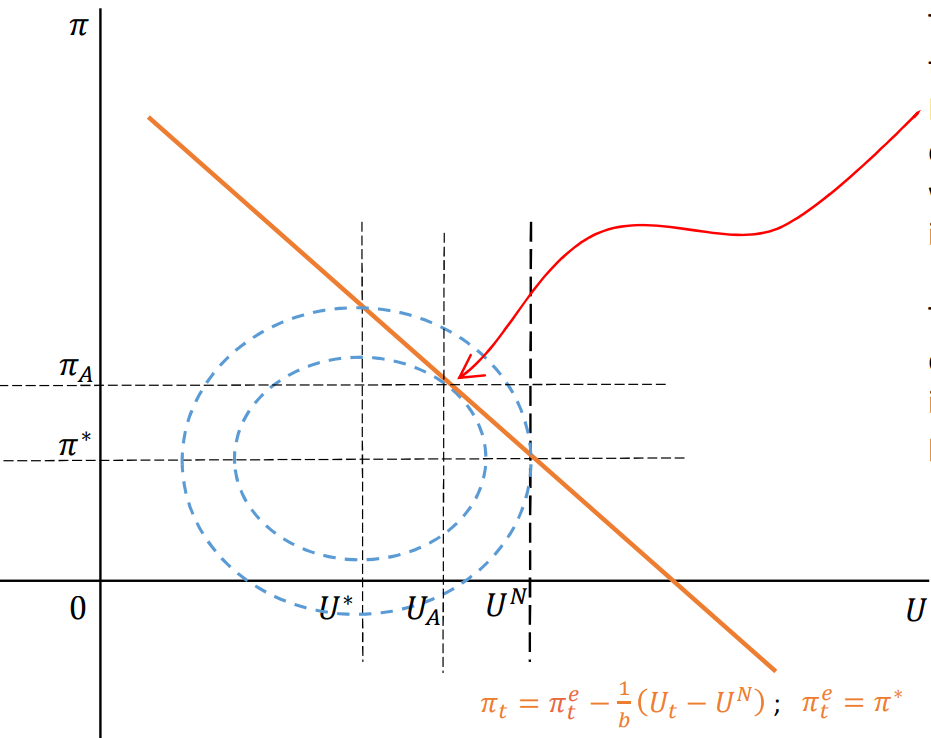
Public believe inflation will be what the government says, so ⊓e = ⊓t = ⊓*
The aim is to minimise the loss function with respect to the constraint of the inverted Phillips curve given ⊓te = ⊓*
We substitute the Phillips Curve into the loss curve and minimise with respect to ⊓t, then setting = 0 and rearranging to get an answer in terms of ⊓t; this answer will be > ⊓*
By substituting the expression for ⊓t into the loss function, one can attain a value of Ut
The government has an incentive to set an inflation rate greater than ⊓te so that they can get an unemployment rate below the natural level
Loss in the naive solution
L > 0 and L = 0 is unachievable if UN > U*
There is incentive to renege on the promise once expectations have been set
The government could achieve ⊓*, but only by setting Ut > U*, where Ut = UN meaning that (UN, ⊓*) is not the welfare-maximising choice
They could achieve U*, but only by allowing ⊓t = ⊓b > ⊓*, thus (U*, ⊓b) is not the welfare-maximising choice either
The solution to the minimising expenditure problem represents the best outcome the government can achieve with a foolish and naive electorate (UA, ⊓A)
This is time-inconsistent because the actual inflation rate is not the same as the one the government promised; this can only be maintained if the public can be convinced that ⊓te = ⊓*
Rational Expectations Outline
⊓te = Et-1⊓t
Et-1 just means that expectations are formed using available information at time t-1
The public (wage-setters, private sector) assume their expectations before ⊓t is realised and before the policy choice ⊓t is made
They are also assumed to have a correct model of the economy
Rational Expectations derivation
Minimise the Loss function subject to the inverted Phillips curve given ⊓te = ⊓t
Substitute the Phillips Curve into the Loss function and differentiate wrt ⊓t, then set = 0
Rearrange to get an expression in terms of ⊓t which is greater than ⊓*
Rational Expectations Solution
Graphically, the solution is understood as a ‘time-consistent equilibrium’, where expectations = the inflation level
The time-consistent solution has higher inflation and unemployment than both the optimum and naive equilibrium points
This is because the rational wage-setters aren’t fooled by the policymaker; they understand the incentive to raise inflation surprisingly, and so they adjust their expectations accordingly
An equilibrium is at (⊓c, UN)
Loss in the rational expectations equilibrium
Because inflation is above optimum, loss will be strictly positive
Despite inflation being above target, there is no compensated gain in lower unemployment because inflation expectations are equal to the actual inflation level
If ⊓t = ⊓e, this naturally implies that unemployment is at the natural rate
There is an inflation bias in the time-consistent equilibrium, which is the difference between actual inflation and optimum inflation (⊓e - ⊓* = b/a (UN - U*))
Anchored Expectations outline
Can be treated in a similar way to naive expectations, but they do move eventually, if people start to realise they’re being fooled
This consists in a movement to more rational expectations
Beliefs are anchored when agents hold inflation expectations in line with the CB’s target rate
Imperfectly anchored expectations
If beliefs are perfectly anchored, they are insensitive to any incoming data, like the naive case
Partially anchored expectations are slightly responsive to changes in information which influences expectations, leading to slight shifts in the inverted Phillips Curve
What is stabilisation policy?
Monetary/fiscal policy aimed to counteract shocks which affect the real economy
The role of anchored expectations in reducing stabilisation policy costs
If expectations aren’t anchored, a shock will shift the Phillips curve by the ‘amount’ of the shock
If expectations are anchored during the shock, unemployment doesn’t need to rise to bring it back down; it will rise and fall itself
If partially anchored, unemployment levels would rise, but less than if they were completely unanchored
Disinflation (stabilisation) policy is less costly when expectations are anchored
Assumptions about policymakers
In the Barro-Gordon model, they assume the policymaker is trying to reach a level of inflation below the natural rate; governments might want to do this to make it look like the economy is doing well before elections
In stabilisation policy, generally policymakers are conceived of as trying to reach the natural rate of unemployment and optimal inflation (Barro-Gordon is (Ut > UN, ⊓a) compared to stabilisation policy’s target of (UN, ⊓*)
What is the time-inconsistency problem?
It concerns the sub-optimal outcomes which can occur if there is incentive at a later point in time to renege on promises made at an earlier point in time
The example is of a policymaker who sets an inflation target and then surprises people with higher inflation for their own ends