ECG Rhythms
 Call Kai
 Learn
Learn Practice Test
 Spaced Repetition
 Match
Match Flashcards
 Knowt Play
1/67

Earn XP
Description and Tags
NUR360 at NAU Module 4
Name | Mastery | Learn | Test | Matching | Spaced | Call with Kai | Chat |
|---|
No analytics yet
Send a link to your students to track their progress
68 Terms
What are the two normal cardiac rhythms?
normal sinus rhythm
sinus arrhythmia
normal sinus rhythm rate
60-100 bpm
what causes sinus arrhythmia?
the SA node fires irregularly
This arrhythmia is often caused by changes in intrathoracic pressure during breathing
sinus arrhythmia
sinus arrhythmia rate
60-100bpm
sinus bradycardia rate
<60bpm
How many p waves should precede each QRS complex?
One P wave should precede each QRS complex.
sinus tachycardia rate
>100bpm
premature atrial contaction (PAC)
a contraction starting from a location that isn’t the SA node. it occurs sooner than the next expected sinus beat
PAC results in an abnormal _ wave
p

what dysrhythmia is this (look at where the arrows point)?
PAC (1)
T/F: The P wave may not be visible at all in PAC.
true, it may be hidden in the preceding T wave
normal length of P wave
<0.12 seconds (3 small squares)
normal length of QRS complex
0.06-0.12 seconds (1.5 to 3 small squares)
In a person with a healthy heart, isolated PACs are/are not significant?
they are not significant
supraventricular tachycardia is also called what?
atrial tachycardia or paroxysmal supraventricular tachycardia (PSVT)
PSVT occurs because of a _____ phenomenon (reexcitaiton of the atria when there is a 1-way block)
reentrant
Causes of PSVT in a healthy heart
overexertion, emotional stress, deep inspiration, and stimulants (such as caffeine/tobacco)
other causes of PSVT (not in a healthy heart)
rheumatic heart disease, digitalis toxicity, CAD, and cor pulmonale
PSVT rate
151-220bpm
PSVT rhythm (regular or irregular)
regular or slightly irregular
what is the shape of the P wave in PSVT?
may be abnormal or be hidden in the preceding T wave
normal length of PR interval
0.12-0.20 seconds (3-5 small squares)
atrial flutter origin
a single ectopic focus in the R (or less often the L) atrium

What rhythm is this (top strip)?
atrial flutter
T/F: Atrial flutter commonly occurs in a healthy heart
false, it rarely occurs in a healthy heart
____ _____ is characterized by total disorganization of atrial electrical activity because of multiple ectopic foci.
atrial fibrillation
What is the most common dysrhythmia?
atrial fibrillation
T/F: Atrial fibrillation usually occurs in a patient with underlying heart disease, such as CAD, valvular heart disease, cardiomyopathy, hypertensive heart disease, HF, and pericarditis.
true
During atrial fibrillation, what is the PR interval?
not measurable
also no discrete P waves!
What is the rhythm in atrial fibrillation?
irregularly irregular
What to do for unstable atrial fibrillation?
immediate synchronized cardioversion

What is this rhythm?
atrial fibrillation

What is this rhythm?
PAC

What is this rhythm?
atrial flutter
What is the atrial rate for atrial flutter?
250-350bpm
Synchronized cardioversion is used for unstable ______ with a pulse when the rhythm is amenable to cardioversion.
tachyarrhythmias
What is the shock synced to in synchronized cardioversion?
the r wave
T/F: Synchronized cardioversion is painless
false
______ ______ uses catheter-delivered energy to interrupt an arrhythmogenic focus or pathway.
catheter ablation
T/F: Catheter ablation is used for typical atrial flutter.
true
If you want to tell sinus bradycardia apart from junctional rhythm, what is the key part to look at?
the p wave
junctional rhythm, where does the impulse arise from?
the AV node
junctional rhythm rate
40-60bpm
What are the p waves like on a junctional rhythm?
absent, inverted, or occur after the QRS complex

What is this rhythm?
junctional rhythm

What is this rhythm?
junctional rhythm
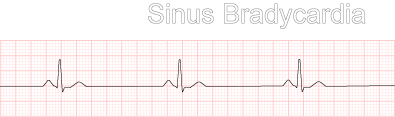
What is this rhythm?
sinus bradycardia
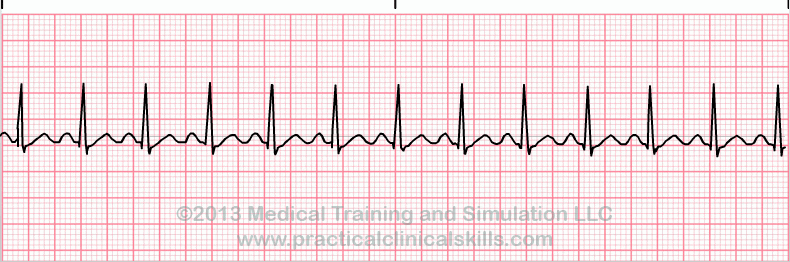
What is this rhythm?
sinus tachycardia
The QRS complex in PVC is wide/narrow?
wide (>0.12 seconds)
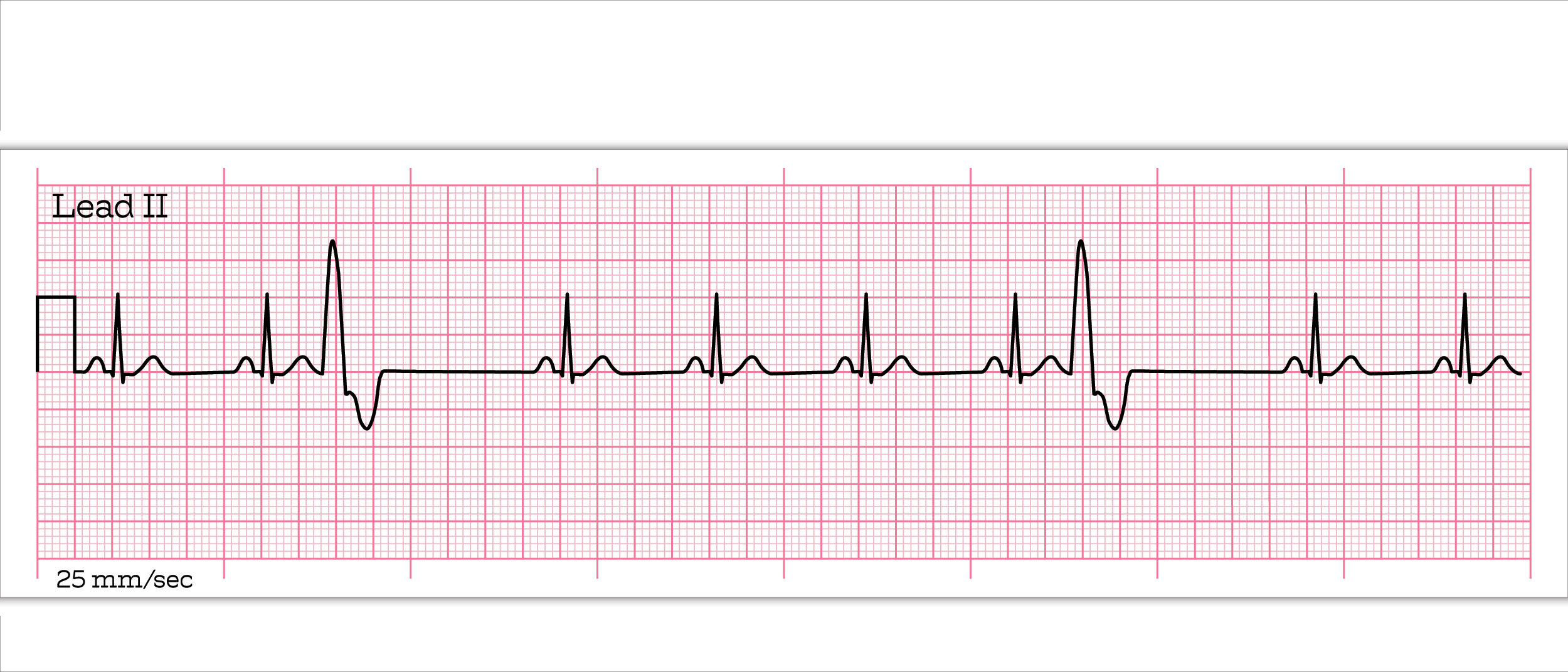
What rhythm is this?
premature ventricular contraction
T/F: Premature ventricular contractions may be benign or reflect ventricular instability
true, significance rises with symptoms, structural disease, ischemia, or high burden
T/F: In PVCs, there is no preceding sinus P linked to the PVC.
true
PVC- an early, wide, abnormal QRS complex without a preceding P wave, followed by a _____ ____.
compensatory pause
In this procedure, doctors open blocked arteries using a tiny metal balloon and place a small metal mesh tube to keep the vessel open
angioplasty and stenting
____ prevents new clots from forming in coronary arteries
heparin
T/F: A person can have both atrial flutter and AFib
true
a fast, abnormal heart rhythm starting in the heart’s lower chambers that prevents the heart from filling with enough blood to pump to the body
V. tach
Which one is taller, v tach or v fib?
v tach
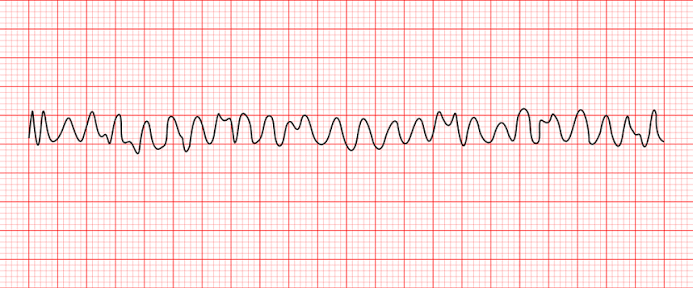
what rhythm is this?
v fib
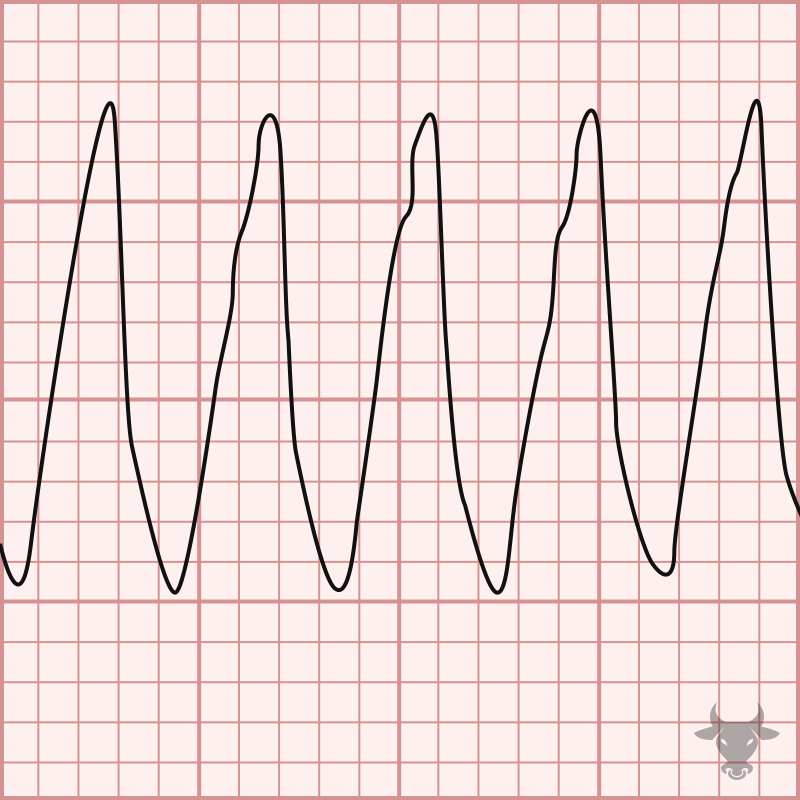
what rhythm is this?
v tach
What is treatment for PEA?
CPR and epinephrine
What is treatment for asystole?
CPR and epinephrine
How does cardiac ablasion work?
a doctor creates tiny scars on cells that send faulty electrical signals, allowing a normal to return
T/F: Synchronized cardioversion uses a timed, high-energy electrical shock
false, it uses a low-energy shock
T/F: Defibrillation is used when a patient has a pulse.
false, it is used when a patient has NO PULSE
T/F: Defibrillation is unsynchronized
true
T/F: EVAR is a minimally invasive surgery for AAA that tends to have a quick-recovery.
true