Earthquake hazards
 Call Kai
 Learn
Learn Practice Test
 Spaced Repetition
 Match
Match Flashcards
 Knowt Play
1/32

There's no tags or description
Looks like no tags are added yet.
Name | Mastery | Learn | Test | Matching | Spaced | Call with Kai |
|---|
No analytics yet
Send a link to your students to track their progress
33 Terms
Hypocentre
Where the earthquakes occur within the crust
Epicenter
The center of the earthquake above ground
Displacement
Rupture and movement of the ground (horizontal and vertical scales in units of Km, displacement scale in units of m)
Seismograph
The recording station
Seismometer
The sensor that moves with the earthquake
Seismogram
The record of an earthquake
What are the two different types of waves emitted by an earthquake
P and S waves
How do you estimate distance of an earthquake
P and S waves have different velocities, so arrival times of each can be used to estimate distance to the earthquake hypocentre
What does the P in P-waves stand for
Primary
What does the S in S-waves stand for
Secondary
Are P or S waves faster
P waves
How do you use the P and S waves to calculate distance
You take the time between S and P wave arrival to determine the distance, the shorter the distance between S and P wave arrival the closer the earthquake
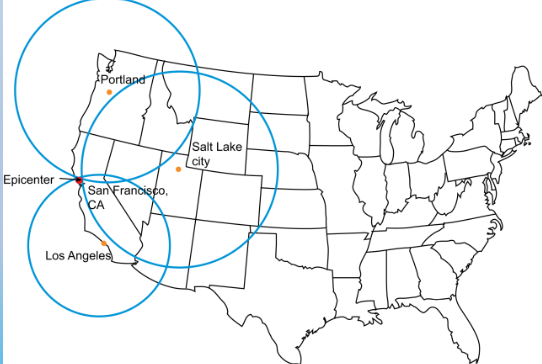
Explain this image
Different S-P times recorded by seismometers in different places (Portland, SLC, and LA) are used to calculate distance of the earthquake and overlaid on top of each other to locate the epicenter of the earthquake
Abbreviation for Richter magnitude
ML
Abbreviation for Surface wave magnitude
Ms
Abbreviation for Moment magnitude
Mw
Description of Moment Magnitude
Universal measure of magnitude, measured from the size of the earthquake source
Equation for seismic moment
Mo=µLWD (µ = lithology and tectonic regime)
Equation for Moment Magnitude
LogMo=16.05+1.5Mw
Increases in magnitude mean…
Increases in amplitude, duration, frequency content
What would a magnitude 10 earthquake lead to
A rupture around the earth
Earthquake intensity definition
The human-felt scale of earthquake shaking (subective)
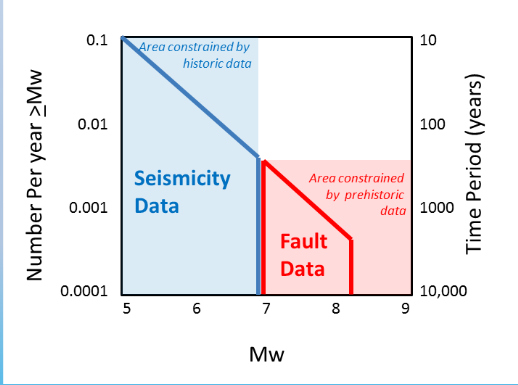
What is this called
The Gutenberg-Richter relationship
What is the importance of the Gutenberg-Richter relationship
describes the statistical relationship between the magnitude and frequency of earthquakes, indicating that larger earthquakes occur less frequently than smaller ones.
What are catalogues
Incomplete records of earthquakes (not knowing the completeness of the catalogue can lead to significant errors in interpretation)
What is defined as prehistoric for earthquakes
Pre 1840AD
Liquefaction
Soils become liquid due to shaking causing objects to sink
Paleoliquefaction
Structure in soil where liquefaction occurred allowing you to identify when an earthquake occurred
Steps of hazard analysis
Where are the sources, how many events on each source, metrics of hazard, hazard curve
Definition of Earthquake source
Element of a seismic hazard model that produces earthquakes of a given magnitude range at a given location
Fault sources
Constrain the location, size, and rate of infrequent major earthquakes. Extend the historical record of earthquakes back into prehistoric time
What does an incomplete fault source model mean
Not sure of where all of the faults that could cause earthquakes are
How far can a fault be and still be of interest to a specific area
Less than or equal to 100Km from site