Chapter 2 : Theoretical Perspective's in Motor Development
 Call Kai
 Learn
Learn Practice Test
 Spaced Repetition
 Match
Match Flashcards
 Knowt Play
1/55

Earn XP
Description and Tags
KINE 3500
Name | Mastery | Learn | Test | Matching | Spaced | Call with Kai | Chat |
|---|
No analytics yet
Send a link to your students to track their progress
56 Terms
What is a theory?
Broad and general statement to explain a body of knowledge and provide predictions to advance that body of knowledge
description of behavior
What is the criteria for a theory?
Testable, Replicable, and Parsimonious
Theories are used to ?
describe, explain, and predict change
What are the theories of Motor Development
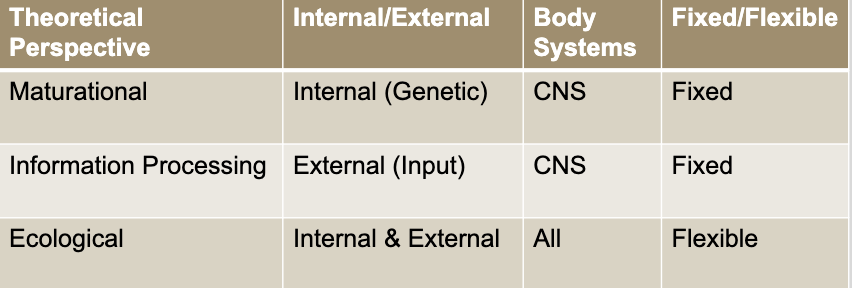
Maturational Perspective: (long time ago, debatable, central nervous system controls everything)
Informational Processing Perspective: (computers came along, input, output)
Ecological Perspective : Newells Model
Motor Development Theories help us
understand explanations and form interpretations from
research findings
What does Motor Development Theories have roots in?
◦ Developmental psychology
◦ Embryology (prenatal/fertilization)
◦ Biology (study of life/organisms)
When was the Precursor Period of Motor Development
1787-1928
The Precursor Period is
Foundational to Motor Development
descriptive observation
Baby Biographies-Cognition
Baby Biographies
◦ D. Tiedemann’s, Observations of the Development of Mental Faculties of Children (1787)
◦ C. Darwin, A Biographical Sketch of An Infant (1877)
◦ W. Preyer, The Mind of a Child (1882)
◦ M. Shinn, The Biography of A Baby (1900)
When was the Maturational Period?
1928-1946
The Maturational Perspective proposes that
Proposed that motor development occurs as a result of maturational processes, specifically, maturation of the central nervous system (CNS)
What are the assumptions of the Maturational Perspective?
Internal or Innate process driven by a biological or genetic time clock
(Genetics + Heredity > Environment)
The Maturational Perspective was popular during
1930’s led by Arnold Gessell
Hereditary factors were ultimately in control of development
Co-twin research : Significant contributions
no twins will be the exact SAME
Myrtle McGraw used what perspective?
Maturational
Also used twins
Growth: A Study of Johnny and Jimmy
Johnny got a lot of the input/feedback and Jimmy was kind of left in crib (Jimmy was control group)
Maturation of CNS to be the trigger for the appearance of new skills.
The Maturational Perspective began to wane in
1950’s
Motor skills will automatically emerge regardless of the environment
What was the reason for changes in behavior (Maturational Perspective)
CNS (Central Nervous System)
Twins Studies (nature vs nurture)
What are long lasting beliefs from maturations theory?
Basic motor skills emerge automatically.
There is no need for special training.
Mild deprivation does not arrest development.
The nervous system is most important.
The Normative/Descriptive Period was when?
1940’s-1970’s
The Normative Descriptive Period focused on
the characterization and development of norms and assessments
use of quantitative scores to describe children’s average performance
During the Normative Descriptive Period, they used
extensive filming of different motor behaviors
What period was product-oriented, used scores and outcomes?
Normative Descriptive
Anna Espenschade, Ruth Glassow, Lawrence Rarick focused on what period?
Normative Descriptive
1950’s : Development of norms and assessments
Quantitative : Focused on products rather than process
Biomechanical Descriptive is
Biomechanical Descriptions of movement patterns in fundamental skills.
Course of sequential movement
Biomechanical Descriptive states that motor development occurs from
the development of several systems, not just CNS.
Running is involved in what Descriptive?
Biomechanical
Wickstrom (1983)
Biomechanical Descriptive for Running
Trends of running
Development of form in running
Mature running pattern
Mechanical principles of running
Analysis of form
For Biomechanical Descriptive, what are the THREE PHASES OF RUNNING?
Flight
Support
Recover
Describe what your arms, legs, and feet do when running
◦ Arms move in opposition to legs with elbows bent
◦ Brief period where both feet are off the surface
◦ Narrow foot placement landing on heel or toes
◦ Non-supporting leg bent about 90 degrees, so foot is close to buttocks
Biomechanical Descriptive for Throwing
Wickstrom (1983)
◦ Throwing pattern of children
◦ Development of form for throwing
◦ Mechanics of throwing
◦ Sports skills that use throwing patterns
◦ Analysis of form in throwing
What are the THREE PHASES OF THROWING (Biomechanical Descriptive)
Prepatory
Execution
Follow-Through
What happens to your body during a throw
Windup is initiated with a downward movement of hand and arm
Rotates hip and shoulder to a point where the non-throwing side faces the wall'
Steps with the foot opposite of the throwing hand towards the wall
Throwing hand follows through after the ball release
When was the Process-Oriented Period?
1970’s - NOW
The Information Processing Perspective says the Brain acts like a
Computer
taking information, processing it, and outputting movement
The Information Processing Perspective focused on
external processes or environmental effects on behavior
response to stimuli in the environment
What is this chart?

Information Processing Perspective
The Ecological Perspective is during what time?
1980’s
The Ecological Perspective states that development is driven by
interrelationships of Individual, Environment, and Task
What are the two approaches of the Ecological Perspective?
Dynamical-Systems approach = Motor control & coordination
Perception-action approach = Perception
The Dynamical Systems Approach states how the
body is organized, physically and chemically constrains behavior across the lifespan
All Body Systems Develop at Different Rates
EX) Structure of hip joints and legs
Dynamical Systems Approach
Skeletal system in infants' creep/crawl
300 bones
Cartilage
Crawling/Creeping
Skeletal system in adults walk
206 bones
Fused together
Walk
In the Dynamical Systems Approach, what holds back or slows down the emergence of a motor skill because it develops more slowly than other systems
Rate Limiters
In the Dynamical Systems Approach, what is changing or aging more quickly than other systems
Rate Controller
Perception Action Approach is by
J.J. Gibson
perceptual-vision, hearing
motor/movement (skeletal, muscular)
The Perception Action Approach states that
Perceptual and Motor systems evolved together, are interrelated and must be studied together
Body Scaling
is the process of changing dimensions of the environment/object in relation to the structural constraints of the performer.
EX) Toddler crawling upstairs vs adult stepping up the stairs
Perception Action Approach
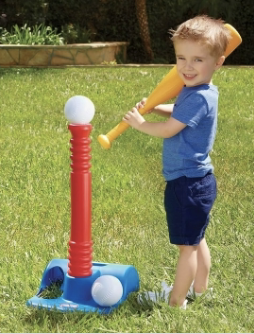
Affordances
describe a function an environmental object provides an individual
a chair allows you to sit down
(Perception Action Approach)
How would a theorist explain a Child Riding a Bike?
Maturational Approach: Body is ready to ride a bike, and your body is gonna do what you need to ride a bike (pedal and steer is natural)
Information Processing Approach:
Input : Kids across street / mom encouragement
Processing : Wants to go faster / want to keep going
Output : Pedals Faster
Ecological: Environment, Individual, Task
Currently, there has been no
paradigm shift since the ecological perspective
Motor Competency
Role of motor skill development in good health
ability to do the skill
Skill proficiency enhances
exercise, and exercise assists individuals in maintaining ideal body weight
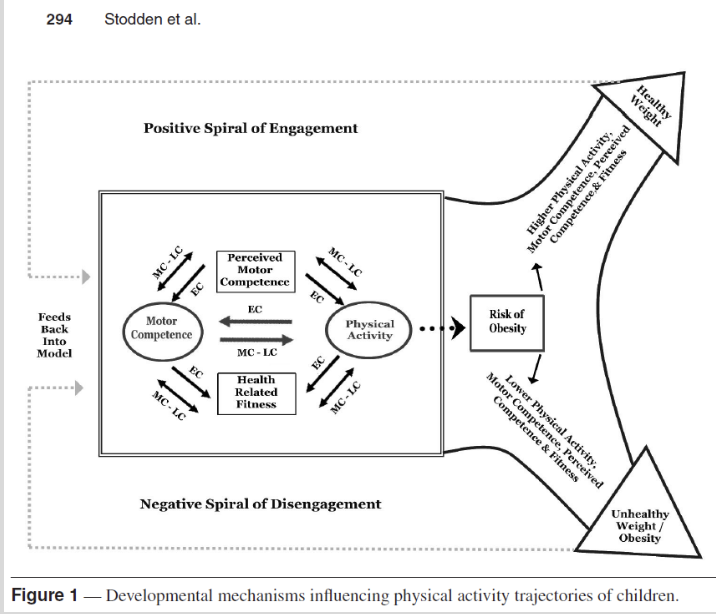
Stodden et al’s (2008) model involves
motor skill competence, physical activity, physical fitness, and weight status has generated new research
.
Motor Development Periods Chart

Different theoretical perspectives of motor development have
emerged throughout the history of motor development.
Although each perspective is unique, there are often benefits to viewing motor development from
different perspectives
The maturational perspective has had a lasting impact on how changes in motor development occurs; however,
the ecological perspective is now more widely used by researchers
Theoretical Perspectives Chart