Chapter 1
 Call Kai
 Learn
Learn Practice Test
 Spaced Repetition
 Match
Match Flashcards
 Knowt Play
1/22

There's no tags or description
Looks like no tags are added yet.
Name | Mastery | Learn | Test | Matching | Spaced | Call with Kai | Chat |
|---|
No analytics yet
Send a link to your students to track their progress
23 Terms
genes
the basic units of biological information
heredity
the way genes transmit traits from parents to offspring
what underlie the formation of every heritable trait
genes
What is genetics?
the science of heredity
Who discovered the basic principles of genetics in the mid-nineteenth century
Gregor Mendel - Augustinian monk
published his findings in 1866 (7 yrs after Darwin’s book appeared in print)
What are the 4 general themes that emerge from Mendel’s work?
Genetic variation is common – Differences in traits are widespread and provide the diversity needed for evolution.
Variation helps track inheritance – Trait differences make it possible to follow how genes are passed from one generation to the next.
Inheritance follows predictable patterns – Mendel’s laws explain how traits are inherited, accounting for both similarities and differences among family members.
Mendel’s laws are universal – The principles of heredity apply to all sexually reproducing organisms, from plants to humans.
What were the 2 major misconceptions prior to Mendel?
One parent contributes the most to an offspring’s inherited feature (male), by Nicolaas Hartsoeker, by the way of the fully formed homunculus inside the sperm
Blended inheritance — parental traits become mixed and forever changed in the offspring
What did Mendel do differently?
Chose the garden pea as experimental organism (can both self and cross fertilize, and can obtain large numbers in short periods)
Examined clear-cut alternative states of particular traits (no intermediate traits existed)
Collected and perpetuated lines of peas that bred true
Made reciprocal crosses — which demonstrated that two parents contribute equally to inheritance
Worked with large numbers of plants and performed numerical analysis
What are pure-breeding/true-breeding lines
produce offsprings that remain constant from generation to generation
also called “inbred” — have been mated only to each other for many generations
What are antagonistic pairs
constant but mutually exclusive alternative (ex. purple vs white flowers), which produced hybrids
How did Mendel explain the 3:1 ratio
He proposed that…
For each trait we carry 2 copies of a unit of inheritance (genes), one from each parent
Each gene comes in alternative forms (alleles), and a combination of the alternative forms determine the contrasting characteristics
what are monohybrids
individuals having 2 different alleles of a single gene
What is Mendel’s Law of segregation?
“The two alleles of each gene separate during gamete formation, and then unite at random, one from each parent, at fertilization”
meaning — each gamete has only one copy of the allele, and during fertilization the two alleles will unite at random
What is the product rule?
the probability of 2 or more independent events occurring together is the product of the probability that each event will occur by itself
Probability of event 1 x Probability of event 2
What is the sum rule?
The probability of either of two mutually exclusive events occurring is the sum of their individual probabilities
Probability of event 1 + Probability of event 2
Homozygote vs Homozygous vs Heterozygote vs heterozygous
Homozygous → A YY or yy genotype
Homozygote → an individual with a homozygous genotype
heterozygous → A Yy genotype
Heterozygote (aka hybrid) → an individual with a heterozygous genotype
What is Mendel’s law of independent assortment?
“During gamete formation, different pairs of alleles segregate independently of each other”
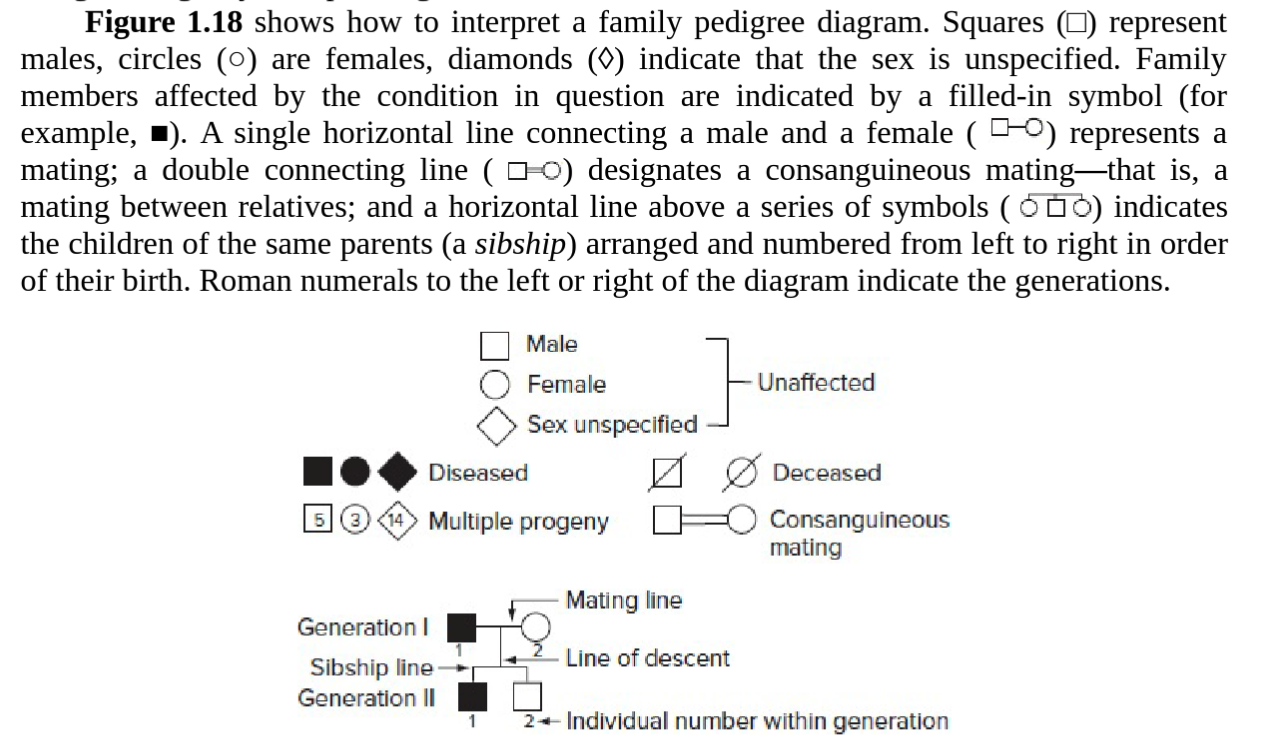
What are the different parts of a pedigree
What is a late onset genetic trait
symptoms are not present at birth and manifest themselves only later in life
What happens in the Huntington disease?
This illness usually shows up in middle age and slowly destroys its victims both mentally and physically. Symptoms include intellectual deterioration, severe depression, and jerky, irregular movements, all caused by the progressive death of nerve cells. If one parent develops the symptoms, his or her children have a 50% probability of suffering from the disease, provided they live sufficiently long.
What does “vertical” pattern of transmission mean?
If you trace back through the ancestors of any affected individual, you would see at least one affected person in each generation, giving a continuous line of family members with the disease
vertical pattern is a strong evidence that a dominant allele causes the condition
What is horizontal transmission?
when the parents, grandparents, and great-granparents of the children that are born with the disease do not themselves have the disease
Strong indication of the trait being recessive
How to recognize dominant and recessive traits in pedigrees?
Dominant
affected children always have at least one affected parent
dominant traits show a vertical pattern of inheritance: the trait shows up in every generation
two affected parents can produce unaffected children, if both parents are heterozygotes
Recessive
affected individuals can be the children of two unaffected carriers, particularly as a result of consanguineous marriage (usually second cousins or closer — indicated by the double line)
all the children of two affected parents should be affected
race recessive traits show horizontal pattern of inheritance: the trait first appears in one or more members of one generation and is not seen in earlier generations
recessive traits may show a vertical pattern of inheritance if teh trait is extremely common in the population