9.1 Nerve Impulses
 Call Kai
 Learn
Learn Practice Test
 Spaced Repetition
 Match
Match Flashcards
 Knowt Play
1/18

There's no tags or description
Looks like no tags are added yet.
Name | Mastery | Learn | Test | Matching | Spaced | Call with Kai | Chat |
|---|
No analytics yet
Send a link to your students to track their progress
19 Terms
Syllabus point
Transmission of nerve impulses is via electro-chemical changes that occur at the generation of the impulse, the propagation of the impulse along the nerve fibre, & the transfer of the impulse across the synapse
Nerve impulses
A nerve impulse is an electrochemical change that travels along a nerve fibre.
This electrochemical change is brought about due to changes in the concentration of ions inside and outside the cell membrane of the neuron.
Electrical ‘potential’ difference
The difference between the amount of negatively and positively charged ions on either side of the membrane results in an electrical 'potential' difference.
This can be measured in millivolts (mV).
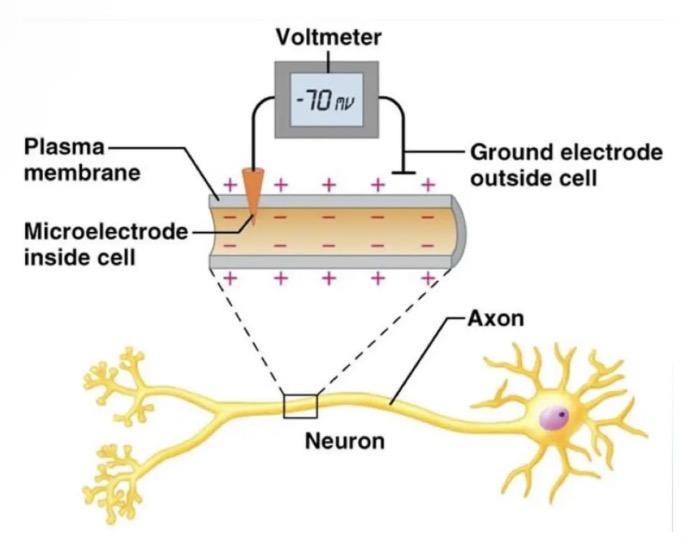
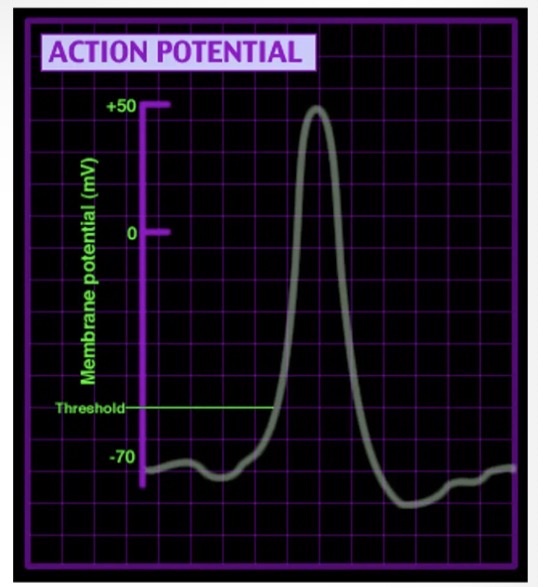
When a neuron is at 'rest' it has a voltage difference of -70mV (measured from inside the cell). This is called the resting membrane potential.
When the neuron is stimulated, there is a reversal in the voltage charge across the membrane of the axon, caused by the movement of ions in and out of the cell.
This is called an 'action potential'.
As the reversal of charge occurs in one region of the membrane, it will cause the reversal of charge in the next adjacent region. In this way, the impulse travels along the axon by self propagation.
Resting membrane potential inside vs outside the cell
When a neuron is at rest:
Inside the cell:
There is a higher concentration of K+ ions inside the cell compared to outside the cell.
There are negatively charged ions that come from a variety of organic substances made by the cell.
Outside the cell (extracellular fluid):
There is a higher concentration of Nat ions outside the cell compared to inside the cell.
There is also a higher concentration of Cl outside the cell compared to inside the cell.
This results in the inside of the cell being negatively charged and the
outside of the cell being positively charged.
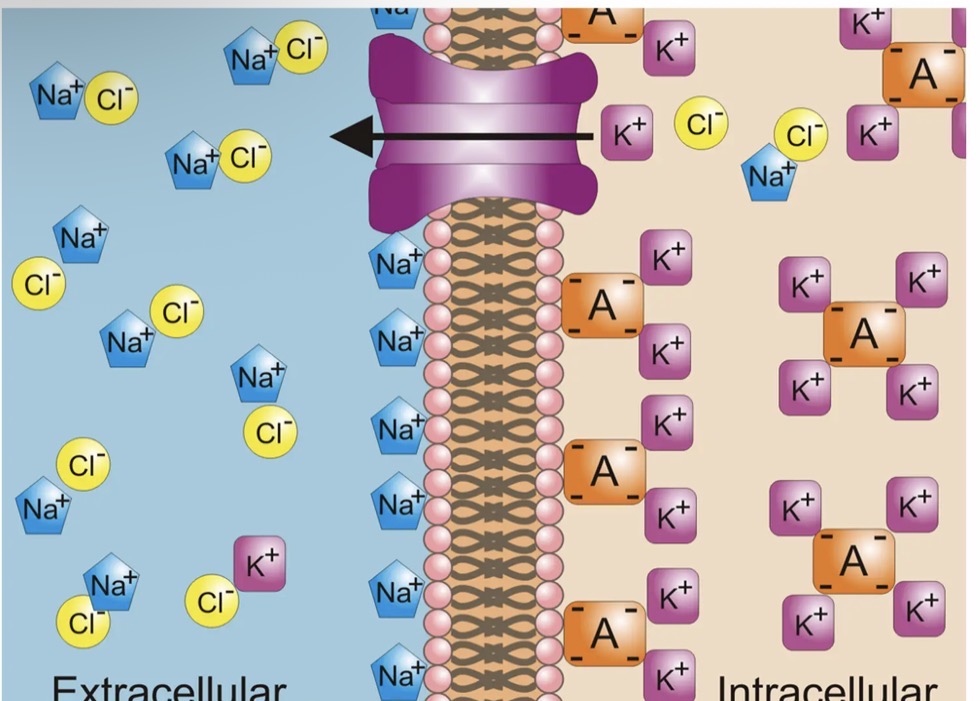
The potential difference is maintained by
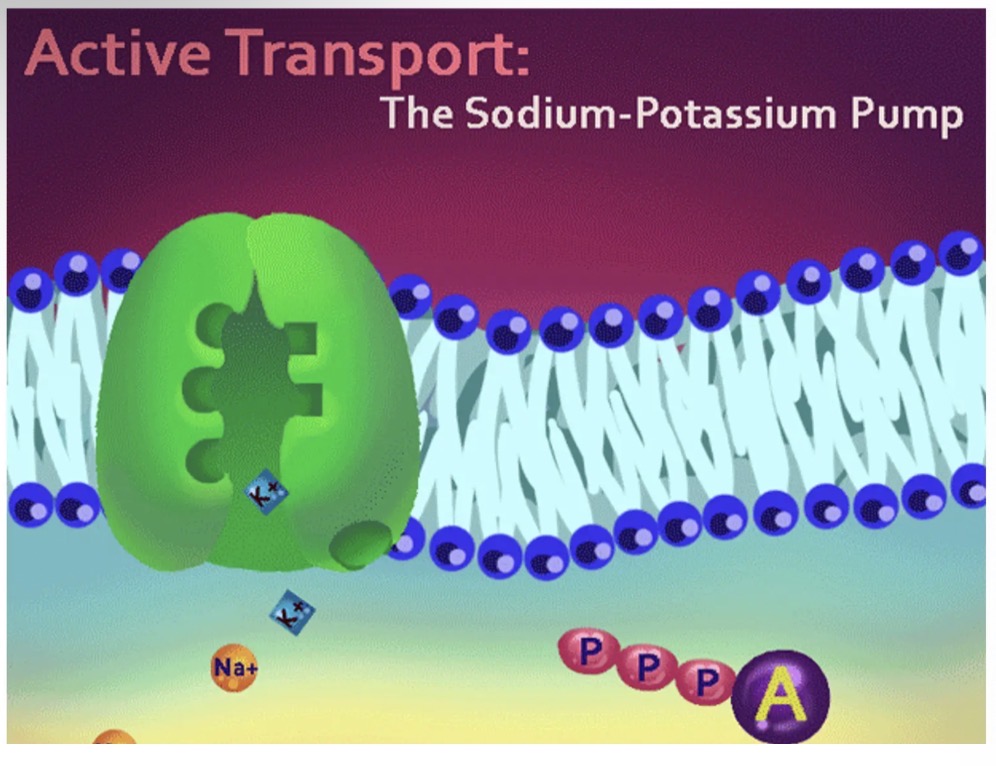
Sodium-potassium pump:
uses ATP to move Nat and Kt ions across the concentration gradient. It will move 3 x Nat ions from inside the cell to outside the cell and it will move 2 x K+ ions to inside the cell.
Cell membrane is not permeable to negative ions and these will remain rapped inside the cell.
Cell membrane at rest
At 'rest' the cell membrane is maintained so that the inside of the membrane is negative, relative to the outside which is positive.
The cell membrane is said to be polarised.
Action potential
The rapid depolarization and repolarization of the membrane is called an action potential.
Change in the membrane voltage is rapid lasting only 1 millisecond.
The movement of the action potential along the nerve fibre (axon) is called a nerve impulse.
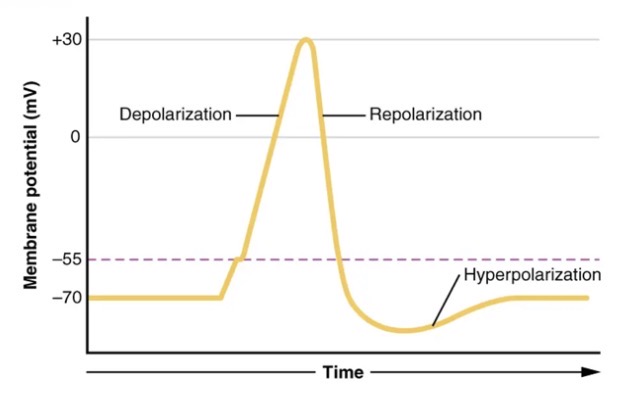
Depolarisation:
Stimulus is applied to the nerve fibre, and ligand gated Nat channels open in the cell membrane.
Nations move into the cell.
The inside of the cell becomes less negative.
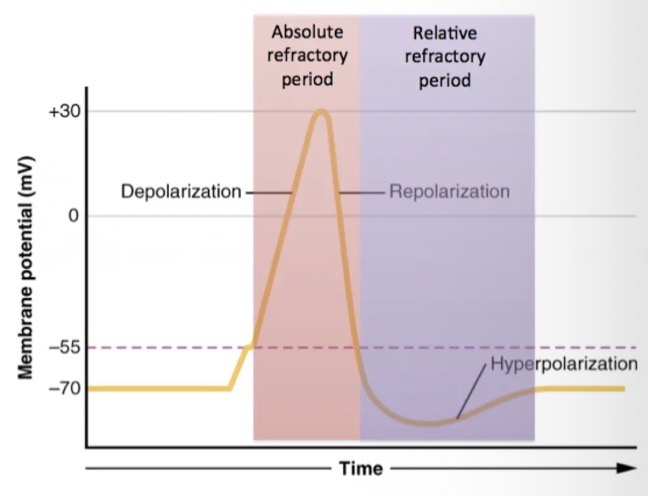
It a strong enough stimulus is applied to cause a change ot 15mv i.e he inside of the cell is -55mV then the threshold potential is reached.
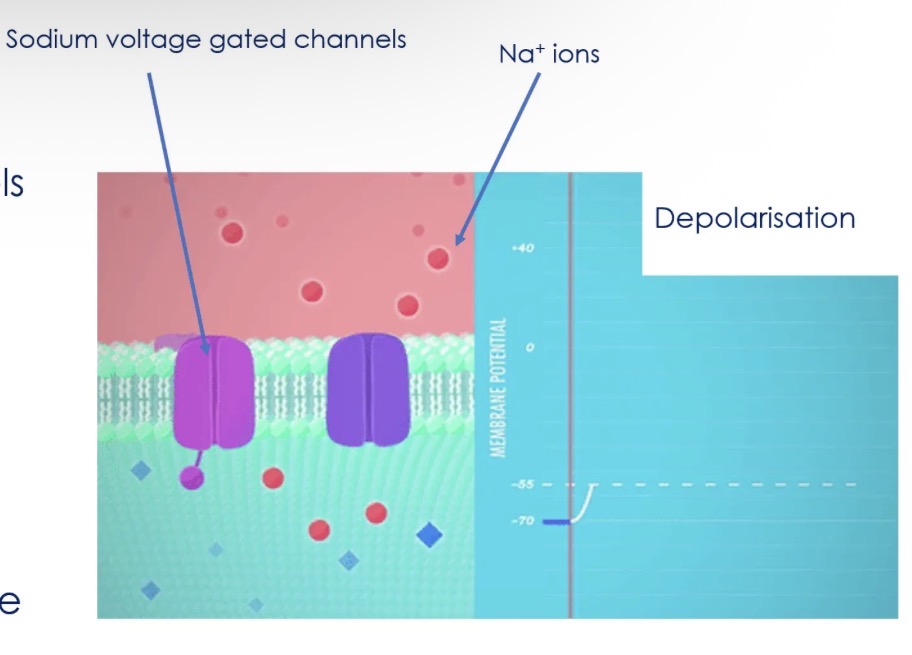
Depolarisation: once threshold is reached
Once threshold is reached the action potential will continue independently of the stimulus. This is known as an all-or-none response.
This is because when threshold is reached more Nat ions channels open (these are voltage gated channels) and more Nations rush into the cell.
The cell membrane is depolarised as the inside of the cell becomes more positive compared to the outside.
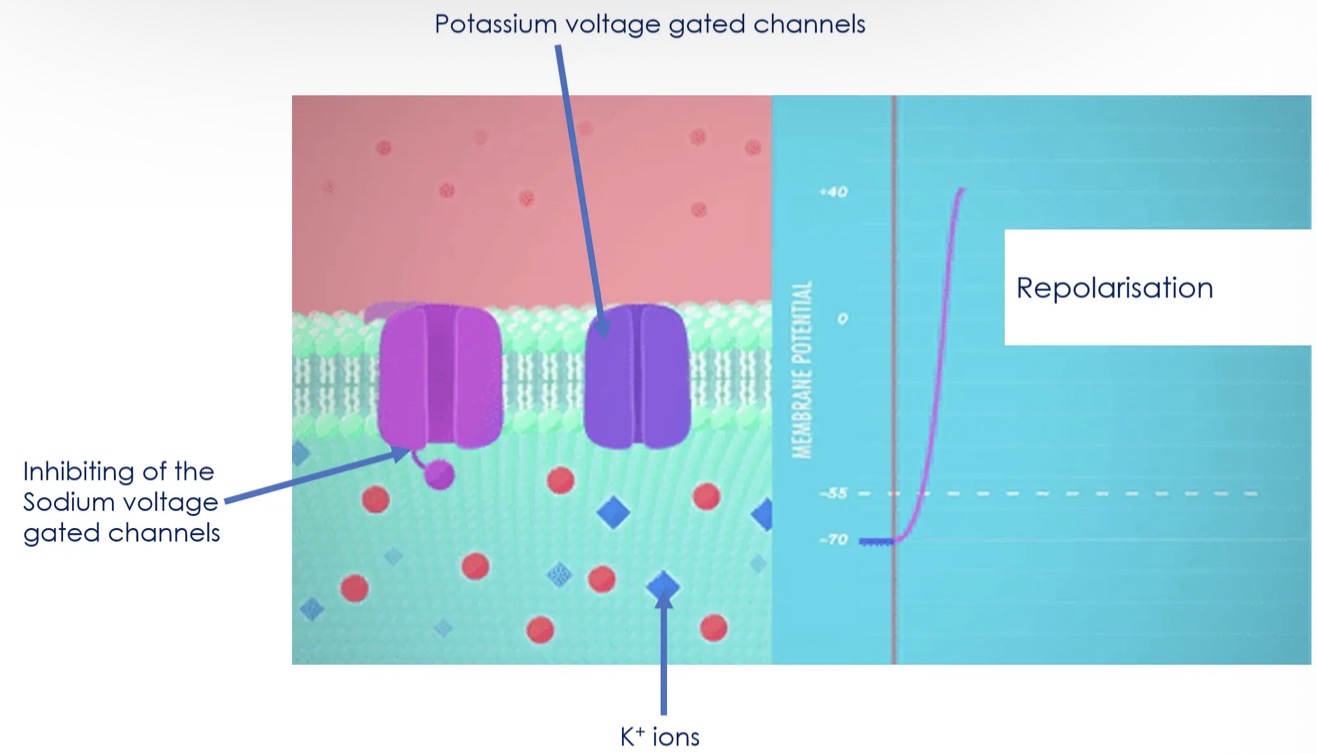
Repolarisation
At the peak of the action potential the voltage gated Nat ions channels will be inhibited - stopping Nat ions from entering the cell.
K+ voltage gated channels will open and Kt ions will rush out of the cell.
This begin the reversal of charges as the cell membrane is repolarised again.
Hyperpolarisation
The K+ voltage gated channels take longer to close and as a result the cell membrane is repolarised beyond the resting membrane potential.
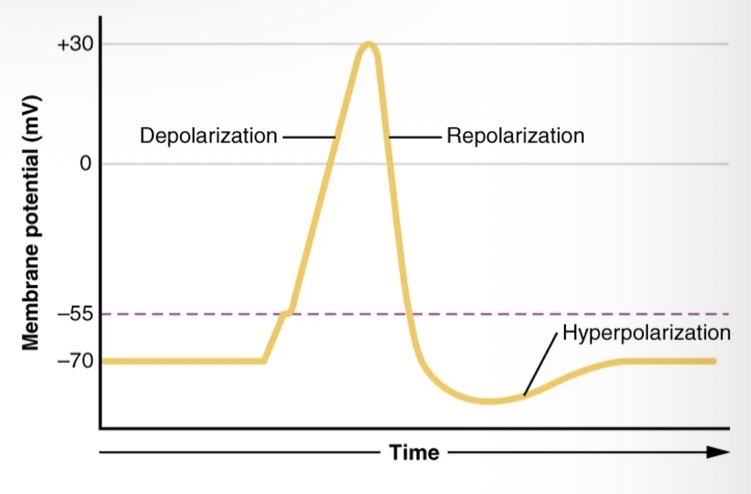
Recovery
Resting membrane potential is restored as the Kt voltage gated channels close and the sodium potassium pump and original K+ ion channels work to restore resting membrane potential.
Refractory period
When a region of the cell membrane is involved in an action potential (and for a short period afterwards) it can not be stimulated to respond again.
This is important as it:
limits the number of action potentials that a nerve cell can produce in a given time.
Prevents the action potential from moving backwards.
Transmission along unmyelinated fibres
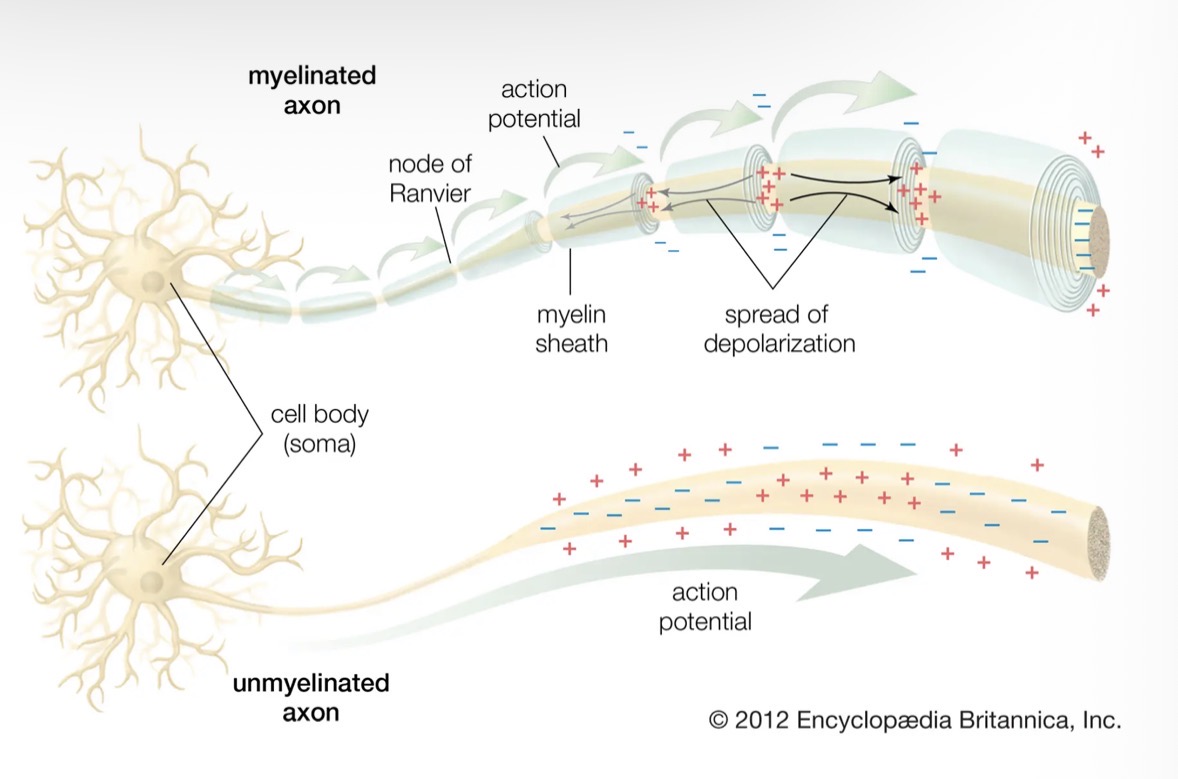
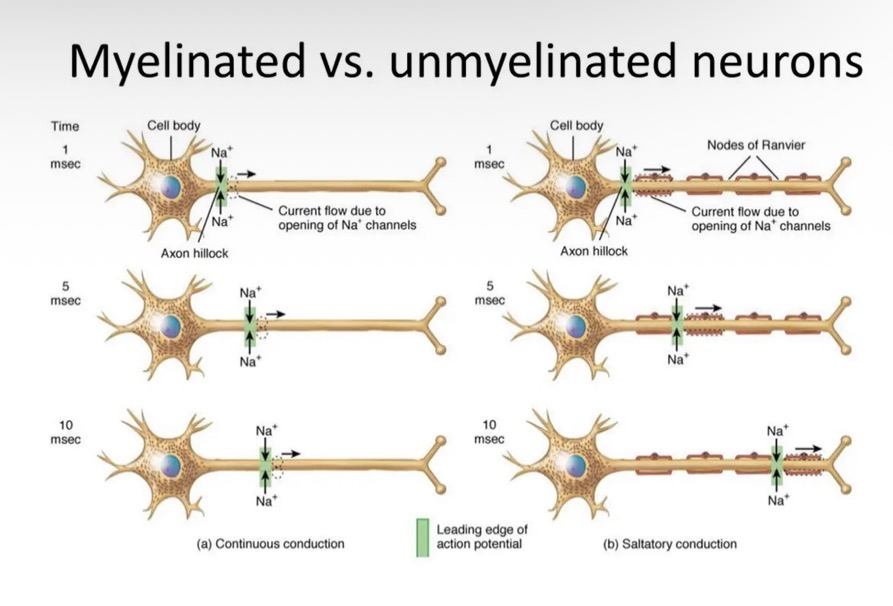
Action potentials are propagated along the axons of neurons via local currents.
Local current flow following depolarisation results in depolarisation of the adjacent axonal membrane.
The process repeats itself along the whole length of the membrane.
The areas of membrane that have recently depolarised will not depolarise again due to the refractory period - meaning that the action potential will only travel in one direction.
Transmission along myelinated fibres: nodes of ranvier
In myelinated fibres there are gaps along the axon where there is no myelin and the axonal membrane is exposed. These gaps are called Nodes of Ranvier.
There is a high density of ion channels in the Nodes of Ranvier. For this reason, action potentials can only occur at the nodes as the ions will flow around the myelin to the nodes.
Where this occurs the action potential will 'jump' from one node to the next. This is called saltatory conduction.
Saltatory conduction in myelinated fibres is faster than continuous conduction in unmyelinated fibres.
Myelinated vs unmyelinated neurons
Transmission across a synapse: Synapse or synaptic cleft
Neurons don't touch.
A gap called a synapse or synaptic cleft separates the axon of one neuron and the dendrites of the next neuron.
The signal must be transmitted across the synapse to continue on its path through the nervous system.
Many nerve impulses are carried across synapses as the following chemical changes
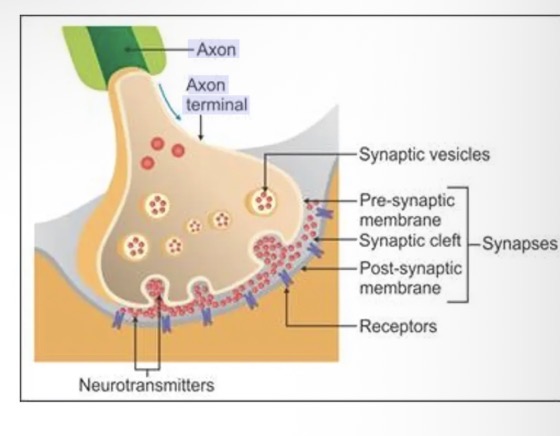
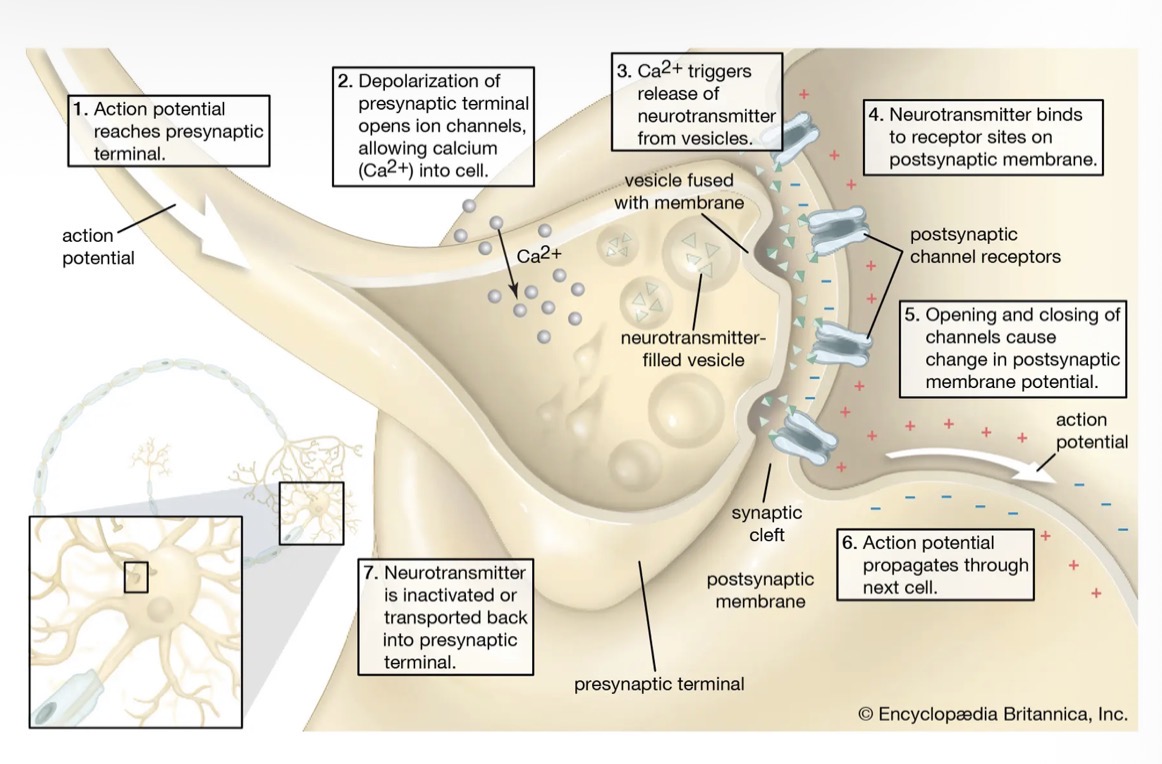
Transmission across a synapse: Action potential arrives at the axon terminals
Action potential arrives at the axon terminals.
This causes the calcium gated ion channels to open, and calcium ions (Ca2+) can enter the cell.
Vesicles containing neurotransmitters are found in the axon terminals. When the calcium ions rush in, it causes the vesicles to fuse with the membrane of the axon terminal and release the neurotransmitter into the synaptic cleft (exocytosis).
The neurotransmitter diffuse across the synapse and binds with receptor proteins on the neuron membrane that's about to receive the impulse.
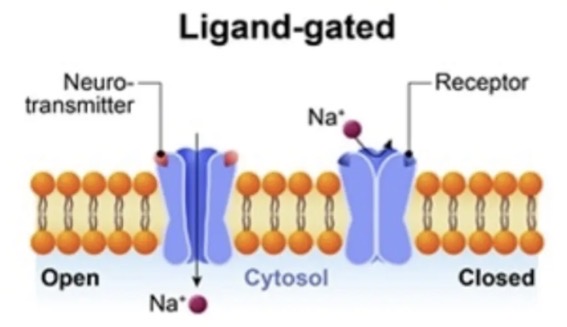
Transmission across a synapse: part 3: depends on the type of neurotransmitter
What occurs next depends on the type of neurotransmitter. For example, if the neurotransmitter causes the Nat channels to open, the neuron membrane becomes depolarised, and the impulse is carried through that neuron.
Examples of neurotransmitters are acetylcholine, adrenaline, dopamine and histamine.
Once the impulse has been transmitted the neurotransmitter will either be broken down by enzymes or taken by a vesicles back into the axon terminals.