MedChem Exam IV
 Call Kai
 Learn
Learn Practice Test
 Spaced Repetition
 Match
Match Flashcards
 Knowt Play
1/75

There's no tags or description
Looks like no tags are added yet.
Name | Mastery | Learn | Test | Matching | Spaced | Call with Kai |
|---|
No analytics yet
Send a link to your students to track their progress
76 Terms
What is the purpose of metabolism in terms of lipo/hydrophilicity?
Turns lipophilic molecules into more water-soluble molecules
What are the characteristics of most primary metabolites? What is the purpose of forming them like this?
Polar and anionic at physiological pH
Keeps them in the cell; can’t pass through cell membrane
What are solute carrier proteins (SCPs)?
Transmembrane proteins that transport molecules into the cell
What are ATP-Binding cassette proteins (ABCs)?
Transmembrane proteins that efflux molecules out of cells
MDR1/ABC1/PGP are major efflux proteins
What are the major reasons for drug failure during development?
Safety, efficacy, and toxicity
What kind of study can provide accurate prediction of drug distribution during human clinical studies?
A combination of animal studies and in vitro human studies
What is the rule for testing metabolite exposure during drug development?
Metabolites formed in greater than 10% of the parent drug overall exposure (AUC) and not present in animals must be tested before starting human studies
If metabolite forms in <10% of AUC or is >10% of AUC but exposure in animal studies is similar to human exposure, no further metabolite testing needed.
At what steps during drug development is metabolite testing required?
All of them
Why is it challenging to transfer drug metabolism data from animals to predict the effect in humans?
What does the FDA do about this?
No single species is sufficiently similar to humans in terms of drug metabolism
FDA requires dose-related toxicity studies in 2 different mammalian species (one non-rodent) before human trials
What are xenobiotics?
Molecules foreign to life that are not utilized for energy or used as metabolic building blocks
How do lipophilic and hydrophilic molecules differ in their excretion?
Hydrophilic molecules can be easily excreted
Lipophilic molecules can accumulate, leading to toxicity
What is the purpose of Phase I metabolism?
Biotransformation
Oxidation, reduction, hydrolysis reactions create a chemical handle (hydroxyl, carboxylic acid, amine) for the purpose of conjugating to another molecule
What is the purpose of Phase II metabolism?
Conjugation
Addition of polar or charged group increases solubility
Addition reaction leading to detoxification
What major areas of the body harbor drug metabolism enzymes?
Liver (hepatocytes) and GI lining (enterocytes)
What is the general major role of CYP450 enzymes in Phase I metabolism?
Oxidation of toxic lipophilic molecules
Where are CYP450 enzymes located in the cell? In the body?
Cell: Located in the membranes of the endoplasmic reticulum (ER)
Body: liver, GI, lungs, skin, brain
What is the most abundant CYP450 isoform?
CYP3A4/5
What CYP450 isoform metabolizes most prescribed drugs?
CYP3A4/5
What inhibits CYP3A4/5?
Ketoconazole, erythromycin, grapefruit juice
What does CYP1A1 oxidize?
Planar polycyclic aromatic hydrocarbons
What induces CYP1A1?
Digoxin, benzopyrene, PCBs, cigarette smoke
What does CYP1A2 oxidize?
Aromatic nitrogen containing compounds (caffeine, imipramine, acetaminophen)
What does CYP2E1 oxidize?
Small molecules such as ethanol, acetaminophen, styrene, halogenated hydrocarbons, and general anesthetics
Small active sites
What is CYP2E1 induced by?
Ethanol
What CYP450 enzyme shows the most genetic variance in humans?
CYP2D6
What does CYP2D6 oxidize?
Oxidizes wide variety of prescribed drugs due to genetic variability
Antidepressant and antipsychotics
How can having multiple isoforms that metabolize the same drug help avoid drug-drug interactions?
Drugs metabolized by multiple isoforms have insurance; if one of the isoforms are inhibited, another isoform is still able to metabolize it
Describe the kinetics and specificity of CYP450 enzymes
Substrate binding pockets of varying shape fit wide range of structures
Small substrates can bind in several different ways, leading to complex kinetics
What is the role of cysteine and heme in CYP450 enzymes?
Cysteine coordinates with heme to activate oxygen for oxidation
What is the balanced equation for CYP450 oxidation of a substrate?
NADPH + H+ + O2 + R -CYP450→ NADP+ + H2O + ROH

Describe how oxygen is activated in a CYP450 enzyme to produce the monooxygenated species (Fe4+=O)
NADPH donates 2 e- and a proton to FAD to reduce it to FADH2
1 electron is transferred and reduces Fe3+ to Fe2+
O2 binds to Fe2+, and a second electron is transferred (Fe3+-O22-)
O-O bond is cleaved forming Fe4+=O (Compound I) and water
Explain the oxygen rebound mechanism for alkane oxidation
Oxygen abstracts H from R-H using its radical, leaving R with a radical
The R radical attacks OH forming R-OH and Fe4+ returns to Fe3+
Explain how CYP450 is induced via ligand induced gene transcription using the AhR induction pathway
1. Binding of inducer ligand to AhR receptors in the cytoplasm induces conformational change
2. Ligand-AhR complex moves to nucleus and binds to transcription factor ARNT that binds to a DNA sequence upstream of CYP121
4. Binding to DNA recruits RNA polymerase which increases gene transcription and therefore the number of enzyme molecules
What are the inducers and inducer receptor for CYP1A1/2?
Inducers: Digoxin (TCDD), 3-methylcolanthrene, smoking
Receptor: AhR
What are the inducers and inducer receptor for CYP3A4?
Inducers: Carbamazepine, St. Johns wort
Receptor: PXR
What are the inhibitors of CYP2E1?
Disulfiram
What are the inhibitors of CYP3A4?
Erythromycin, grapefruit juice, ketoconazole
What is the inhibitor of CYP2D6?
Paroxetine
What are the inducers of CYP2D6?
None
What are the inhibitors of CYP1A1/2?
None
What is the mechanism for CYP450 inhibition?
Inhibitors competitively bind to the protein active site (heme Fe) to block substrate binding
What are the 4 categories of CYP450 metabolizers and their alleles?
Poor metabolizers – two copies of inactive alleles
Intermediate metabolizers – one partially active and one inactive allele
Extensive metabolizer – at least one wt copy
Ultrarapid metabolizer - multiple copies of a wt allele
What is a synonymous and nonsynonymous mutation?
Synonymous: a mutation that results in a change in the amino acid expressed
Nonsynonymous: a mutation that does not result in a change in the amino acid expressed
What is a frameshift mutation?
An insertion or deletion of a nucleotide that ruins the protein sequence
Describe the relationship between the number of alleles and serum concentration
Inverse relationship between allele quantity and serum concentration
Poor metabolizers have larger AUC leading to toxicity
Extensive metabolizers have low AUC leading to therapeutic failure
Explain how AUC is affected when poor and extensive metabolizers are given active parent drugs and prodrugs
If the parent drug is active, a poor metabolizer would have high AUC while an extensive metabolizer would have low AUC
If the metabolite is active, a poor metabolizer would have low AUC while an extensive metabolizer would have a high AUC
What is the Roche CYP450 AmpliChip?
Identifies alleles to predict a patient’s phenotype
What is Flavin Monooxygenase (FMO)?
A microcosmal Phase I enzyme similar to CYP450 that oxidizes N and S to N-oxides and sulfoxides
Mechanism involves flavor hyperoxide, similar to the monooxygen species in CYP450
What is Alcohol Dehydrogenase (ADH)?
What is unique about its mechanism and location?
A Phase I catalyzes the reversible oxidation of alcohols to aldehydes/ketones using NAD+
Mechanism involves Zn chelation and Lewis acid catabolism
All ADH isoforms are cystolic
What is Aldehyde Dehydrogenase (ALDH)?
Where are they expressed?
A Phase I enzyme that uses NAD+ to produce carboxylic acid from aldehydes which is handle for Phase II enzymes
Expressed throughout the body due to its ability to oxidize a wide range of aldehydes that form as a result of cell damage from ROS
Why is methanol toxic to humans?
What is used to cure methanol poisoning?
Methanol is metabolized by ADH forming formaldehyde which is then metabolized by ALDH to formic acid which causes acidic pH
Antidote is ethanol due to competitive inhibition; fomepizole is an inhibitor of ADH
What is Aldo-Keto Reductase (AKR)?
A Phase I enzyme that uses NADPH to reversibly reduce aldehydes and ketones to produce alcohols, and possibly alcohols back to carbonyls
What are Carbonyl Reductases (CBRs)?
Phase I enzymes similar to Aldo-Keto reductases that use NADPH to reduce aldehydes and ketones into alcohols
CBR1 is known to reduce HNE which is the product of lipid oxidation by ROS
What is Epoxide Hydrolase (EH)?
What is unique about it?
What is its mechanism?
A Phase I enzyme catalyzes the reaction of arene oxides or epoxides with water to produce vicinal diols
Can be considered Phase II due to it detoxifying epoxides
Contains charge relay catalytic triad: Instead of serine as nucleophile like in an esterase, it uses aspartate
What are carboxyesterases?
What are its two major isoforms?
Phase I enzymes that catalyze the hydrolysis of esters, amides, and carbamates to carboxylic acids
CES1: prefers bulky acyl groups
CES2: only form in small intestine; prefers larger alcohol groups
How are carboxyesterases exploited in drug therapy?
Prodrugs with esters can be metabolized by CES into the active metabolite
Esters added to protect active drug in GI before being metabolized in liver
Where are carboxyesterases located?
Membrane bound in the ER lumen
What is Monoamine Oxidase (MAO)?
What is its proposed mechanism?
A Phase I mitochondrial enzyme expressed in the CNS and periphery that oxidizes amines to imines
Mechanism is 2 electron oxidation via hydride transfer to oxidized flavin, similar to CYP450
How can drugs with amine be protected from metabolism by MAO?
Steric hindrance
What are the handles for conjugation?
Hydroxyls(Phenols)
Amines (Anilines)
Carboxylic Acids
Thiols
What is Thiopurine Methyltransferase (TPMT)?
A Phase II enzyme that metabolizes thiopurine anticancer drugs to inactive metabolites by transferring a methyl group onto the thiol
What is Catechol O-Methyltransferase (COMT)?
What are examples of substrates?
A Phase II enzyme that methylates one phenolic hydroxyl in catechol containing substrates
Dopamine and NE are substrates
How can a drug be protected from metabolism by COMT?
Use prodrug with esters to mask catechol
Alter catechol structure while maintaining activity
What are N-Acetyltransferases (NATs)?
How is their role different than most Phase II enzymes?
Phase II enzymes that use acetyl-CoA to transfer acetyl groups onto amines
Major role is detoxification rather than clearance
What are UDP-Glucuronosyltransferases (UGTs)?
Phase II enzymes that catalyze the transfer of glucuronic acid from UDP-glucuronic acid (UDPGA) to hydroxy, amino and carboxylic acid groups
Gives more water-soluble glucuronide conjugates
Where is UGT found in the body?
Microsomal - inserted into ER membrane in proximity to CYP450s and other metabolic enzymes
Allows for rapid metabolism of Phase I to Phase II and efflux via transporters
Explain the mechanism of UGTs
UDPGA synthesized from UTP and glucose
Alcohol, carboxylic acid, or amine reacts with UDPGA to attach UDP
GA can be converted back into UTP
What are Glutathione S-Transferases (GSTs)?
A Phase II enzyme that conjugates the thiol on glutathione with a wide range of hydrophobic electrophiles
Regenerates aromaticity in arene oxides that was lost from CYP450 metabolism
Product is degraded to mercapturic acid prior to excretion
What are Sulfotransferases (STs)?
Phase II enzymes that conjugate amino, hydroxy, and carboxyl handles using an activated sulfate donor to produce sulfate esters and amides
Sulfate donor is PAPS, made from ATP and a sulfate
Sulfate group is highly acidic and is always charged at physiological pH
System is easily saturated due to limited supply of sulfate in the cell
At high doses glucuronidation predominates sulfation
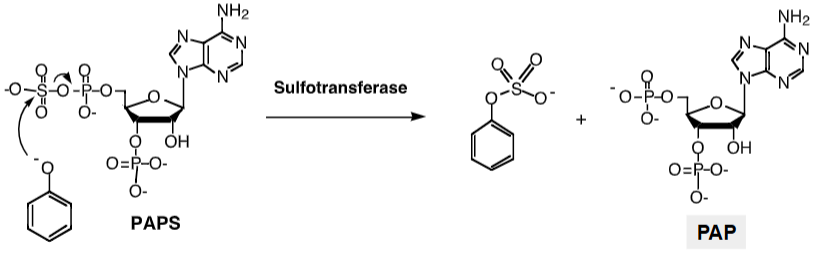
What are the two classes of STs?
1 class located in Golgi apparatus to sulfate proteins and peptides
Cytosolic class sulfates lipophilic xenobiotic compounds
What determines the carcinogenicity of epoxides/arene oxides?
The relative rate of reaction with DNA and Phase II enzymes
What medications should be avoided if there is a known CYP2D6 mutation?
Codeine, TCA, tramadol
What is the pharmacogenetic profile for an extensive metabolizer with CYP2D6?
CYP2D6 *1
Which enantiomer of Warfarin is more potent?
What is Warfarin metabolized by?
S enantiomer
CYP2C9
What family of FMO is responsible for fish odor associated with cardiovascular disease?
FMO3
What is epoxide hydrolase inhibited by?
Valproic acid and Valpromide