INTEGUMENTARY SYSTEM
 Call Kai
 Learn
Learn Practice Test
 Spaced Repetition
 Match
Match Flashcards
 Knowt Play
1/126

There's no tags or description
Looks like no tags are added yet.
Name | Mastery | Learn | Test | Matching | Spaced | Call with Kai | Chat |
|---|
No analytics yet
Send a link to your students to track their progress
127 Terms
Integumentary System
consists of the skin and accessory structures, such as hair, glands, and nails.
Integument
means covering, and the integumentary system is one of the mor familiar systems of the body to everyone because it covers the outside of the body and is easily observed
Protection
The skin provides protection against abrasion and ultraviolet light.
Protection
It also prevents microorganisms from entering the body and reduces water loss, thus preventing dehydration
Sensation
The integumentary system has sensory receptors that can detect heat, cold, touch, pressure, and pain
Vitamin D production
When exposed to UV light, the skin produces a molecule that can be transformed into vitamin D, an important regulator of calcium homeostasis
Temperature regulation
The amount of blood flow beneath the skin’s surface and the activity of sweat glands in the skin both help regulate body temperature
Excretion
Small amounts of waste products are lost through the skin and in gland secretions
epidermis and dermis
The skin is made up of two major tissue layers
Epidermis
is the most superficial layer of skin
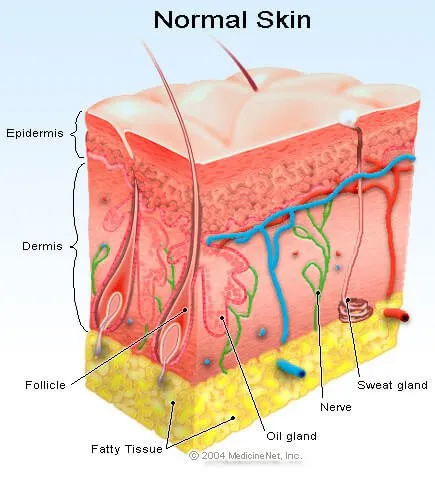
Epidermis
It is a layer of epithelial tissue that rests on the dermis.
Dermis
Dense connective tissue that forms the deep layer of the skin; responsible for the structural strength of the skin

Epidermis
Outer portion of the skin formed of epithelial tissue that rests on the dermis; resists abrasion and forms a permeability barrier
Subcutaneous tissue
under the skin; same tissue as the hypodermis

Subcutaneous tissue
not part of the skin, but it does connect to the skin to underlying muscle or bone
Epidermis
stratified squamous epithelium; in its deepest layers, new cells are produced by mitosis
Epidermis
many cells of this prevent water loss and resist abrasion
Keratinization
Production of keratin and changes in the structure and shape of epithelial cells as they move to the skin surface
Outermost cells of epidermis
protect the cells underneath, and the deeper, replicating cells replace cells lost from the surface
Keratinization
reflects the fact that the cells become filled with the protein keratin which makes them more rigid and durable
Keratin
Protein that accumulates in cells of nails, hair, and the superficial layers of the epidermis of the skin
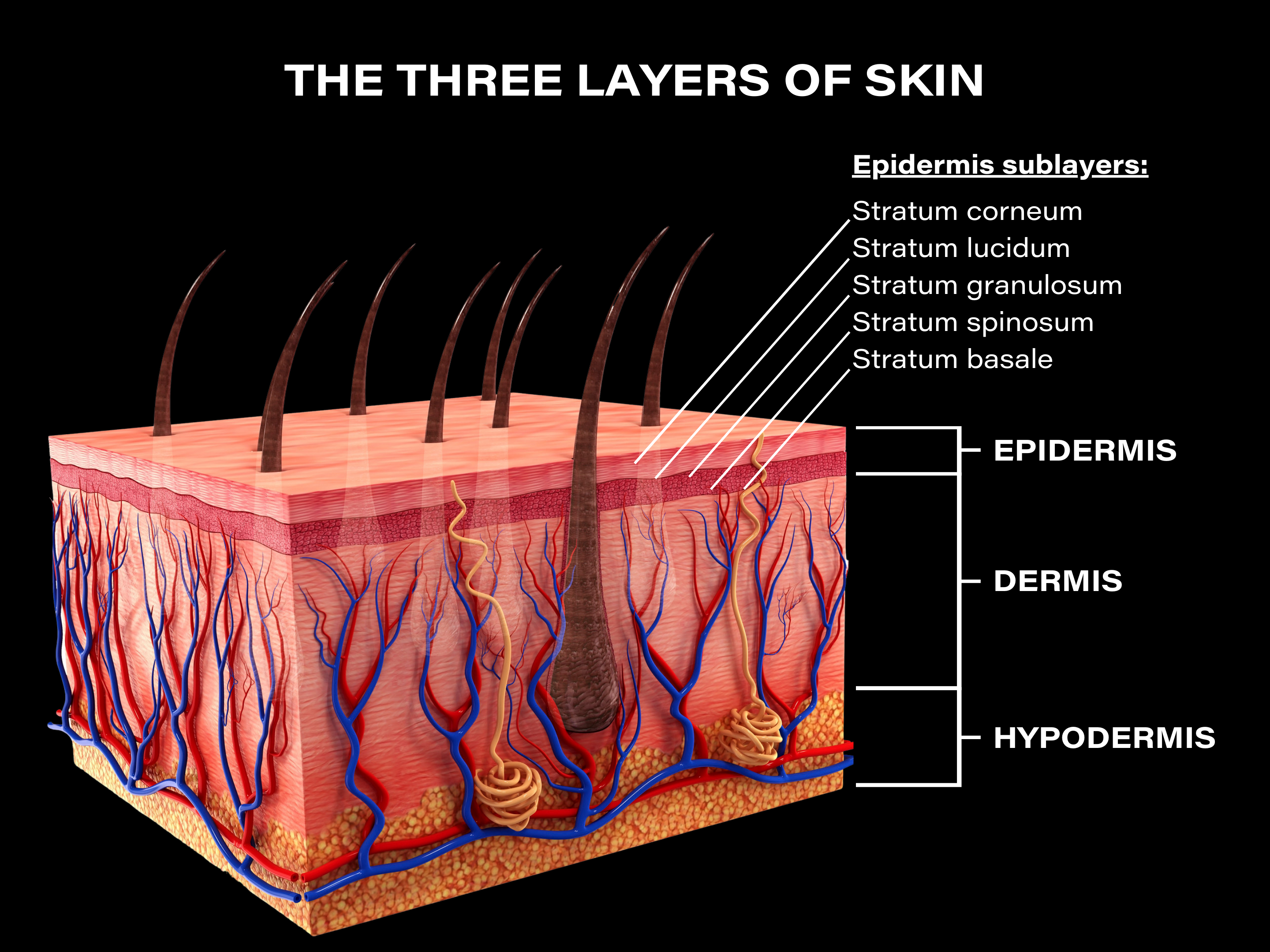
Stratum basale, stratum spinosum, stratum granulosum, stratum lucidum, and stratum corneum
Five layers that divides the epidermis into layers
Stratum basale
consists of cuboidal or columnar cells that undergo mitotic divisions about every 19 days

Stratum spinosum
take on a flattened appearance and accumulate lipid-filled vesicles called lamellar bodies
Flat and diamond-shaped
shapes of the cells of the stratum granulosum

Dermal papillae
project toward the epidermis
Stratum lucidum
is a thin, clear zone between the stratum granulosum and stratum corneum.

Thick skin
has all five strata and is found in areas subject to pressure or friction, such as the palms of the hands, the soles of the feet, and the fingertips.

Thin skin
lacks the stratum lucidum and covers the rest of the body
Thick and thin skin
only refer to the number of epidermal strata and not to the overall thickness of the skin, which is determined by the dermis
Stratum corneum
the most superficial stratum of the epidermis

Stratum corneum
consists of dead squamous cells filled with keratin
Stratum corneum
cells are also coated and surrounded by lipids released from the lamellar bodies of the skin cells
Stratum corneum
these lipids act as waterproofing material, thereby preventing fluid loss through the skin
Stratum corneum
composed of 25 or more layers of dead squamous cells joined by desmosomes
Callus
thickening of the stratum corneum of skin in response to friciton; the zone of tissue repair between fragments of a broken bone
Corn
Thickening of the stratum corneum of the skin over a bony projection in response to friction or pressure
Dermis
composed of dense collagenous connective tissue containing fibroblasts, adipocytes, and macrophages
Dermis
Nerves, hair follicles, smooth muscles, glands, and lymphatic vessels extend into this
Superficial papillary layer and deep reticular layer, reticular layer
Two layers of dermis
Superficial papillary layer
composed of loose, connective tissue
Deep reticular layer
composed of dense irregular connective tissue
Reticular layer
thicker, main layer of the dermis
Collagen and elastic fibers of the reticular layer
responsible for the strength of the dermis
Collagen fibers of the dermis
oriented in many different directions and can resist stretch
Collagen fibers of the dermis
produces cleavage lines, or tension lines, in the skin, and the skin is most resistant to stretch alone these lines
Stretch marks
can develop when a person increases in size quite rapidly
Dermal papillae
projection of the papillary layer of the dermis which extend toward the epidermis
Friction ridges
The dermal papillae in the palms of the hands, the soles of the feet, and the tips of the digits are arranged in parallel, curving ridges that shape the overlying epidermis into patterns
Intradermal injection
delivers material to the blood slowly and is administered by drawing the skin taut and inserting a small needle at a shallow angle into the dermis; an example is the tuberculin skin test
Subcutaneous injection
achieved by pinching the skin to form a “tent” and inserting a short needle, into the adipose tissue of the subcutaneous tissue; an example is an insulin injection
Intramuscular injection
delivers material to the blood faster than intradermal or subcutaneous injection
Intramuscular injection
is accomplished by inserting a long needle at a 90-degree angle to the skin
Intramuscular injection
are used for most vaccines and certain antibiotics
Pigments in the skin, blood circulating, thickness of the stratum corneum
several factors that determine skin color
Melanin
Brown to black pigment responsible for skin and hair color
Melanin
provides protection against ultraviolet light from the sun
Melanin
is produced by melanocytes
Melanocytes
are irregularly shaped cells between the stratum basale and the stratum spinosum
Melanosomes
pigment granule produced by melanocytes
Skin cancer
the most common type of cancer
Basal cell carcinoma
the most frequent type, begins with cells in the stratum basale and extends into the dermis to produce an open ulcer
Squamous cell carcinoma
develops from cells immediately superficial to the stratum basale
Squamous cell carcinoma
Normally, these cells undergo little to no cell division, but in [blank] the cells continue to divide as they produce keratin. The typical result is a nodular, keratinized tumor confined to the epidermis
Malignant melanoma
a rare form of cancer that arises from melanocytes, usually in a preexisting mole
Melanoma
can appear as a large, flat, spreading lesion or as a deeply pigmented nodule
Metastasis
common and unless diagnosed and treated early in development, this cancer is often fatal
Carotene
a yellow pigment found in plants such as squash and carrots
Carotene
lipid-soluble, and when consumed it accumulates in the lipids of the stratum corneum and in the adipocytes of the dermis and subcutaneous tissue.
Carotenoderma
if large amounts of carotene are consumed, the skin can become quite yellowish
Hypodermis
is not part of the skin but instead attaches the skin to underlying bone and muscle and supplies it with blood vessels and nerves
Subcutaneous tissue
loose connective tissue, including adipose tissue that contains about half the body’s stored lipids
Subcutaneous tissue
can be used to estimate total body fat
21%-30%
The acceptable percentage of body fat for females
13%-25%
The acceptable percentage of body fat for males
Hair
found everywhere on the skin, except on the palms, the soles, the lips, the nipples, parts of the genitalia, and the distal segments of the fingers and toes
Hair follicle
an invagination of the epidermis that extends deep into the dermis
Shaft of the hair
protrudes above the surface of the skin
Root
below the surface of the hair
Hair bulb
is the expanded base of the root
Cortex
outer part of an organ such as the brain, kidney, adrenal gland, or hair
Medulla
Center, or core, of an organ, such as the adrenal gland, kidney, or hair
Cuticle
single layer of overlapping cells that holds the hair in the hair follicle
Hair bulb
rests on the hair papilla
Hair papilla
an extension of the dermis that protrudes into the hair bulb
Arrector pili
smooth muscle attached to the hair follicle and dermis that raises the hair when it contracts
Contraction of the arrector pili
causes the hair to become more perpendicular to the skin’s surface, or to “stand on end”, and it produces a raised area of skin
Goose bump
raised area of skin
Sebaceous and sweat
major glands of the skin
Sebaceous gland
gland of the skin that produces sebum; usually associated with a hair follicle
Sebaceous gland
simple, branched acinar glands
Sweat glands
secretory organ that produces a watery secretion, called sweat, that is released onto the surface of the skin; some sweat glands, however, produce an organic secretion
Glands
produce sebum
Sebum
an oily, white substance rich in lipids
Sebum
released by holocrine secretion and lubricates the hair and the surface of the skin, which prevents drying and protects against some bacteria
Eccrine and apocrine
two kinds of sweat glands
Eccrine sweat glands
simple, coiled, tubular glands and release sweat by merocrine secretion
Eccrine sweat glands
located in almost every part of the skin but are most numerous in the palms and soles
Eccrine sweat glands
have ducts that open onto the surface of the skin through sweat pores
Emotional sweating
can also occur in the palms, soles, armpits, and other places