4.4 Trade policies and negotiation
 Call Kai
 Learn
Learn Practice Test
 Spaced Repetition
 Match
Match Flashcards
 Knowt Play
1/22

There's no tags or description
Looks like no tags are added yet.
Name | Mastery | Learn | Test | Matching | Spaced | Call with Kai | Chat |
|---|
No analytics yet
Send a link to your students to track their progress
23 Terms
Protectionism
Measures taken by a country to restrict international trade
Trading bloc
Where a group of countries in a region agree to cooperate in international trade through some sort of free trade area or other form of association
Tariffs
A tax imposed on imported goods
Quotas
An agreement by a country to limit its exports to another country to a given quantity
Trade creation
The replacement of more expensive domestic production or imports with cheaper output from a partner within the trading bloc
Trade diversion
The replacement of cheaper imported goods by goods from a less efficient trading partner within a bloc
World Trade Organisation
A multilateral body now responsible for overseeing the conduct of international trade
Economic integration
The process by which the economies of different countries become more closely linked, e.g. through free trade agreements or common currencies.
Free Trade Area
A group of countries that agree to remove tariffs, quotas and other restrictions on trade between the member countries, but have no agreement on a common barrier against non-members
Customs Union
A group of countries that agree to remove restrictions on trade between the member countries, and set a common set of restrictions (including tariffs) against non-member states e.g European Union
Common market
A set of trading arrangements in which a group of countries remove barriers to trade among them, including adopting a common set of barriers against external trade and allowing free movement of factors of production
Monetary union
A situation in which countries adopt a common currency
Economic union
A set of trading arrangements the same as for a common market, but in addition having a common currency (or permanently fixed exchange rates between the member countries) and a common monetary policy
Reasons for protectionism
-Protect infant industries
-Employment protection
-Raising tax revenues for government
-Response to chronic trade deficit
-Response to export ‘dumping’
-Environmental reasons
Arguments against protectionism
-Risk of retaliation
-Higher prices for consumers
-Regressive effect on income inequality
-Higher cost of production for firms which import resources (cost-push inflation)
-Potential creation of a shadow market
-Barrier to entering market reduces contestability and increases monopoly power
Advantages of free trade
-Firms can exploit economies of scale
-Lower prices for consumers
-Increased choice for consumers
-Increased competition encourages more innovation
Disadvantages of free trade
-Vulnerability to external shocks if overly dependant on imports
-Structural unemployment
-Environmental impact
-Income inequality
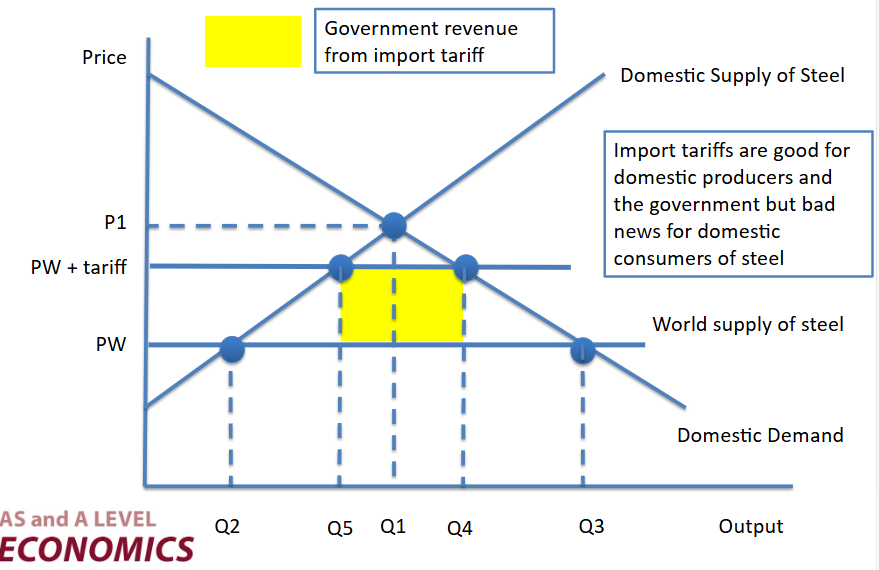
Tariff diagram
-Import tariffs are a form of protectionism
-Tariffs aim to protect domestic industries from overseas competition by increasing the relative price of imports, thereby causing a fall in import demand.
-Thus a higher proportion of domestic demand will be met from domestic suppliers
-Tariffs can also generate tax revenues for the governments who levy tariffs. Indeed for many developing countries, import tariffs are an important source of tax revenues
-A reduction in the quantity of imports as a result of the import tariff may also improve a nation’s trade balance
Quota diagram
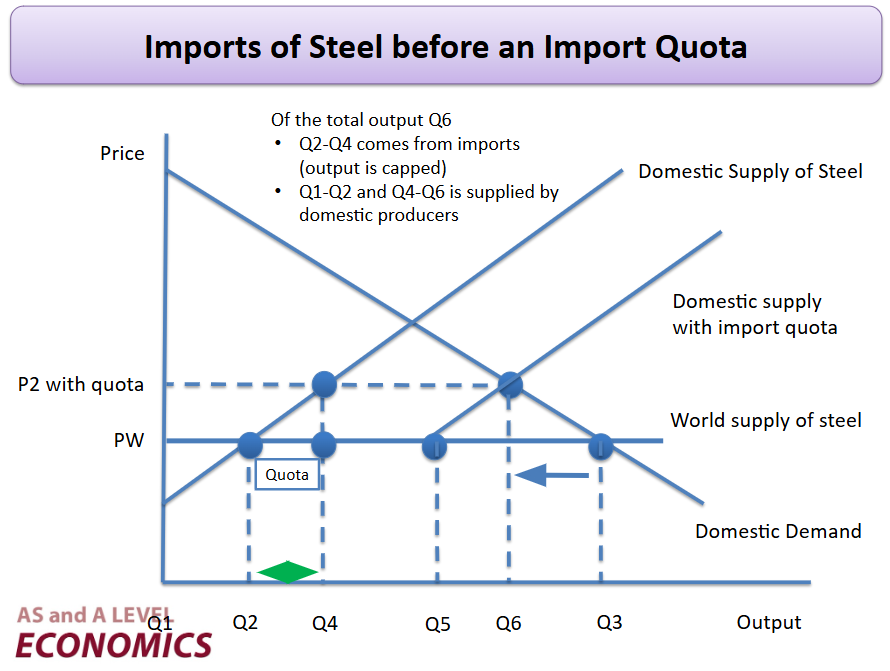
-A quota places a quantity limit on the volume of imports of a product that can come into a country
-The quota has an indirect effect on market price by creating an artificial scarcity
-A quota caps the volume or quantity of imports
-The effect of a quota is to create excess demand for imports for a given level of domestic demand
-The quota therefore pushes up the market price
-The higher market price incentivizes domestic producers to increase their supply / enter the market
-Domestic supply + the quota is the new domestic supply curve
Impact of import quota on firms
Domestic producers benefit from the cap on imports – increases the market price and makes it more profitable for them to stay in / enter the market
Quota is a barrier to trade, might encourage domestic firms to become less productively efficient
Some producers affected by scarce supply of higher quality overseas imports used in their production process – hurts their competitiveness
Impact of import quota on consumers
Consumers likely to face a higher price in the market because of limit on import products. Less competition in the market might also affect the quality of products available – impact on utility
Consumers who work for domestic firms may benefit from higher employment
Impact of import quota on government
Improved balance of payments from the reduction in imports and an expansion of GDP from the increase in domestic production
No immediate tax revenues from an import quota - a contrast with an import tariff
Non-tariff barriers
-Intellectual property laws e.g. patents
-Technical barriers to trade including labelling rules and sanitary standards
-Preferential state procurement policies – where government favour local producers when finalizing contracts for state spending e.g. infrastructure projects or purchasing new defence equipment
-Domestic subsidies – government help for domestic businesses
-Financial protectionism – e.g. when a government instructs banks to give priority when making loans to domestic businesses
-Managed exchange rates – government intervention in currency markets to affect relative prices of imports and exports