AQA A level Chemistry 3.1.2 Amount of substance
 Call Kai
 Learn
Learn Practice Test
 Spaced Repetition
 Match
Match Flashcards
 Knowt Play
1/43

There's no tags or description
Looks like no tags are added yet.
Name | Mastery | Learn | Test | Matching | Spaced | Call with Kai | Chat |
|---|
No analytics yet
Send a link to your students to track their progress
44 Terms
What does Avogadro's constant represent? (1)
The number of molecules in one mole of any substance
How do you calculate the mass of a substance? (1)
Mass = Mr * Moles
What formula is used to calculate the number of moles in a solution and what are the units? (3)
- n = c x v
- n = number of moles
- c = concentration (mol/dm³)
- v = volume (dm³)
What is the ideal gas equation? (6)
- pV = nRT
- p = pressure (Pa)
- V = volume (m³)
- n = number of moles
- R = ideal gas constant
- T = temperature (K)
How do you convert from °C to K? (1)
+ 273
How do you convert from K to °C ? (1)
-273
How do you convert from KPa to Pa? (1)
x1000
How do you convert from cm3 to m3? (1)
/1,000,000
What is the definition for empirical formula? (1)
Simplest whole number ratio of each element in a compound
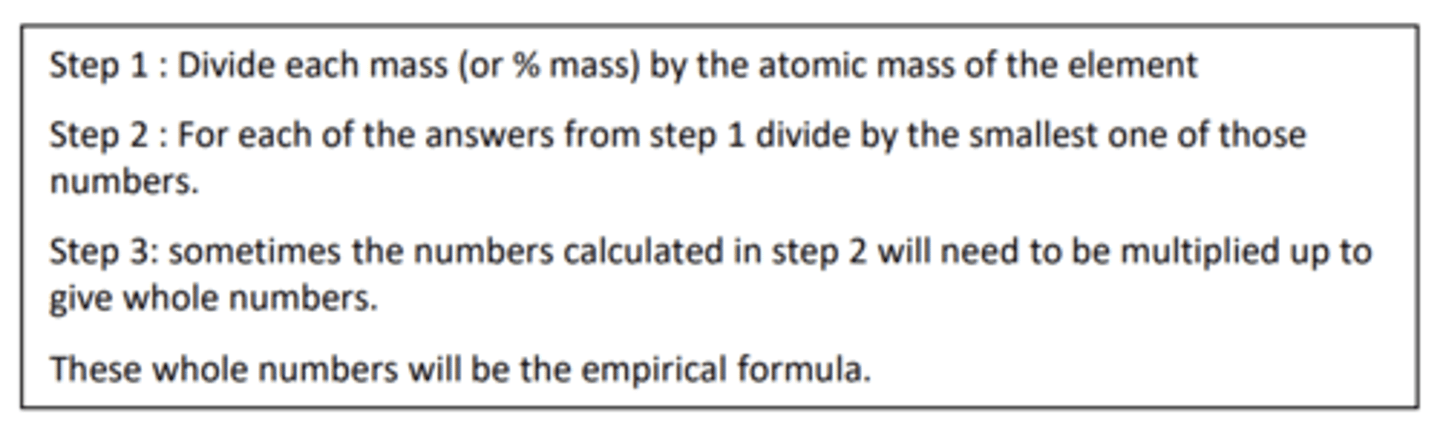
What is the general method for working out empirical formula? (3)
What is the definition for molecular formula? (1)
The actual number of atoms of each element in the compound.
Deduce the molecular formula for the compound with an empirical formula of C3H6O and a Mr of 116 (2)
- C3H6O has a mass of 58 The empirical formula fits twice into Mr of 116
- So the molecular formula is C6H12O2
What method do you use to work out the number of waters in a hydrated salt? (!)
Use the empirical formula method expect now you working with two different compounds (water and the salt)
What is the purpose of heating in a crucible? (2)
- To measure mass loss during thermal decomposition reactions
- To measure mass gain when reacting magnesium with oxygen
What does the equation for removing water of crystallisation from calcium sulfate look like? (1)
CaSO4⋅xH2O(s)→CaSO4(s) + xH2O(g)
What is the method for heating in a crucible? (6)
1. Weigh an empty, clean, dry crucible and lid.
2. Add 2 g of hydrated calcium sulfate to the crucible and weigh again.
3. Heat strongly with a Bunsen burner for a couple of minutes.
4. Allow to cool.
5. Weigh the crucible and contents again.
6. Repeat heating and reweighing until a constant mass is achieved (to ensure the reaction is complete)
Why should the lid be used during heating in a crucible? (1)
To prevent loss of solid from the crucible while allowing gas to escape
Why should large amounts of hydrated calcium sulfate not be used? (1)
Decomposition is likely to be incomplete
Why must the crucible be dry before use? (2)
- A wet crucible gives inaccurate results.
- Water loss from heating would cause a larger mass loss than expected
Why should very small amounts of solid not be used in this experiment? (1)
High percentage uncertainties in weighing
How do you convert from concentration in g dm-3 into concentration in mol dm-3? (1)
Concentration in g dm-3 = Concentration in mol dm-3 x Mr
What is the first step in making a volumetric solution? (2)
1. Weigh the sample bottle containing the required mass of solid on a 2 d.p. balance.
2. Transfer the solid to a beaker and reweigh the sample bottle to record the difference in mass.
What is the next step after weighing the solid? (2)
1. Add 100 cm³ of distilled water to the beaker
2. Use a glass rod to stir and help dissolve the solid
What should you do if the substance does not dissolve well in cold water? (1)
Heat the beaker gently until the solid dissolves completely
How should the solution be transferred to the volumetric flask? (3)
1. Pour the solution into a 250 cm³ graduated flask via a funnel.
2. Rinse the beaker and funnel, adding the washings to the volumetric flask.
3. Use a glass rod to transfer all washings to the flask
How do you ensure the solution reaches the correct volume? (2)
1. Make up to the mark on the neck of the volumetric flask using distilled water, adding the last few drops with a dropping pipette.
2. Ensure the bottom of the meniscus is aligned with the mark on the neck of the flask.
How can you ensure the solution is uniform? (1)
Invert the flask several times to mix the solution thoroughly.
What is an alternative method to transferring the solid? (2)
1. The known mass of solid in the weighing bottle can be transferred to the beaker
2. With the bottle washed and the washings added to the beaker
Why can dark liquids like potassium manganate pose challenges during making a volumetric soloution? (1)
It can be difficult to see the meniscus against the line on the neck of the flask
What precautions should you take for irritants and corrosive substances? (2)
- Wear goggles
- Wear gloves
What precautions should you take for flammable substances? (1)
Keep away from naked flames
What precautions should you take for toxic substances? (3)
- Wear gloves.
- Avoid skin contact.
- Wash hands after use
How do you calculate atom economy? (3)

How do you calculate percentage yield? (3)

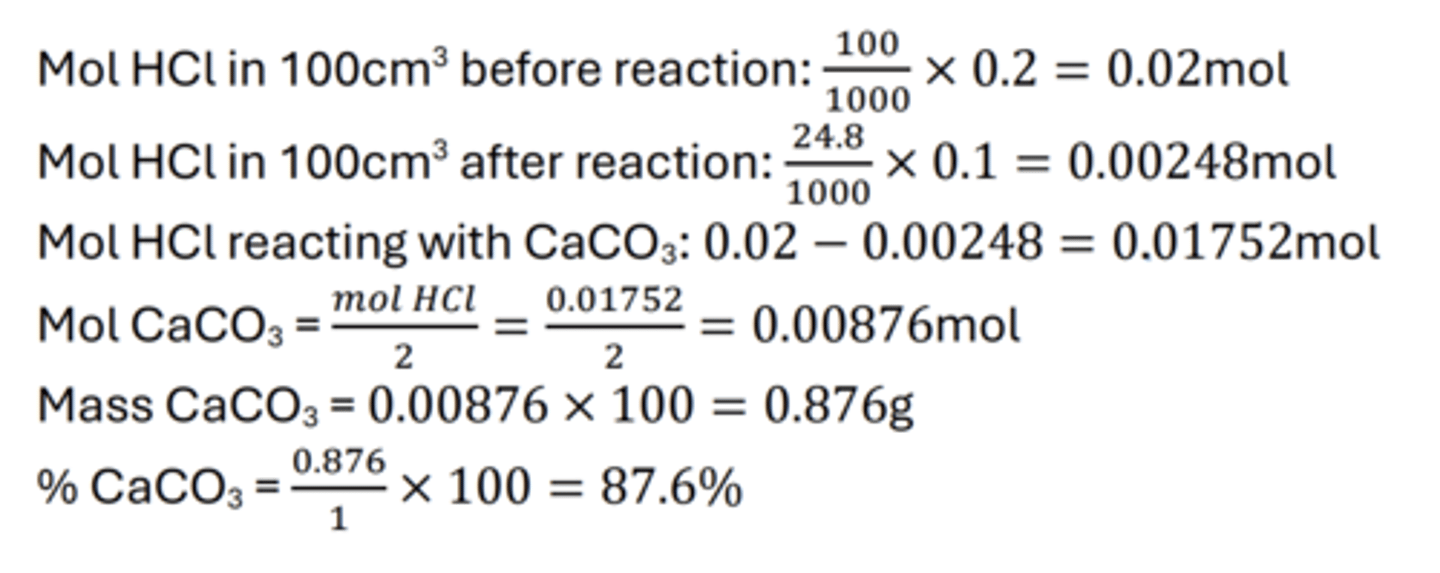
Limestone is an impure form of CaCO3 consisting of variable amounts of 2 major impurities, SiO2 and clay. 1g of limestone is reacted with 100cm3 of 0.200moldm-3 HCl. After the reaction, the solution formed is still acidic, requiring 24.8cm3 0.100moldm-3 NaOH for neutralisation.
What is the % CaCO3 by mass in the limestone? (BACK TITRATION EXAMPLE)
How do you calculate percentage uncertainty? (2)

How do you calculate percentage purity of a solid? (3)

What does concordant results mean? (1)
- Within 0.10 cm^3 of each other
- Which allows you to calculate a mean titre
What is the colour of phenolphthalein in an acidic solution? (1)
Colourless
What is the colour of phenolphthalein in an alkaline solution? (1)
Pink
What is the endpoint colour of phenolphthalein in a titration? (1)
Very pale pink
What is the colour of methyl orange in an acidic solution? (1)
Red
What is the colour of methyl orange in an alkaline solution? (1)
Yellow
What is the endpoint colour of methyl orange in a titration? (1)
Pale orange