ZOOLOGY - CHAPTER 1: An Evolutionary and Ecological Perspective
 Call Kai
 Learn
Learn Practice Test
 Spaced Repetition
 Match
Match Flashcards
 Knowt Play
1/23

Earn XP
Description and Tags
BSPSY 2ND YEAR (REVIEWER)
Name | Mastery | Learn | Test | Matching | Spaced | Call with Kai | Chat |
|---|
No analytics yet
Send a link to your students to track their progress
24 Terms
Zoology
Is the scientific study of animals and their behavior, physiology, classification, and distribution.
Entomology
Is the branch of zoology that focuses on the study of insects.
Herpetology
Is the branch of zoology that studies reptiles and amphibians.
Ichthyology
Is the branch of zoology that focuses on the study of fish.
Mammalogy
Is the branch of zoology that studies mammals.
Ornithology
Is the branch of zoology that focuses on the study of birds.
Protozoology
Is a branch of zoology that studies about protozoa.
Cichlid fishes
Mouth Brooding in ____.
Female carries eggs inside her mouth.
Fertilization occurs after sperm enters the female's mouth.
Eggs develop inside the mouth.
Young return to the mother's mouth when threatened.
IMPORTANT:
Protects eggs and young from predators.
Increases offspring survival.
Cichlid fishes
2,000-3,000 known species.
Demonstrate remarkable animal diversity.
Used throughout the chapter to explain evolution and ecology.
Highly diverse in:
- Color patterns
- Body forms
- Habitats
- Feeding habits
Evolutionary Perspective
Shapes the diversity of animals.
Understanding this helps explain what animals are and how they originated.
Charles Darwin
Published convincing evidence for evolution in 1859.
Proposed a mechanism to explain evolutionary change.
His proposal serves as the foundation of modern zoology.
Organic evolution
Is the change in the genetic makeup of populations over time.
It is the source of animal diversity.
Evolution of Color Patterns
Different populations became geographically isolated.
Isolation occurred among rocky habitats separated by sandy areas.
Fish rarely crossed sandy regions because of predators.
Breeding mainly occurred within isolated populations.
Over time, different _______ evolved.
Evolution of African Cichlids
Oldest cichlid populations found in:
- Lake Tanganyika
- Lake KivuThey later spread to:
- Lake Victoria
- Lake Malawi
- Other African lakesGeographic isolation promoted formation of new species.
Evolutionary Plasticity
Lake Victoria nearly dried out about 14,700 years ago.
Some cichlid populations survived in isolated refuges.
After the lake refilled, these populations recolonized the lake.
More than 500 cichlid species evolved in fewer than 15,000 years.
This rapid diversification is called ________?

Phylogenetic Tree
Zoologists study how different animal groups are related.
Evolutionary relationships are represented using tree diagrams.
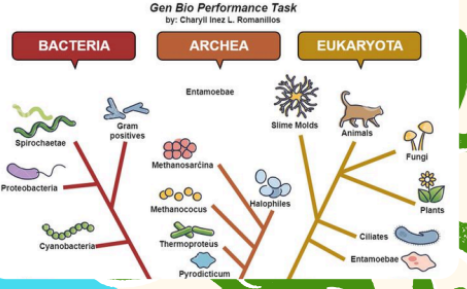
Binomial Nomenclature
Developed by Carl von Linné (Linnaeus)
Every species has a two-part scientific name:
- Genus name
- Species name
Ex. Staphylococcus aureus
Rules for Binomial Nomenclature
Do not use the species epithet alone.
The genus name or its abbreviation should always accompany it.
Taxonomic Hierarchy

Ecology
Greek words: oikos, meaning house + logos, to study)
It is the study of the relationships between organisms and their environment.
Case Study: Lake Victoria
Introduction of the Nile Perch
In the 1950s, the Nile perch (Lates niloticus) was introduced into Lake Victoria.
Purpose: To increase the lake's fishery production.
Result: Unexpected ecological consequences.
Case Study: Lake Victoria
Ecological Effects of the Nile Perch:
Cichlid fish biomass decreased from 80% to less than 1%.
About 65% of cichlid species became extinct.
The loss of cichlids disrupted the lake ecosystem.
Chain of Ecological Consequences:
Introduction of Nile Perch → Decline of cichlid fishes → Algae increased → Dead algae decomposed → Oxygen levels decreased → Water quality deteriorated → More aquatic organisms were affected.
Case Study: Lake Victoria
Economic Consequences
Changes resulting from the Nile perch introduction:
Nile perch became an important commercial fish.
Large fishing fleets replaced many local fishermen.
Fish processing shifted to large corporations.
Increased agriculture contributed to:
- Deforestation
- Sewage pollution
- Agricultural runoff
- Industrial pollution
Case Study: Lake Victoria
Ecological Lessons
Positive developments:
Heavy fishing reduced Nile perch populations.
Some cichlid species began to recover.
Certain species evolved adaptations to survive low oxygen levels.
Ex., increased gill surface area and changes in head morphology.