Toxicology- Lyon- Exam 1-Lecture 1 Outcomes (PART 1)
 Call Kai
 Learn
Learn Practice Test
 Spaced Repetition
 Match
Match Flashcards
 Knowt Play
1/34

There's no tags or description
Looks like no tags are added yet.
Name | Mastery | Learn | Test | Matching | Spaced | Call with Kai | Chat |
|---|
No analytics yet
Send a link to your students to track their progress
35 Terms
1. Herb/Nutrient/Drug interactions with pharmaceuticals can be deadly or cause nutrient depletions
2. Majority of patients will be on three of more different medications
3. Some patients need medications to survive!
Describe the rational behind having pharmacology as part of the chiropractic program
Toxicology
what is the study of adverse effects of chemical, physical or biological agents on living organism and the ecosystem?
Pharmacology
What is the study of the science of drugs...including their uses, effects and modes of action?
a substance that a person exposes themselves to in order to result in a specific outcome
a drug must interact with a molecule!!
define "drug"
TRUE
t/f: one characteristic of all drugs is they need to interact with a molecule (such as a receptor or enxyme)
NOTHING.
don't require FDA approval and are not required to determine efficacy or safety
What are the FDA requirements for supplements?
An agonist binds to the receptor/enzyme and activates activity
an antagonist binds to the receptor/enzyme to block activity
differentiate between agonist and antagonist
An agonist binds to the receptor/enzyme and activates activity
what is an agonist drug?
an antagonist binds to the receptor/enzyme to block activity
What is an antagonist drug?
Compounds that are similar to a ligand and can bind to the ligand's receptor/enzyme to activate or block activity (agonist or antagonist)
what is an anolog
pharmacodynamics
"What the drug does to the body" is referred to as...
Pharmacokinetics (what the body does to the drugs)
ADME is associated with which one...pharmacokinetics or pharmacodynamics?
pharmacokinetics
"what the body does the the drug" is referred to as...
PK- what body does to drug
PD- what drug does to body
differentiate between pharmacokinetics and pharmacodynamics
1. hormone and NT receptors
2. Enzymes
3. Membrane transport proteins
4. Membrane lipids
What are the 4 drug "targets" or "receptors" discussed in lecture
intracellular receptors are found in the cytosol or nucleus and bind lipid soluble signal molecules (steroid and amines)
whereas
cell surface receptors are only found on the surface of cells within the membrane and bind water soluble molecules (peptides and amines)
Differentiate between intracellular vs cell surface receptors
intracellular receptors
Steroid hormone receptors are what type of receptor class?
1. Ion-channel linked
2. G-protein linked
3. enzymes linked (ex: RTK and non RTK)
what are the three types of cell surface receptors mentioned in lecture?
-respond to the ligand binding
- activate rxns
-coordinate rxns
- induce ampliphication signals
what is the role of secondary messengers formed via signaling cascades
secondary messengers
cAMP and cGMP are examples of what?
response selectivity
(same effectors, different effects)
Tamoxifen acting as an antagonist on estrogen receptors expressed in breast tissue but as an agonist in bone is an example of what?
irreversible-destroys enzymes ability to interact with substrate.
reversible- substrate levels can alter inhibition of the enzyme and it's active site.
defferentiate between irreversible and reversible enzyme ingibitor
irreversible enzyme inhibitors
aspirin and penicillin are examples of what type of enzyme inhibitors?
FALSE: enzyme is cooked no matter how much substrate is present. the irreversible inhibitor is BOUND
T/F: the more substrate present near an irreversible inhibitor, the less the enzyme will be inhibited.
competitive and non-competitive inhibitors
what are the two types of reversible inhibitors?
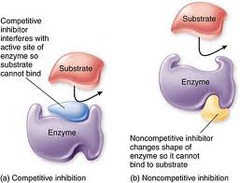
competitive- competes with substrate for active site. once bound, blocks substrates access to active site.
non-competitive- have a separate binding site away from the substrate's active binding site. Once bound, changes the shape of the substrates active binding site.
differentiate between competitive and non competitive enzyme inhibitors.
(both reversible inhibitors)
TRUE!! substrate levels matter!
T/F: increase in substrate concentration can know the reversible inhibitors off and allow substrate to bind to the active site.
competitive (reversible) enzyme inhibitors
majority of pharmaceuticals are what type of enzyme inhibitors?
the potency
the measure of the amount of a drug necessary to produce the median effect (half of the maximum response, ED50) is what?
efficacy
think--> "biggest bang for your buck"
the measure of the magnitude of the effect of the drug (Emax) is what?
potency is least amount you can use to get the desired effect (think stevia is sweeter than sugar, therefor more potent)
whereas efficacy is the most effective affect you can get with the lowest amount (biggest bang for your buck)
what is the difference between potency and efficacy of a drug? TQ
upregulation
downregulation
When more receptors are available, this is referred to as what?
what about a loss of receptors?
strength of ligand/receptor binding and can alter efficacy of a drug
Affinity and pH can alter what?
the THERAPEUTIC INDEX
The ratio of the dose that produces toxicity in half the population to the dose that is clinically effective (ED50)
What does TD50 mean?
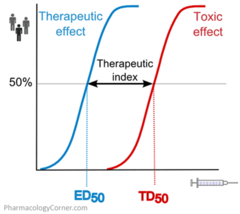
narrow--> effective dose is close to its toxic does. easy to OD
wide-->toxic dose isn't close to effective dose. hard to OD
A therapeutic margin with a "narrow window" vs a "wide window" means what?