2.2.5 SOCIAL: Habits
 Call Kai
 Learn
Learn Practice Test
 Spaced Repetition
 Match
Match Flashcards
 Knowt Play
1/79

Earn XP
Description and Tags
1- 10: Define the features that characterise habits 11-44: Critically evaluate the empirical evidence that these features characterise habits. 44-55: Identify ways to break – or overcome – habits. 56-76: Critically evaluate the extent to which each strategy is effective. 77-80: Summary
Name | Mastery | Learn | Test | Matching | Spaced | Call with Kai |
|---|
No analytics yet
Send a link to your students to track their progress
80 Terms
William James (1899) quote
ninety-nine hundredths or, possibly, nine hundred and ninety-nine thousandths of our activity is purely automatic and habitual, from our rising in the morning to our lying down each night.
if habits make up most of our behaviour, why study anything else?
researchers may be biased towards ‘agentic’ accounts of behaviour- like Mazar and Wood (2022) suggest people are
people tend to prefet to explain behaviour in a way that gives them agency- give a reason, implying intention choice. yet when investigate in more detail, it is bc the behaviour is habitually done- repeated action
habits: what are they and how do they develop (in brief)
strong associations (in memory) between contexts and responses that have developed through repetition
habits: definition
relatively automatic responses to contexts that are insensitive to changes in the value or contingency of response outcomes
what domain do habits come under?
not necessarily behavioural- e.g. habitual pessimistic thinking. behavioural but cognition can be habitual too.
what are habits triggered by?
context
does not have to be environmental context, can also be internal feeling e.g. when i feel depressed i do x
trigger associated w behaviour
why do habits build?
they are functional for us
behaviour is reinforced due to factors e.g. reward, convenience
what style of response do habits take?
becomes automatic → persist even when no longer rewarding
Verplanken: habits should not be equated with…
frequency of occurence
habits = doing something frequently
yes or no, and why
no, more than that
key indicator is how often/ for how long someone does smth, but not enough → is also possible to habitually not do something (as opposed to just not doing smth)
habits = strong associations in memory between contexts + responses
there are different routines for activities, e.g. lunches depend on diff settings
evidence that habits are represented by strong associations between contexts and responses: study
Adriaanse et al., (2011, Study 1)
Adriaanse et al., (2011, Study 1): procedure
identify habits
asked what they would usually snack on at home? (habitual response)
asked what snack would they eat if this was not available (alternative response)
primed lexical decision task
decide if letter string word or no word
prime: home
targets: responses that the Ps had generated + filler items (e.g. stairs, clock, saddle, wheels)
Adriaanse et al., (2011, Study 1): reasoning behind procedure
investigating if ppl who habitually snack do so context dependently or independently
gave context → at home → to q what usually snack on/ what usually eat in that situation
alternative response = non habitual response
tried to tap into associations via primed lexical decision task, that used the context prime ‘home’ outside of conscious awareness → reasoning: if have mental representation between two things, if activate one thing, it primes association to the other via spreading activation
if activate home → some activation associated with things at home, e.g. what u habitually snack on, meaning u wld response quicker if those were presenting
mixed in with non-critical filler words
what was Adriaanse et al., (2011, Study 1) investigating
do ppl who habitually snack do it context dependently or independently
if habits are represented by strong associations between contexts and responses
Adriaanse et al., (2011, Study 1): results
mean response latency of the habitual response = 620
mean response latency of the alternative response = 675
response latency
time delay between when a stimulus is presented + individual responds
Adriaanse et al., (2011, Study 1): findings
habitual responses faster than non-habitual
if prime word home + present snack → takes shorter amount of time to respond to a habitual snack than alternative response, which is not as associated w home
evidence that there is association between context and response
first part of habit definition- strong associations
evidence for whether the associations in habits develop through repetition: study
Wood, Quinn, and Kashy (2002)
Wood, Quinn, and Kashy (2002): beliefs/rationale + aims of study
beliefs/rationale:
re second part of habit definition
believes strong associations occur thru instrumental learning → behaviour either reinforced or not
daily life full of repetition/learning , tho do not often try novel things
aim:
to estimate the proportion of what we do that is habitual
Wood, Quinn, and Kashy (2002): procedure
experience sampling
Ps recorded what they were doing at the moment of the watch chime
the frequency with which they had performed the behaviour in the past month
the extent to which they performed the behaviour in the same physical location each time
the involvement of other ppl in the behaviour (others involved vs others not involved)
also:
what they were thinking about during the activity
and whether they considered each behaviour to be a habit
Wood, Quinn, and Kashy (2002): results
about 43% of actions were performed almost daily and usually in the same context
Wood, Quinn, and Kashy (2002) vs William James(1899)
WJ- habits account for 99% or 99.9% of what we do
WQK- habits account for 43% of what we do
→ WQK lower estimate than WJ → possibly due to reporting more agentic accounts (drawn to differences rather than similarities)
(some) criteria for establishing automaticity
do not require deliberation (i.e. are efficient)
occur outside conscious awareness
insensitive to changes in the values of the response (i.e. not dependent on ppls goals)
are difficult to control
to what extent are habitual responses automatic? rationale + intuitive
habits = assoc in memory that develop thru repetition
dont require cog resources → done without deliberation
even when behaviour no longer rewarded, habit persists → perhaps due to being difficult to control or occuring outside conscious awareness
ppl often have ‘bad habits’ e.g. nail biting, mindless eating, staying up late that they wish to stop but cannot- difficult to control, insensitive to changes in the value, occur outside conscious awareness, no delibration
intuitively suggests habitual responses are very automatic
do habits remove the need for deliberation? study
Aarts et al., (1997)
Aarts et al., (1997): procedure
do habits remove need for deliberation?
measure strength of cycling habits for 82 students
decide, as quickly as poss, how to travel for nine trips
freq of mentioning bike → measure of habit
16 descriptions of travel situations, each with four attributes:
1) weather conditions (rain, no rain)
2) weight of luggage (4kg, 20kg)
3) departure time (9am, 2pm)
4) distance to destination (2.5km, 5km)
favourability of using the bicycle in each travel situation (1-10 scale)
the number of attributes used to make decision
operationalised as how predictive attributes were of decision
what was the measure of habit in Aarts et al., (1997)
frequency of mentioning the bicycle
why was number of attributes used to make decision measured in Aarts et al., (1997)?
bc examining deliberation
to what extent ppl take into account the attributes of the event
if u are a habitual cyclist → do not consider the attributes of the trip as much (how rewarding it is)
operationalised as how predictive attributes were of decision
Aarts et al., (1997): results + findings
number of statistically significant predictors of choice of travel mode (out of possible 4: weather, weight, distance, departure time) by strength of cycling habits (weak vs strong)
ppl w weak habits took into account 2.2 attributes
habitual cyclists (strong habit) took into account 1.8
habitual cyclists took less attributes into account
does not show no deliberation, but considerably smaller proportion of deliberation for strong habits
do habitual responses occur without ppl being aware of them? study
Wood, Quinn, and Kashy (2002)
Wood, Quinn, and Kashy (2002) study is evidence for
whether the associations in habits develop through repetition
whether habitual responses occur without people being aware of them
Wood, Quinn, and Kashy (2002): do habitual responses occur w/o ppl being aware of them: relevant study parts + hypothesis
experience sampling watch chime study
part of study relevant to this: asked what they were thinking abt during the activity recorded when watch went off, asked whether they considered each behaviour to be a habit (yes/no)
→ are you thinking abt activity being done or smth else? if w/o conscious awareness, ppl wld be less likely to be thinking about habitual behaviour when it is being performed
Wood, Quinn, and Kashy (2002): what % of the time do thoughts correspond with behaviour? results Part 2
non-habitual behaviours
thoughts correspond 70% of the time
habitual behaviours
thoughts correspond 40% of the time
→ thought less likely to correspond with habitual behaviour
are habits insensitive to changes in the value of the response? study
Neal et al., (2011)
Neal et al., (2011): procedure
examining if habits are insensitive to changes in value of response
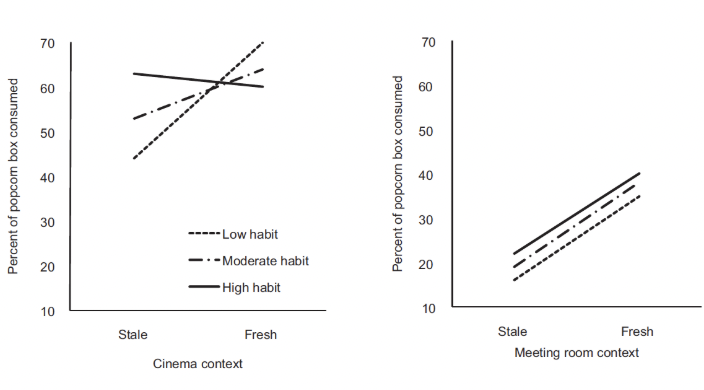
Ps thought they either evaluating movie trailers (wld be assoc w eating popcorn) or music videos
manipulated three variables through contexts consistent or inconsistent with eating popcorn + gave Ps a bag of popcorn to snack on:
habit strength
how frequently do you eat popcorn in movie theatres?
→ habitual popcorn eaters + non habitual
context
cinema or meeting room
→ cinema- contextual cues associated
value of response
popcorn either fresh or stale
→ stale shld not reinforce eating as lower quality; if not a habitual eater then behaviour shld cease
Neal et al., (2011): findings
cinema context
contextual cues support habit
behaviour depends more on strength of habit- habitual popcorn eaters eat it regardless (of if stale or fresh) whilst low habit eat less if stale and more if fresh, same for moderate habit but for a much lesser degree (cld say no effect), compared to high habit where freshness does not matter at all
meeting room context
generally popcorn not eaten in meeting room, even less if its state - not dependent on contextual cues
congruent responses between different habit types, slightly more in each condition has habit strengthens
overall prefer fresh to stale
cinema vs meeting room
even low habit eat the same amount of stale popcorn in cinema as high habit do fresh popcorn in meeting room
Verplanken et al., (2007)
habits not just about behaviour
mental habits
aka habitual patterns of thought
assessed with HINT
HINT
Habit Index of Negative Thinking
HINT assesses…
mental habits
what is this question from?:
Thinking negatively about myself is something . . . .
I do frequently.
I do automatically.
I do unintentionally.
that feels sort of natural to me.
I do without further thinking.
that would require mental effort to leave.
I do every day.
I start doing before I realize I’m doing it.
I would find hard not to do.
I don’t do on purpose.
that’s typically “me.”
I have been doing for a long time.
HINT, Habit Index of Negative Thinking
Verplanken et al., (2007)
are habits part of who we are? how is this assessed
Self-Report Habit Index (Verplanken & Orbell, 2003)
Self-Report Habit Index (Verplanken & Orbell, 2003)
measures whether thought responses can have same properties as behavioural responses
“doing X is something that is typically me”
how does Self-Report Habit Index (Verplanken & Orbell, 2003) assess if habits are part of who we are?
one item on screen → opens broader question as to what extent we are defined/define ourselves by our habits
how consistently do you need to be a pessimist before this comes ‘who you are’- until other ppl perceive u as this
debate about extent to which habits become part of self identity
are habits part of who we are? studies
Self-Report Habit Index (Verplanken & Orbell, 2003)- debated, especially about self/concept self identity- evidence in both directions
Murtagh et al., (2012)- being a driver vs transport type- no/ very weak correlation (but didnt measure actual driving)
Albini et al. (2018)- habitual veg/fruit eater + acc eating them: moderate for veg, no/very weak for fruit- unclear
Verplanken and Sui (2019)- median moderate correlation between general behaviours being part of one’s self-concept/identity + frequency of performance (large size effects)
Verplanken & Orbell quote on breaking habits (2022)
“habits are often seen as ills of society that need to be overcome … in order to create healthier, safer, or more sustainable societies. However, this narrow view of habits overlooks the important role habits play in regulating desirable everyday behaviour or in consolidating long-term behaviour change”
motivation + habit breaking
motivation alone unlikely to be enough to change/break habits
need to be supplemented with smth more substansive
why is it hard to change/break habits?
people may not be aware that habits drive behaviour (links to Mazaar + Wood’s coffee study 2022)
may not be aware of the cues that trigger habits, e.g. the context of being at home in snacking (Adriaanse et al. 2011)
may not be aware of the habitual responses themselves (Wood et al. 2002)
habits also insensitive to changes in value of response (Neal et al. 2011)
habits may come to define us + how others see us (Verplanken & Orbell, 2003)
is it possible to change/break habits? study
Webb & Sheeran (2006)
Webb & Sheeran (2006)
is it poss to change/break habits?
motivation unlikely to be enough
meta analysis of 47 studies that changed Ps’ intentions to do things
changes in intentions → larger changes in behaviours that Ps performed sporadically (d = 0.74)
than in behaviours that cld be repeated into habits (d = 0.22)
why do people fail to act on their intentions? (Sheeran et al., 2005)
intention viability (impossible for some decisions to find expression in the absence of particular abilities, resources, or opportunites)
counter-intentional habits (intentions have smaller effects on behaviours performed frequently in similar situations (Quellette & Wood, 1998)
lack of resources/ outside personal control (need supportive environment)
which of the reasons why people fail to act on their intentions highlighted by Sheeran et al., (2005) links to breaking/changing habits?
counter-intentional habits
(intentions have smaller effects on behaviours performed frequently in similar situations (Quellette & Wood, 1998)
reducing intention viability
strategies to break/change/overcome habits
change circumstances
vigilant monitoring
make a plan
strategy one - idea
change circumstances
if habits cued by recurring stimuli, changes in circumstances that remove these stimuli should disrupt habits
strategy two- idea
vigilant monitoring
habits often below conscious awareness, so trying to pay attention to things you usually wouldn’t/ effortfully paying attention to habits → may mitigate habit performance
strategy three- idea
make a plan
implementation intentions
forming an implementation intention → creates a new association with critical cue that is then pitted against the habitual association
idea of spreading activation; if creating multiple associations with a single cue, which one determines our responses depends o which is activated more strongly/first
study on strategy one: change circumstances
Wood, Tam, & Guerrero Witt (2005)
Wood, Tam, & Guerrero Witt (2005): rationale, predictions, theory etc
students moving to new uni → bound to experience naturally changing contexts → so cues likely to prompt habitual behaviour will change
tracked whether habits persisted → predicted would persist if cues that prompted these habits remained the same
if things stay relatively unchanged → contextual cues remain → habit more likely to persist
if cues change → more likely to be change in behaviour
Wood, Tam, & Guerrero Witt (2005): procedure
reported at two times
time 1: 4 weeks before moving (measured stability of context also)
time 2: 4 weeks after moving (measured changes in context also)
Ps reported at time 1 + time 2:
frequency of performance
how often they:
exercised
read the newspaper
watched tv
also reported:
Ps indicated whether they typically performed each behaviour in the same location, with the same ppl/alone, and whether those around them performed the behaviour
time 2: Ps also reported:
the extent to which the context in which they performed each behaviour at the two unis was similar/different
Wood, Tam, & Guerrero Witt (2005): findings (1): frequency of activities x degree of change (less, more) x strong vs weak habits
freq of activity as a function of strength of activity habits at old uni, intentions at new uni, and change in performance location/ perceived change in performance circumstances
found those w strong habits very disrupted by changes in cues, whilst those with weaker are less disrupted + therefore more flexible (can adapt to new circumstances)
if characteristics underpinning habit changes, this breaks the habit
those with strong habits also perceived more change
found pattern of findings = exactly the same across different activities for PERCEIVED CHANGE IN CIRCUMSTANCES AND/OR CHANGE IN LOCATION
→ different for change in others’s presence
Wood, Tam, & Guerrero Witt (2005): results (1): frequency of exercise x degree of change in location (less, more) x strong vs weak habits
strong habits + less change in location = freq of 0.9
strong habits + more change in location = freq of -0.35
weak habits + less change in location = freq of 0.5
weak habits + more change in location = freq of 0.1
Wood, Tam, & Guerrero Witt (2005): results (2): frequency of TV watching x degree of perceived change in performance circumstances (less, more) x strong vs weak habits
strong habits + less perceived change = freq of 0.8
strong habits + more perceived change = freq of 0.1
weak habits + less perceived change = freq of 0.48
weak habits + more perceived change = freq of 0.38
Wood, Tam, & Guerrero Witt (2005): results (3): frequency of reading paper x change in others’ presence (less, more) x strong vs weak habits
strong habits + less ppl change = freq of 1.2
strong habits + more ppl change = freq of 0.65
weak habits + less ppl change = freq of 0.6
weak habits + more ppl change = freq of 0.8
only one where more change produces higher freq, specific to weak habits + peoples’ presence
Wood, Tam, & Guerrero Witt (2005): interpretation of results (3): frequency of reading paper x change in others’ presence (less, more) x strong vs weak habits
presence/absence of other ppl = a cue that can change freq at which behaviour is performed
therefore changing contextual cues = effective method to change habits, but not always viable
strategy two: vigilant monitoring: study
Quinn et al (2010)
Quinn et al., (2010: procedure
vigilant monitoring for habit changing/breaking
Ps asked to ID behaviours that they tried to inhibit or change during a typical day
measured strength of Ps’ habits (how often performed in past, extent to which performed unwanted act in same location each time)
at follow up:
reported strategies used
vigilant monitoring- e.g. thinking “dont do it”, watching carefully for mistakes, monitoring behaviour (trying to gage how much time spent doing that habit)
distraction
stimulus control- i.e. removing opportunity
nothing
rated overall sucess of each attempt to change their behaviour
Quinn et al., (2010: results
weak habits: similar results for monitoring strategy, distraction, and stimulus control. participant rated success of self control 4.1, 4, 4.2
strong habits: monitoring strategy most effective, followed by distraction, then stimulus control (ineffective). P rated success of self control: 3.9, 3.3, 2.9
Quinn et al., (2010: findings + interpretation
data suggested vigilant monitoring reported as most effective
more successful at changing things that are less habitual, but strong habits were most effected by vig mon
seems contradictive against Woods et al, where changing circumstances = effective
means if changing context not viable, this may be effective strategy
people may not often be able to identify contextual cues that underlie habits
strategy three, make a plan: Adriaanse et al., (2011) hypothesis
forming implementation intention creates new association w critical cue that is then pitted against habitual association in a race
occurs like a horse race between associations
spreading activiation- multiple activations, which one determines responses depends on which is activated strongly/first
strategy three, make a plan: Adriaanse et al., (2011) procedure
mean response latencies of the habitual and nonhabitual responses study 1
got people to form implementation intentions “if i am at home and i want a snack then i will take.. alternative”
strategy three, make a plan: Adriaanse et al., (2011) findings
those who formed implementation intentions responded more quickly to alternative food and slower to habitual response
suggests new association had been formed which partially inhibited old association
suggest implementation intentions/making a plan is an effective strategy → forges alternative associations
Holland, Aarts, & Langendam (2006): procedure
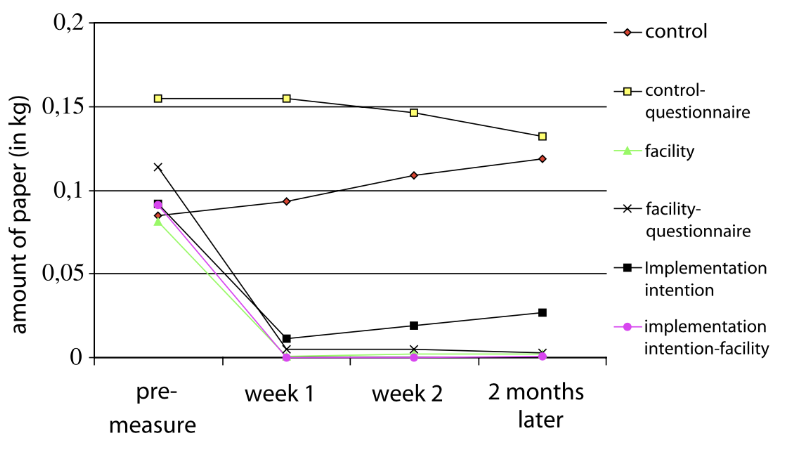
telecom company installed recycling boxes for old paperwork and plastic cups but amount binned did not seem to be reduced
one group of employees- plan when, where, and how, wld recycle their paper and plastic cups
recycling behaviour measured by weight of paper and cups in each Ps dustbin at end of working day
→ initially strong waste habits due to performing this behaviour for years
→ assessed whether specifying plans changed waste habits
Holland, Aarts, & Langendam (2006): findings
were other conditions- control, control questionnaire, facility, facility questionnaire, implementation-intention, implementation-intention-facility
overall, planning seems to have disrupted the habits, resulting in less waste behaviour
what may the effectiveness of planning depend on?
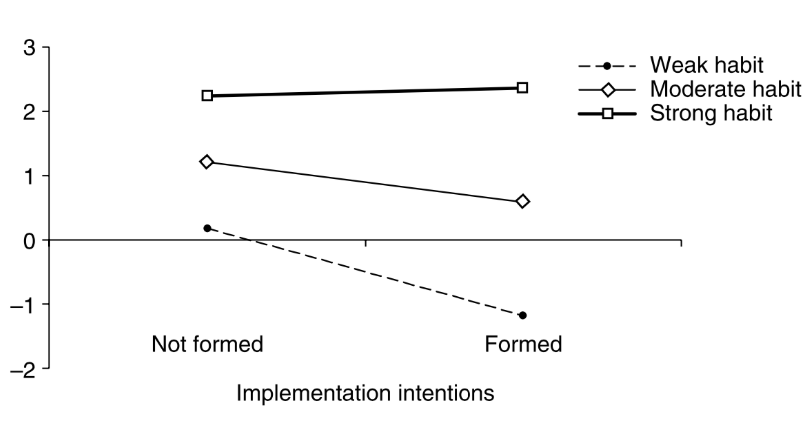
strength of the habit
habit strength often unaccounted for
Webb, Sheeran, & Luszczynska (2009, Exp 2): procedure
assessed strong habit as it has physiological response
two strategies- implementation intentions + planning alternative response
recruited regular smokers who wanted to quit from high schools
measured strength of smoking habits- Fagerstrom Test for Nicotine Dependence, number of months as smoker, number of attempts to give up smoking
one half formed implementation intentions “when… i will…”
control condition completed one of three control exercises concerning seat belt use
one month later, smoking behaviour followed up- no of cigs a day
does the effectiveness of planning depend on habit strength? study
Webb, Sheeran, & Luszczynska (2009, Exp 2)
Webb, Sheeran, & Luszczynska (2009, Exp 2): findings
found strength of smoking habit moderated implementation intentions
some strategies may be more effective for stronger habits than for weaker ones
what features characterise habits?
underpinned by strong associations between contexts and responses
develop through repetition
insensitive to changes in the value of the outcome
require few cognitive resources
relatively automatic
do not require deliberation (4)
occur outside conscious awareness
(3)
difficult to control
habits are generally _____, but when they become ______ they are ____ __ ______
helpful, unwanted, hard to change
changes in ______ that ____ _____ to the ____ that trigger the _____ response can _____ habits
circumstances, reduce exposure, cue, habitual, disrupt
if changes in _______ are not possible, then ______ _____ or _____ _____ that link the cue with a ___ _____ _____ may help
circumstances; vigilant monitoring; forming plans; new, alternative response