GAS EXCHANGE IN THE LUNGS
 Call Kai
 Learn
Learn Practice Test
 Spaced Repetition
 Match
Match Flashcards
 Knowt Play
1/16

There's no tags or description
Looks like no tags are added yet.
Name | Mastery | Learn | Test | Matching | Spaced | Call with Kai |
|---|
No analytics yet
Send a link to your students to track their progress
17 Terms
Inspiration
INSPIRATION
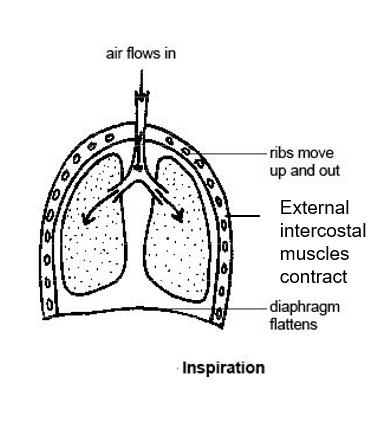
The diaphragm contracts and flattens down.
The external intercostal muscles contract and move the rib cage up & out.
The volume of the chest cavity increases.
Pleural membrane (pleura) adhered to inside of chest cavity expands lungs.
Lungs are now a large, empty space so air pressure in lungs is less than air pressure outside.
Air flows into the lungs to equalise.
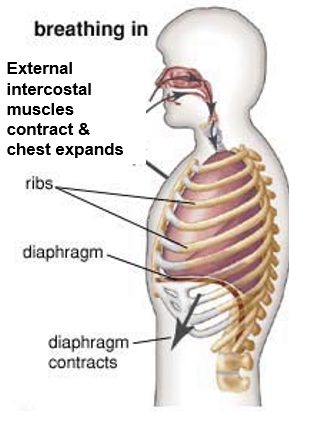
EXPIRATION
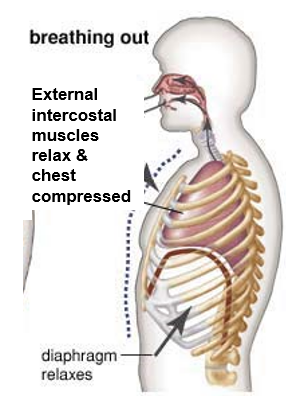
EXPIRATION
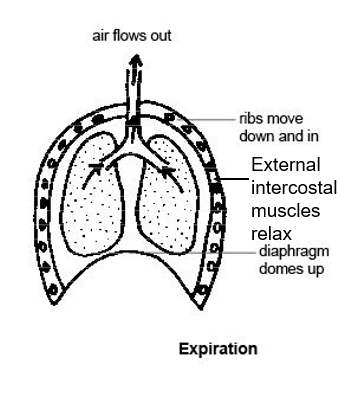
The diaphragm relaxes & bulges into chest cavity.
The external intercostal muscles relax and move the rib cage down and in.
The volume of chest cavity decreases.
Pleural membrane (pleura) adhered to inside of chest cavity compresses lungs.
Lungs are now a small, tight space so air pressure in lungs is greater than air pressure outside.
Air flows out of lungs to equalise the pressure.
Air flows in
Air flows out
GAS EXCHANGE BETWEEN LUNGS AND BLOOD
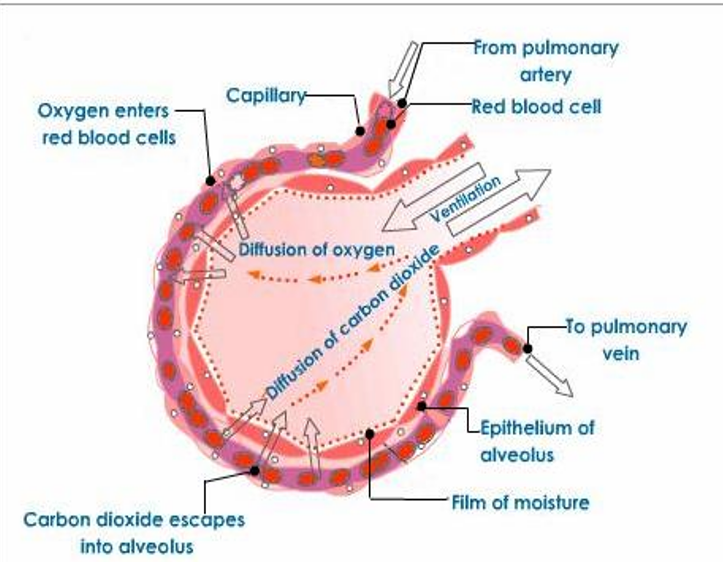
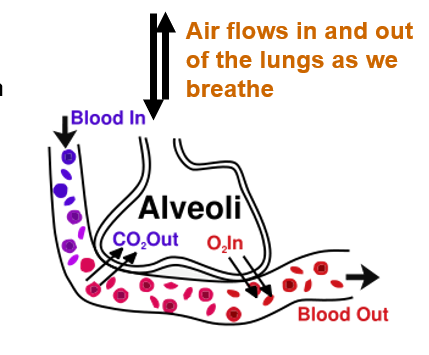
Between alveoli of lungs and surrounding capillaries by diffusion.
Oxygen enters alveoli in inspired air and diffuses to the capillaries.
Carbon dioxide in the blood diffuses from the capillaries to the lungs and leaves the body in expired air.
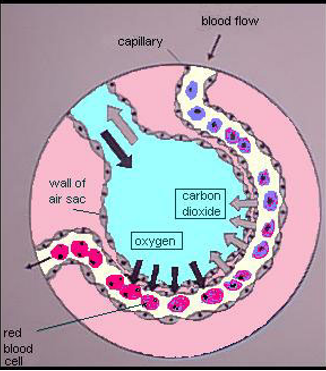
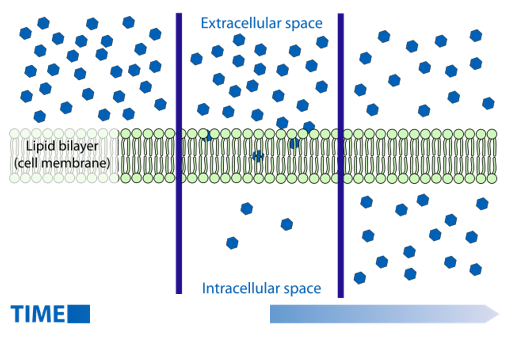
Diffusion
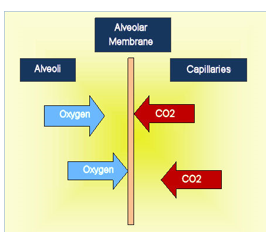
A CONCENTRATION GRADIENT EQUALISES OVER TIME
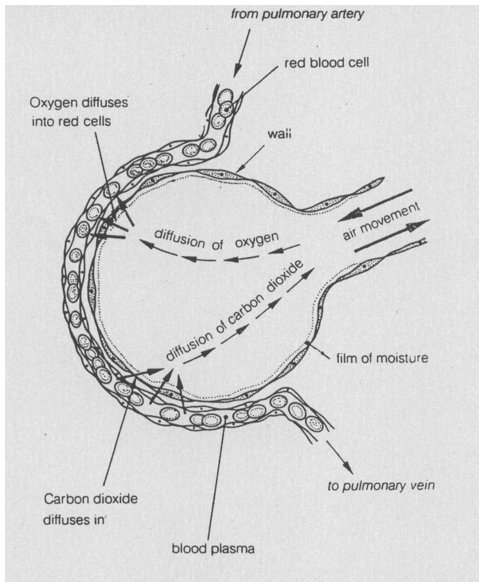
DESCRIPTION OF GAS EXCHANGE – O2
Blood low in oxygen & high in carbon dioxide enters the capillaries around the alveoli (via pulmonary artery).
Inspired air enters the alveoli (via the nose and trachea).
The concentration of oxygen in the blood is lower than in the air in the alveoli.
Oxygen diffuses from the air in the alveoli to the blood in the capillary.
DESCRIPTION OF GAS EXCHANGE –CO2
The concentration of carbon dioxide in the blood is higher than in
the air in the alveoli.
Carbon dioxide diffuses from the blood in the capillary to the air in the alveoli.
Blood high in oxygen & low in carbon dioxide leaves the capillaries around the alveoli (via
the pulmonary vein).
Expired air leaves the alveoli (via the trachea and nose).
ADAPTATIONS OF THE LUNGS FOR GAS EXCHANGE
1.Many alveoli each with a large surface area compared to their volume. The larger the surface area, the faster diffusion can occur.
2.Each alveolus well supplied with blood capillaries in which blood flow is continuous. The
greater the
volume of blood,
the faster diffusion
can occur.
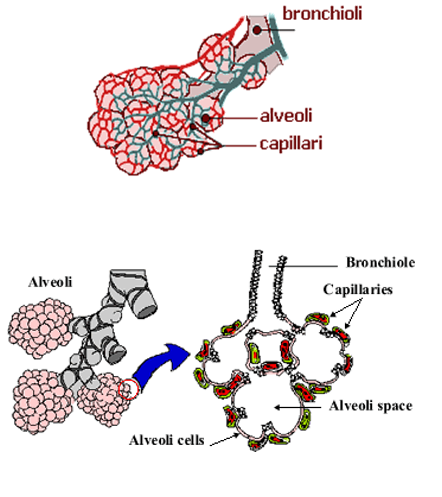
ADAPTATIONS OF THE LUNGS FOR GAS EXCHANGE
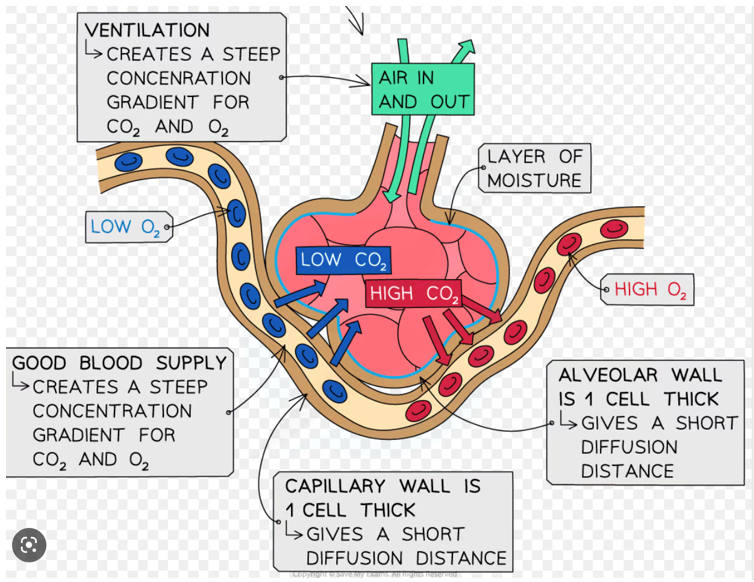
3.The walls of the alveoli & capillaries are only 1 cell thick. The shorter the diffusion distance, the faster diffusion occurs.
4.The walls of the alveoli & capillaries are moist. The lungs are deep inside the body to prevent evaporation. The gases must dissolve in fluid for the diffusion to occur.
ADAPTATIONS OF THE LUNGS FOR GAS EXCHANGE
5.Constant blood flow in the capillaries
and air flow in the lungs maintain the concentration gradient.
The larger the concentration gradient, the faster diffusion occurs.
Pleural membrane
stops friction
Cell used oxygen for
aerobic respiration
How does our respiratory system maintain the gradient
the blood keeps moving
How aveoli is built
it is folded and wrinkled creating a larger SA therefore a faster diffusion rate

