Lecture 4: (finishing Bacterial gene expression) and Plasmids
 Studied by 0 people
 Call Kai
 Learn
Learn Practice Test
 Spaced Repetition
 Match
Match Flashcards
 Knowt Play
1/51

There's no tags or description
Looks like no tags are added yet.
Name | Mastery | Learn | Test | Matching | Spaced | Call with Kai |
|---|
No analytics yet
Send a link to your students to track their progress
52 Terms
Polycistronic mRNA
Multiple proteins made form this mRNA
Often operons
Proteins must be translated and properly ___ to be stable and active. Some can fold automatically but others need help from ___
Folded, chaperones
Chaperones; examples?
Proteins that help other proteins fold into their final conformation
Heat shock proteins (Hsp, Dnak), trigger factor
Do all proteins exist in the cytoplasm?
No, some are secreted or transported out of the cytoplasm. They can be fully secreted or membrane anchored
Sec system
transports unfolded peptides across the membrane that can then be folded
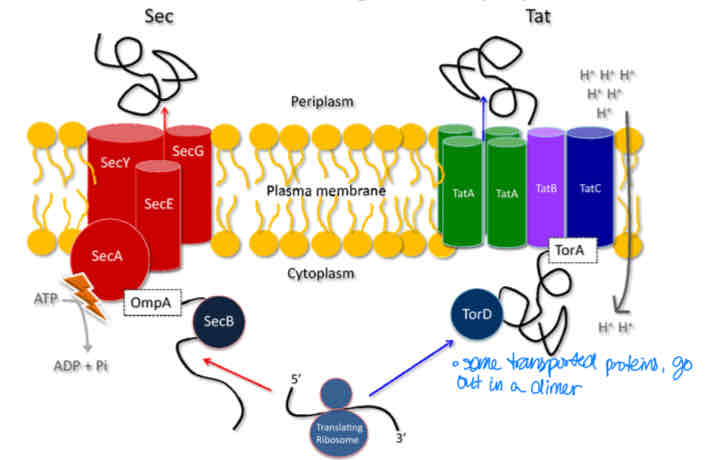
Tat system
Transports folded proteins
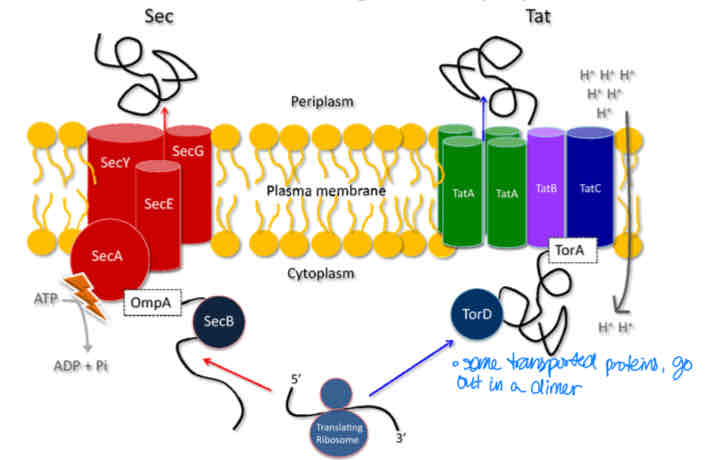
Signal sequences
Sequences on the N terminus of a peptide that can target a protein for transport out of the cell or for anchoring to the cytoplasmic membrane
Reporter gene
gene whose product is stable and easy to assay, conveniently detectable and quantifiable
Plasmids
DNA molecules that exist within bacteria separately from chromosome
Important for bacterial adaptation + evolution
Useful tool in molecular biology
T or F: plasmids are often circular but can be linear
True
T or F: number of copies of plasmid in a bacteria can vary and bacteria can have more than one type
True
Are plasmids partitioned?
Yes, they encode RNA and proteins. They replicate as the cell grows, and are passed down to daughter cells
T or F: plasmids generally encode essential functions for bacterial growth
False: they usually do NOT encode essential functions
T or F: plasmids have the same origin of replication as chromosomes
False
How were plasmids HISTORICALLY named?
Were named based on phenotype they provide to bacteria carrying them.
R-factor plasmids = resistance to several antibiotics
how are plasmids named now?
Now plasmids are given number and letter names, much like strains of bacteria
A small “p” for plasmid goes before capital letters that describe the plasmid or person who isolated or constructed it
Numbers usually go after the letters to identify the construct
Ex: JAT101, pJAT102 (modified), pJAT103 (different modification)
What is the benefit of harboring plasmids? Examples?
Plasmids give bacteria a selective advantage under certain conditions
enzymes for certain carbon source utilization
Resistance to substances (antibiotics)
Synthesis of antibiotics
Synthesis of toxins + proteins that aid in infection of higher organisms
5 reasons to not just have plasmid genes as part of the chromosome
Decreases competitiveness
Allows for smaller chromosomes
By distributing different plasmids among species members, ensures some members will survive
Allow bacteria to occupy larger ecological niches
Contributes to the success of the plasmid itself]
Basically, it is energetically costly and allows for some heterogeneity in population
Plasmids are generally circular with no free ends that are ___ closed
Covalently
In plasmids, having no free ends to rotate leads to ___
Supercoiling
Supercoiling makes the plasmid run ___ on an agarose gel
Faster
T or F: plasmids have replicons that allow them to replicate independently
True
Requirements for replicons
must have at least 1 origin of replication (ori site)
Must code for the proteins required for replication to initiate (the rest of the replication machinery can be borrowed from the host like ligases, primates, helicases etc)
What are the 2 types of mechanisms that plasmids can replicate by
Theta replication (most common)
Rolling circle replication
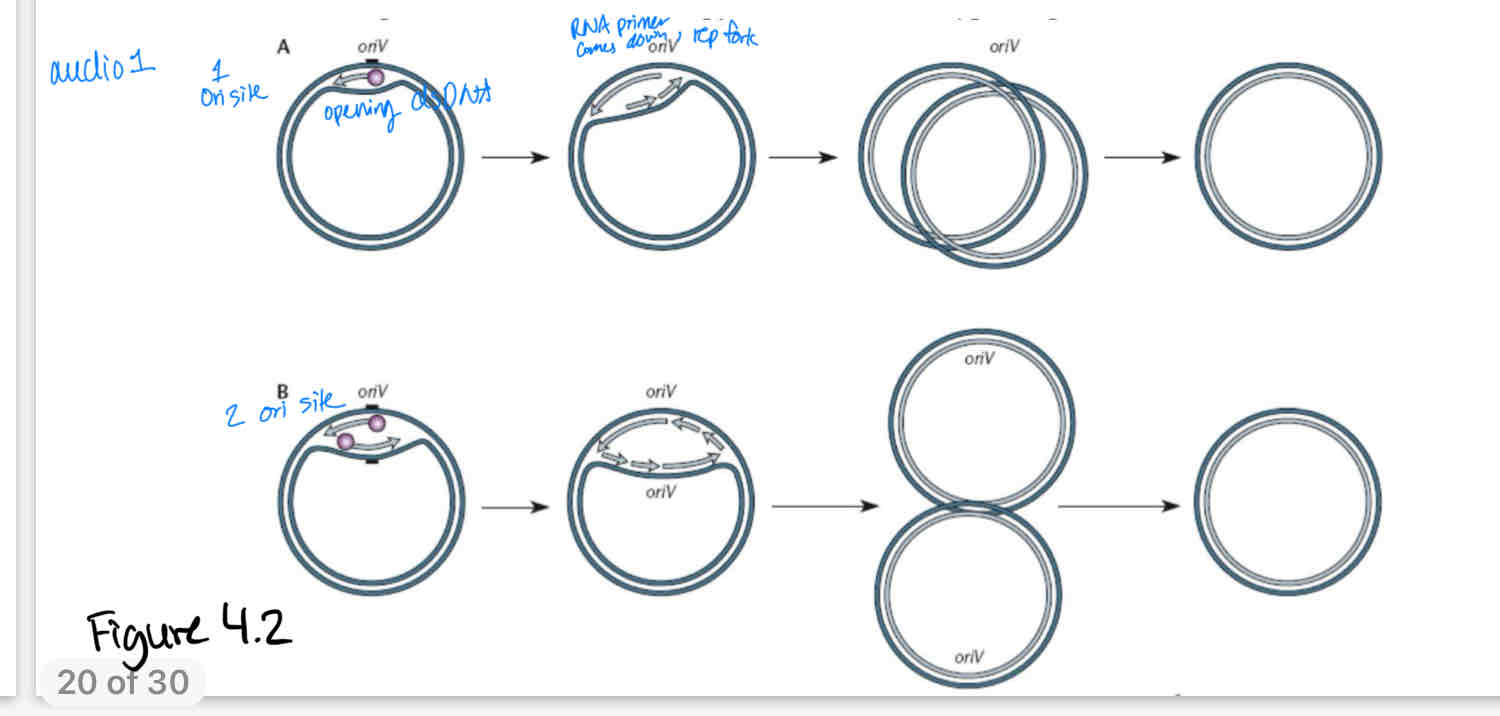
Steps of Theta Replication
Opening of the 2 strands of DNA at the ori region creates a structure that looks like the Greek letter theta
RNA primer begins replication
Replication fork can proceed in 1 or both directions around the DNA
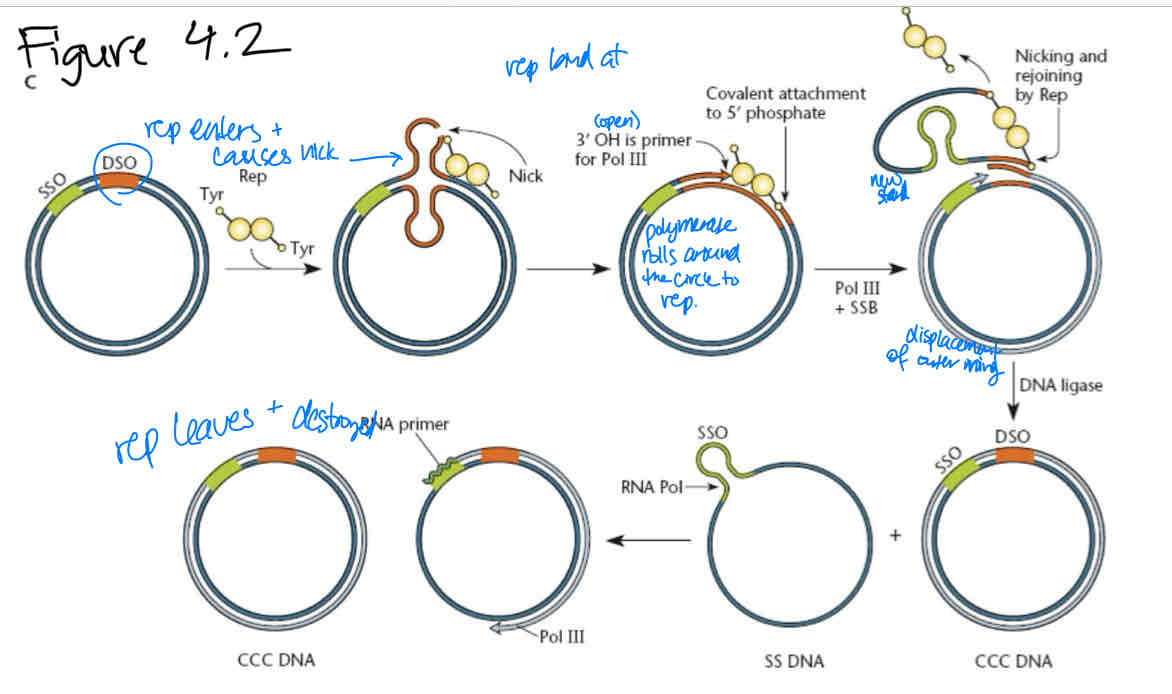
Steps of Rolling Circle Replication
Rep protein recognizes a palindromic sequence (double strand origin, DSO) in the DNA and makes a nick
Free 3’ OH primer for DNA pol III to make new strand using other strand as template, displacing the nicked single strand
The displaced single stranded DNA is replicated using only host-encoded proteins
RNA polymerase makes a primer at a different single strand origin (SSO) and DNA pol III synthesizes the other strand starting at the primer using the single strand as a template
Rep is used once for each round of replication and is then destroyed —> the level of Rep controls the plasmid number
Genes required for replication of plasmids are located very close to the ___
Ori region
Functions of the ori region often determine plasmid properties like:
host range
Copy number
Incompatibility
What is a host range for a plasmid
All types of bacteria in which the plasmid can replicate (broad vs species specific)
Copy number of a plasmid
The average number of that plasmid per cell
Incompatibility of a plasmid
The ability of 2 plasmids to co-exist in the same cell
Narrow vs wide host range
Narrow = can only replicate in a few species (ex: exist only in E.coli and closely related species — pET and pUC protein expression vectors)
Wide = can replicate in many types of bacteria, both Gram + and Gram -
Broad host range plasmids must encode their own ___
Proteins required for initiation of replication
__ and __ for replication genes of broad-host-range plasmids have evolved so they can be recognized by a wide variety of bacteria
Promoters and ribosome binding sites
How to determine the host range of a plasmid
Largely done by trial + error
Requires a way of introducing plasmid to other bacteria (transformation system, electroporation, or some are self-transmissible or mobilizable via conjugation)
Requires a way to select for bacteria which have taken up the plasmid (ex: antibiotic resistance)
3 ways of introducing plasmid to other bacteria
Transformation system
Electroporation
Conjugation (self-transmissible/mobilizable)
T or F: bacteria can possess more than 1 type of plasmid at a time
True
T or F: all plasmids can co-exist inside the same bacteria
False, some cannot coexist inside the same bacteria
If 2 plasmids can NOT coexist stably, they are said to be member of ____
The same incompatibility (Inc) group
If 2 plasmids can coexist stably, they are said to be of ___
Different incompatibility (Inc) groups
Plasmids can be incompatible for a number of reasons like:
they can regulate each other’s replication
They can share the same partitioning (par) functions
Why does copy number of a plasmid need to be regulated?
to prevent overproduction of the plasmid
To prevent too few copies being made
Relaxed plasmids are ___ copy number plasmids
High
Stringent plasmids are
Low copy number plasmids
Relaxed plasmids need only have a mechanism that inhibits replication when ____
Plasmid concentration reaches a certain level
Stringent plasmids replicate only once or very few times during each cell cycle and have tighter ___
Mechanisms to regulate replication
Cloning vectors
Replicons that DNA can be added into
Advantages of plasmids as cloning vectors
don’t kill host cells
Relatively easy to purify
Small size since few genes are required for replication
Requirements for creating a cloning vector
plasmid origin (oriV)
Selectable markers (like antibiotic resistance genes)
Multiple cloning site (downstream of promoters and TIRs)
Multiple cloning site
designated site for addition of DNA with several unique restriction enzyme sites
Downstream of promoters and TIRs
T or F: plasmids are ideally small and relatively high copy number
True
 Note
Note  Flashcards (96)